

It's Saturday morning, your preschooler has claimed the living room, and a blanket fort keeps collapsing every time someone crawls out for juice. You want something sturdier, prettier, and easier to put away, but you don't want a toy that promises learning it can't deliver or a tent your child will outgrow in a month.
What a Princess Playhouse Tent Is
Your child pops the tent open, calls it a castle, and hands her brother a cardboard invitation. He has to knock, wait to be announced, and enter as a royal guest. That small scene tells you more about this toy than the print on the fabric does.
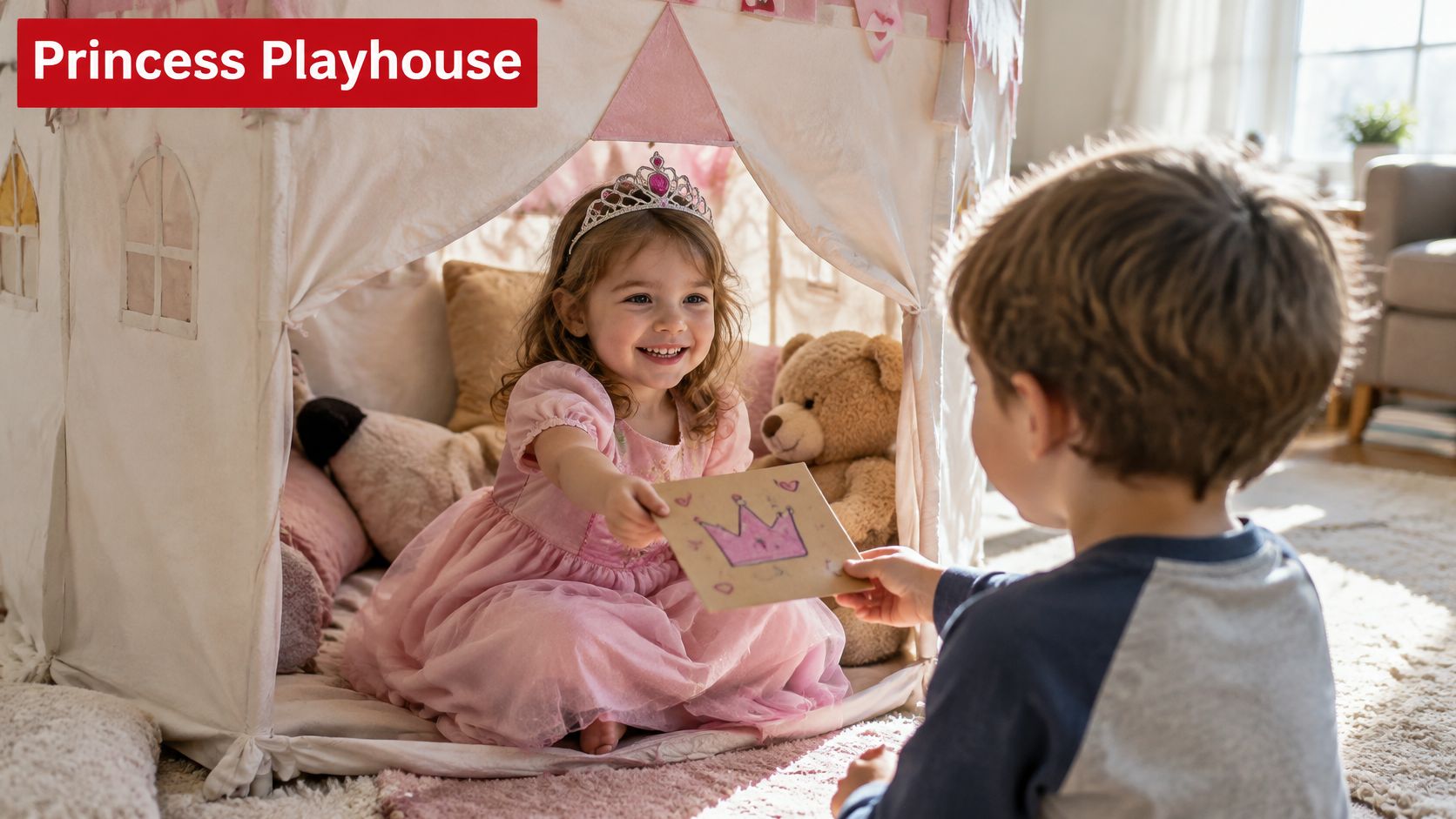
A princess playhouse tent is a pop-up fabric enclosure with a royal print, windows, and a child-size door, made for indoor pretend play. It's a defined room for stories, not a piece of camping gear.
Two lookalikes worth separating
A bed canopy is décor. It hangs over a mattress, it has no play floor, and children don't host scenes inside it. A camping tent is the opposite problem. It's built for weather and sleep, with stakes, rain protection, and closures meant to stay shut.
This toy sits between them. It gives children walls, a doorway, and a sense of inside versus outside, while staying light enough to fold away after play.
What children actually do inside
The value isn't the princess label. It's the five pretend behaviors the space can host. A 2022 observational study in ERIC examined 73 preschool children aged 3 to 5 across 34 hours of naturalistic play and found that age significantly predicted engagement in social interaction, role play, and metacommunication.
Those behaviors look like this in a tent:
- Substituting objects: A pillow becomes a throne or a birthday cake.
- Assigning pretend properties: The doorway is now a drawbridge that only opens at noon.
- Playing with others: Two children negotiate who greets guests.
- Taking roles: One child hosts, another arrives, a third delivers messages.
- Signaling pretend: A child says, "Pretend you didn't know I was hiding."
Older preschoolers in that observation used richer social and role play than younger ones. Say that plainly to yourself before buying. The tent hosts that progression, it isn't proven to cause it. You'll find more on how adults support that kind of play in this guide to the benefits of pretend play.
As a shopper, hold a few anchors in mind. Floors are often about 48 to 60 inches across, heights about 48 to 53 inches, with a polyester shell, spring-steel or fiberglass poles, and a carry bag. What follows uses those anchors to compare listings, match ages, run safety checks, plan scenes, and care for the fabric.
Features to Compare Before You Buy
Run the table before you read brand stories or star ratings. A pretty castle print can't fix a footprint that blocks your hallway or a door your child can't open from inside.
Princess playhouse tent buying checks
| Check | Look for | Skip if | Fits best |
|---|---|---|---|
| Age label | Printed range, commonly 3 and up | No age, or loose small parts for under 3 | A gift matched to the youngest user |
| Fabric | Soft polyester, often around 190T, with mesh windows | Airtight plastic or a strong chemical smell | Bedroom or classroom |
| Frame | Capped steel or fiberglass poles that pop open and fold flat | Bent poles or exposed wire ends | Daily setup and storage |
| Floor size | About 48 to 60 inches across | Wider than the clear floor path | Apartment or playroom |
| Height | About 48 to 53 inches tall | Too low for comfortable kneeling | Standing pretend play |
| Door | Opens from inside with no automatic lock | A latch or zipper the child cannot undo | Supervised solo play |
| Ventilation | Mesh or openings on more than one side | Solid walls only | Longer play sessions |
| Setting | Indoor or covered patio use | Sold as a sleep space or storm shelter | Parties and daytime play |
Read the age row first
Match the printed age to the youngest child who will crawl inside, not to the birthday child on the invitation. A tent bought for a 5-year-old's party will attract a 2-year-old cousin within minutes. If that younger child is below the label, you need a different plan for crowns, beads, and detachable decorations, or a different gift.
Gift buyers get this wrong most often. They buy for the theme on the box. Buy for the smallest body that will realistically be in the room.
Fabric, frame, and air
Choose breathable polyester with mesh on more than one side rather than a lovely print on solid fabric. Solid walls look like a castle in photos. They feel stuffy after ten minutes of active hosting, and adults can't see in without crouching at the door.
Check the frame in person or in close-up photos. Poles should be enclosed, ends should be capped, and the tent should both pop open and fold flat into its bag. If you can't picture yourself folding it on a tired Sunday evening, you won't. It'll live half-open in a corner and collect laundry. The steps in these play tent instructions show the kind of fold you should expect to manage without forcing the frame.
Practical rule: If a listing shows ten photos of the print and none of the mesh, door, or folded bag, treat that as missing information, not a minor omission.
Measure against a clear path, not an empty room
A floor about 48 to 60 inches wide and a height about 48 to 53 inches lets most preschoolers kneel, turn, and stand for a greeting scene. Adults mostly stay outside, which is fine. You're a guest at the door, not a resident.
Measure the path around it too. Children need room to parade in, carry props, and exit without climbing over furniture. A tent wedged between a sofa and a bookshelf turns every exit into a squeeze and every prop delivery into a collision.
Name the job before you pay
Daily bedroom play needs easy folding and washable, spot-cleanable fabric. A party station needs a wide door and quick visual supervision. A classroom corner needs sturdier seams and mesh an educator can see through from across the room.
Skip any listing that sells the toy as a nap space or an all-weather shelter. That's not this product, however castle-like it looks.
Finish with three yes-or-no questions. Does the youngest user match the label? Does the footprint fit your room with a path around it? Can a child inside get air and get out on her own? If any answer is no, keep looking, even if the print is perfect.
Ages and Play Scenes That Work
Age doesn't just change whether a tent is safe. It changes what a good session looks like, what props help, and how much you should join in.
Play stages by age
| Age | Typical play | Adult role | Session length |
|---|---|---|---|
| About 2 | Short visits with one realistic prop such as a soft crown | Stays inside the scene | Brief visits |
| 3 to 5 | Inventing roles, negotiating entry, royal quests | Joins for the first few minutes, then steps back | 20 to 30 minutes |
| 6 to 8 | Rules, sequels, jobs like shopkeeper or map maker | Offers props, leaves room for rules | 30 to 45 minutes |
| Over 8 | Reading nook or party station | Light touch | Open-ended quiet time |
What each age band needs from you
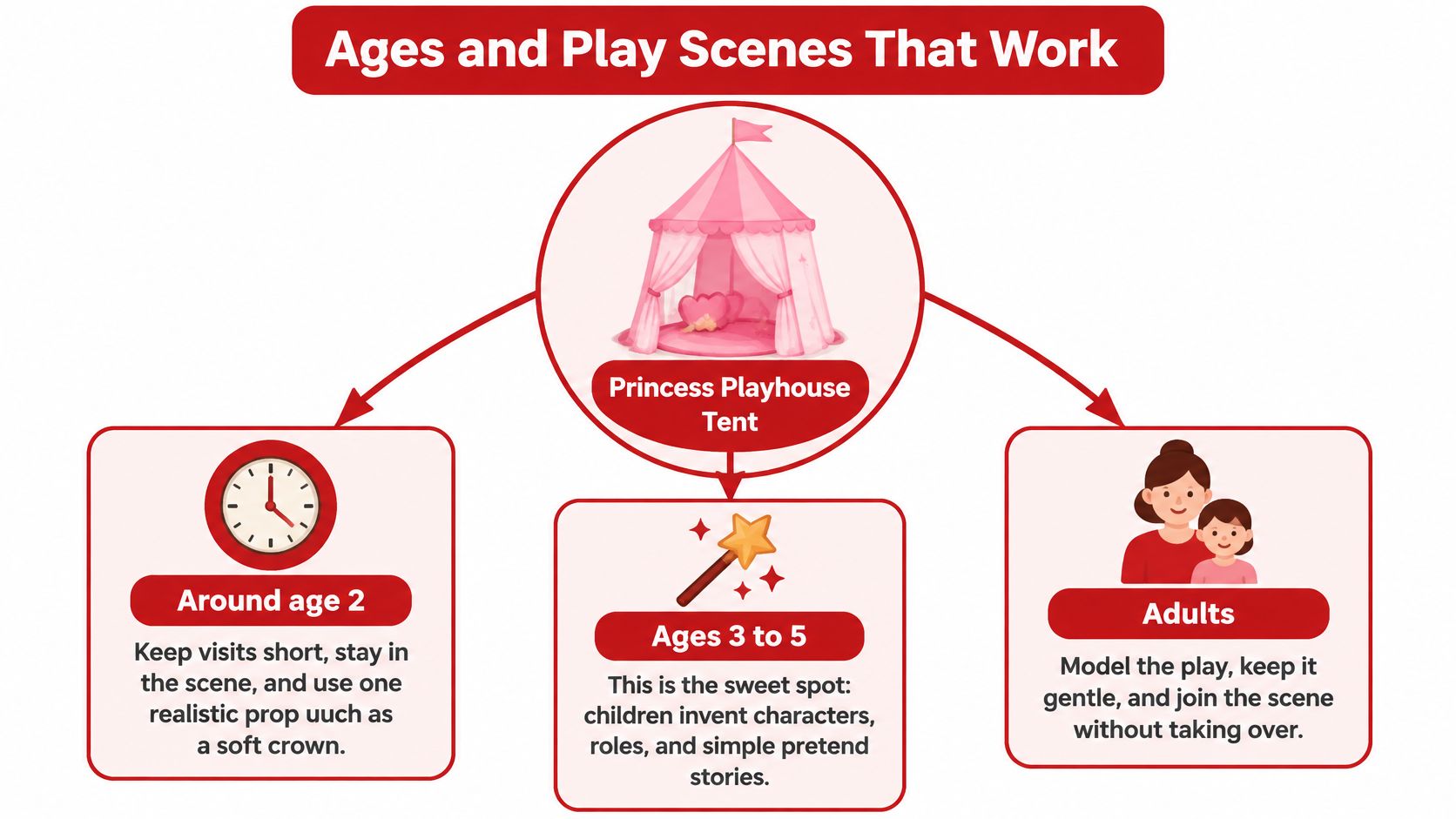
Around age 2, don't expect a story. Expect in-and-out play, peekaboo at the door, and carrying one soft crown back and forth. Stay in the scene, keep visits short, and let the child leave whenever interest fades. One realistic prop beats a basket of accessories.
Ages 3 to 5 are the sweet spot. Children invent roles, argue productively about who may enter, and sustain a 20 to 30 minute royal quest if the problem is simple. Someone has lost the invitation. The royal shop is out of bread. A guest has arrived at the wrong castle.
By 6 to 8, the play shifts toward systems. Children write rules on scrap paper, make maps, assign jobs like shopkeeper or map maker, and return tomorrow for a sequel. Past about 8, castle pretend often fades. The same tent still earns its floor space as a reading nook or a party photo station, and that's a respectable second life.
Keep developmental claims honest
The American Academy of Pediatrics guidance on playing with your child links make-believe play with experimenting with social roles, cooperation, negotiation, communication, and language. That's a good reason to protect time for it.
It isn't a promise. Pretend play alone isn't proven to raise intelligence or executive function, and you shouldn't buy a tent expecting test-score gains. Treat it as a setting where children practice observable things, like vocabulary use, turn-taking, sequencing, and collaborative problem-solving.
The Harvard Graduate School of Education explanation of intentional imaginary play notes that children create rules for their roles, hold complex ideas in mind, and inhibit actions that don't fit the chosen role. It also notes that younger children often respond better to literal, realistic props, while older children can repurpose ordinary household objects.
That distinction is practical. Give a 3-year-old a picture menu she can point to. Let a 7-year-old rename a cushion as a throne and defend the choice. Both are doing the right work for their age.
A sample session that doesn't feel like a lesson
Try this shape for ages 3 to 5. Children name their roles. Together they plan three story beats, such as a guest arrives, something goes missing, and everyone helps solve it. They act out one made-up problem, then switch roles and run a shorter version again.
Join for the first few minutes to model a greeting or a polite disagreement. Then step back to the doorway. If you direct every line, children stop negotiating with each other, and negotiation is where much of the practice lives. Families who enjoy building their own settings can borrow scene ideas from these fort building ideas and shrink them to tent size.
Join to start the scene, not to run it. Your exit is part of the design.
Three scenes families actually repeat
Birthday station, 10 to 15 minutes. One child greets at the door, guests choose from a picture menu, and a quest card sends them to find one hidden soft object nearby. Rotate the greeter every few guests so the birthday child isn't working her own party.
Weekday castle block, 20 to 30 minutes. Set the tent up after school and before screens. Predictability matters more than novelty. Children who know the castle opens at the same time each day walk in with a plan already forming.
Two-child royal shop. One child hosts inside, one visits from outside, and they trade three pretend items using play money or drawn coins. Then they swap sides. The doorway becomes a counter, which naturally creates greetings, requests, and polite refusals.
Add small variations without buying more gear. Rotate one prop weekly, such as fabric crowns one week and cardboard invitations the next. Keep a slow parade around the tent as a separate movement round between calmer scenes, with a clear path and no running through the door. For a quiet option, put two picture books inside during daylight and let a child read to a stuffed guest.
Frame it for yourself this way. The tent is a room where practice can happen. The practice comes from roles, rules, partners, and a problem worth solving together.
Safety Checks Before Every Play Session
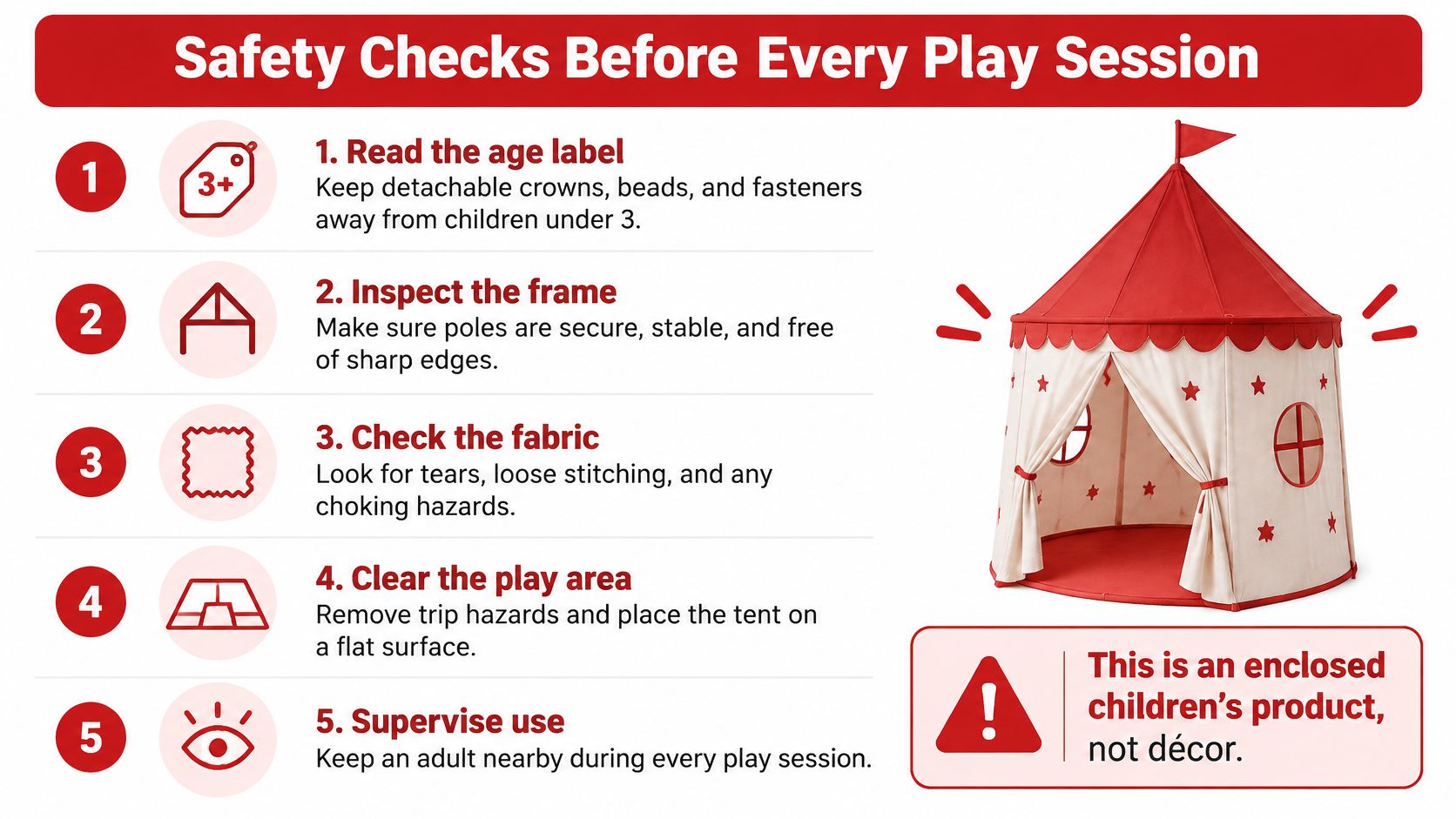
Treat a princess playhouse tent as an enclosed children's product, not as décor that happens to have a child inside it. That one shift changes what you check, where you put it, and what you never use it for.
Health Canada's advice on safety for specific toy types warns that play tents can trap, suffocate, or strangle children, and recommends airflow through mesh or openings on multiple sides. It also advises avoiding long cords and loops, checking frame stability, positioning tents away from stairs, furniture edges, and heat sources, and not using the tent as a sleep space.
Run this inspection in order
- Read the age label. Keep detachable crowns, beads, and fasteners away from children under 3, even if an older sibling owns them.
- Confirm ventilation. You want mesh or openings on more than one side so air can move through, not just in at the door.
- Test the exit. The door must open from the inside and must not lock by itself. Have your child demonstrate it before guests arrive.
- Remove cords and loops. Take out long ribbons, dangling ties, and costume sashes that could catch around a neck during a tumble.
- Place it on a flat floor. Keep it away from stairs, furniture corners, heaters, candles, stoves, and lamps. Indoor use doesn't remove fire risk.
- Rule out sleep. No naps, no overnight camping in the bedroom, no unsupervised enclosed play for a child who might fall asleep inside.
- Inspect before each session. Look for torn fabric, bent poles, loose connectors, and small parts that have worked free since yesterday.
The whole routine takes about a minute once it's a habit. Do it while children choose props, so it doesn't feel like a delay to the fun.
Ventilation and a working exit matter more than the princess print.
Two confusions to clear up
First, indoor doesn't mean fire-safe. Polyester near a space heater, a birthday candle carried past the door, or a lamp knocked against the wall is still a risk. Keep ignition sources out of the play path entirely, not just out of the tent.
Second, a bedroom playhouse isn't a weatherproof shelter. Wind lifts lightweight frames, rain soaks seams, and a tent that feels cozy at noon can feel hot and still on a sunny patio. Covered, supervised, daytime patio play is one thing. Storm shelter is another.
Look for labeling, not adjectives
Words like safe and durable on a listing tell you almost nothing. In the United States, toys for children 12 and under are expected to carry manufacturer certification to applicable rules, so shoppers should look for clear age and compliance labeling they can verify. This overview of toy safety for children helps you read those labels without needing a legal background.
None of this replaces supervision. Stay within sight of younger children, keep the mesh side facing you, and end the session if the frame bends, a child can't work the door, or play turns into climbing on the walls. A tent that fails a check goes back in the bag until it's fixed or retired.
How to Clean and Store the Tent
Polyester play tents don't need much care, but they do need the right kind. Crumbs in the seams, juice on the door, and damp fabric folded into a bag will shorten its life faster than daily play will.
A six-step clean that protects the frame
- Shake it out. Tip the tent over a hard floor, shake out crumbs, then sweep or vacuum the floor panel.
- Spot-clean marks. Use lukewarm water and a drop of mild dish soap on a cloth. Dab at sticky spots rather than scrubbing the print.
- Rinse with a damp cloth. Wipe away soap residue instead of soaking the tent. Soaking fills seams and takes forever to dry.
- Air dry fully open. Leave it popped up indoors, out of direct sun and away from heaters, until every panel feels dry.
- Wipe poles and connectors. A dry cloth is enough for the frame and plastic joints.
- Fold only when dry. Pack it into the carry bag once nothing feels cool or damp to the touch.
Skip the washing machine, dryer, bleach, and hot iron. Agitation can bend an integrated frame, heat can melt mesh, and bleach attacks both colour and fabric strength. If a mark won't come out with a cloth, it's better tolerated than treated with something harsh.
Storage test: If you wouldn't fold a shirt in that state and put it in a drawer, don't fold the tent either.
Rhythm, smells, and outdoor dust
Keep a simple rhythm. A quick shake after play handles most mess. A deeper spot clean once a month, or right after a party, handles the rest. Party tents collect frosting fingerprints at exactly door height, so check there first.
If the tent has been on a covered patio, clean it the same day. Dust plus evening moisture settles into seams and smells stale by the weekend. If a smell lingers anyway, leave the tent open indoors for a day and check the seams for dampness before you store it. Storing a damp tent to deal with later almost guarantees a worse smell later.
Where you put the bag matters too. Store it flat or upright where the frame can't be crushed under storage bins or a stroller. A sensible home for it is part of any plan to organize a toy room, because a tent that's easy to reach gets used, and a tent buried under boxes doesn't.
Know when to stop repairing. Retire or replace a tent with torn mesh, a pole that won't straighten, exposed wire, or a door that no longer opens freely. Those aren't cosmetic flaws. They change ventilation, stability, and exit, which are the things that made the tent acceptable in the first place.
Frequently Asked Questions About Princess Playhouse Tents
Can a child under 3 use one
Only if the age label allows it, and even then with close supervision. Remove detachable crowns, beads, and small accessories first. Short, adult-led visits suit this age better than open-ended group play.
Can it go outdoors
Use it as a covered patio play space in calm, dry weather, with an adult nearby. It isn't a weatherproof or camping shelter, and wind can move a lightweight frame. Bring it in the same day and clean off patio dust.
Can a child nap in it
No. Health Canada advises against using play tents as sleep spaces. Move a sleepy child to a proper bed, however peacefully she's settled among the cushions.
How often should it be cleaned
Shake it out after play and spot-clean monthly or after parties. Always let it dry fully open before folding it into its bag.
Does pretend play raise test scores
The evidence is mixed, so don't buy on that basis. Treat the tent as practice in social play, language, and turn-taking, not as a guaranteed academic boost.
Is it a good gift
Yes, when three things line up. The youngest user matches the label, the floor fits the family's room, and there's a repeating scene, like an after-school quest, that'll bring children back. Without that third piece, even a well-made tent becomes storage.
Choose a Tent and Start Pretend Play
Your decision fits in four lines. The youngest child matches the age label. The floor fits the room with a clear path around it. Mesh on more than one side and an inside-opening door pass your safety check. Your family has one repeating scene, such as the after-school quest, that'll happen more than once.
If all four are true, a themed pop-up is a reasonable gift or everyday play spot. If one fails, fix that line first. A smaller footprint, an older age match, or a simpler scene will serve you better than a prettier castle.
One concrete option to compare against
Playz is one option built for story play rather than camping. The Princess Castle Tent with Costume is priced at $49.94 and has a 4.6 out of 5 rating from 6116 reviews. Check those figures before you rely on them, since prices and review counts change, and judge the tent itself on the same rows you'd apply to any listing, mesh, door, frame, footprint, and fold.
Playz also makes story-driven play tents and science experiments, which suits families who want screen-free play that continues after the castle phase. A child who starts by hosting royal guests may move on to building, experimenting, and explaining. The through line is doing something with her hands and her imagination, not the theme of the month.
If you're styling a whole corner rather than just placing a tent, removable wall pieces can finish the scene without committing to paint. Something like pretty princess peel-and-stick décor from Quote My Wall can mark the castle wall behind the tent and come down cleanly when tastes change. Keep décor on the wall, though, not draped over the tent where it can block mesh.
Pros and cons, briefly. On the plus side, you get a defined pretend room that folds flat, invites siblings and guests, and works for reading after castle play fades. On the minus side, it takes real floor space while open, it needs a minute of inspection before sessions, and it won't entertain a child who has no partner, prop, or problem to play with.
So do the unglamorous part first. Measure your room, confirm the age label against your youngest player, and compare the castle tent with any other pop-up using the checks in this guide. Then set it up once this week, play one 20-minute scene together, and pack it away dry so it's ready for the next royal visit.
Playz makes story-driven play tents and science experiments that give children a reason to build a scene, invite a partner, and stay off screens a little longer. If a princess castle is the right first room for that kind of play in your home, visit Playz to compare the Princess Castle Tent with Costume against your measurements and age checks.