

Your toddler is stacking blocks on the living-room rug, your preschooler is copying a bridge, and an older child insists the bridge won't hold anything. You've got plenty of pieces, but you're still wondering whether anyone needs help, a harder challenge, or more room to play.
With educational toys, blocks earn their place through what children do with them, not how many come in the box. Start with the materials you already own, match the activity to the youngest player, and add a challenge only when it gives the child something useful to investigate.
Block Activities Matched to Age
Use this table as this week's play plan, not a shopping list or a developmental test. The older-child activities are suggested challenges, not milestones every child must meet on schedule.
Educational block activities by age
| Age | Skill focus | Try this activity | Say this |
|---|---|---|---|
| About 1 to 2.5 years | Balance, grasp, sequencing | Stack from 2 blocks toward 8 or more | On top. More. Down. |
| Age 3 | Counting, height, stability | Build a tower, knock it, and rebuild taller | How many? Taller or shorter? |
| Ages 4 to 5 | Symmetry, cooperation, position words | Bridge plus a copy-and-match pattern with a partner | Beside, under, taller than this block. |
| Ages 6 to 8 | Measurement, cause and revision | Limited-shape bridge that holds a toy, then a second try | Why did it fall? What will you change? |
| Ages 8 and older | Planning, systems, iteration | Sketch, build, fail once, and rebuild | What is the plan? What failed? |
Toddlers typically move from stacking a couple of blocks toward taller stacks over their second year, so treat the range in the table as a rough guide rather than a deadline. What matters more is repeated, low-pressure practice with pieces a small hand can easily control.
Start with the action the child can manage
For a toddler, place large, age-appropriate blocks within easy reach on a firm surface. Let the child place the next block rather than guiding their hand into position. Say on, more, and down as the action happens, and treat the collapse as part of the activity.
Stacking brings balance, hand-eye coordination, and sequencing into the same task. Don't turn the upper end of the stacking range into a target that must be reached today.
For the age-three activity, count pieces as the child places them. After a tower falls, compare its base with the rebuilt version: was the bottom narrow, uneven, or leaning? A basic set used with an attentive adult is a better practical starting point than a deluxe kit nobody opens.
For the preschool bridge activity, leave a visible gap for a toy to pass beneath. Then suggest a matching pattern on the other side, with a partner choosing the next shape. Accept an uneven bridge if the children can explain their choices.
Make older challenges about testing
Keep the base activity open-ended for every age in the table, then add the optional challenge only once the child has a working structure. A finished tower invites the knock-down-and-rebuild test. A finished bridge invites the load question. If the child declines the challenge, the open-ended version still counts as the session.
For early-elementary builders, offer a deliberately limited selection of shapes. Ask them to span a gap, measure its length using blocks, and test whether it supports a toy. Keep the test object light and the structure low.
For older builders, suggest a sketch before construction. Arrange a controlled failure by gradually adding a light load or widening the gap, then ask for a rebuild that addresses what failed. Don't reward complexity just because it looks impressive.
In a mixed-age group, follow the youngest child's row for shared materials and keep older challenges optional. Use childhood development milestones as broader context, not a reason to rush ahead.
Practical rule: Match the challenge to what the child is trying to understand, not to the picture on the box.
During the first four years, block play also offers hands-on opportunities for mathematical, scientific, and general reasoning: counting, comparing, balancing, predicting, and trying again.
How to Run One Block Session
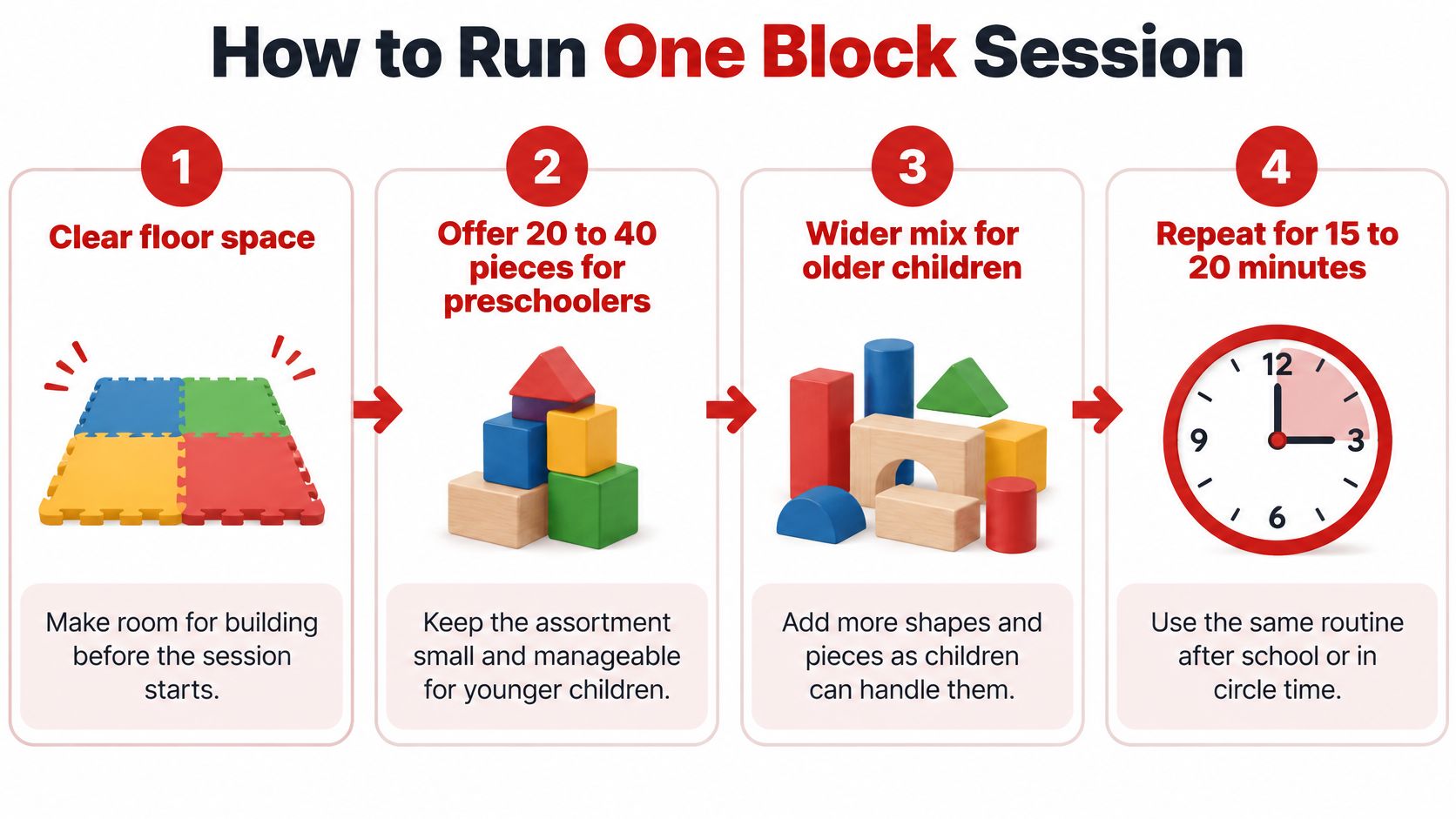
For a repeatable session, I'd set aside 15 to 20 minutes as a practical starting routine, not a required learning dose. Shorten it when a child is tired, and allow uninterrupted building to continue when everyone's engaged.
The setup below keeps materials manageable before you introduce a challenge.
Follow the routine without taking over
- Clear the floor and choose the assortment. For example, offer about 20 to 40 age-appropriate pieces to a preschooler, with a wider mix available to an older builder. A firm, uncluttered surface makes it easier to notice whether the structure itself is unstable. The common slip is tipping out every piece before the child has a plan.
- Allow free construction first. Try about two minutes in which the child chooses what to make. This gives you something meaningful to respond to, rather than imposing an unrelated task. Don't mistake an unconventional arrangement for a request for help.
- Show a simple target, hide it, and invite a rebuild. Choose something within reach, such as a short bridge or stepped arrangement. Removing the model changes the task from continuous copying to remembering and reconstructing the relationships between pieces. If the child becomes frustrated, uncover the model or simplify it instead of insisting.
- Add one constraint only. Suggest a structure taller than a single block, a span a toy car can cross, or a model viewed from another side. One change makes the result easier to interpret. Adding height, speed, symmetry, and a load test together makes it difficult to know what caused trouble.
- Ask how pieces fit together. Let the child turn a piece and explain its placement. For children ready for cooperative play, including those aged four and up in this suggested routine, invite a partner to negotiate the next piece. Avoid appointing one child as the permanent builder and the other as the supplier.
- Record the process, not the production count. Note accuracy, elapsed time, and one strategy, such as rotating a block before placing it. These are informal observations, not a standardized assessment. Don't equate a fast, familiar build with flexible spatial skill.
- Finish while the activity still feels worthwhile. Photograph the structure before cleanup if the child wants a record. Ask what changed after a wobble or collapse. The common slip is demanding another completed model once attention has already gone.
Why the target should change
In a spatial-assembly study of 102 three-year-olds, design difficulty produced a very large within-child effect on the Test of Spatial Assembly, and spatial skill explained meaningful variation in concurrent mathematics performance. That makes rotation, fitting, and part-to-whole relationships useful choices for guided challenges, without establishing that a block session causes higher mathematics scores.
Familiar, very easy builds can flatter your impression of a child's skill. Construction-play frequency alone also hasn't consistently corresponded with spatial ability or mathematics in older children, so minutes logged aren't a useful scorecard.
The distinction between copying a product and working through a problem is central to constructive play. For this session, done means the child can point to a change they made after a fall, even if the final structure is modest.
Questions That Grow Spatial Language
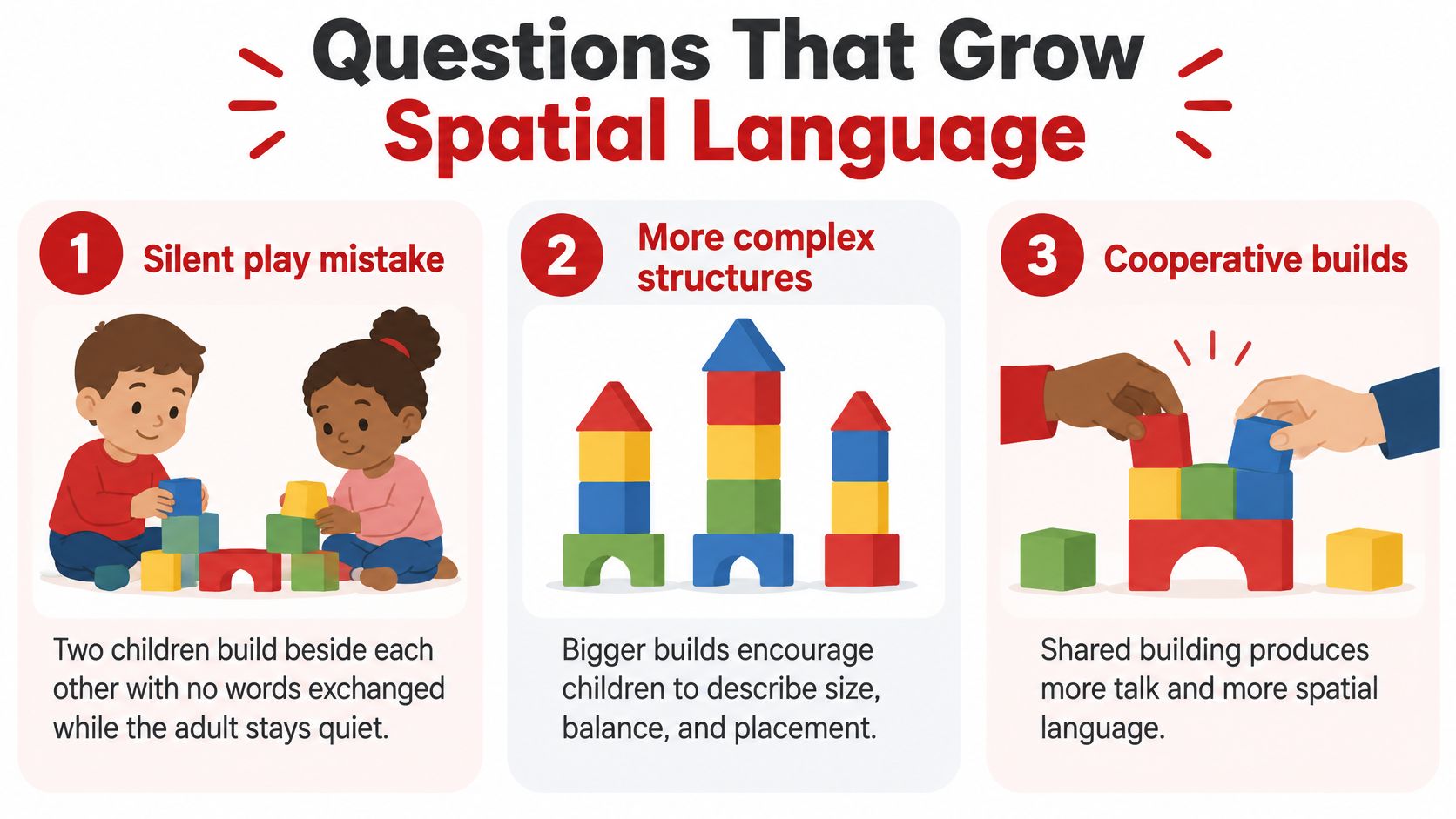
Two children can build beside each other without exchanging a word while an adult supervises. There's nothing wrong with absorbed, silent play, but placing children at the same block shelf doesn't automatically create conversation or cooperation.
During daily unit-block play among 228 kindergarten children, more complex structures and cooperative construction were associated with more spatial language in a study of construction activity and spatial talk. The effect of construction structure was small, so a complicated model isn't a substitute for purposeful interaction.
Give children something worth discussing
Say two children want to get a stuffed animal across a gap between pretend islands. One proposes a long bridge; the other starts making supports. Instead of assigning each child a job, ask where the animal needs space and let them negotiate the arrangement.
Use this prompt table to select three prompts for the next session, rather than delivering a long script.
Prompt sets for spatial talk
| Prompt set | Example question | Use when |
|---|---|---|
| Position | Where can the car go, beside or under the bridge? | Child is building a span |
| Comparison | Which tower is taller, wider or heavier? | Child is comparing two structures |
| Cause | Why did it fall? | After a collapse |
| Revision | How could you make it stronger? | After a successful or failed test |
Position words become useful when someone needs to explain where a support belongs: beside the tower, under the span, or behind the opening. Comparison words work best when children can point to the difference they mean.
Don't fill every pause. Give the child time to inspect the build, gesture, move a piece, or disagree with a partner.
These reminders help keep adult talk connected to the children's construction.
Use structure as an invitation
Follow a simple rule: free play first, one question second, a model only if the child asks. Offer a harder challenge without correcting the child's design into your preferred answer.
A 2026 early-childhood intervention involving four children aged 4 to 5 used 15 construction levels and reported sustained gains in construction complexity and spatial-language diversity, with engagement comparable to free play. The small group limits broad conclusions, but the approach illustrates how optional structured levels can sit alongside child-directed building.
If you want to understand the difference between observing play and formally assessing visual-spatial cognitive skills, Orange Neurosciences offers a useful introduction. A child's block structure alone shouldn't become a diagnosis or an ability label.
For everyday conversation, combine these prompts with other language development activities. The practical takeaway is to add a meaningful question and a slightly harder construction problem before adding another pile of bricks.
Safety Checks Before the Next Build
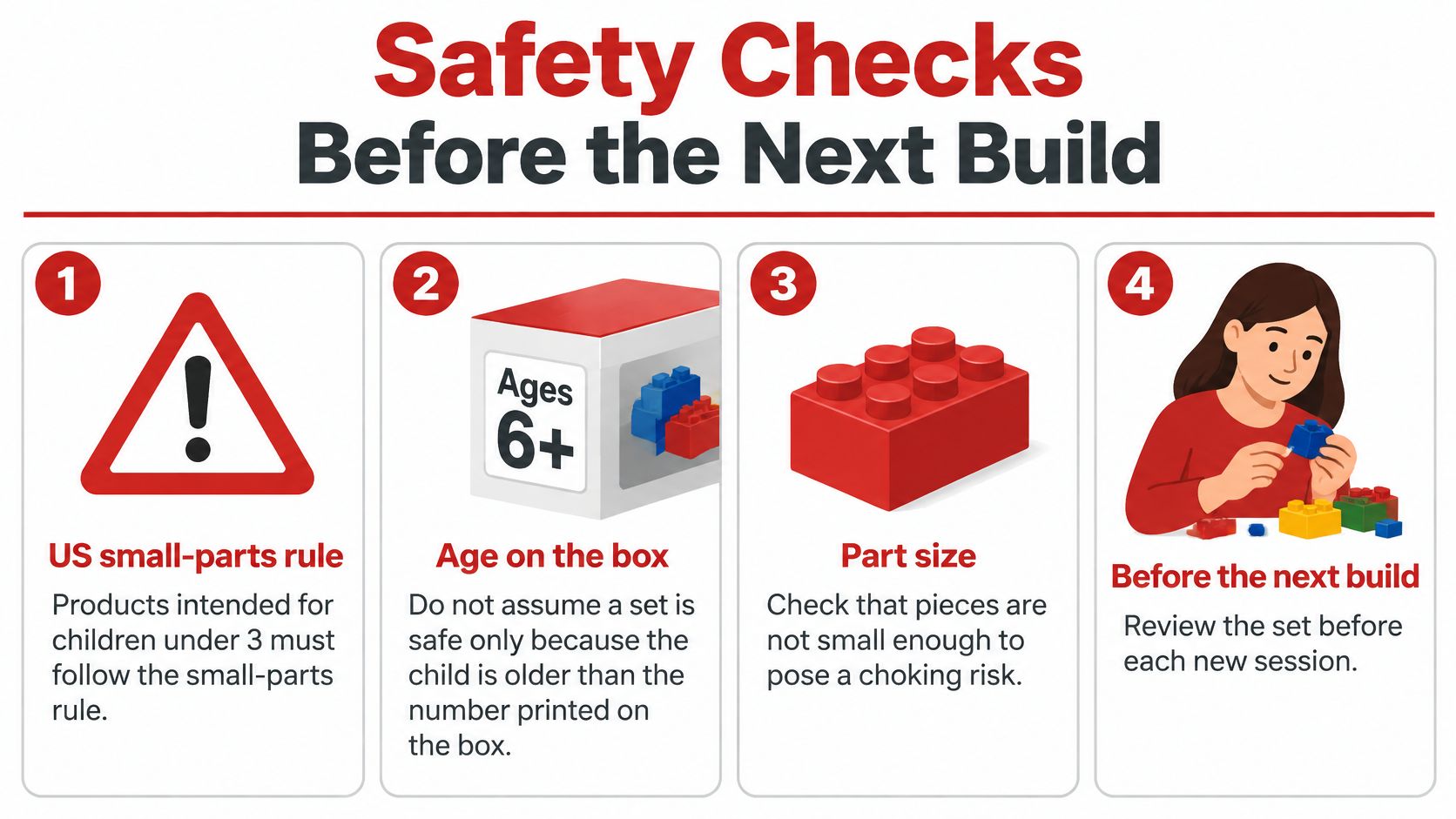
Being older than the age printed on the box doesn't make every set safe. In the United States, products intended for children under 3 cannot contain hazardous small parts; the CPSC small-parts guidance describes a test cylinder approximately 1.25 inches in diameter and 2.25 inches deep, with assessment including parts released after simulated rough treatment.
That last point matters. Inspect the toy your child is using now, not just the intact product pictured on its packaging.
Block hazards and what to do
| Hazard | What to check | Do this |
|---|---|---|
| Small parts under age 3 | Piece fits a cylinder about 1.25 in wide and 2.25 in deep, including after rough use | Do not give that set to a child under 3 |
| Magnetic cubes that open | Cracks, gaps, loose panels, weak closures | Remove the set; do not mix damaged cubes back in |
| Possible swallowed magnet | Missing magnet plus a child who had the set | Urgent medical care; do not wait for symptoms |
| Child still mouths toys | Behavior, not the age printed on the box | Supervise and keep magnets and small parts away |
Don't give detachable small blocks to a toddler unless the set is specifically made and compliant for that age. Supervision doesn't turn an unsuitable small-part toy into a suitable one.
Treat accessible magnets differently
A 2026 U.S. magnetic-building-cube recall report covered more than 200,000 cubes, cited at least 27 reports of products opening, and described two children requiring surgery after magnet ingestion. Swallowed high-powered magnets can attract through digestive tissue, causing perforation, blockage, infection, or death.
Possible magnet ingestion is a medical emergency, not a wait-and-see situation. Seek urgent medical care even if the child appears comfortable; a missing magnet is concerning, but you don't need to prove one is missing before seeking help.
Check cube seams, panels, and closures before play. Remove an affected set from access, isolate damaged pieces, and don't repair a cracked magnetic cube for continued use.
Use this inspection reminder before bringing the next bin onto the floor.
Read the safety text before the learning claims
The CPSC toy-safety FAQ explains third-party testing and Children's Product Certificate requirements for toys intended primarily for children 12 and under. Read the age range, warnings, and certification information rather than treating a STEM label as evidence of suitability.
Our Playz toys meet and exceed all USA CPSC Toy Safety Guidelines. Caregivers still need to choose appropriate materials, inspect their condition, and account for children who continue mouthing objects.
Keep a shared toy safety for children routine wherever toys move between home, childcare, and the classroom.
Storage and Care That Keep Sets in Play
Storage should help a child begin the next build, not hide the last mess. If finding a long block requires emptying a deep tub, change the container before buying more pieces.
For example, try an active bin of about 30 to 50 pieces, with reserve materials stored elsewhere. That's a manageable trial arrangement, not a research-backed ideal quantity; adjust it to the builders and the space.
Make the next piece easy to find
Sort the active collection by shape and size. A shallow tray for long blocks and another for short blocks can be more useful than sorting everything by color, especially when children are planning supports and spans.
Attach photo labels for children who aren't reading yet. Use a picture of the actual contents rather than a decorative symbol they have to interpret.
- Separate age zones. Keep toddler-safe large blocks away from small interlocking pieces, including during cleanup.
- Rotate deliberately. As a trial schedule, refresh the active assortment every two weeks, keeping familiar useful shapes while changing some others.
- Keep projects distinct. Put an unfinished build on a tray when space allows, so saving it doesn't make every loose piece unavailable.
A storage system works when the child can find a long block and a short block without dumping the whole bin.
For more room-layout options, use how to organize kids' toys to choose accessible storage that fits your space. A child-height shelf is useful only when the items on it are safe for every child who can reach it.
Clean by material, then inspect separately
For ordinary wooden blocks, wipe with a barely damp cloth and dry flat. Skip prolonged soaking, and follow any finish-specific care directions.
For washable plastic bricks without electronic or magnetic components, use warm soapy water, rinse, and air-dry thoroughly. Avoid a hot dishwasher cycle, which can distort pieces or affect their fit; don't assume the same washing method suits every product.
Keep cleaning separate from the hazard response. A clean cracked piece is still damaged, and washing is never a reason to return it to play.
Give cleanup a clear finish
For example, schedule a monthly five-minute inventory: match storage lids, remove pieces with split tubes, and gather incomplete specialty components. Bag sound but incomplete assemblies together so a missing wheel doesn't repeatedly interrupt a planned build.
In a classroom, display a shelf photo showing the reset arrangement. Give older children a short reset job with a clear endpoint, such as returning long blocks to their outlined space.
Use a lost-piece cup for safe, unidentified loose parts awaiting sorting, stored beyond younger children's reach. Damaged pieces and suspected loose magnets belong in secure isolation, not in that cup.
Frequent Questions About Block Play
Should I use instructions or leave play open-ended?
Start with a short period of free construction, then offer one optional challenge. Use instructions when the child wants help achieving a particular result, not as the default definition of successful play.
How do I know a build is too hard?
Watch for repeated collapses without a new strategy, escalating frustration, or requests for you to do everything. Reduce the assortment, restore the visible model, or choose a simpler activity from the age table.
Is a bigger set better?
No, not automatically. A manageable active bin with useful shapes can serve a child better than an overflowing tub, particularly when they can find pieces and explain what they're testing.
What if a piece goes missing?
Put safe stray pieces in the lost-piece cup and sort them during inventory. Don't substitute a part from another set until you've checked its age suitability and fit; a potentially missing magnet needs urgent attention rather than routine tidying.
Can a mixed-age group share one set?
Yes, if every accessible piece is suitable for the youngest participant. Older children can take on planning or measurement challenges without bringing small pieces into a toddler's play space.
Does block play need a screen?
No. A 2023 peer-reviewed study of constructive play with loose parts describes links with problem-solving, higher-level thinking, social interaction, and communication, supporting hands-on construction without requiring a screen.
Keep the standard practical: Look for a child choosing, testing, explaining, or revising, not merely completing a model that looks adult-made.
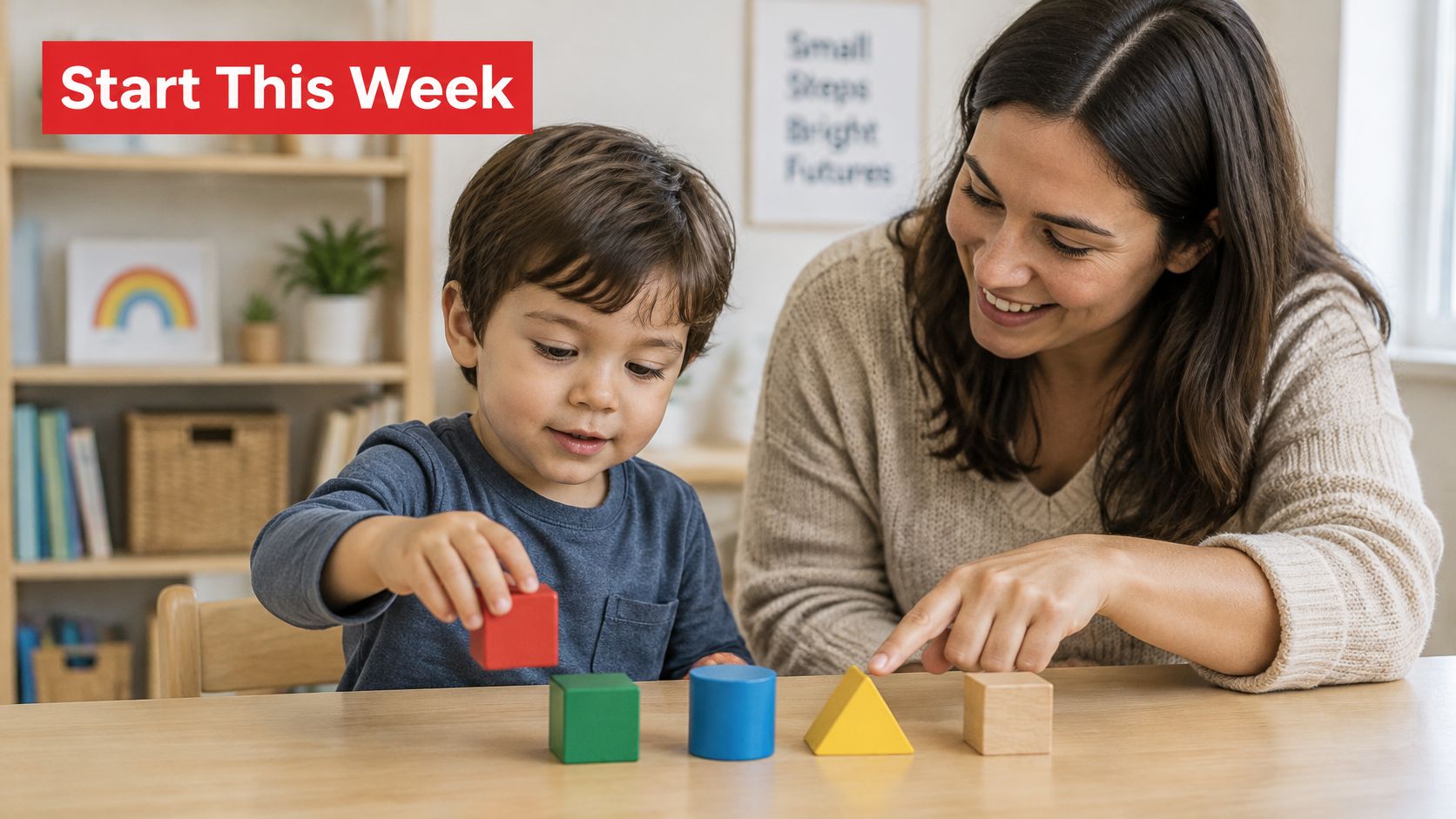
Choose an Age Band and Start This Week
Make three decisions before adding anything to your cart:
- Choose the activity row. Match shared materials to the youngest regular player, then adapt the challenge for other children.
- Schedule the routine twice. Repeat the seven-step session with the same basic materials so you can notice a change in approach.
- Select three spatial prompts. Pick questions that fit the child's current construction, and leave room for their answers.
You don't need a new theme to begin. If the current set supports building, taking apart, and trying another arrangement, use it.
A nearby adult can help by noticing the child's choices without directing every placement.
Buy for the missing activity
Before purchasing, read the package's age range, small-parts warning, and certification statement. Then ask what the new materials would let the child do that the current materials don't: grasp larger pieces, make a longer span, or investigate a more involved system.
A display model can be satisfying, but it serves a different purpose from a collection available for repeated rebuilding. Don't choose one expecting it to do the other's job.
Our Playz age groups include 1 to 3 years, 3 to 8 years, and 8 and older. Those shopping bands broadly align with the activity progression, but they don't replace individual product warnings; confirm current listings and safety text on the Playz website before ordering.
For children interested in extending hands-on problem-solving beyond blocks, our Coding & Computer Science Kit includes binary necklaces, ancient encryption devices, sorting races, mystery mazes, and pixelated pictures. Our Science Kits cover chemistry, biology, physics, and more. Treat these as optional directions for a child's existing interests, not necessary upgrades from simple construction.
Keep the routine when materials change
When something new arrives, resist turning the first session into a demonstration of every possible feature. Give the child time to explore, then offer a challenge they can accept, alter, or decline.
Choose the activity today and put the first session on the calendar. Children learn best through play, and this week's win is one finished build they can explain, not a bigger pile of bricks.
Playz offers age-grouped creative toys, Science Kits, and Model Kits for hands-on exploration beyond the block bin. Visit Playz to compare options with your child's next building or problem-solving interest, and check the age guidance before choosing.