

One company founded to make padded slides, tunnels, and climbers reports more than 40,000 installations worldwide, used by an estimated over 2.6 billion children, according to Daddy Types on the history of soft modular play. That scale is striking, but it also hides the question parents need to answer. A product can feel squishy and still have a torn cover, loose foam, or a filling you can't identify. Softness isn't a safety label. Judge soft play toys by their materials, age label, condition, and cleaning method, and you'll make much better choices for your child.
Soft Play Toys at a Glance
Soft play toys are padded, cushioned items that let young children climb, crawl, roll, stack, and cuddle while foam or other padding replaces hard impact surfaces. You'll find them in homes, nurseries, classrooms, and play centers. Some are big enough to climb on. Others fit on a lap.
That range is where confusion starts. A foam climbing block, a pop-up tent, and a plush toy all get called soft, but they ask different things of your space and your supervision. They also fail in different ways. A climber can tip or expose foam through a split cover. A plush toy can lose stitching and leak filling.
Practical rule: Ask what happens when the surface fails, not just how soft it feels in the shop.
Common Soft Play Toy Types Compared
| Type | Typical use | Space needed | Key check before buying |
|---|---|---|---|
| Foam play sets | Climbing, crawling and stacking | Medium to large room | Bonded foam that cannot break off when bitten |
| Crash pads and soft tunnels | Jumping, crawling and rolling | Medium floor area | Firm base and sealed cover |
| Pop-up play tents | Imaginative play and quiet corners | Small to medium | Enclosed fabric with no loose parts |
| Soft-filled plush toys | Holding, cuddling and sensory comfort | Table-top or lap size | Sealed filling and a clear age label |
| Ball pits | Sensory play and sorting | Medium floor area | Cleanable balls and supervision for under-3s |
Use the last column first. If you can't confirm that check from the label, photos, or seller answers, don't buy on color or price alone. For example, two foam sets can look identical online. One has enclosed foam and reinforced seams you can inspect. The other gives no construction details at all. The first gives you something to verify. The second asks you to trust a squishy photo.
Cushioning reduces the impact of falls. It doesn't reveal what's inside, whether a seam will hold, or whether you can clean the surface properly. Keep that distinction in mind for every product below.
Developmental Benefits of Soft Play
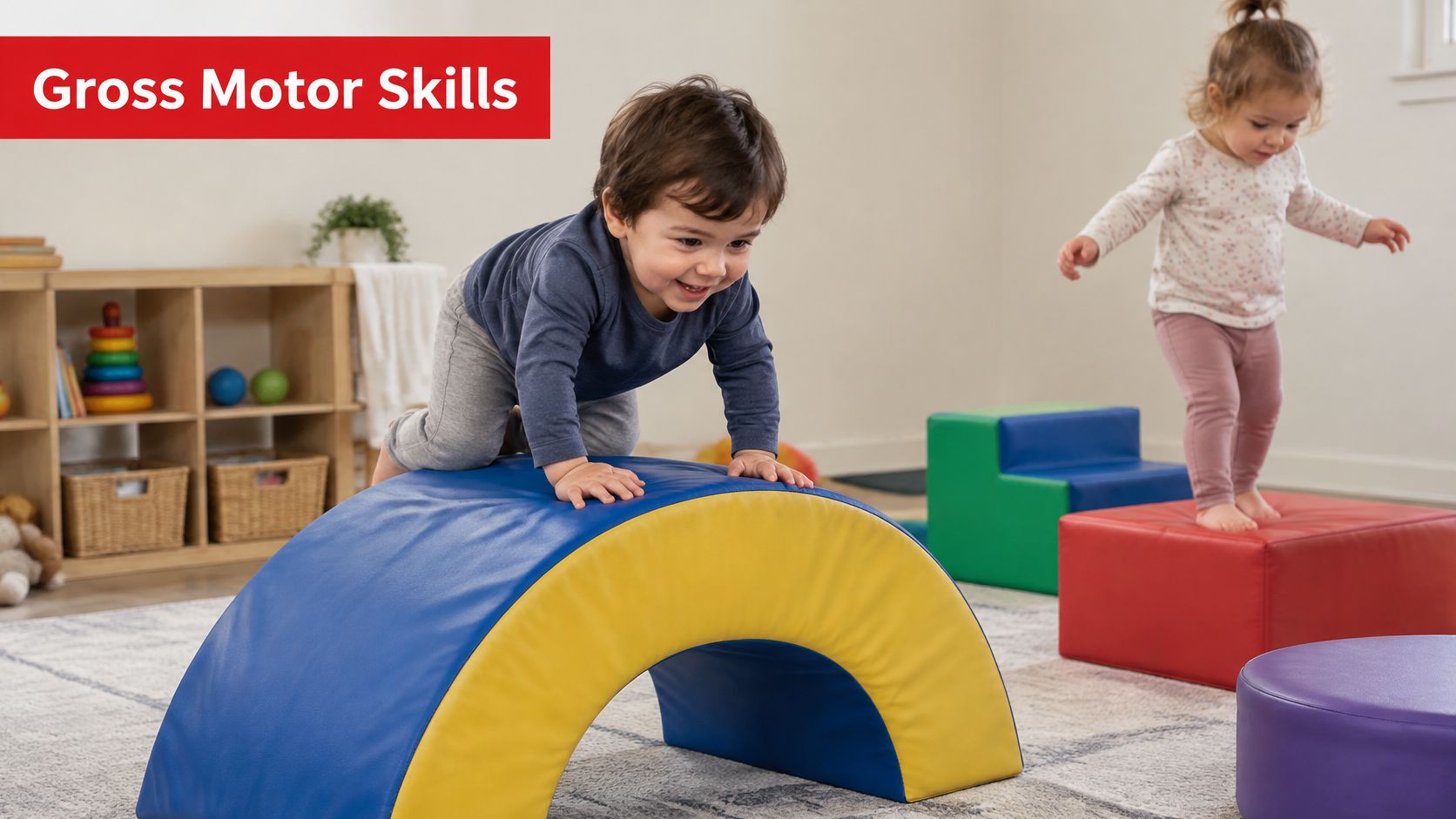
Say a toddler spots a soft tunnel with a ball just inside the entrance. She drops to hands and knees, rocks forward, and crawls in to reach it. She bumps the side, adjusts, and keeps going. That short sequence builds gross motor skills, balance, and confidence in moving through space, all on a surface that forgives the bumps.
Here's that kind of active, padded play in a typical playroom setting.
A preschooler stacking foam blocks beside peers gets something different. He climbs, steadies himself, negotiates who places the next block, and tries again when the tower falls. That's motor practice, social skills, and persistence in one activity. Research summaries associate multisensory play with emotional regulation, motor coordination, creativity, and cognitive development, and a 2025 study on inclusive early-childhood classrooms reported benefits across cognitive, social, emotional, and psychomotor areas for children aged 3 to 5 with functional diversity, as catalogued in the Mendeley catalogue entry for that study.
More Sensory Input Isn't Always Better
This is the part product pages skip. The same enclosed tent that calms one child can distress another. Textures, echoing tunnels, bright colors, and group noise can overwhelm a sensory-sensitive child. If you're planning for varied needs, start with what sensory play involves and how children respond differently to it, then match features to the child in front of you.
Watch regulation before, during, and after play. Offer a choice of smooth and textured surfaces. Keep a dimmer opt-out space nearby with fewer items. A child who won't climb can still take part by rolling a ball through the tunnel, passing blocks to a builder, or counting peers at the entrance.
Step in when a child shows prolonged distress, hides for long stretches, or repeatedly avoids contact. Note what triggered it. That record lets you lower the noise, swap a texture, or shorten the next session instead of adding more stimulation.
The short clip below shows how varied soft play setups can look in practice.
Soft play complements outdoor movement. It doesn't replace running, digging, or unstructured time outside.
Matching Age and Space to the Right Product
Read this table before you read any marketing copy. It pairs each age band with a sensible focus and the product note that matters most.
Age Bands, Activity Targets and Product Focus
| Age band | Typical soft play focus | Daily activity guideline | Product note |
|---|---|---|---|
| Under 1 year | Tummy time and reaching on low, firm padded mats | No daily minute target; use short, supervised floor sessions spread through the day | No foam pieces that can be mouthed or broken off |
| 1-2 years | Crawling, cruising and low climbing | At least 180 minutes per day, spread through the day | Check label; supervise closely around foam pieces |
| 3-4 years | Climbing, crawling tunnels and balancing | At least 180 minutes per day, including 60 minutes moderate to vigorous | Check EN 71-1 category and label |
| 5-8 years | Obstacle courses and active games | At least 60 minutes per day moderate to vigorous (WHO, ages 5-17) | Check label; separate from toddler zone |
Those minute targets come from movement guidance, not from a single play session. The World Health Organization physical activity fact sheet recommends that children aged 1 to 2 spend at least 180 minutes per day in physical activity of any intensity, spread throughout the day, and that children aged 3 to 4 get at least 180 minutes daily, including at least 60 minutes of moderate-to-vigorous activity. Several short bouts of crawling, climbing, balancing, and pushing add up across the day.
How to Read the Age Label
A product's likely use, not its marketing name, decides its age category. European guidance under EN 71-1 treats soft-filled toys with simple features intended for holding and cuddling as toys intended for children under 36 months, according to the SNV listing for EN 71-1. That classification can trigger stricter requirements for seams, filling, and accessible parts. Check the stated age category and conformity information rather than assuming every padded toy suits an infant.
Supervision follows the youngest child who can reach the toy, not the child you bought it for.
Say a 2-year-old and a 6-year-old share one room. Put low foam shapes and a short tunnel in the toddler zone, perhaps a ball pit and tunnel combination sized for younger children, and keep taller climbing pieces behind a clear boundary for the older child. Measure your floor, leave clear fall zones around climbers, and keep low-height items nearest the toddlers.
Safety Standards and Warning Signs
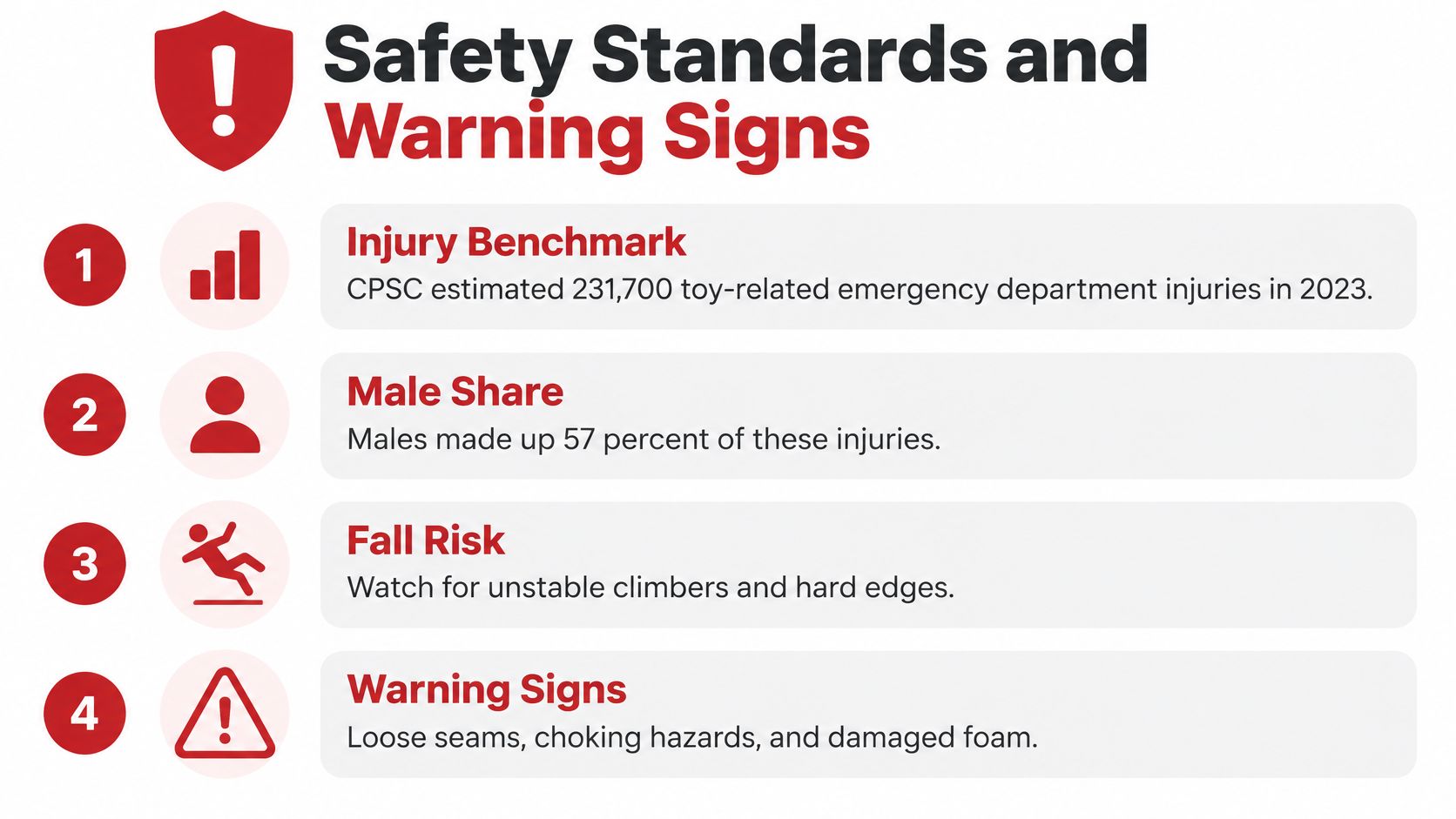
Soft doesn't mean safe, and the broader toy figures show why design and condition matter. The U.S. Consumer Product Safety Commission 2023 toy report estimated 231,700 toy-related injuries treated in hospital emergency departments in 2023, with males representing 57% of those injuries, and recorded 40 toy-related deaths among children aged 14 or younger from 2021 through 2023. Those figures cover toys broadly, not soft play alone. They're a benchmark for scale, not a soft play injury rate.
This summary pulls the key figures and hazard signs together.
What Testing Should Sit Behind the Label
In the United States, toys intended primarily for children aged 12 or younger must undergo third-party testing at a laboratory accepted by the Consumer Product Safety Commission and be covered by a Children's Product Certificate, under the framework incorporating ASTM F963 through 16 C.F.R. Part 1250, as explained in the CPSC toy safety FAQ. The current guidance identifies ASTM F963-23 as the accepted version for toys manufactured on or after April 20, 2024. Ask for evidence of testing and clear age guidance. Don't accept the word soft as proof. For a plain-language walkthrough of what to ask sellers, see this guide to toy safety for children and the checks behind the label.
Two material risks deserve your attention. Testing of accessible foam commonly uses torque, tension, drop, impact, and compression checks because biting and climbing can expose loose foam or seams, as set out in the CASP toys annex on mechanical testing. Foam that breaks off when bitten is a choking risk for under-3s. Separately, squishy products may contain water beads, gels, liquids, powders, or sand, and a torn covering can create ingestion, aspiration, chemical-exposure, or burn risks, a hazard covered in the CPSC consumer safety alert on counterfeit squishy toys. Heat from cars, sunlight, or heaters can worsen that risk.
Cushioning also doesn't remove entrapment, falls from excessive height, or overcrowding. Use this table as your working inspection tool.
Inspection Points, Warning Signs and Actions
| Inspection point | Warning sign | Action |
|---|---|---|
| Seams | Split or loose stitching | Remove from use until repaired |
| Foam covering | Tears exposing foam or filling | Stop use and replace the cover |
| Loose parts | Detachable pieces that fit in a child's mouth | Remove, or keep out of reach of under-3s |
| Filling | Beads, gel, liquid or sand showing | Discard; do not reuse |
| Odor and surface | Mildew smell or sticky, tacky feel | Clean; replace if the problem persists |
| Storage conditions | Left in a hot car or near a heater | Move to cool, dry storage and inspect before use |
Remove any item showing a warning sign until it's repaired or replaced. Don't hand it back because the padding still feels fine.
Cleaning and Hygiene for Shared Soft Play
Porous materials hold onto microorganisms, and the gap between soft and hard toys is large. A pediatric infection-control review reported coliform contamination on 90% of soft toys versus 13.5% of hard toys, and soft toys were contaminated again after one week of use while hard toys were not, according to the Hertfordshire soft play infection control guidance. Routine cleaning every one to two weeks reduced contamination on hard toys but produced similar counts for soft toys.
A nursery intervention in that same guidance found that cleaning and disinfecting toys every two weeks reduced detection of adenovirus, rhinovirus, and respiratory syncytial virus, but didn't reduce overall illness absence or bacterial load. Cleaning helps. It doesn't turn a porous toy into a sealed one.
Design Choices That Make Cleaning Possible
Choose sealed, non-absorbent, detergent-compatible coverings where you can. Removable washable components and a way to dry pieces fully matter just as much. Facilities that handle high turnover well treat this as a visible routine, much like the facility hygiene practices that build guest trust described for high-touch surfaces. If you're considering alcohol-based products for hard accessories, check material compatibility first, including guidance on 90% isopropyl alcohol and where it should and shouldn't be used.
Always remove soil with detergent before you disinfect. Organic matter can reduce disinfectant effectiveness, so skipping that first step wastes the second one.
Cleaning Method and Frequency by Soft Play Item
| Item | Cleaning method | Frequency |
|---|---|---|
| Sealed foam with non-absorbent cover | Remove soil with detergent, then disinfect | Every one to two weeks in shared settings, and after bodily fluids |
| Removable washable covers | Wash per label and dry fully before use | Every one to two weeks in shared settings |
| Porous fabric soft toys | Wash per label; expect rapid recontamination | Frequent cleaning; replace if it cannot be cleaned properly |
| Ball pit or loose filling | Follow manufacturer cleaning instructions | After bodily-fluid contamination and between high-turnover sessions |
Clean immediately after bodily-fluid contamination, whatever the schedule says. Where a porous item can't be cleaned properly, replace it rather than returning it to the shared box.
Setting Up a Soft Play Area Step by Step
Follow these steps in order. Each one prevents a specific problem, and skipping an early step makes the later ones harder to fix.
This visual overview shows the setup sequence at a glance.
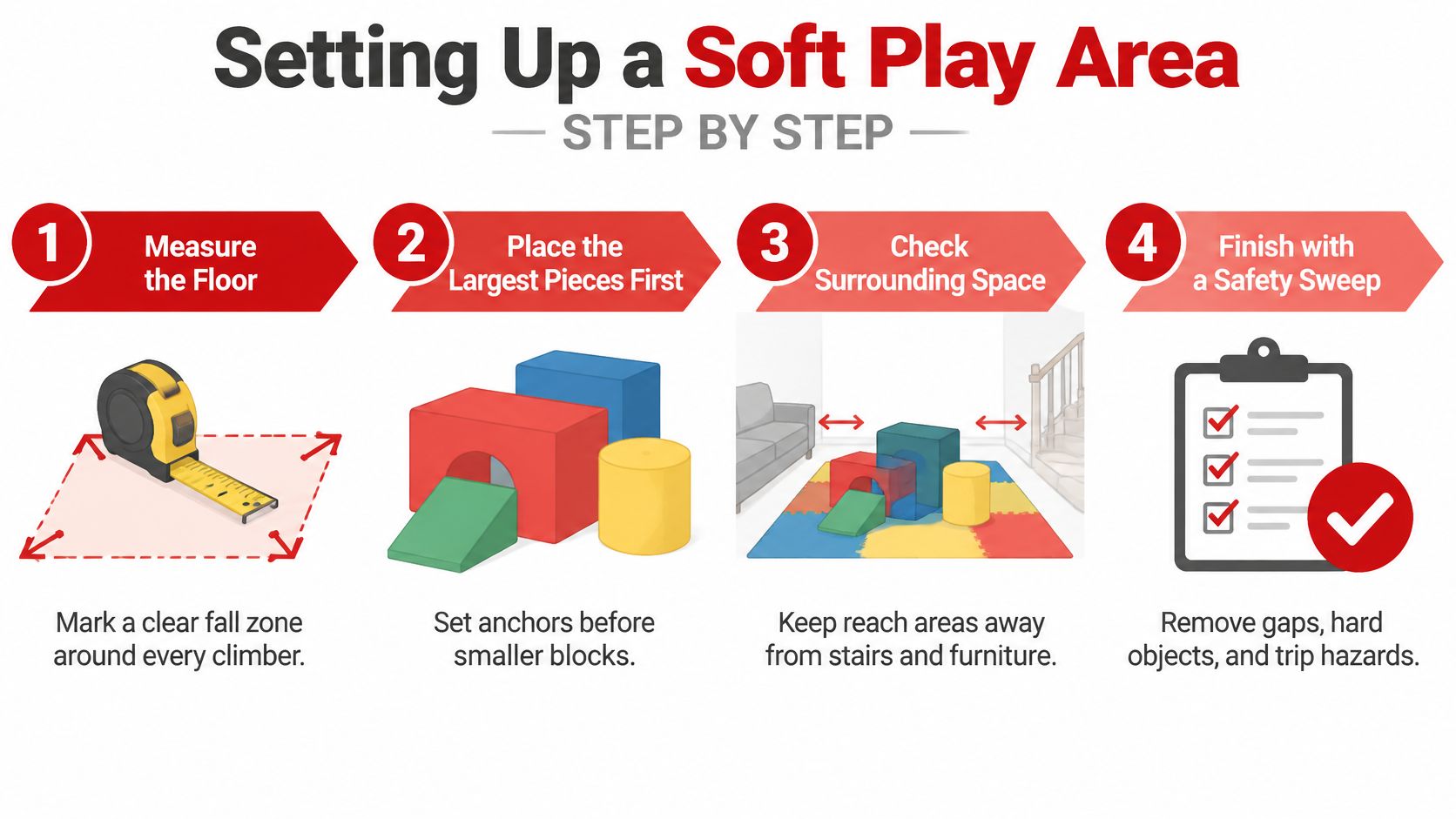
- Measure and mark. Measure the floor and mark a clear fall zone around every climber. Skip this and children approach climbers from unsafe angles, including from nearby furniture.
- Split the room into zones. Create a low-level toddler zone, a climbing zone for older children, and a quiet corner. One open pile of equipment serves nobody well. If you're arranging a whole room, these daycare room setup ideas for zoning and traffic flow can help you place boundaries before you buy.
- Secure and check connections. Fasten stacked or connected pieces so they don't shift under weight. Run your hand along joins and check for gaps that could trap fingers or heads.
- Set height by the youngest reach. Set height limits for the youngest child who can reach the area. A gate or low shelf only works if adults close and respect it.
- Lay a firm, level base. Put mats on a firm, level surface and clear the zone of sharp objects, cords, and hard-edged furniture. A mat that slides on a smooth floor needs fixing down or moving.
- Post the rules where adults stand. Put the age label, supervision rule, and inspection schedule on the wall at adult eye level. New staff and visiting grandparents shouldn't have to guess.
- Add an opt-out space. Set aside a spot with dimmer light, a mat, and one or two cushions. Children who need a break shouldn't have to leave the room entirely.
Room check: If you can't see every zone from one supervising position, rearrange before you add more equipment.
In a childcare room, that might look like this. The toddler zone sits by the door with low foam shapes. The climbing zone occupies the far wall with its marked fall zone. The quiet corner sits behind a shelf with a mat and two cushions. Staff check the mats each Friday and record results on a wall chart, so a split seam found on Monday doesn't get forgotten by Wednesday.
Soft Play Questions Answered
Do Babies Under One Need Different Soft Play Toys
Yes. There's no daily minute target set for this group in the guidance used here, so think in short, supervised floor sessions rather than a quota. Low, firm padded mats suit tummy time and reaching because babies can push against them without sinking. Keep any foam piece that can be mouthed or broken off completely out of reach.
Are Second-Hand Soft Play Toys Worth Buying
Only after a hands-on inspection. Look for a visible age label and some evidence of testing on the product or original listing. Check for tears, split seams, sticky surfaces, and any mildew smell. If it's porous and you can't clean it properly, walk away, however cheap it is.
A second-hand pop-up tent with intact fabric and no loose parts is a reasonable buy. A foam block with a cracked cover isn't, because you can't verify what's happening inside it.
Do European Rules Matter to Buyers in the United States
They're worth understanding if you buy imported products. Goods sold in European markets follow EN 71-1, which applies stricter thinking based on a product's likely use. A simple cuddly soft-filled toy gets treated as a product for very young children, whatever the listing calls it. Check the category printed on the label for any product, wherever it was made.
Pick Your First Soft Play Product with Confidence
A soft surface can cushion a bump, but it does not make a toy safe by itself. Match the product to the child and setting, then check its label, construction, and cleaning requirements.
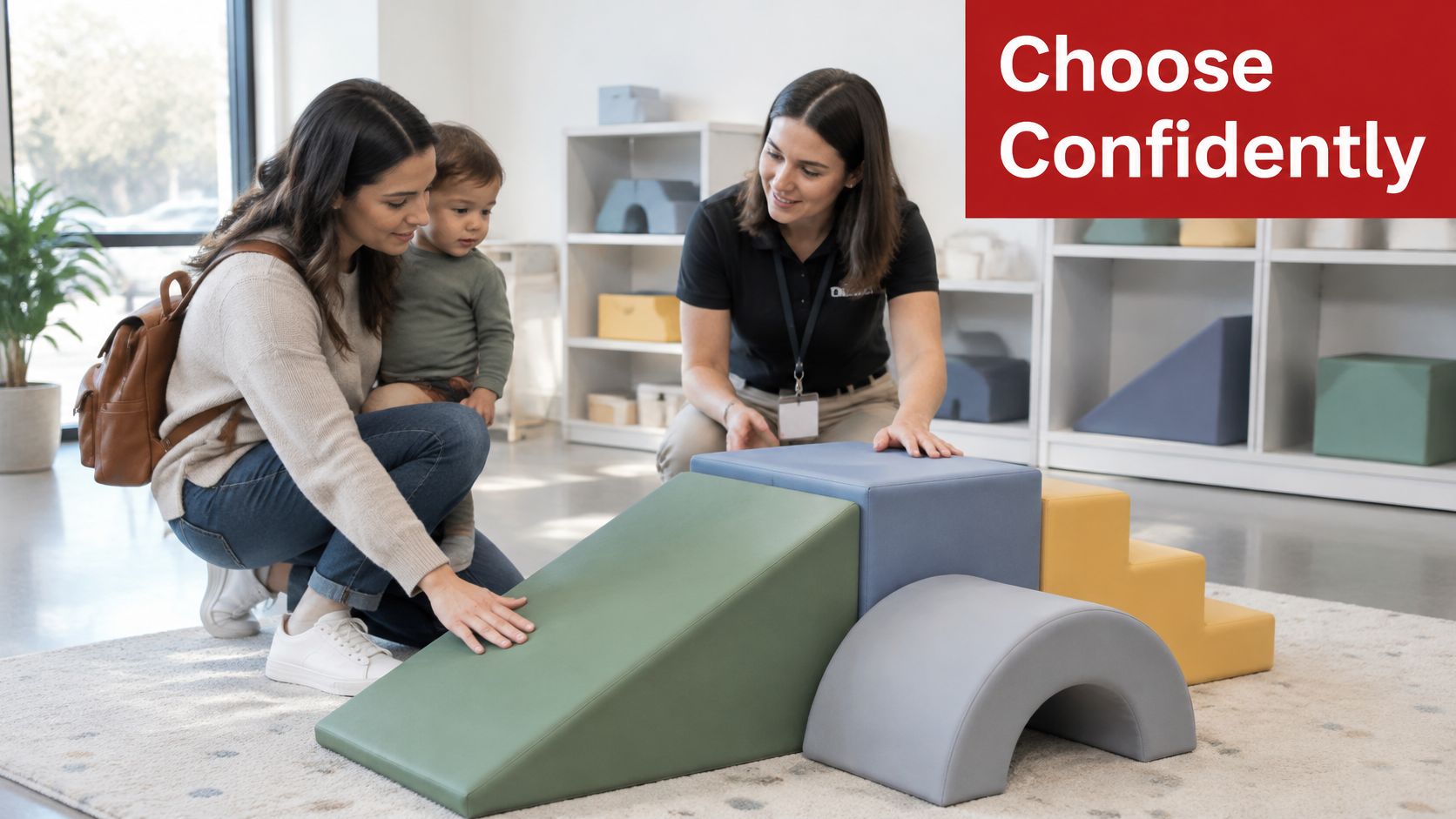
- Parents of toddlers: Choose firm, enclosed items with surfaces you can clean, and start with the age label. A toy within reach of your youngest child needs to suit that child.
- Educators and childcare providers: Look for covers that can be cleaned, set a written inspection routine, and plan where each item will be used. Porous items can be difficult to keep clean with frequent shared use.
- Gift buyers: Check the age guidance and whether the seller is identifiable. Skip filled products if the seller provides no testing information.
Brands such as Playz offer play tents and other soft play options, so run the same verification on any product before you buy. A soft fabric cover, for example, tells you little about the filling or whether the item can be cleaned as needed.
Your pre-purchase verification list:
- Age match: The label suits the youngest child who can reach the toy.
- Testing evidence: The seller provides testing details and clear age guidance.
- Cleanable surface: The cover can be wiped or washed and dried fully.
- No leak risk: No loose or filled parts can escape.
- Traceable seller: The seller's identity and contact details are clear.
Compare each listing with the age and inspection tables in this guide. If a product fails any check, choose another.
Playz offers play tents, science kits, and creative toys that support imaginative and purposeful play. Browse the Playz toy range, then check the age label and product details before buying.