


Welcome, dedicated early childhood educators and providers! You understand that a daycare room is far more than just four walls. It’s the 'third teacher,' a dynamic environment that profoundly shapes learning, behavior, and emotional well-being. But translating that understanding into a functional, engaging space can feel overwhelming. Where do you even begin with planning a layout that is both practical and inspiring?
This guide is designed to cut through the noise. We've curated 10 powerful and distinct daycare room setup ideas, moving beyond generic advice to offer actionable blueprints for creating an environment where every child can thrive. Instead of just telling you what to do, we'll show you how with practical strategies, real-world examples, and fresh perspectives on designing a classroom that truly works.
We'll cover everything from Montessori-inspired layouts and nature-based designs to setting up sensory-rich play zones and quiet, low-stimulation retreats. You'll discover how to organize learning centers, manage storage effectively, and incorporate elements that support your core educational philosophy. The visual appeal of the space is just as crucial for creating a welcoming atmosphere. For a wealth of inspiration on creating vibrant, child-friendly environments, explore these nursery wall decor ideas. Whether you're starting from scratch or revamping an existing room, this comprehensive list provides the tools you need to build a space that sparks curiosity and nurtures a lifelong love of learning. Let’s dive in.
1. Montessori-Inspired Learning Environment
A Montessori-inspired approach is one of the most effective daycare room setup ideas for fostering independence and self-directed learning. This child-centered philosophy, developed by Dr. Maria Montessori, is built on the principle of a "prepared environment." The classroom itself becomes the teacher, with every element designed to be accessible, engaging, and supportive of a child's natural curiosity.
The core idea is to create a calm, orderly space where children can freely choose their activities from a curated selection of materials. This freedom within a structured framework helps develop concentration, confidence, and a genuine love for learning. By placing materials on low, open shelves and using child-sized furniture, you empower children to take ownership of their learning journey.
Why It Works for Daycare Settings
This approach is highly effective because it respects each child's individual pace and interests. Rather than a one-size-fits-all curriculum, the Montessori method allows for personalized learning experiences. This is particularly beneficial in a mixed-age group, as children can select activities that match their developmental level. The emphasis on practical life skills, such as pouring and buttoning, also builds fine motor skills and a sense of responsibility.
Key Takeaway: The goal is to create a peaceful and empowering environment where the room's design encourages exploration, independence, and respect for the learning process.
How to Implement a Montessori-Inspired Setup:
- Organize by Learning Areas: Group materials into distinct zones. Dedicate shelves for Practical Life (e.g., pouring stations, dressing frames), Sensorial (e.g., sound cylinders, texture tablets), Language, and Math.
- Use Natural and Neutral Tones: Opt for furniture made of natural wood and use a calm, neutral color palette for the walls and floors. This minimizes overstimulation and creates a tranquil atmosphere conducive to concentration.
- Emphasize Accessibility: Arrange everything at the child's eye level. Use low, open shelves so children can see, choose, and return their materials independently.
- Rotate Materials: Keep the environment engaging by rotating activities based on the children's current interests and skill levels. This prevents boredom and introduces new challenges. The focus on tactile materials perfectly aligns with the principles of hands-on education. You can explore more about the benefits of hands-on learning to see how this approach enhances cognitive development.
2. Nature-Based Learning Spaces
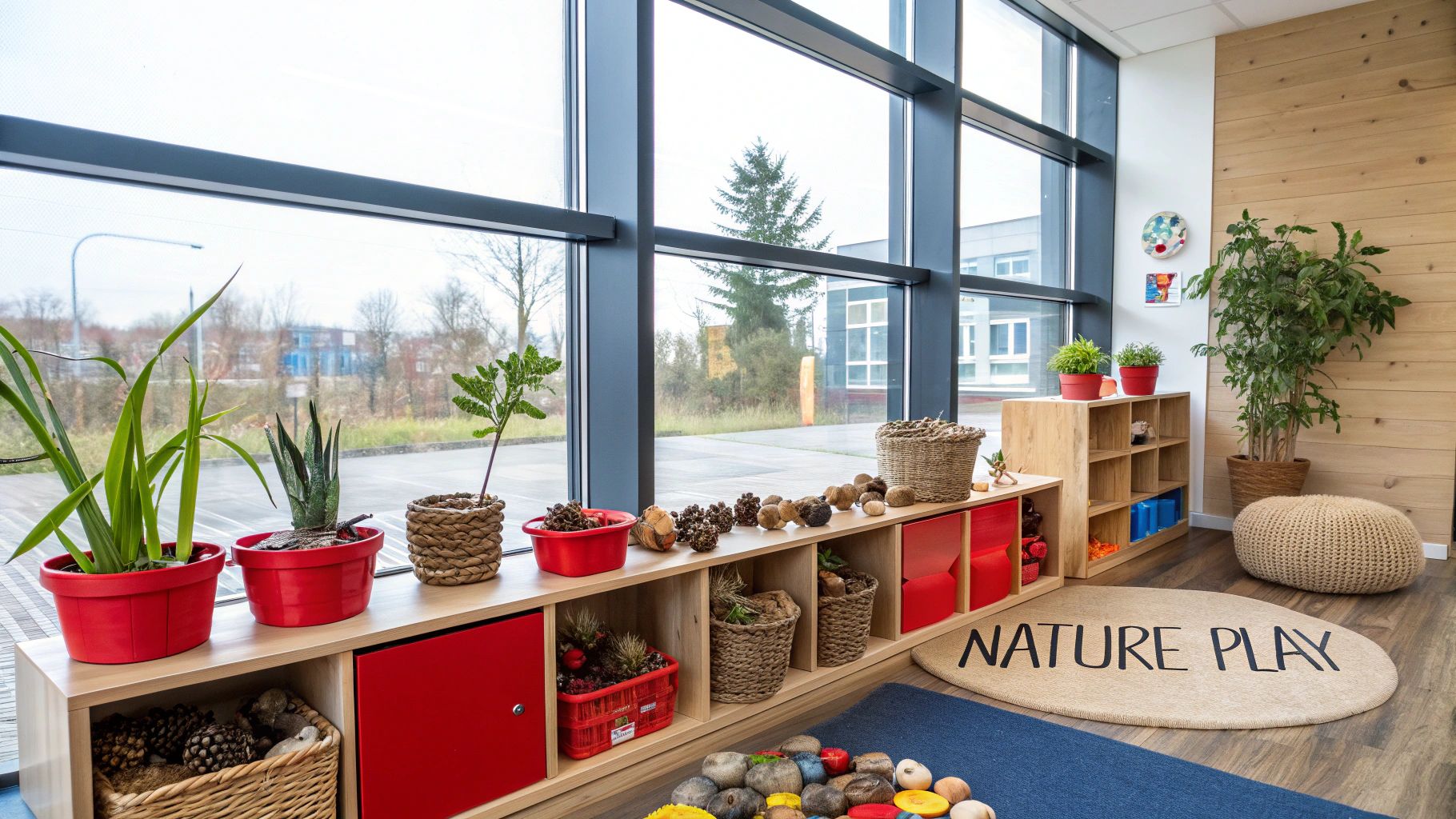
A nature-based learning space is one of the most enriching daycare room setup ideas, designed to connect children with the natural world. This approach, inspired by models like Forest Kindergartens, involves integrating natural elements directly into the classroom and emphasizing outdoor exploration as a core component of the daily curriculum. It transforms the environment into a living, breathing classroom that stimulates the senses and promotes well-being.
The fundamental concept is to dissolve the traditional barrier between indoor and outdoor learning. By incorporating natural light, plants, wood, stones, and other organic materials, you create a calming and grounding atmosphere. This setup encourages children to observe, question, and interact with the environment, fostering a deep respect for nature and a strong foundation in scientific inquiry.
Why It Works for Daycare Settings
This approach is highly effective because it supports holistic development by engaging children's physical, cognitive, and emotional senses. It helps reduce stress and improve focus, addressing concepts like "Nature Deficit Disorder," as popularized by Richard Louv. This setup is incredibly adaptable, as the "materials" change with the seasons, offering endless opportunities for discovery.
Regular outdoor time also enhances gross motor skills, resilience, and problem-solving abilities. You can discover more about the extensive benefits of outdoor play and see how it builds a foundation for lifelong health and learning.
Key Takeaway: The goal is to create a seamless connection between the indoor and outdoor environments, using natural materials to inspire curiosity, calmness, and a profound appreciation for the natural world.
How to Implement a Nature-Based Setup:
- Bring the Outdoors In: Incorporate natural elements throughout the room. Use wooden furniture, wicker baskets for storage, and create a "nature table" with seasonal finds like pinecones, leaves, and smooth stones for sensory exploration.
- Use Living Elements: Add child-safe, non-toxic plants to purify the air and create a living classroom. Caring for plants also teaches children responsibility and introduces them to life cycles.
- Maximize Natural Light: Arrange the room to take full advantage of windows. Use light, airy curtains or leave windows uncovered to create a bright, open space that connects children to the time of day and weather.
- Create Natural Loose Parts Stations: Designate an area with "loose parts" from nature, such as sticks, shells, wood slices, and pebbles. These open-ended materials encourage creativity, engineering, and imaginative play far more than single-purpose toys.
3. Reggio Emilia-Inspired Creative Studios
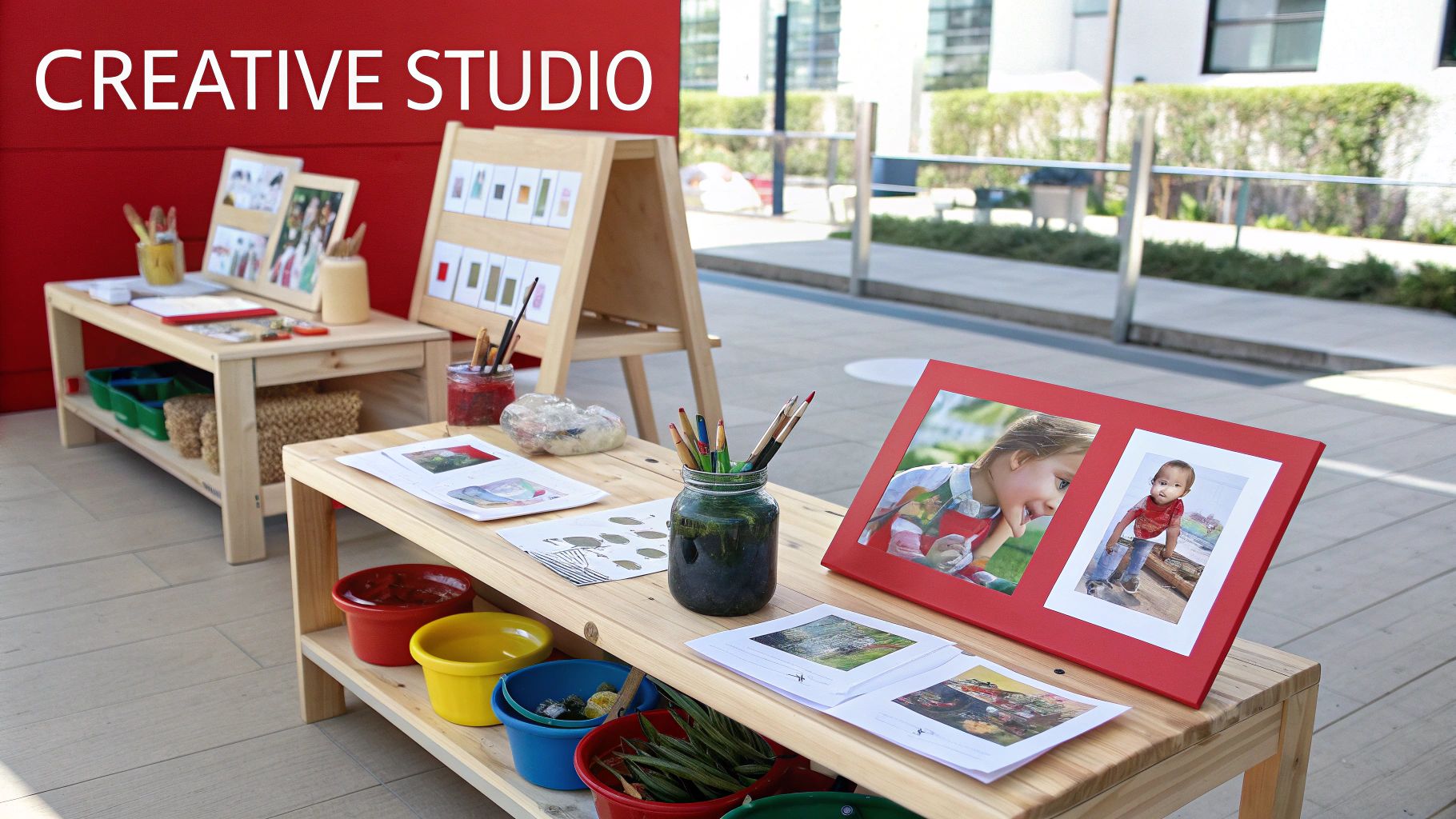
The Reggio Emilia approach transforms the daycare classroom into a vibrant studio or "atelier," where children are seen as capable researchers and collaborators. This philosophy, originating in the Italian city of Reggio Emilia, views the environment as the "third teacher," designed to provoke curiosity, communication, and creative expression. The space is intentionally beautiful, filled with natural light, mirrors, and displays of children's ongoing projects.
The central concept is that learning is a co-constructed process. Children, teachers, and the environment work together. Abundant, open-ended materials like clay, wire, paint, and natural items are provided not just for art, but as tools for children to represent their ideas, theories, and understanding of the world. This makes it one of the most dynamic daycare room setup ideas for nurturing critical thinking and creativity.
Why It Works for Daycare Settings
This approach excels in daycare settings because it honors the child's voice and promotes deep, project-based learning. Instead of moving quickly from one activity to the next, children are encouraged to revisit and build upon their work over days or weeks. This fosters persistence, problem-solving, and a strong sense of community as they collaborate on shared investigations. The emphasis on documenting their work makes learning visible and values the process over the final product.
Key Takeaway: The environment should act as a source of inspiration and a reflection of the children's learning journey, encouraging collaboration, expression, and inquiry.
How to Implement a Reggio Emilia-Inspired Setup:
- Create an Atelier: Dedicate a well-lit area as an art studio. Stock it with a rich variety of high-quality materials, such as different types of paper, watercolors, clay, and recycled items. Store them in clear containers on accessible shelves.
- Use Light and Reflection: Incorporate mirrors, light tables, and overhead projectors. These tools allow children to explore concepts of light, shadow, and perspective, adding a new dimension to their creative work.
- Document and Display Learning: Use a "learning wall" to display photos of children engaged in projects, their quotes, and their evolving artwork. This documentation makes the learning process visible to children, parents, and educators.
- Integrate Natural Materials: Bring the outdoors in by providing materials like leaves, stones, shells, and branches. This connection to nature inspires observation and sensory exploration, which is essential for developing foundational art and craft for preschoolers. Explore more ideas for preschooler art and craft activities to enrich your studio.
4. Sensory-Rich Play Zones
Creating sensory-rich play zones is a powerful daycare room setup idea that supports cognitive growth, motor skills, and emotional regulation. This approach involves dedicating specific areas to different sensory experiences, allowing children to safely explore their world through touch, sight, sound, smell, and movement. Popularized by occupational therapists like Jean Ayres, this setup is designed to help children process and organize sensory input in a structured way.
The fundamental concept is to provide a variety of textures, materials, and activities that stimulate the senses in a controlled environment. Instead of a single, overwhelming sensory table, you create multiple, clearly defined stations. This might include a "wet" zone with water and bubbles, a "dry" zone with sand or beans, a tactile wall with different fabrics, and a quiet corner with soft lighting and calming sounds.
Why It Works for Daycare Settings
This setup is exceptionally beneficial because it caters to the diverse sensory needs of all children, including those with sensory processing disorders. It allows children who are sensory-seeking to find appropriate stimulation, while providing those who are easily overstimulated with calming, predictable spaces. By offering choice and control over their sensory input, you help children learn self-regulation skills.
Key Takeaway: A sensory-rich environment intentionally provides varied sensory input to help children develop crucial processing skills, manage emotions, and engage more deeply with their learning.
How to Implement a Sensory-Rich Setup:
- Designate Clear Zones: Use low shelving, colorful rugs, or tape on the floor to create distinct boundaries for different sensory activities. For example, have a messy play zone, a tactile exploration area, and a listening station.
- Offer a Variety of Textures: Stock zones with a wide range of materials. Include bins with sand, water beads, rice, and pasta, as well as textured balls, soft fabrics, and rough surfaces like sandpaper blocks.
- Incorporate All Senses: Go beyond touch. Add a listening station with different sounds, a "smell and guess" game with scent jars, and visually stimulating elements like light tables or colorful scarves.
- Provide a Quiet Retreat: Position a calm-down corner near the sensory zones. Equip it with soft pillows, a weighted blanket, and noise-canceling headphones to offer children a space to decompress if they feel overwhelmed. By understanding the core principles of engagement, you can better design these crucial spaces. You can find more information by reading about what sensory play is and why it's important.
5. Loose Parts and Open-Ended Play Setup
A loose parts and open-ended play setup is a dynamic and minimalist approach that champions child-led creativity. This concept, popularized by architect Simon Nicholson, revolves around providing children with materials that have no single, predetermined function. Instead of structured toys, the environment is filled with versatile, open-ended items that can be moved, combined, redesigned, and tinkered with in countless ways.
This setup transforms the daycare room into a laboratory for imagination. Materials like cardboard tubes, fabric scraps, wooden blocks, pinecones, and recycled containers become the building blocks for whatever a child can envision. This freedom to manipulate and invent fosters critical thinking, problem-solving, and complex imaginative scenarios, which are foundational to cognitive development. You can discover more about how this type of play builds essential skills by exploring the benefits of pretend play.
Why It Works for Daycare Settings
This approach is exceptionally effective in a daycare because it caters to a wide range of developmental stages and interests simultaneously. A toddler might focus on stacking and sorting the loose parts, while a preschooler uses the same materials to construct an elaborate fort or spaceship. It promotes collaboration and social negotiation as children work together to bring their ideas to life. Furthermore, it's a sustainable and budget-friendly option, relying heavily on natural and recycled materials.
Key Takeaway: The goal is to create a flexible and resourceful environment where children are empowered to direct their own play, fostering unparalleled creativity and ingenuity.
How to Implement a Loose Parts and Open-Ended Setup:
- Curate Diverse Materials: Collect a wide variety of items. Think natural (stones, sticks, shells), recycled (cardboard boxes, plastic bottles, lids), and manufactured (pipes, bolts, fabric remnants).
- Organize for Accessibility: Store materials in clear, labeled bins on low shelves. This allows children to easily see their options and encourages them to be responsible for cleanup.
- Provide a "Creation Station": Designate a large, open area with a flat surface, like a durable rug or large piece of plywood, where children can build and create without limitations.
- Establish Clear Safety Guidelines: Teach children the rules for using the materials safely. For example, specify which items can be used for building versus those that are for smaller, tabletop creations.
- Enrich with Versatile Toys: For enriching open-ended play, consider incorporating versatile materials like magnetic tiles that stimulate creativity and problem-solving. You can also explore the educational benefits of magnetic tiles for toddlers.
6. Technology-Integrated Smart Classroom
A technology-integrated smart classroom thoughtfully weaves age-appropriate digital tools into the learning environment. This is not about replacing traditional play but enhancing it. The setup includes items like interactive whiteboards for group activities, tablets with educational apps for individualized learning, and simple coding robots that introduce foundational STEM concepts.
The core idea is to create a dynamic space that prepares children for a digitally-fluent future. By using technology as a tool for exploration, creativity, and problem-solving, you can support 21st-century skills. This approach leverages digital resources to document learning, connect with families, and provide new avenues for discovery that complement hands-on experiences.
Why It Works for Daycare Settings
This approach is highly effective for introducing foundational digital literacy in a controlled, purposeful way. Technology can open up worlds of information, allowing children to virtually visit a museum or explore the deep sea. It also offers powerful tools for differentiation, as educational apps can adapt to a child's individual skill level. Furthermore, using technology for documentation, such as digital portfolios, streamlines communication with parents and provides a richer view of their child’s progress.
Key Takeaway: The goal is to purposefully integrate technology to enhance learning experiences and build foundational digital skills, ensuring a healthy balance with traditional, hands-on play.
How to Implement a Technology-Integrated Setup:
- Create a Dedicated Tech Zone: Designate a specific area for technology use with comfortable seating and charging stations. This helps manage screen time and signals to children when and where digital tools are used.
- Balance with Hands-On Play: For every tech-based activity, ensure there are complementary non-digital options. If children are learning about animals on a tablet, also have animal figures, puzzles, and books available in the science area.
- Choose Developmentally Appropriate Tools: Select educational apps and software reviewed for quality by organizations like Common Sense Media. Introduce simple coding toys like Bee-Bots that teach logic and sequencing without requiring screen use.
- Use Tech for Documentation: Utilize apps like Seesaw or Tadpoles to capture photos and videos of children's work. This creates a digital portfolio that makes learning visible to parents and aids in assessment.
7. Warm, Home-Like Cozy Corner Design
A warm, home-like design is one of the most reassuring daycare room setup ideas, focused on creating an environment that feels safe, comforting, and familiar. This approach, heavily influenced by attachment theory and European childcare philosophies, aims to replicate the emotional security of home. It uses soft furnishings, warm lighting, and personalized elements to ease separation anxiety and build a strong sense of belonging, especially for infants and toddlers.
The core idea is to move away from an institutional feel and towards a nurturing, intimate atmosphere. By incorporating familiar comforts like plush rugs, comfortable seating, and family photos, you create a space where children feel emotionally supported. This setup acts as a secure base from which young children can confidently explore, play, and form positive relationships with caregivers and peers.
Why It Works for Daycare Settings
This approach is particularly effective for younger age groups who are still developing secure attachments. A home-like environment significantly reduces stress and anxiety, making the transition from home to daycare smoother. It fosters a sense of trust and safety, which is foundational for all other learning and development. The gentle, predictable atmosphere supports emotional regulation and encourages positive social interactions among children.
Key Takeaway: The goal is to design a nurturing, non-institutional space that provides emotional comfort and security, helping children feel as safe and loved as they do at home.
How to Implement a Home-Like Cozy Corner:
- Soften the Space: Use area rugs, floor cushions, soft chairs or a small, child-safe sofa. Choose machine-washable fabrics for easy cleaning and hygiene.
- Incorporate Warm Lighting: Avoid harsh fluorescent lights. Instead, use warm-toned lamps placed safely out of reach or string lights to create a gentle, calming ambiance.
- Add Personal Touches: Create a designated wall or board to display family photos for each child. This visual connection to home is incredibly comforting for young children.
- Establish Personal Cubbies: Give each child their own small, labeled cubby at their height. This provides a sense of ownership and a personal space for their belongings, reinforcing their place within the group.
8. Active Movement and Gross Motor Development Spaces
Incorporating an area dedicated to active movement is one of the most vital daycare room setup ideas for supporting holistic child development. This approach prioritizes physical literacy by creating a safe, designated space where children can climb, jump, balance, and engage in whole-body activities. It moves beyond simple playtime and treats gross motor skill development as a foundational component of the daily learning experience.
The core principle is to provide children with opportunities to challenge their bodies, build strength, and develop coordination in a structured yet playful environment. By offering a variety of equipment and activities, from soft climbing blocks to indoor obstacle courses, you cater to a child's innate need to move. This not inly supports physical health but also enhances concentration, emotional regulation, and cognitive function.
Why It Works for Daycare Settings
This setup is crucial because young children learn through physical exploration. Providing a dedicated space for large-muscle movement helps them release energy constructively, which can lead to improved focus during quieter, seated activities. It also builds physical confidence and resilience as children learn to navigate challenges, assess risks safely, and understand their body's capabilities. This is especially important for settings with limited outdoor access or during inclement weather.
Key Takeaway: The goal is to design an intentional space that encourages children to move their bodies freely and purposefully, building strength, coordination, and a positive relationship with physical activity.
How to Implement an Active Movement Setup:
- Establish a Safe Zone: Designate a specific area of the room for gross motor play, away from quiet zones like the reading nook. Use high-quality safety mats and ample padding under all climbing structures or balance beams to prevent injuries.
- Create Versatile Obstacle Courses: Use a combination of soft play equipment, tunnels, small slides, and balance beams that can be reconfigured regularly. This keeps the space exciting and offers new physical challenges.
- Integrate Music and Movement: Dedicate a corner with a durable speaker and colorful scarves or ribbons for daily dance and movement sessions. Mirrors installed at a low height are excellent for helping children develop body awareness as they move.
- Offer Variety and Progression: Provide equipment that caters to different skill levels. Include low balance beams for beginners and more complex climbing structures for older children to ensure everyone is appropriately challenged.
9. Quiet, Low-Stimulation Retreat Spaces
A quiet, low-stimulation retreat space is one of the most thoughtful daycare room setup ideas for supporting children's emotional regulation. This dedicated area, often called a "calm-down corner" or "peace corner," provides a safe haven for children who feel overwhelmed, overstimulated, or are experiencing big emotions. It is a proactive tool, not a punitive one, designed to teach self-regulation skills in a supportive environment.
The core concept is to create an intentional space that is physically and sensorially separate from the more active parts of the classroom. By offering a retreat with soft textures, muted colors, and calming tools, you give children a place to decompress and process their feelings. This approach is fundamental to creating an inclusive, trauma-informed environment that acknowledges and respects the emotional needs of every child.
Why It Works for Daycare Settings
This setup is crucial because the dynamic, sensory-rich daycare environment can easily become overwhelming for young children. A designated quiet space validates a child’s need for a break and teaches them a healthy coping strategy: when you feel overwhelmed, it's okay to seek a calm space. It empowers children to manage their own emotional states, a foundational skill for social-emotional development. This is especially beneficial for children who are highly sensitive, neurodivergent, or have experienced trauma.
Key Takeaway: The goal is to provide a voluntary, comforting space where children can self-regulate, preventing emotional escalations and fostering long-term emotional intelligence.
How to Implement a Quiet Retreat Space:
- Choose a Calm Location: Select a corner of the room away from high-traffic areas like the block center or dramatic play zone. Use a small tent, canopy, or bookshelf to create a sense of enclosure and privacy.
- Create a Soothing Sensory Experience: Use soft lighting (like a small, covered lamp), comfortable seating such as floor pillows or a beanbag chair, and a soft rug. Keep visual clutter to a minimum and use a neutral, calming color palette.
- Stock with Calming Tools: Include items that promote self-regulation. Good choices include soft stuffed animals, stress balls, sensory bottles, quiet fidget toys, and books about emotions.
- Establish Clear Expectations: Teach children that this is a safe space for anyone who needs to feel calm. It is not a "time-out" or punishment area. Model its use and use visual aids to explain its purpose and rules, such as "one friend at a time."
10. Theme-Based Immersive Learning Environments
Transforming your daycare into a theme-based immersive learning environment is a dynamic way to captivate children's imaginations and integrate learning across all domains. This approach involves designing the entire room, from decorations to activities, around a single, unifying concept, such as seasons, community helpers, or even a classic children's story. The room becomes a living, breathing storybook where every element supports the central theme.
The goal is to create a cohesive and stimulating world that sparks curiosity and makes learning a natural part of play. When a room is set up for an "ocean exploration" theme, the dramatic play area might become a submarine, the art easel might have blue and green paints for creating seascapes, and the sensory bin could be filled with water, sand, and shells. This integration reinforces concepts in a memorable, hands-on way.
Why It Works for Daycare Settings
This setup is one of the most engaging daycare room setup ideas because it fosters deep, contextual learning. Children aren't just learning about dinosaurs; they are in a prehistoric land. This immersive context helps them make meaningful connections between different subjects. A theme provides a natural framework for introducing new vocabulary, scientific concepts, and cultural awareness in a way that feels like an exciting adventure rather than a formal lesson.
Key Takeaway: The goal is to create a holistic and immersive environment where a central theme connects all learning areas, promoting curiosity and making education an exciting, integrated experience.
How to Implement a Theme-Based Setup:
- Plan Collaborative Themes: Involve children in choosing the next theme. Taking a vote or listening to their current interests ensures high engagement and gives them a sense of ownership over their learning environment.
- Integrate All Learning Centers: Ensure every part of the room reflects the theme. For a "gardening" theme, stock the science area with seeds and magnifying glasses, add flower-themed books to the reading nook, and use vegetable stamps in the art area.
- Rotate Themes Regularly: Keep the environment fresh and exciting by changing themes every two to four weeks. This prevents boredom and allows you to introduce a wide range of topics and concepts throughout the year.
- Create a Central Theme Board: Designate a bulletin board or a central wall space to display key vocabulary, pictures, and children's work related to the current theme. This serves as a visual anchor and a reference point for ongoing learning.
Comparing 10 Daycare Room Setup Ideas
| Item | Implementation Complexity 🔄 | Resource Requirements ⚡ | Expected Outcomes 📊 | Ideal Use Cases 💡 | Key Advantages ⭐ |
|---|---|---|---|---|---|
| Montessori-Inspired Learning Environment | Moderate–High: requires staff training and prepared environment | High: specialized materials, child‑height furniture, space | Independence, concentration, refined motor skills | Preschools, progressive daycares, mixed‑age groups | Promotes self‑directed learning and sustained engagement |
| Nature-Based Learning Spaces | Moderate: outdoor coordination, safety and seasonal planning | Medium: outdoor space, plant care, weather‑appropriate shelters | Improved wellbeing, gross motor skills, environmental awareness | Forest schools, outdoor classrooms, nature centers | Connects children to nature; reduces stress |
| Reggio Emilia-Inspired Creative Studios | High: intensive documentation and pedagogical commitment | High: abundant art materials, display/archive space, trained staff | Creativity, collaboration, critical thinking, strong family ties | Arts‑focused centers, community‑engaged preschools | Environment as "third teacher"; celebrates process |
| Sensory-Rich Play Zones | Moderate: zoning, hygiene protocols, clear boundaries | Medium–High: specialized equipment, frequent cleaning | Regulated sensory input; greater engagement for diverse learners | Inclusive programs, therapeutic preschools, OT‑informed settings | Supports sensory processing and self‑regulation |
| Loose Parts and Open-Ended Play Setup | Low–Moderate: sourcing, organization, safety checks | Low: recycled/natural materials, storage systems | Enhanced creativity, problem‑solving, extended open play | Sustainable programs, community play spaces | Cost‑effective, highly adaptable, fosters imagination |
| Technology-Integrated Smart Classroom | High: tech integration, policies, ongoing troubleshooting | High: devices, connectivity, charging/maintenance | Digital literacy, easy documentation, adaptive supports | STEM preschools, tech‑forward centers, urban programs | Prepares for digital futures; efficient documentation |
| Warm, Home-Like Cozy Corner Design | Low–Moderate: furnishing choices and cleanliness routines | Medium: soft furnishings, washable fabrics, replacements | Emotional security, reduced separation anxiety, calmness | Infant‑toddler care, attachment‑focused settings | Creates comforting, family‑friendly atmosphere |
| Active Movement and Gross Motor Development Spaces | Moderate–High: safety planning, supervision, layout | High: space, climbing equipment, padding, upkeep | Improved strength, coordination, behavior regulation | Gymnastics preschools, movement‑focused centers | Promotes physical health, confidence, and energy outlet |
| Quiet, Low-Stimulation Retreat Spaces | Low–Moderate: designated area plus staff training | Low–Medium: calming tools, soft seating, minimal décor | Emotional regulation, fewer meltdowns, coping skill practice | Trauma‑informed programs, autism support, inclusive settings | Essential for self‑soothing and emotional recovery |
| Theme-Based Immersive Learning Environments | Moderate–High: ongoing planning and rotation logistics | Medium–High: props, décor, storage and prep time | High engagement, integrated curriculum, language gains | Project‑based preschools, thematic curricula, seasonal programs | Deep, sustained engagement and cross‑domain learning |
Bringing It All Together: Your Next Steps to a Dream Daycare Room
Navigating the world of daycare room setup ideas can feel overwhelming, but as we've explored through ten distinct approaches, the core principle is beautifully simple: create a space that nurtures curiosity, safety, and joy. From the child-led order of a Montessori environment to the creative expression fostered in a Reggio Emilia-inspired studio, each concept offers a unique lens through which to view early childhood education. Your ideal classroom isn't a carbon copy of a picture-perfect template; it's a dynamic, living environment that reflects your teaching philosophy and the specific children you serve.
The most impactful takeaway is the power of intentional design. A well-planned space does more than just contain activities; it actively teaches. A nature-based corner connects children to the natural world, while a dedicated gross motor area supports crucial physical development. By thoughtfully organizing your room into distinct zones, implementing smart storage, and regularly rotating materials, you create a landscape ripe for discovery and deep, meaningful play.
Your Actionable Blueprint for Transformation
Transforming your vision into reality is a journey, not a destination. It requires observation, adaptation, and a willingness to see the environment through a child's eyes. Instead of trying to implement everything at once, focus on a clear, step-by-step process.
Here are your next steps to bring these daycare room setup ideas to life:
-
Define Your Philosophy: Before you move a single piece of furniture, reflect on your core beliefs. Are you drawn to the self-sufficiency of Montessori, the project-based learning of Reggio Emilia, or the comfort of a home-like setting? Your philosophy is the compass that will guide every decision.
-
Assess Your Current Space: Take a critical look at your room. What’s working? What are the persistent challenges? Identify high-traffic areas, sources of natural light, and potential safety hazards. Use this assessment to create a rough floor plan, mapping out where your new learning zones could logically fit.
-
Prioritize and Start Small: Choose one or two key areas to overhaul first. Perhaps you start with creating a cozy, low-stimulation reading nook or revitalizing your art corner with open-ended materials. Celebrating these small victories will build momentum for larger changes.
-
Observe and Iterate: The most important feedback you'll receive comes from the children themselves. Watch how they interact with the new setup. Are they engaged? Are certain materials being ignored? Use these observations to make adjustments, swap out toys, and continuously refine the environment to meet their evolving needs.
Key Insight: The ultimate goal of a well-designed daycare room is not just to look good, but to function as a "third teacher." It should be an environment that actively guides exploration, encourages collaboration, and empowers children to take ownership of their learning journey.
Mastering these setup concepts elevates your practice from simply managing a group of children to curating a truly exceptional learning experience. A thoughtfully arranged room reduces behavioral challenges, promotes independence, and deepens engagement. It communicates to children that they are valued, capable, and welcome. By investing time and intention into your classroom design, you are investing directly in the well-being and developmental success of every child in your care. This is the foundation upon which a love for lifelong learning is built.
Ready to furnish your new learning zones with toys that inspire creativity and discovery? The Playz collection is designed to be the perfect catalyst for play-based learning, fitting seamlessly into any of these daycare room setup ideas. Explore our award-winning STEM kits and play tents to equip your classroom and empower the next generation of innovators and explorers.