

You're on the floor with a tower of blocks between you and your three-year-old. You add one more block, and your child announces that it isn't a tower at all. It's a rocket ship for the dog. A moment later, the dog needs a ticket, the rocket needs a door, and you're asked to wait for your turn.
That kind of play is the heart of choosing learning toys for 3 year olds. The right toy doesn't need to deliver a lesson through lights or sounds. It needs to give a child something meaningful to do with their hands, words, imagination, and growing ability to cooperate. Play-based learning connects these areas naturally, so product selection should begin with development, not packaging.
What Three Looks Like Through Play
At three, play starts carrying a storyline. A block can become a bus, a cardboard box can become a castle, and a stuffed animal can become a patient who needs careful attention. Your child may still stack, dump, and repeat actions, but now those actions often serve a purpose inside an invented world.
That shift matters because symbolic play asks your child to hold an idea in mind and represent it with an object. A wooden spoon becomes a microphone. A cushion becomes a boat. You can find more examples of this developmental pattern in this guide to symbolic play.
Look for meaning, not perfect performance
A three-year-old may build a structure, knock it down, and immediately rebuild it with a new explanation. That isn't wasted effort. The child is testing balance, remembering what happened, changing a plan, and using language to make the activity understandable to someone else.
Many children also begin moving from parallel play toward playing with other children. They may offer a toy, attempt a turn, or assign roles such as “you're the doctor” and “I'm the baby.” The NHS describes many three-year-olds as engaging in more vivid pretend play, playing with other children, taking turns, understanding sharing, and saying numbers up to 10. NHS milestone guidance
Follow the story your child starts
If your child turns blocks into a rescue vehicle, don't redirect them immediately toward the “correct” model. Ask, “Who needs help?” or “Where is the vehicle going?” One question can invite planning, vocabulary, sequencing, and emotional understanding without turning play into a quiz.
Families looking for more ways to build this kind of shared pretend play can explore imagination boosting play for families from Encore Academy for the Performing Arts. The resource is useful because it treats imagination as an activity families can join, rather than a skill children must demonstrate on demand.
The visible scene, a tower, a story, a turn, is only the surface. Underneath it, your child is coordinating movement, organizing ideas, practicing language, managing frustration, and learning how other people fit into the same play world.
The Skills Your Child Is Building Right Now
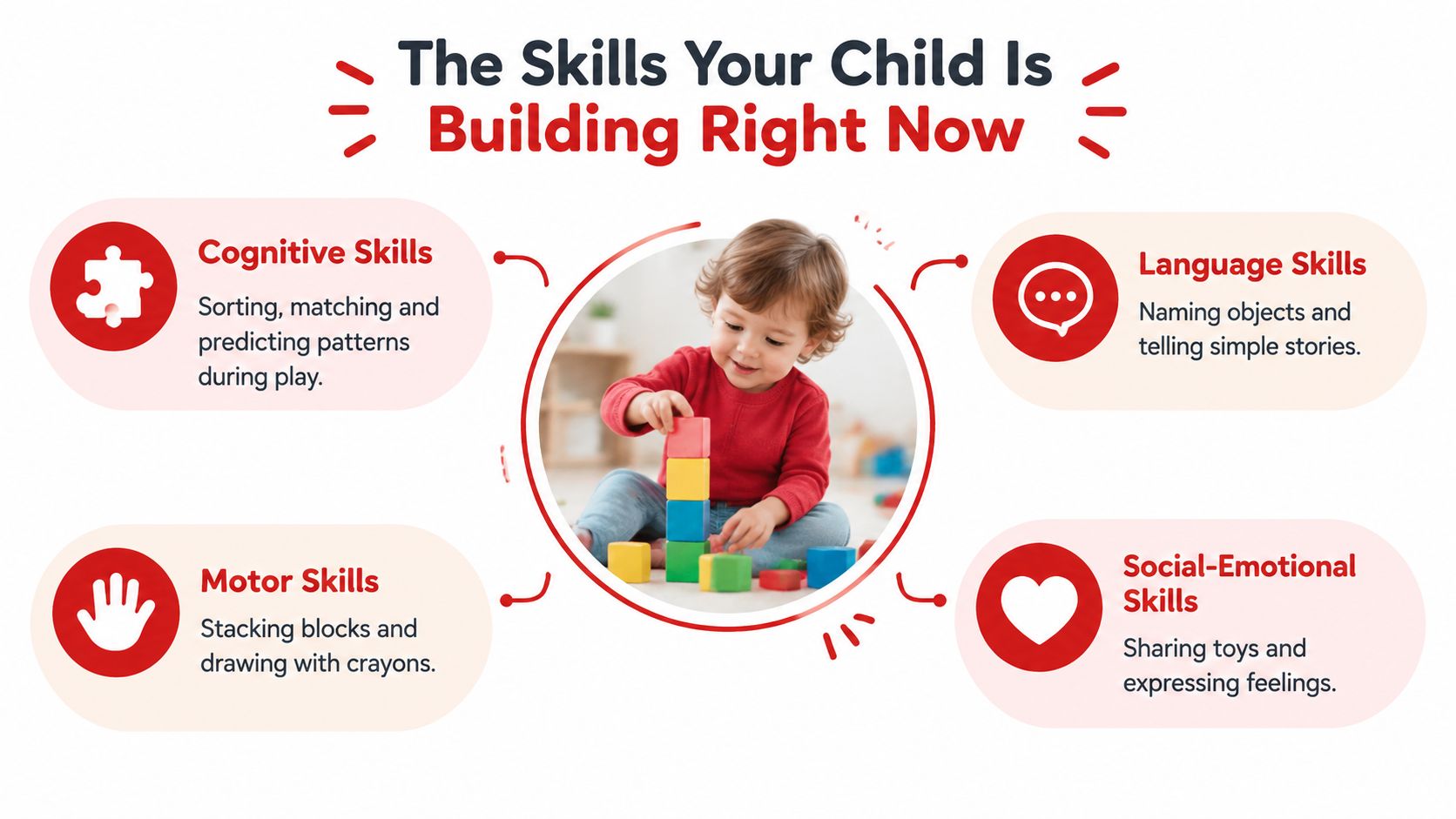
A useful toy supports more than one developmental area, but it helps to know what you're looking for. At age three, four domains overlap constantly.
Cognitive skills grow through small problems
When your child matches a puzzle piece, sorts objects by color, or predicts that a tall tower will wobble, they're practicing early reasoning. Blocks are especially valuable because they let children test cause and effect directly. If the base is narrow, the tower falls. If the pieces interlock, the structure may hold.
Simple number and letter activities can also fit naturally into play. Count the blocks as you stack them, find a matching shape, or notice which piece comes next in a repeating pattern. These activities work best as invitations, not drills.
Motor skills connect hands and whole body
Fine motor work includes pinching, threading, placing, squeezing, drawing, and turning. A child handling chunky puzzle pieces or pressing modeling material is strengthening control needed for everyday tasks such as dressing and using art tools.
Gross motor development needs room to move. Carrying large blocks, balancing along a tape line, crawling through a play tunnel, or pedaling a ride-on toy gives the body a different kind of challenge. The CDC's three-year milestone guidance includes joining other children in play, avoiding hot objects when warned, and putting on some clothes independently, all of which point toward toys and activities that support coordination, rules, and self-help.
Language and social-emotional growth happen together
A pretend kitchen gives children reasons to name objects, describe actions, and tell someone what happens next. A doctor kit can support caring language, while a cooperative building task creates natural opportunities to request a piece or wait for a turn.
Use these four domains as your buying filter. A toy is doing useful work when it gives your child a real action to perform, a problem to consider, a story to tell, or another person to include. For a broader developmental perspective, see this overview of childhood development milestones.
Safety Rules That Actually Matter at Age 3
A toy's educational label doesn't replace a safety check. Start with the size of every detachable component, especially if younger children share the home.
The U.S. Consumer Product Safety Commission defines a small part as an object that fits completely into its official small-parts cylinder. For products intended for children under three, toys containing those small parts are treated as banned hazardous products under the applicable rule. CPSC small-parts guidance
Use a physical size test
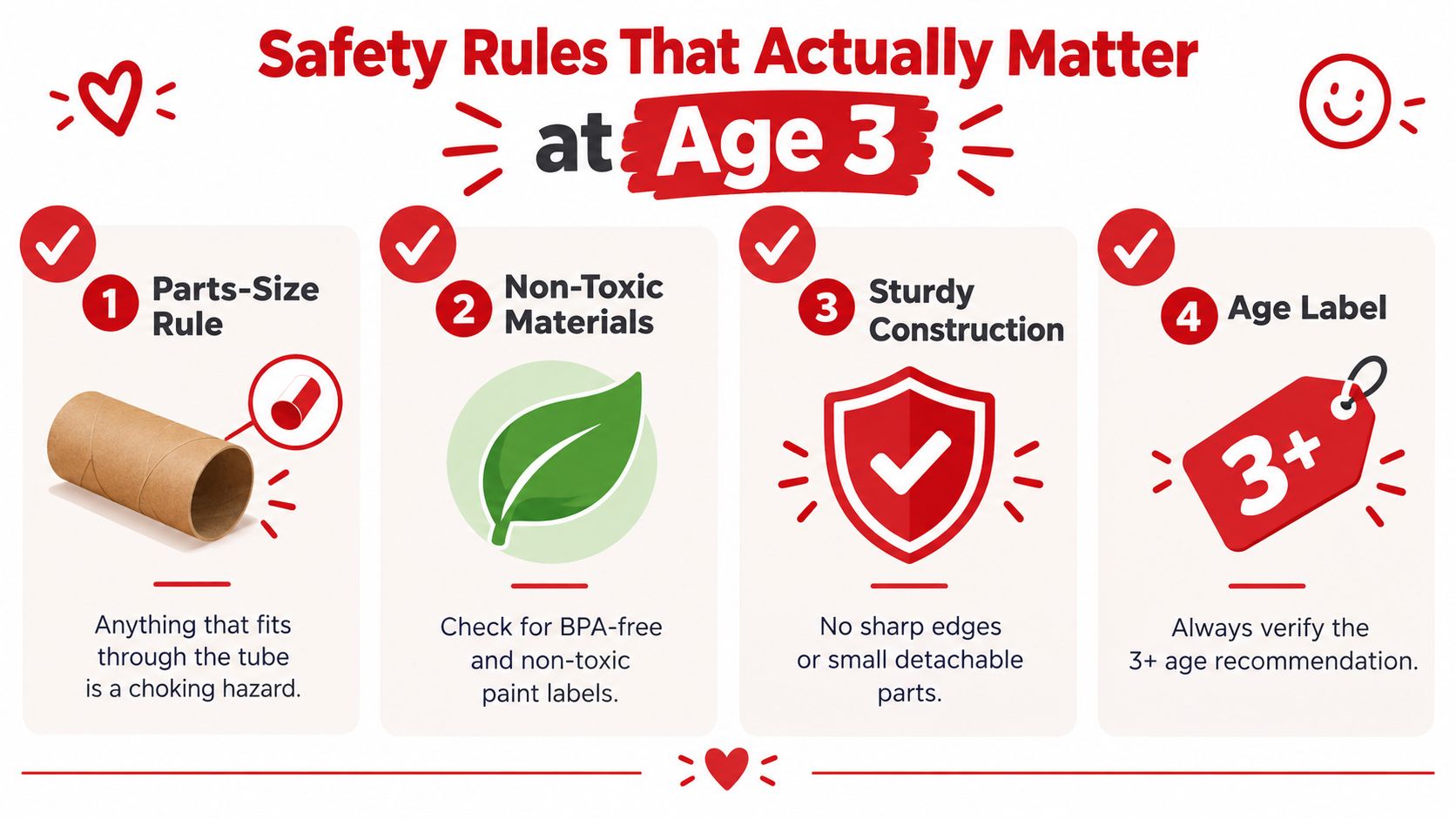
For toys intended for children under three, the technical cylinder is approximately 2.25 inches long and 1.25 inches wide, and a detachable part must not fit entirely inside it. The standard remains relevant around age three because mouthing can continue into the third year, so oversized, firmly attached components are a sensible choice. CPSC small-parts standard
For children around three, Nemours advises choosing parts large enough not to fit inside a toilet paper tube. Its guidance also gives a minimum size of 1¼ inches in diameter and 2¼ inches in length, and warns against marbles, coins, and balls 1.75 inches or smaller because they can lodge in the throat. Nemours toy safety guidance
Check construction, batteries, and movement
Look for rounded edges, securely closed battery compartments, durable attachments, and materials described as non-toxic. Avoid loose magnets, detachable tiny pieces, and components that a child can pull apart with ordinary play. Button batteries deserve special caution because swallowing one requires urgent medical attention.
Strings, projectile features, and rough-play accessories need close supervision. Before each session, make a quick sweep for loose pieces, torn fabric, peeling surfaces, or cracks. For ball selection, this guide to toddler ball sizes and materials offers useful context about choosing age-appropriate equipment.
The video below provides another visual reminder of practical toy safety checks.
Toy Categories Compared and What Each One Builds
The best toy category depends on the capability your child is practicing and the kind of play they naturally repeat. Some toys invite a changing story, while others offer a clear challenge with a beginning and an end.
| Category | Primary Skill Built | Best Age to Introduce | Play Style |
|---|---|---|---|
| Building sets | Fine motor control and spatial reasoning | Around 30 to 42 months | Open-ended |
| Pretend play kits | Narrative language and social understanding | Around 30 to 42 months | Open-ended with guided prompts |
| STEM and early science kits | Cause-and-effect reasoning | Around 30 to 42 months, with adult support | More structured |
| Art and sensory materials | Creative expression and hand strength | Around 30 to 42 months | Open-ended |
| Puzzles | Spatial memory and problem solving | Around 30 to 42 months | Structured, then flexible |
Building sets
Large blocks let a child grip, lift, align, balance, and rebuild. A realistic session might begin with stacking and end with a garage, bridge, or animal shelter. Building is open-ended, so the same materials can meet a child at different ability levels.
Pretend play kits
A kitchen, doctor kit, or dress-up set turns vocabulary into action. Your child might take an order, check a stuffed animal, or prepare a meal for several guests. These kits are flexible, but an adult can enrich them with prompts about roles, sequence, and feelings.
STEM and early science kits
At this age, science should mean safe observation and simple testing. A child might predict whether an object will sink, watch a color change, or notice what happens when pieces connect. Adult involvement matters because the value comes from asking, noticing, and describing, not from completing a complicated procedure. Play-based science and other toy categories are discussed in this guide to STEM toys for preschoolers.
Art, sensory materials, and puzzles
Art materials invite marks, textures, and stories. Sensory materials strengthen hands while giving children language for soft, sticky, rough, or smooth. Puzzles offer a clearer structure, helping children compare shapes, remember locations, and persist through a manageable challenge.
A balanced rotation can include two or three categories rather than every type at once. Change the dominant category across the week, then let your child combine them when an idea calls for it.
Simple Activities That Stretch a Toy's Learning
You don't need a new purchase every time you want to add a learning goal. A familiar toy becomes more valuable when you change the question or add a small social challenge.
Five short extensions
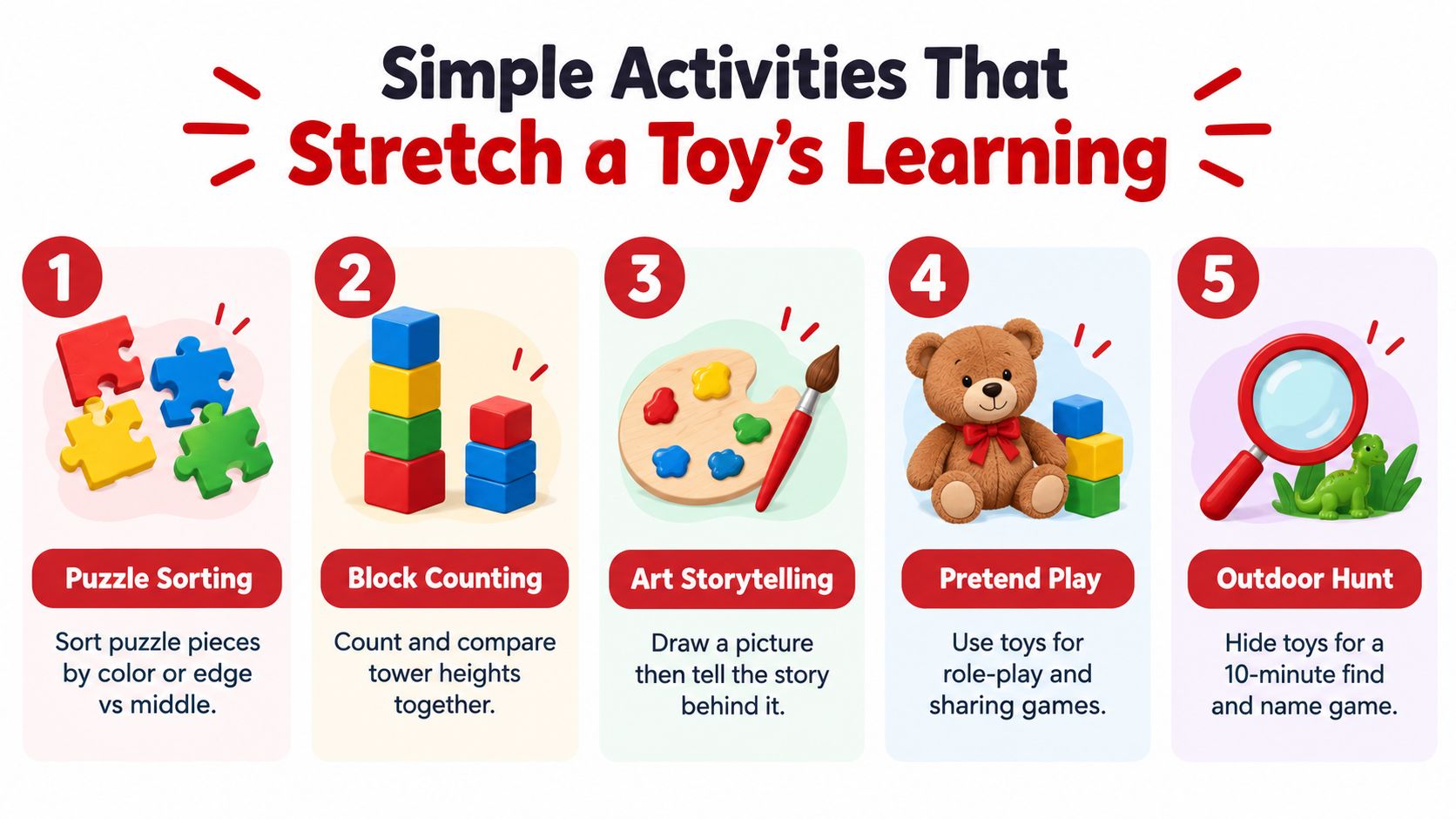
- Sort a puzzle: Separate pieces by color, animal, or edge and middle pieces. Your child practices visual discrimination while using a simple rule.
- Measure a block tower: Count pieces as you build, compare two towers, and ask what might make one steadier. This adds number language and prediction to construction.
- Sequence pretend cooking: Ask your child to choose ingredients, prepare them, serve them, and clean up. The routine builds action vocabulary and memory.
- Predict, then test: Before a safe STEM activity, ask what your child thinks will happen. Let them observe the result and explain whether it matched their idea.
- Turn art into a story: After drawing, ask who is in the picture, where they're going, and what happens next. The picture becomes a prompt for narrative language.
Keep each activity short enough to stop while your child is still interested. The aim isn't to extract every possible lesson. It's to layer skills naturally, so one toy can involve movement, language, reasoning, and cooperation during the same sitting.
Movement can receive the same treatment. A simple ball game can include rolling to a named person, stopping on a signal, or aiming at a large target. Families seeking additional ideas can browse training ideas for toddler soccer and adapt the movement concepts for a younger child's abilities.
More activity variations are available in this collection of play-based learning activities.
Choosing Toys by Budget and Occasion
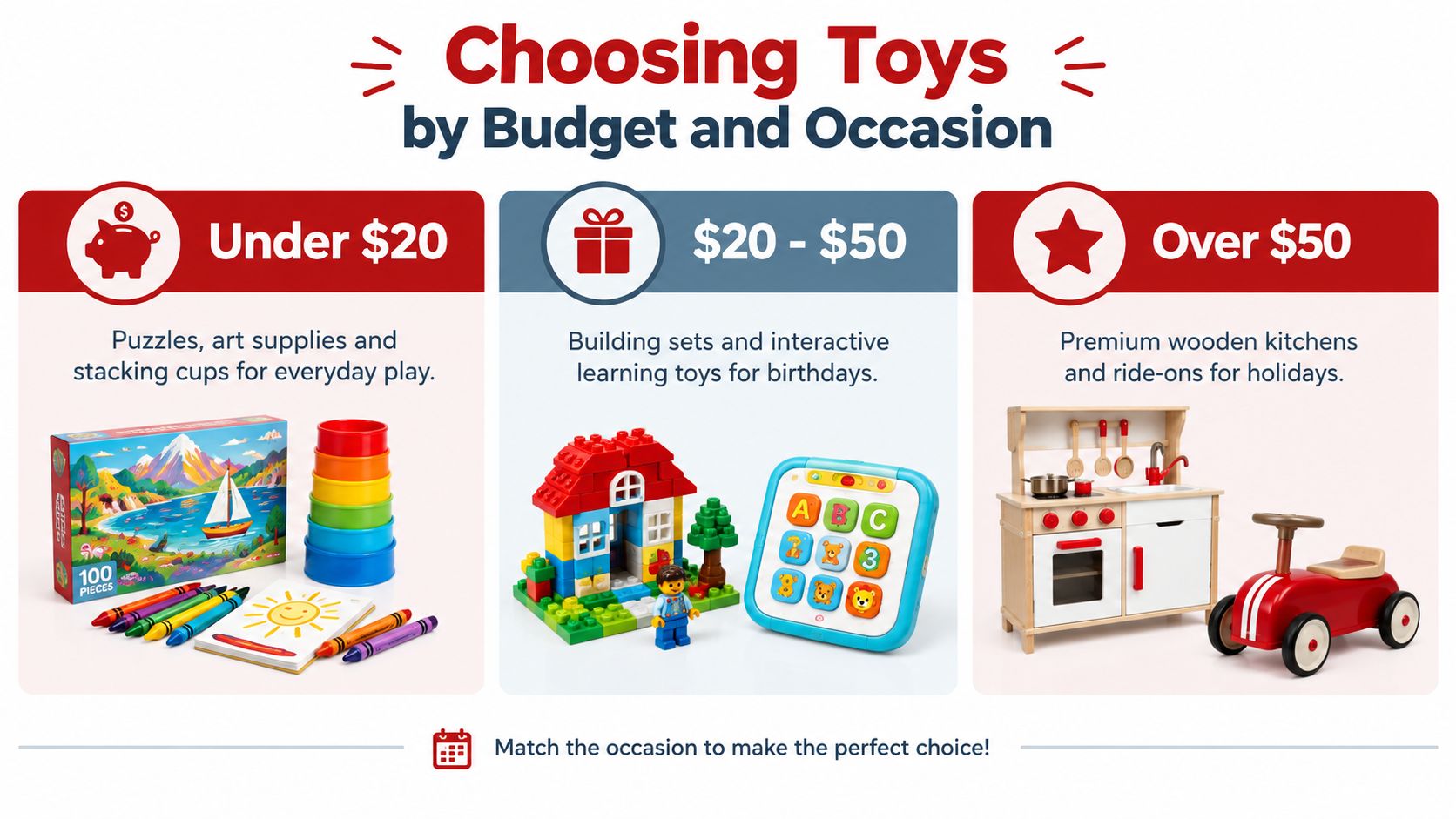
A useful budget starts with the child's play pattern, not the toy's feature list. A child who builds with cushions may use a simple block set more often than a licensed electronic gadget, while a child who cares for stuffed animals may gain more from a basic doctor kit than from an advanced construction system.
For everyday purchases, the under-twenty-dollar range can cover chunky puzzles, washable art supplies, stacking materials, or simple blocks. These are practical choices for a quiet Tuesday because they're easy to introduce without creating a major setup burden.
The twenty-to-fifty-dollar range often suits birthday gifts and entry-level pretend-play or science activities. Choose a set with enough flexibility to support repeated play, not one that only works when a child follows a single sequence.
The fifty-and-above range makes more sense for durable building systems, larger pretend-play furniture, or kits intended for shared use. For a holiday gift, storage space and construction quality matter as much as the number of included pieces.
Spend for repeat play
When money is tight, prioritize open-ended materials over licensed designs and durability over electronics. Two simpler toys can create more play combinations than one expensive toy with a fixed script. A puzzle plus washable art supplies, for example, supports different moods and skills without requiring a large setup.
For a gift buyer, match the occasion to the family's space. A compact art set may suit an everyday present, while a larger building or pretend-play item needs a clear storage plan. The right rule is simple: match the toy to the child, not the trend.
How Playz Toys Map to These Needs
Product selection becomes clearer when each item has a defined developmental job. Playz kits can fit into a rotation when the activity matches the child's current interests, the adult can provide suitable supervision, and the packaging confirms age guidance and component details.
| Playz Product | Skill Domain | Toy Category | Key Skills Built |
|---|---|---|---|
| Slime kit | Motor and sensory development | Art and sensory | Squeezing, pinching, texture vocabulary |
| Volcano eruption lab | Cognitive and language development | STEM | Sequencing, prediction, cause and effect |
| Crystal-growing set | Cognitive and language development | STEM | Observation and early chemistry vocabulary |
| Kid-friendly kitchen | Language and social-emotional development | Pretend play | Narrative language, turn-taking, role play |
| Doctor kit | Social-emotional and language development | Pretend play | Caring routines, naming body parts, empathy |
A slime activity gives small hands repeated opportunities to press, stretch, pinch, and combine materials. During a volcano activity, an adult can use words such as “first,” “next,” “change,” and “overflow,” helping the child connect sequence with observation. A crystal-growing activity can support careful looking and descriptive language, while the adult handles any steps that aren't suitable for independent use.
Pretend-play products create a different kind of learning. A kitchen can become a café, home, or restaurant, and a doctor kit can support stories about caring for a teddy bear. The activity guides bundled with Playz kits can help adults turn solo exploration into shared conversation, which adds language and social-emotional practice.
Safety still comes before novelty. Check the stated age range, inspect component size, confirm that packaging remains secure, and use adult supervision for sensory or science activities. The Playz collection for ages 2 to 4 provides a starting point for reviewing age-based options.
A practical rotation might combine one sensory or art kit, one science activity, and one pretend-play setup. Together, they can touch the four developmental domains without requiring a scattered collection of unrelated purchases.
A Confident Starting Point for Parents
Choose the toy for the skill your child is practicing, not the trend on the shelf. Favor materials that can become several things, confirm safety details before admiring the design, and rotate categories so your child gets opportunities to build, pretend, create, solve, and move.
Keep the collection healthy with a simple maintenance routine:
- Inspect regularly: Look for loose parts, cracks, peeling paint, and damaged fabric.
- Clean after sensory play: Wash hands and wipe the work surface when activities involve sticky or powdery materials.
- Store clearly: Use labeled bins so small components stay together and supervised play is easier.
- Retire worn toys: Remove anything that no longer holds together securely.
- Observe return visits: The toys your child chooses repeatedly are giving you useful information about genuine engagement.
You only need one thoughtful starting point. Sit beside your child, follow the story they begin, and add a question when they're ready. At three, the strongest learning often comes from shared attention, not from the number of features printed on the box.
Playz offers age-based creative toys, science kits, and pretend-play materials that can connect everyday play with early developmental goals. Visit Playz to explore options for a purposeful rotation, then choose one activity and join your child on the floor today.