

A preschool classroom can have full shelves and still feel strangely empty. Blocks remain untouched, the new puzzle loses pieces, and children drift from one center to another because the materials look appealing but don't give them a reason to stay. In a busy room, the problem usually isn't a lack of toys. It's a mismatch between the toy, the learning purpose, the children's abilities, and the way the material is introduced.
The most useful preschool toys for classroom settings are not only colorful or labeled educational. They invite children to move, talk, test ideas, cooperate, pretend, and try again. They also come with clear safety documentation, fit the classroom's daily routines, and can be adapted so children with different languages, motor abilities, and prior experiences can participate.
Why Toy Selection Changes Everything in Early Learning
A shelf of expensive toys can produce less learning than a small basket of blocks if children can't see what to do with the materials. I've seen classrooms where a boxed “learning” game sat untouched while children repeatedly built roads from cardboard tubes. The tubes offered more possibilities. Children could connect them, roll objects through them, compare lengths, negotiate roles, and change the design when it failed.
That is the shift teachers need to make. Play isn't a break from instruction. It's an instructional context. The National Association for the Education of Young Children's developmentally appropriate practice guidance states that play is essential from birth through age 8 and supports cognitive, physical, social, emotional, and language development.
Choose materials by the work they invite
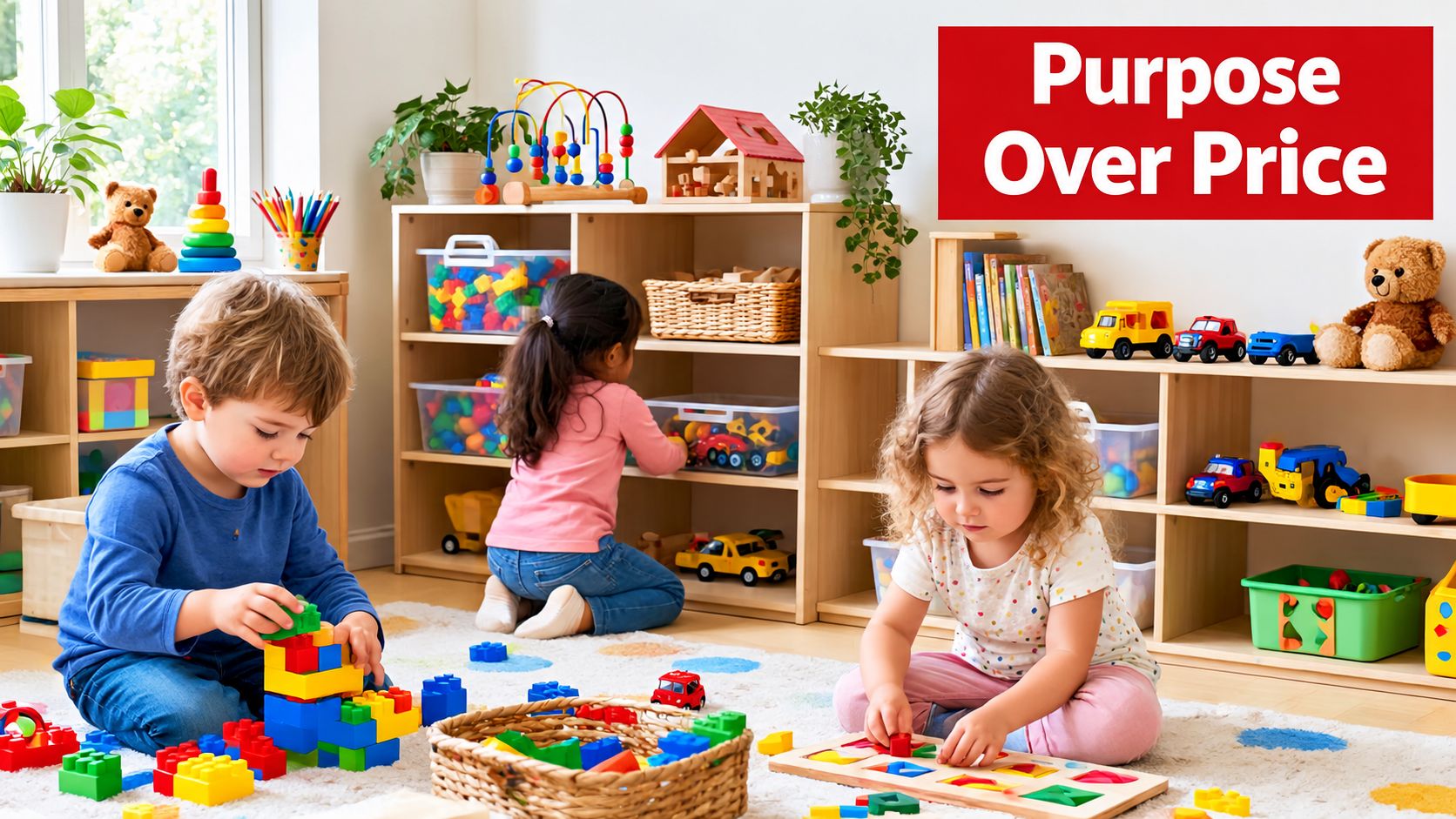
Blocks encourage planning, spatial reasoning, fine-motor coordination, and persistence. Pretend-play props create reasons to use vocabulary, tell stories, take another person's perspective, and negotiate roles. Puzzles, counters, sorting objects, pattern materials, art supplies, and simple science tools connect hands-on investigation with language and early mathematical thinking.
The packaging matters far less than the behavior it prompts. A toy earns its place when children can use it in more than one way and when an adult can extend the play without taking it over.
Practical rule: Choose toys that let children represent experiences, test an idea, solve a problem, and revise a strategy.
A vehicle basket, for example, can become much more than a quiet table activity. Children can build a road, describe where each vehicle is going, compare sizes, act out a delivery story, or sort vehicles by how they move. A resource for vehicles vocabulary practice for kids can help a teacher add language intentionally without turning the play into a worksheet session.
Build a balanced play environment
NAEYC recommends combining self-directed play, guided play, and direct instruction, while giving children meaningful opportunities to choose materials, play partners, topics, and approaches. Children also need sustained indoor and outdoor play opportunities, so a classroom collection should include more than tabletop manipulatives.
A practical mix includes:
- Construction materials: Blocks, connectors, tubes, and ramps for building and spatial exploration.
- Dramatic-play props: Fabric, menus, bags, phones, dolls, and household tools for narrative and social play.
- Discovery resources: Magnifiers, containers, natural materials, measuring tools, and simple science equipment.
- Movement toys: Balls, scarves, balance materials, tunnels, and obstacle-course pieces for active play.
- Fine-motor materials: Puzzles, large beads, pegboards, play dough tools, and manipulatives selected for the group's age and abilities.
Teachers who want a deeper explanation of the relationship between materials and development can also review how toys affect child development. The central question remains practical: What will children do with this toy, and what can I observe while they do it?
Implementing Guided Play with Measurable Goals
Putting a toy on a shelf doesn't create guided play. The teacher has to connect the material to one observable goal, then protect enough child choice for genuine exploration to happen.
A useful protocol has five steps.
1. Define one target
Choose a skill you can notice and record. Suitable targets include shape recognition, early mathematics, spatial vocabulary, or task switching. Avoid a goal such as “learn STEM.” A clearer goal might be, “The child will use positional words such as under, beside, and between while building a road.”
2. Select an open-ended material
Use a manipulative or construction toy that permits multiple solutions. Blocks, magnetic building pieces, ramps, sorting objects, loose natural materials, and pretend-play props work well because children can change their approach. A toy with one correct sequence may be useful for direct instruction, but it gives you less room to observe flexible thinking.
3. Let children initiate
Place the materials where children can reach and examine them. Watch what they already attempt before giving directions. If children immediately build a tower, don't interrupt with a demonstration of the “right” structure. Their first design gives you information about interests, language, confidence, and misconceptions.
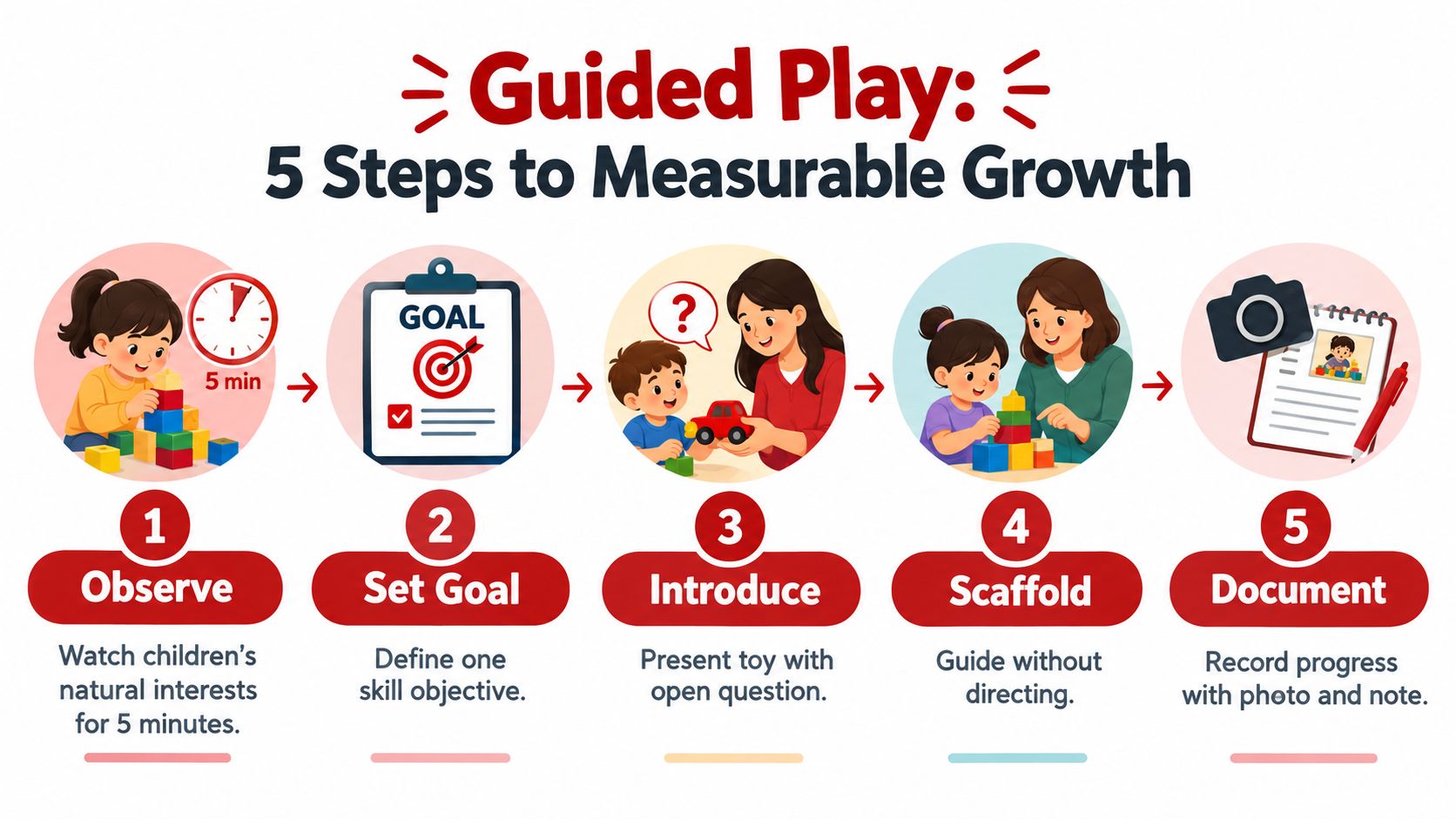
4. Add a brief scaffold
Use a question, prompt, model, or constraint that keeps the child in charge. Try, “How could we make the bridge taller?” or “Can you put the animal behind the box?” Then wait. Too many questions turn play into an oral quiz, while taking the pieces from a child removes the thinking you wanted to see.
A guided-play interaction might look like this:
- A child builds a short ramp.
- The teacher asks which vehicle might travel farther.
- The child chooses a vehicle and tests it.
- The teacher introduces the word “steeper.”
- The child changes the ramp and tests again.
The adult supplies language and a reason to investigate. The child still makes the decisions.
5. Repeat and document
Repeat the activity across approximately 6 to 20 exposures, recording a simple pre- and post-skill measure. The systematic review of guided play research included 39 studies and 3,893 children aged 1 to 8. It found guided play outperformed direct instruction for early mathematics, shape knowledge, and task switching, and outperformed free play for spatial vocabulary across 6 to 20 exposures.
Your documentation doesn't need to be elaborate. Record the target, the prompt used, what the child did independently, and what changed after repeated opportunities. Purposeful play becomes much easier to plan when teachers can see which prompts extend engagement and which ones shut it down.
The protocol is not a guarantee of success. Guided play works only when “guided” doesn't become “teacher-directed.” Preserve child choice, and treat the observation as important evidence.
Choosing Active Play over Passive Screen Time
“Screen-free” is an incomplete buying criterion. A quiet toy can still produce repetitive, isolated play, while a simple tunnel, play tent, or box of construction materials can generate movement, conversation, cooperation, and sustained pretend play.
The relevant comparison is not only screen versus toy. It is passive behavior versus active participation.
| Classroom choice | What children may do | What the teacher should check |
|---|---|---|
| Fast-paced digital content | Watch, swipe, or react to changing images | Is the child creating anything or mainly consuming? |
| A repetitive tabletop toy | Repeat a narrow action alone | Can the material support language, choice, or collaboration? |
| Open-ended construction | Build, compare, test, and revise | Can the teacher add a useful question? |
| Dramatic-play equipment | Move, negotiate roles, and tell stories | Can every child enter the play in a meaningful role? |
| Movement equipment | Crawl, balance, carry, throw, or navigate | Is the activity safe and active for more than one child? |
A 2025 study of preschool-aged children found that more than 60 minutes of noneducational, fast-paced screen exposure was associated with lower developmental scores. The same study found that each additional 30 minutes of active play predicted a measurable increase in fundamental motor skill scores. These findings don't mean every digital experience has the same effect, or that every screen-free toy creates strong development. They do support a closer look at what children do during the activity.
Design activity zones around behavior
Put movement materials where children can use them safely without waiting for an adult to set up the entire experience. A tunnel can connect two areas of the room. Scarves can support dancing, sorting, storytelling, and rhythm games. A play tent can become a house, clinic, reading nook, shop, or hideaway, depending on the props and the children's ideas.
Teachers should also watch for the social difference between access and engagement. A basket of balls may be available all day but produce little movement if children can't reach it easily or don't know how to share the space. Short, repeated play blocks with a prompt such as “Can you make a path for two people?” may create more participation than leaving equipment untouched in a corner.
The active-play toy ideas can help with brainstorming, but the classroom test is simple: Does this material invite children to move, communicate, cooperate, or imagine? If it only keeps children occupied, it may not deserve prime shelf space.
The World Health Organization recommends at least 180 minutes of physical activity each day for children under five, at any intensity, spread throughout the day, as described in its guidance on toy safety and active play. That is a full-day benchmark, not a demand for continuous vigorous activity in one center. Indoor transitions, dramatic movement, outdoor play, and short active games can all contribute.
Meeting Safety Standards and Certification Requirements
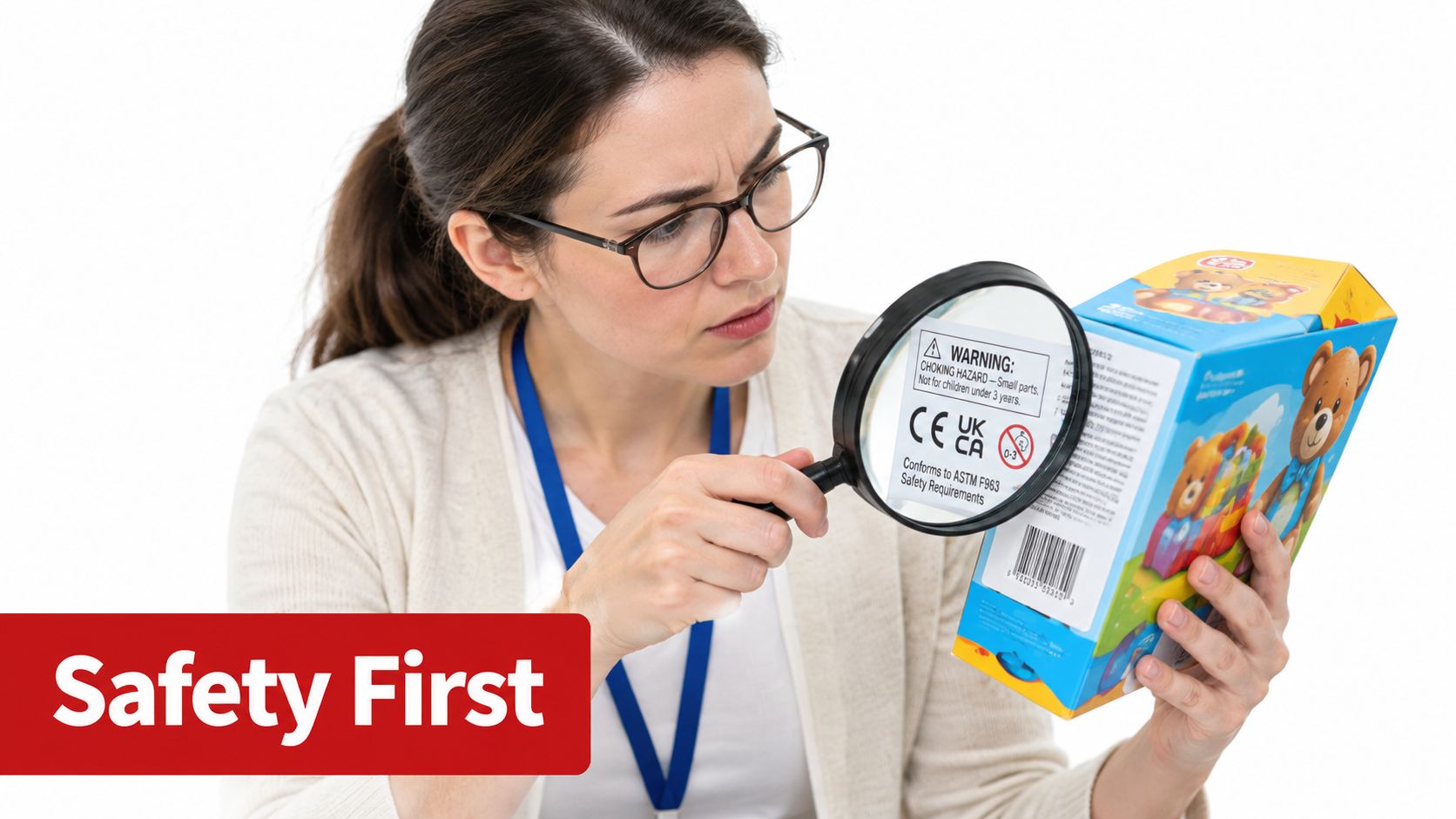
Safety paperwork belongs in the purchasing routine, not in a folder that nobody opens until an incident occurs. Attractive packaging, an age suggestion, and words such as “educational” or “non-toxic” don't replace compliance documentation.
For U.S. purchasing, toys intended primarily for children age 12 and under must undergo third-party testing by a laboratory accepted by the U.S. Consumer Product Safety Commission. Manufacturers or importers must issue a Children's Product Certificate confirming compliance, as explained in the Children's Product Certificate requirements.
Create a repeatable purchasing check
Before adding a large set to the classroom, ask the supplier for the relevant certification information. Keep the product name, intended age range, supplier details, purchase date, and documentation together. Replacement pieces and accessories deserve the same attention as the original set, especially when they introduce detachable parts.
A practical safety record should answer:
- What is the product? Record the exact product name and manufacturer.
- Who supplied it? Keep the vendor information with the purchasing record.
- What evidence exists? Store the Children's Product Certificate or supplier documentation.
- Who can use it? Match the intended age range to the children who can access the material.
- What needs inspection? Check connectors, magnets, fasteners, edges, seams, and detachable parts.
This procedure may feel slower during ordering, but it makes decisions easier later. Staff members can see why a material was approved, what age group may use it, and when it needs review. Guidance on non-toxic toys for babies can offer useful product-selection context, but marketing language still isn't a substitute for required compliance records.
Treat small parts as a classroom system issue
The small-parts rule creates a specific concern for mixed-age settings. Products intended for children under three that contain small parts, or can release them after reasonably foreseeable use and abuse testing, are prohibited. A small part is an object that fits completely, without compression and in any orientation, inside the federal small-parts cylinder, as described in the World Health Organization toy safety guidance.
A toy marketed for children three and older may still be a poor choice in a room where toddlers enter during drop-off, extended care, or family events. Inventory loose beads, miniature connectors, tiny counters, magnets, marbles, and detachable pretend-play accessories. Store small-piece activities separately, supervise their use, and inspect them after a component breaks or separates.
Labels are a minimum safeguard, not permission to place a hazard within reach of a younger child. For mixed-age classrooms, larger durable manipulatives often provide a safer common starting point, while small-piece activities can remain available to an age-appropriate group under direct supervision.
Organizing Classrooms with Purposeful Rotations
Children need choice, but too many visible options can make choice difficult. A shelf packed with every puzzle, prop, sensory tool, and construction piece often produces dumping rather than sustained play. Organization should help children identify an activity, use it independently, and return it without needing a long adult explanation.
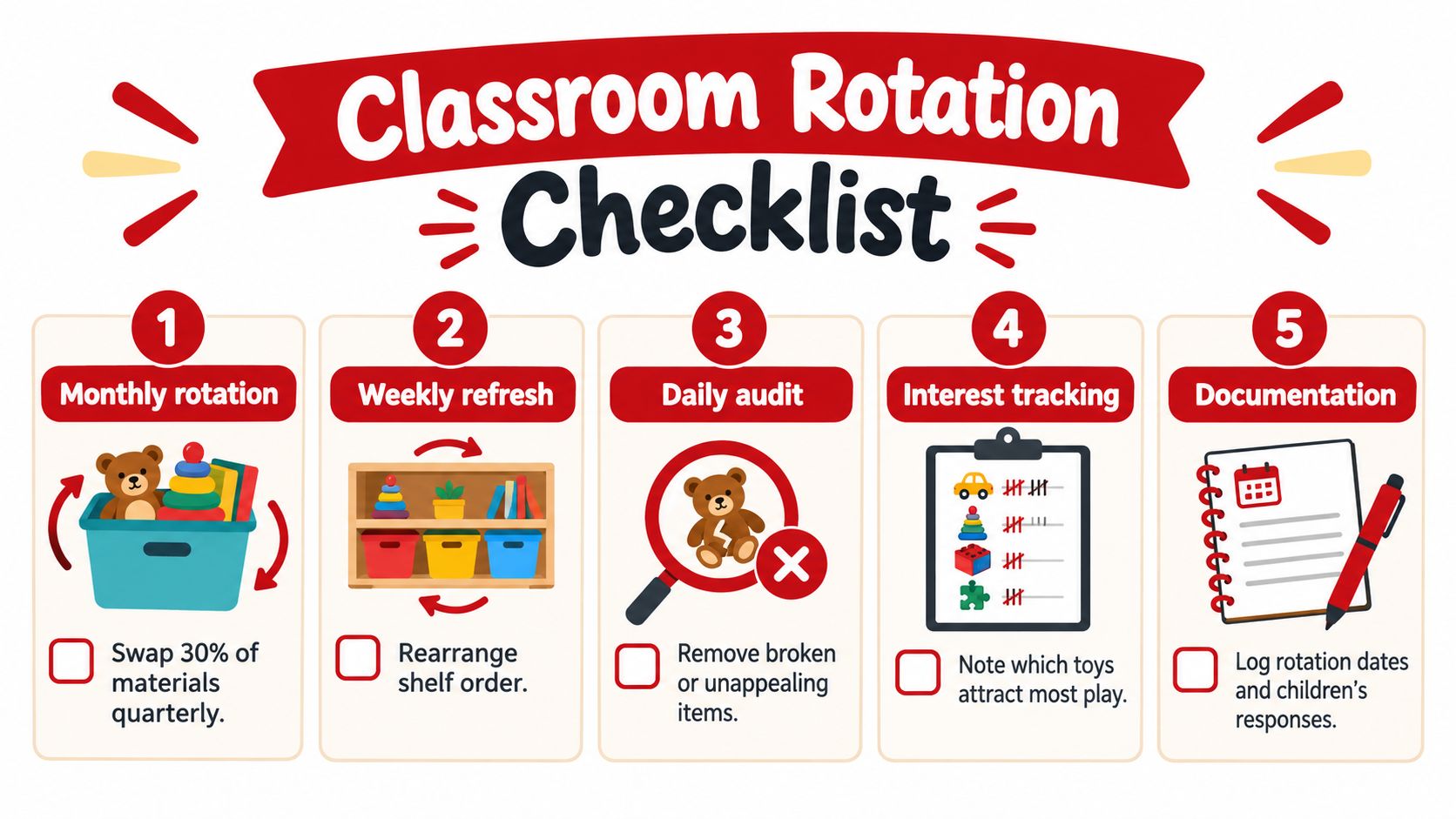
Head Start regulations require preschool programs to provide developmentally appropriate schedules, lesson plans, indoor and outdoor experiences, opportunities to choose and experiment, accessible physical space, and accommodations for children with disabilities. They also require materials to change intentionally and periodically in response to children's interests, development, and learning, as reflected in the CPSC classroom toy safety guidance.
Keep familiar anchors and rotate a portion
Don't remove everything at once. Keep core materials such as basic blocks, drawing tools, and familiar dramatic-play items available while changing a small portion of the collection every few weeks. A sensory area might gain measuring tools and containers, then later shift to sorting objects or natural materials. The environment feels fresh without taking away resources children use confidently.
A rotation record can be simple:
- Observe interest: Note which materials children choose, ignore, combine, or misuse.
- Remove friction: Repair broken items and reduce duplicate pieces that create clutter.
- Add a connection: Introduce a material that extends current play, such as clipboards for a pretend store.
- Record the response: Write down the language, collaboration, or problem-solving that appears.
- Review access: Check whether children can reach, understand, and return the materials.
The toy rotation system should serve classroom life rather than create another maintenance burden. Clear bins, picture labels, open shelves, and small activity trays help children see where materials belong. The system can look imperfect and still work if children can use it.
Adapt the same toy for different learners
Equity doesn't require a separate toy for every child. It requires more than one way to enter the activity. Add visual instructions for multilingual learners, assign partner roles such as builder and materials manager, provide larger components for children who need easier grasping, and offer tactile alternatives when visual access is limited.
A single construction invitation might include:
- An entry task: Copy a simple structure using large pieces.
- A social role: Describe a design to a partner or deliver materials.
- A sensory option: Explore textured building surfaces or weighted pieces.
- A language support: Use picture cards for “on,” “under,” “long,” and “short.”
- A challenge extension: Design a structure that must hold a toy animal or connect two spaces.
This approach respects mixed abilities without lowering expectations. It also helps children with limited resources at home, because the classroom provides repeated access to materials and adult support that may not be available elsewhere.
Putting It All Together in Your Daily Practice
A useful toy audit can fit on one page. For each classroom material, record:
- Learning purpose: What skill or behavior can you observe?
- Child choice: Can children use it in more than one way?
- Teacher role: What prompt could extend play without taking control?
- Safety record: Is the supplier documentation available?
- Age access: Are loose parts separated from younger children?
- Rotation plan: When will you review or change the material?
- Inclusion options: Can children participate through visual, tactile, verbal, physical, or partner support?
Start with one center rather than redesigning the whole room. Choose one open-ended toy, define one measurable target, observe how children use it, add a brief scaffold, and document what changes across repeated opportunities. Then keep the adaptations and rotations that increase meaningful participation, and remove the materials that only create clutter.
Educational value depends less on a label than on whether children can participate, communicate, and make decisions with the material. The best classroom toy is the one teachers can use safely, intentionally, and equitably in the actual conditions of the day.
Playz offers play tents, crawl-through tunnel sets, science kits, and creative toys that can support indoor imaginative play, movement zones, and hands-on classroom activities. Review the available options at Playz, then apply the same safety, accessibility, and guided-play checks before adding a product to your classroom.