

You've probably stood in the sandbox or at the beach with a child who's happily digging, then suddenly asking for “something better” than bare hands. That's usually the moment parents realize toys for sand play aren't all the same. The right bucket, scoop, mold, or truck changes what a child can do, and it changes how long the play stays interesting.
Sand play has a long history, too. From nineteenth-century beach scenes to the first sand garden in Boston in 1885, the record shows that sand has always been more than filler, it's a material children can shape, sort, and explore in their own way. For families planning a backyard corner or a beach day, a good guide to backyard play spaces can help with the bigger setup, while the toy choice determines what happens inside it.
A simple clue shows why the details matter. In one observational study, at least one child appeared in the sand area in 97.8% of photographs, but when cars and trucks were added, the share showing at least one child playing with sand rose to 87.6% (Museum of Play study PDF). Small changes in the tool set can turn nearby curiosity into real engagement.
For families comparing setup ideas, the internal guide on 1-minute sand timers is a useful companion if you want to add time-based turn-taking or cleanup routines to play.
A Day at the Sandbox Starts With the Right Tools
A child drops dry sand into a bucket, tips it out, and watches the pile collapse. Next to them sits a long shovel they can barely control, while a star mold stays untouched because packed sand behaves differently from loose sand. That small mismatch explains a lot. Sand toys are not interchangeable, because each one asks the child to do a different job with the material.
The useful question is simple: what action does this tool invite? A bucket supports lifting, carrying, and dumping. A scoop helps a child gather and pour with more control than bare hands. A mold depends on pressing, filling, and releasing. A sifter turns play toward sorting, filtering, and noticing what stays behind. The toy works like a prompt. Its shape, handle, depth, and opening all affect what the child can try.
Practical rule: the best sand toy is the one that creates a next step, not just a thing to hold.
That is why one extra piece can change the whole play pattern. With only a shovel, a child may dig a hole and lose interest. Add a dump truck, and digging becomes a sequence: load, transport, unload, rebuild. Add a funnel or sifter, and the same sand becomes something to compare, test, and watch. The toy does not create learning by magic. It creates a clearer action, and repeated actions are what build skill.
Sand play stays open-ended, but it is not random. Children pour, pat, scrape, stack, and compress. Each action gives different feedback from the sand, which is why the right tool keeps play going longer than a toy that merely looks appealing.
If you are setting up a corner in the yard or at the beach, start with simple layers: a container, a transfer tool, one shaping tool, and one extra that changes movement, such as a truck or water wheel. For the larger setup around the play area, this guide to backyard play spaces helps. For routines like turn-taking or cleanup, 1-minute sand timers for play transitions can fit in naturally.
The Seven Categories of Sand-Play Toys Explained
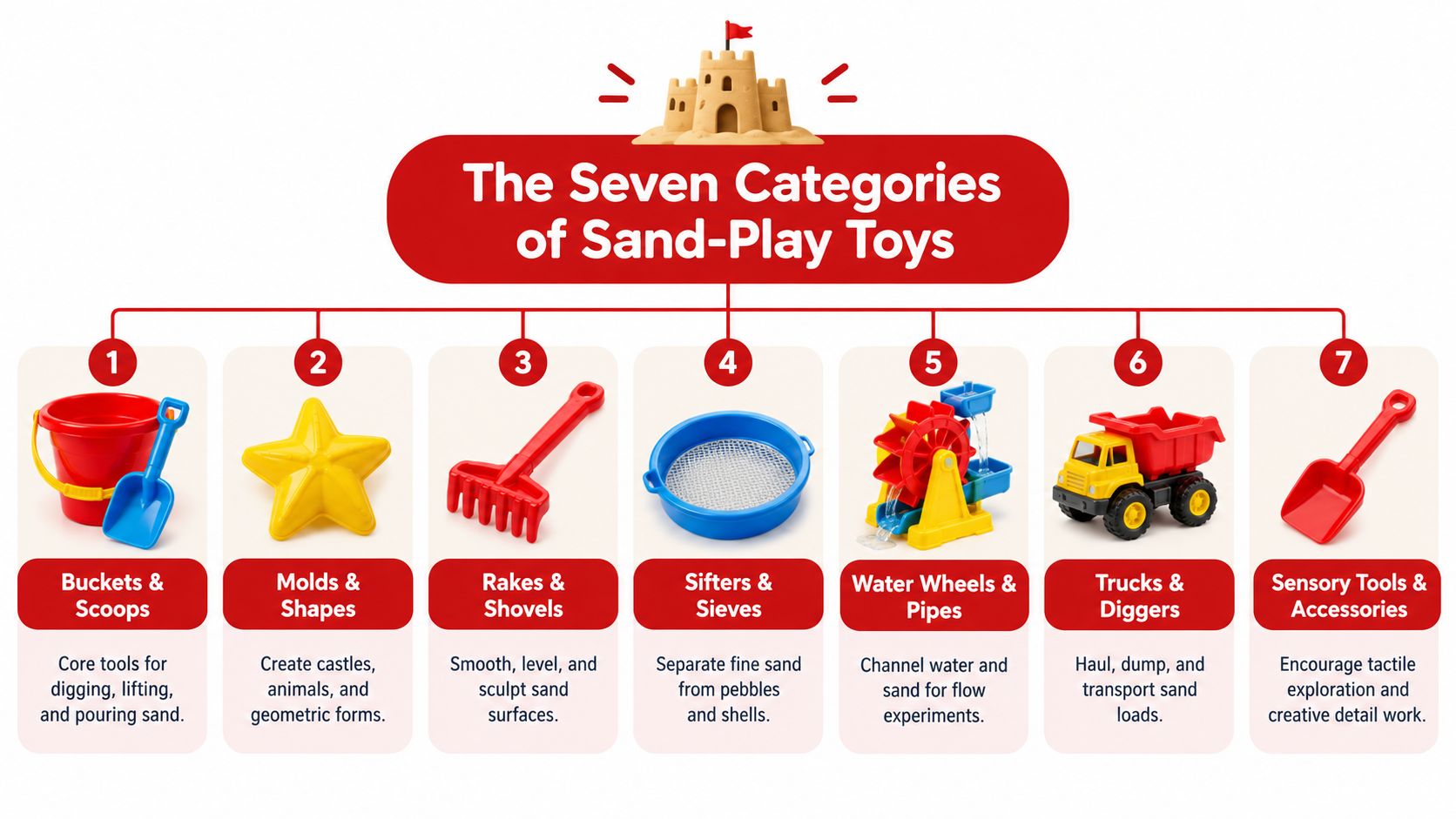
Sand changes its behavior depending on how a child handles it. Dry sand pours and mounds freely, while water's surface tension creates cohesion between grains, letting children scoop, compress, mold, and carve (PMC article). That's why the seven toy categories below feel different in practice, even when they all live in the same sandbox.
| Category | Core Action | Key Design Variation | Play Type |
|---|---|---|---|
| Buckets | Carrying and dumping | Handle size and rim shape | Transfer play |
| Scoops | Lifting and pouring | Bowl depth and angle | Volume play |
| Molds | Pressing and releasing | Base shape and wall geometry | Construction play |
| Sifters | Sorting and filtering | Mesh size and frame stiffness | Sensory discovery |
| Construction toys | Hauling and moving loads | Wheel size and dump action | Collaborative play |
| Water-sand hybrids | Channeling and combining materials | Flow path and reservoir control | STEM play |
| Sensory kits | Mixed tactile exploration | Variety of textures and loose parts | Open-ended play |
Buckets and scoops
These are the starter tools. A bucket gives the child a container to fill, carry, and dump. A scoop narrows the action, so the child can move sand in smaller, more deliberate amounts.
The design details matter more than parents expect. A deep scoop makes pouring easier, while a shallow one gives less resistance and can feel more manageable for younger children. A bucket with a wide opening is easier to fill, while one with a tall rim is better for transport.
Molds
Molds are where sand play starts to look like building. Flat-bottomed molds make patties and simple impressions. Taller molds, like towers or castle walls, ask the child to pack the sand more firmly.
Curved shells and connected scene pieces invite storytelling as well as construction. The child isn't only making a shape, the child is testing whether a shape holds together. That's why molds are useful even when they seem repetitive at first glance.
Sifters and sieves
Sifters turn the sandbox into a sorting station. Children notice pebbles, shells, clumps, and fine grains differently when they can shake material through a mesh and watch what stays behind.
For a quiet afternoon, this can be one of the richest tools in the set. It slows the pace, sharpens attention, and gives children a visible reason to compare textures. Families looking for a compact tabletop setup can also compare sand and water table ideas in the Ocodile sand table recommendations.
Construction toys and water-sand hybrids
Loader trucks, dump trucks, and diggers add motion. They don't just sit in the sandbox, they move material from one place to another, which is why they can deepen engagement so quickly.
Water-sand hybrids change the physics of the play. A wheel, pipe, or channel lets children see flow, pooling, and drainage, while the water itself changes how the sand responds to pressure. The play shifts from filling and emptying to experimenting with cause and effect.
Sensory kits
Sensory kits bundle tools, textures, and extras into one planned activity set. That can be helpful for families who want some structure without losing open-ended play.
Think of them as starter labs, not finished lessons. A good kit gives a child enough variety to explore, then leaves room for the child to invent the next move. For more age-appropriate ideas, the internal overview on sensory toys for toddlers pairs well with this approach.
Matching Toys to Age and Developmental Stage
The age label on the box matters, but not in the lazy way many shoppers think. It's not just about skill level. It's about grip size, part size, attention span, and how much complexity a child can manage without frustration.
For children under 3, start with large, single-piece tools. A bucket with a sturdy handle and a scoop with no detachable parts is a better fit than a set full of tiny accessories. The U.S. small-parts cylinder measures 2.25 inches long by 1.25 inches wide, and any toy or detachable component fitting entirely inside it is generally prohibited for children under 3 (CPSC small-parts guidance).
If a piece can come off, fit in a small cylinder, or roll underfoot, it deserves a second look before it reaches a toddler.
Ages 3 to 5 are often the sweet spot for molds, buckets, and simple transfer tools. Children in this range can usually handle intentional filling, packing, and releasing, which makes castles, tunnels, and sand “cakes” much more satisfying. They're also more willing to repeat a build after it collapses, which is where a lot of the learning sits.
Ages 6 to 8 often enjoy the toys that move material across the play space. Dump trucks, loaders, and diggers add planning, role play, and group problem-solving. One child can excavate, another can haul, and a third can build the road or wall.
For a quick check against typical milestones, the internal childhood development milestones guide can help parents and educators match toy complexity to what children are ready to do. The best match is usually the one that's just hard enough to feel interesting, but not so hard that the child gives up after one try.
How Sand Toys Build Motor, Sensory, and STEM Skills
A child scooping sand is doing more than moving dirt from one place to another. The hand has to judge force, the eyes have to track where the sand falls, and the body has to adjust when the bucket gets heavier than expected. That combination is why sand play can feel so absorbing.
The movement pattern is the point. Scooping, pouring, smoothing, pinching, and shaping all ask for different levels of control, and they support both fine and gross motor practice. Children also get sensory input from texture, resistance, temperature, and weight, which is why wet sand feels like a different medium from dry sand.
Across 79 children in eight early-childhood settings, constructive play was estimated to be 66% higher when children spent all observed play time on sand rather than other surfaces (Wiley study). That doesn't mean every sand toy creates the same result. It does show that sand can be a strong setting for building, creating, and trying again.
The skills that show up in ordinary play
- Fine-motor practice: squeezing a mold, turning a scoop, or pressing sand into a shape gives the fingers real work.
- Sensory exploration: sand's texture changes depending on whether it's dry, damp, packed, or sifted.
- STEM thinking: children estimate volume, compare stability, and watch what happens when they add water or change the base of a structure.
A small shovel, a funnel, and a set of molds can support all three areas at once. The key is not the toy alone, it's the action the toy invites. If you want more ideas for turning play into hand-strength practice, the internal how to improve fine motor skills guide is a helpful next step.
Safety, Hygiene, and Sand Quality Essentials
A child arrives at the sandbox, reaches for a scoop, and starts digging. Safe play depends on more than supervision. Check the toy's parts, the sand's condition, the storage setup, and whether the child can use the tools comfortably.
For children under three, inspect every detachable part before play. Any piece that fits inside the small-parts cylinder presents a choking risk and does not belong in a toddler's set, as explained in the CPSC FAQ.
For U.S. children's products intended primarily for children 12 and younger, the Consumer Product Safety Commission requires testing by a CPSC-accepted third-party laboratory, with the manufacturer or importer issuing a Children's Product Certificate (CPSC small-parts guidance). A simple-looking bucket or mold can still crack, shed pieces, or include parts that detach during use, so inspect toys regularly.
The sand deserves the same attention as the tools. Some synthetic sands contain fine crystalline-silica particles that may become airborne. Choose washed, dust-controlled sand, inspect it regularly, remove debris, provide drainage, and cover it when unused. A non-toxic toy does not automatically make the sand suitable for play.
A practical safety checklist
- Check the sand: remove visible debris and replace sand that becomes dusty, contaminated, or difficult to keep clean.
- Cover the area: use a secure cover whenever the sandbox or bin is not in use.
- Control moisture: wet sand needs drainage and supervision. Standing water can affect cleanliness and comfort.
- Watch the environment: animals, poor airflow, and accumulated heat can change the conditions around play.
- Include every child: a lower edge, stable seat, or tool with an easier grip may help children with sensory or mobility differences participate.
Tabletop bins, outdoor sandboxes, and portable sets each need a slightly different routine. Warm climates and enclosed balconies require extra attention to humidity, heat, and airflow. Store clean, dry tools separately from damp sand, and check the setup before the next session. A consistent cleanup routine protects the play space as much as careful toy selection.
Activity Ideas, DIY Options, and Smart Storage
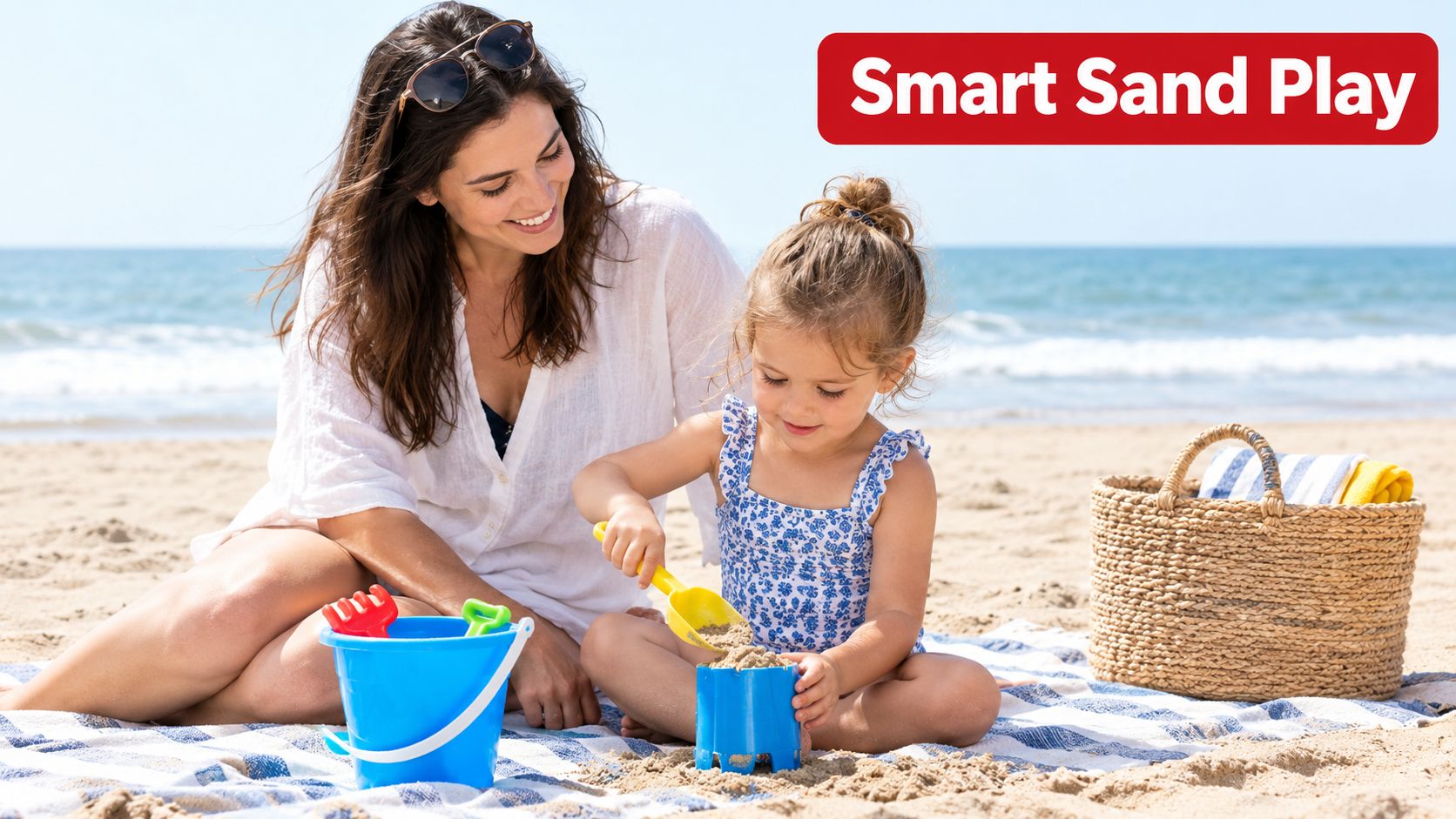
A good sand session doesn't need a whole afternoon. It needs a clear prompt, the right tools, and a way to reset the scene when the child loses interest. That's how a pile of sand becomes a real activity instead of background noise.
Start with a measurement game. Give a child two cups, one wide and one narrow, and ask which one will hold more before pouring begins. Then let the child test the guess with dry sand, and repeat with damp sand if you've got water nearby.
Another simple script is a build-and-repair challenge. Ask the child to make a tower, then ask which base is wider and which one feels wobbly. That one prompt turns a shape into a small lesson in stability without making the play feel like homework.
If you're putting together a DIY kit, kitchen tools can work well when they're large, sturdy, and easy to clean. Muffin tins, measuring cups, silicone molds, and a plastic funnel can all earn a place in the sandbox. Skip anything sharp, tiny, or fragile, and avoid glass completely.
For more compact setups, the internal toy storage solutions for small spaces guide pairs nicely with sand gear because the best kit is the one you can put away and bring back out.
A simple afternoon sequence
- Start with transfer tools. Let the child fill, dump, and refill before adding any challenge.
- Add one prompt. Ask a question about volume, shape, or stability.
- Introduce one change. Add water, a truck, or a sieve so the child can compare results.
- End with cleanup. Sift, shake, dry, and cover so the next session starts clean.
The World Health Organization recommends at least 180 minutes of varied physical activity daily for children aged 1–4, including at least 60 minutes of moderate-to-vigorous activity for ages 3–4 (WHO guidance). Sand play can support that active routine when children are digging, carrying, squatting, and walking back and forth between stations.
Smart storage keeps the play usable. Dry tools last longer when they're rinsed, dried, and stored where they won't trap moisture. Covered bins, mesh bags, and simple shelf space make it easier to reuse the set for backyard days, beach trips, or classroom centers.
If you want sand play that feels purposeful instead of random, explore Playz for screen-free play ideas that support movement, curiosity, and hands-on learning. Their approach fits families who want tools that invite action, not just clutter. Visit Playz and build a sand play setup that your child will use again tomorrow.