

Rainy Tuesday, four energetic preschoolers, and a kitchen table already covered in crayons. One child is pressing too hard, another is asking for a screen, and a third has turned the crayon box upside down. The materials may look ordinary, but meaningful learning can begin here.
The best hands-on activities for preschoolers rarely need expensive kits. Children learn by squeezing, sorting, building, pouring, pretending, moving, and explaining what they notice. The Education Endowment Foundation's review of play-based learning found a moderate positive effect on early-years learning outcomes, equivalent to approximately four additional months of progress on average, while also cautioning that results vary and the evidence base remains limited.
This guide moves quickly through ten low-prep activities, organized by the skill each one develops. Every idea includes materials, practical steps, setup time, supervision guidance, real trade-offs, and adaptations for different ages, abilities, and settings.
1. Playdough and Clay Play for Fine Motor Development
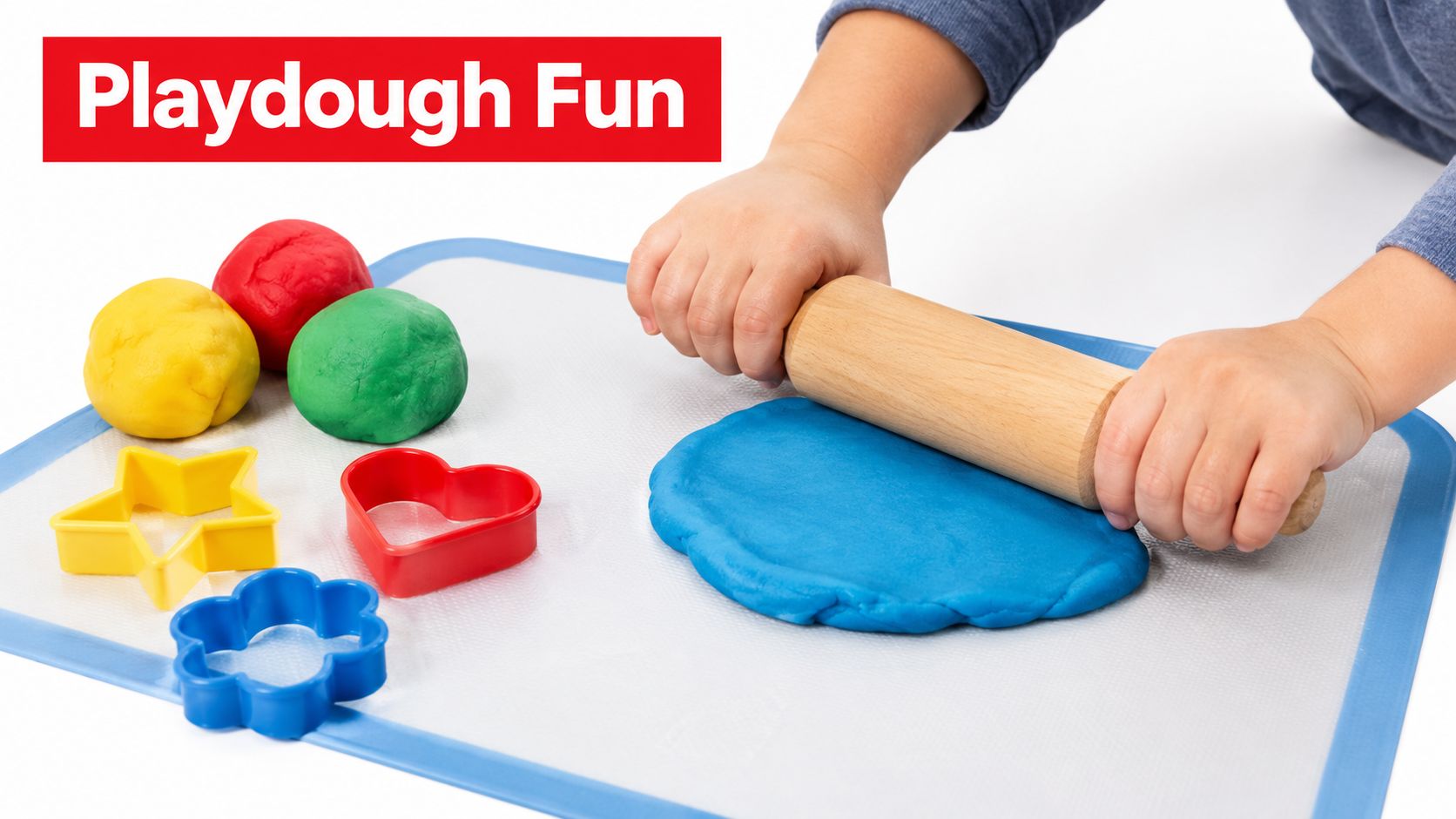
Playdough gives small hands useful resistance without turning practice into a worksheet. Children squeeze, roll, pinch, flatten, poke, and cut, strengthening the hand and finger muscles they later use for writing, buttoning, and cutting. The CDC specifically recommends playdough actions such as squishing, pressing, pinching, and rolling colored balls to support these developing skills.
Setup time: About five minutes.
Supervision: Close supervision, especially when using tools.
Best for: Ages three to five, with simpler motions for younger preschoolers.
Start with free exploration. Then add one purposeful challenge, such as, “Make a snake as long as your arm,” “Pinch five tiny pieces,” or “Roll three blue balls.” Alphabet stamps can turn the dough into a tactile letter activity, while toy animals, pretend food, or child-safe cutters connect fine motor practice to imaginative play.
Practical rule: Add one new tool at a time. Too many choices often produce scattered play instead of deeper practice.
A washable mat or silicone tray keeps crumbs contained. Store the dough in an airtight container so it stays soft, and choose unscented or lightly scented materials for children who avoid strong smells. For children who dislike sticky textures, offer tools, a small piece of dough, or a no-pressure observation role. For older preschoolers, ask them to build a model, copy a simple shape, or explain how they made it.
Read more ideas for fine motor skills development activities when you want to extend dough play into drawing, grasp, and tool-use practice.
2. Threading, Lacing, and Bead Play
Threading turns a quiet table activity into coordinated two-handed work. One hand steadies the lace while the other guides the bead, building hand-eye coordination, bilateral coordination, visual tracking, and pattern awareness. It also gives children a concrete way to compare, repeat, and predict sequences.
Setup time: Two to five minutes.
Supervision: Active supervision because beads can be choking hazards.
Best for: Older toddlers with large materials and preschoolers ready for smaller challenges.
Begin with large wooden beads and thick laces. Tape one end of the lace to the table, or tie it around a sturdy tray handle, so children don't have to manage a moving string and a bead at the same time. Once threading becomes comfortable, introduce a simple color pattern such as red-blue-red-blue. Later, try ABC or AABB patterns.
Lacing cards offer a different type of challenge. A card shaped like an animal or vehicle gives children a visual route to follow, while the repeated in-and-out motion prepares them for later fastening skills, including tying shoes.
Make the difficulty visible
Use a shallow tray or cup to keep materials contained. Present only the amount needed for the activity, then add more if the child remains engaged. If a child becomes frustrated, use larger beads, a stiffer lace, or a partially completed pattern.
A successful threading activity should feel challenging, not like a test of patience.
You can connect the finished strand to pretend play. A child might make a necklace for a stuffed animal, a “train” of colored beads, or a bracelet pattern for a dramatic-play shop. Avoid correcting every mistake. Ask, “What comes next?” and let the child revise the pattern independently.
3. Sensory Bins with Rice, Beans, and Water Exploration
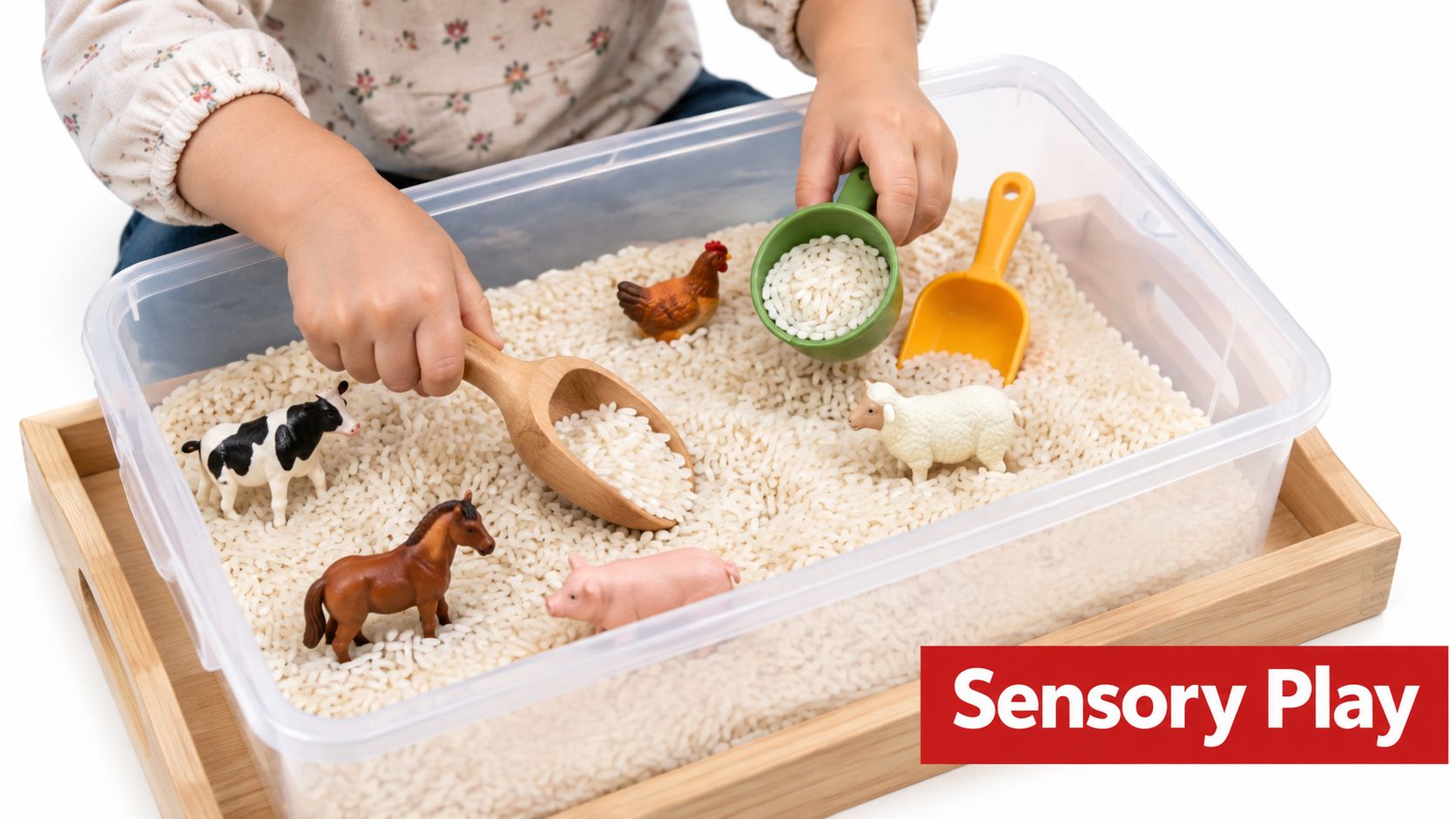
A sensory bin works because it gives children something to do with their hands immediately. They scoop, pour, bury, uncover, sort, and transfer materials while building vocabulary around full, empty, heavy, smooth, rough, hidden, and visible. A shallow tub filled with one main material is usually more successful than a crowded container with too many unrelated objects.
Setup time: Five to ten minutes.
Supervision: Close supervision, especially with dry beans, small toys, or water beads.
Best for: Preschoolers who enjoy tactile exploration, with low-mess alternatives available.
Try dry rice with farm animals, kinetic sand with toy construction vehicles, or water with cups and funnels. A themed “dinosaur dig” can invite children to find and name objects, while a sorting bin can group items by color, size, or texture. Keep a towel or washable mat underneath so cleanup doesn't determine whether you offer the activity again.
For children who hesitate around messy textures, begin with a small sensory tray rather than a full tub. Offer a scoop, tongs, or cup so they can participate without touching the material directly. Children who seek more sensory input might enjoy heavier scooping tools or a deeper container, provided an adult can monitor the play.
The Playz guide to sensory activities for kids offers related ideas using playdough, kinetic sand, rice, and water-based materials.
Rotate themes when interest drops, but reuse the same containers and tools. The learning comes from the child's actions and the adult's language, not from buying a new filler for every session.
4. Water Play with Floating, Sinking, and Pouring Experiments
Water play turns ordinary cups into tools for science and early mathematics. Children can predict which objects will float, test those predictions, pour between containers, compare amounts, and explore absorption with sponges or cotton balls.
Setup time: About five minutes.
Supervision: Constant, close supervision.
Best for: Preschoolers who can follow simple water-safety directions.
Place a low tub on a towel or waterproof mat. Add cups, funnels, spoons, sponges, and a small collection of safe household objects. Before each test, ask, "What do you think will happen?" Afterward, ask, "What did you notice?" The point isn't to provide the correct answer quickly. Children need time to compare their predictions with what happened.
A sink-or-float station supports classification. A pouring station supports volume language. A sponge station introduces absorption. You can also give children two differently sized containers and ask which one holds more, then let them test the idea.
Keep the activity controlled
Water play is calming and engaging, but it can create slipping hazards and quickly spread across a room. Use a small amount of water, keep the tub within reach, and empty containers when the activity ends. Outdoor water play offers more freedom, while indoor play works best with a clearly defined boundary.
For a child who avoids wet textures, offer a sealed water painting bag or let them use tongs to move floating objects. For an older preschooler, add a simple recording sheet with pictures, not written explanations.
Find more age-appropriate ideas for science experiments with water.
5. Block Building and Construction Play
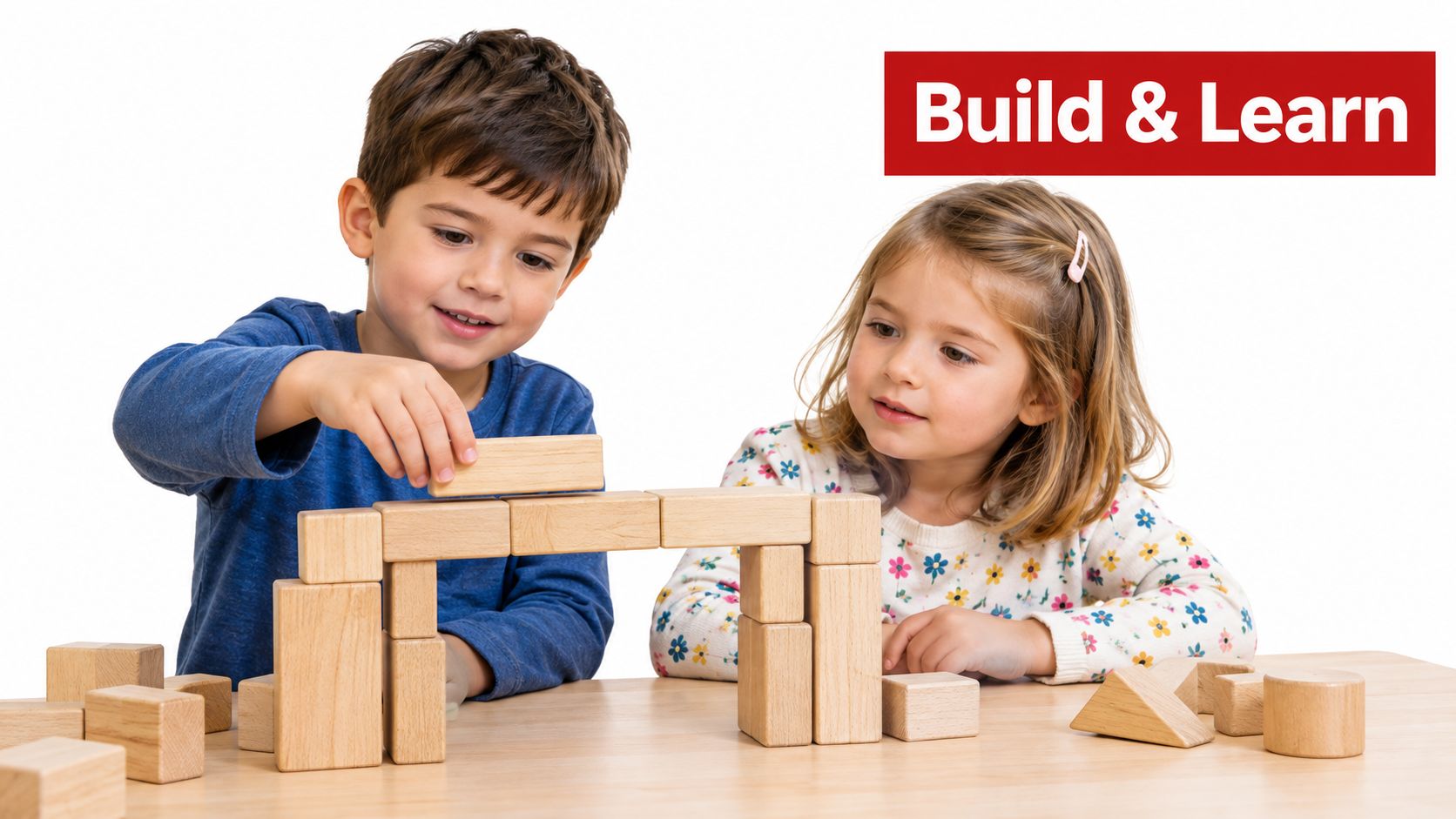
Give a child a basket of blocks and you may see a tower, a garage, a bed for a toy, or a carefully defended castle. Block building develops balance, spatial reasoning, counting, planning, and early engineering because children test what stands, what falls, and what changes when they alter the base.
Setup time: Less than five minutes.
Supervision: General supervision, with closer support for large or heavy blocks.
Best for: All preschool ages, with material size and challenge adjusted to the child.
Wooden unit blocks, interlocking bricks, and foam blocks each create different experiences. Large foam blocks suit younger children and active builders. Smaller bricks encourage precision. A low shelf with outlined spaces helps children return pieces by shape, which adds matching and organization without interrupting play.
Offer a challenge rather than a model to copy. Ask children to build a bridge that holds a toy car, a ramp that changes speed, or a house with an entrance. If the structure collapses, resist rebuilding it for them. Ask what they might change, such as a wider base or a shorter tower.
A block that falls is useful feedback, not a failed project.
Photograph finished structures so children can revisit their designs. Add toy people, animals, fabric, or signs to move construction into storytelling. For children who find open-ended building overwhelming, start with two choices, such as “Would you like to build a road or a house?” For children ready for more complexity, introduce ramps, marble runs, or simple plans drawn with crayons.
6. Kitchen Science with Baking Soda and Color Mixing
Preschool science starts with a question, not a lecture. Baking soda and vinegar create a visible reaction, while colored water lets children observe mixing, changing, and movement. Children don't need formal chemistry vocabulary to benefit. They need a safe setup, time to predict, and an adult who takes their observations seriously.
Setup time: Ten minutes.
Supervision: Close supervision, especially with liquids and food coloring.
Best for: Ages three to five, with adults handling preparation and cleanup.
Place baking soda in a tray or shallow container. Give children small cups of vinegar and droppers so they can control how much liquid they add. Before the reaction, ask what might happen. Afterward, compare the result with each child's prediction. A simple drawing journal can capture bubbles, colors, and changes without requiring writing.
For color mixing, prepare clear cups of colored water and let children combine drops. Ask which new color they expect and what happens when they add more of one color. Use smocks and a tray because food coloring stains surfaces and clothing.
The Playz resource on science experiments using baking soda provides another route into this kind of investigation.
Here's a short visual demonstration to show children before or after their own experiment:
Keep the language concrete: “It bubbled,” “The red and yellow changed,” or “It overflowed.” If an activity becomes a performance where children only watch an adult, it loses much of its hands-on value. Give them a controlled action whenever safety allows.
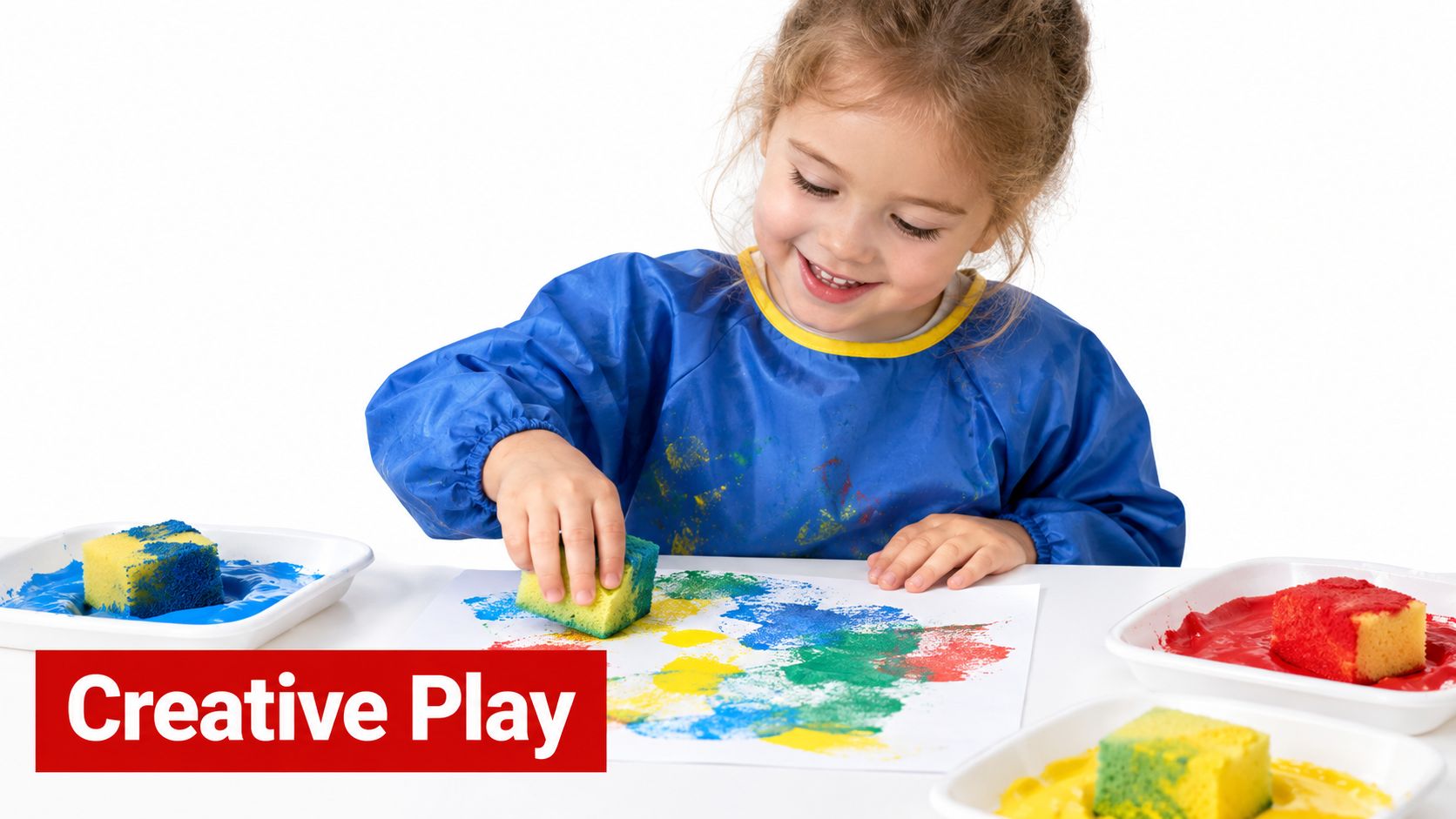
7. Process Art with Sponge Painting, Collage, and Ice Painting
Process art values what children discover while creating rather than whether the final picture looks recognizable. Sponge painting, collage, and ice painting invite children to experiment with pressure, texture, color, and movement. A child can make a mark with a sponge, drag frozen colored water across paper, or arrange scraps without needing to produce a particular image.
Setup time: Ten minutes.
Supervision: General supervision, with active support around paint and small collage pieces.
Best for: Preschoolers who benefit from choice and open-ended expression.
Cover the table with a plastic sheet or washable tarp. Put out thick paper, sponges, glue, textured scraps, crayons, and frozen colored water with safe handles. Let children choose their tools. One child may dab carefully, another may mix every color, and another may spend the session arranging materials without gluing them.
Ask open questions such as, “What did you try?” “What changed when you pressed harder?” or “Which texture do you want to add?” Avoid turning the adult into an evaluator. “Make it look like mine” limits experimentation, while “Tell me about this part” invites language and reflection.
Make adaptation part of the setup
Children who dislike wet textures can use dry collage materials, gloves, brushes, or a tool-only painting option. Children with limited fine motor control may work on a large sheet with thick-handled tools. A quieter child can observe first and join when ready.
Display the work as a gallery of choices rather than a collection of identical crafts. Keep a portfolio of selected pieces so children can see changes in control, planning, and confidence over time.
8. Dramatic Play with Play Tents and Pretend Kitchens
Dramatic play gives children a reason to use language, negotiate roles, and organize a shared story. A pretend kitchen can become a restaurant, clinic, bakery, or family home. A play tent can become a campsite, reading nook, animal hospital, or quiet retreat.
Setup time: Five to fifteen minutes.
Supervision: General supervision, with adults joining briefly when children need help entering the play.
Best for: Ages three to five, with simple role prompts for younger children.
Set up a pizza restaurant with menus, order pads, baskets, play food, and pretend money. Children can take orders, count items, mark choices, and deliver meals. You don't need to correct every word or turn the play into a lesson. Add vocabulary naturally by saying, “The customer ordered two slices,” or “The chef needs a tray.”
Rotate themes in response to children's interests. Boxes, scarves, baskets, paper tubes, and fabric can become almost anything, so open-ended props often last longer than narrowly designed accessories. A tent also creates a useful boundary for children who need a quieter space after busy group play.
Join the story, but don't take it over.
Ask before entering, accept the child's role assignment, and add one small problem to extend the narrative: “The store is out of apples. What can we offer instead?” Children practice flexibility, turn-taking, and problem-solving when the adult supports rather than directs the story.
For more ideas on choosing and using indoor play tents, connect the space to reading, pretend camping, or small-group storytelling.
9. DIY Obstacle Courses for Gross Motor Development
A hallway, classroom corner, or outdoor path can become an obstacle course with pillows, cushions, tape lines, chairs, and blankets. Children crawl, balance, step over, jump, and change direction while developing coordination and body awareness.
Setup time: Five to ten minutes.
Supervision: Close supervision, with the adult positioned near the most difficult movement.
Best for: Ages three to five, with low-height and low-speed options.
Mark a balance path with colored tape. Add a cushion to step over, a blanket tunnel to crawl through, and a soft target for jumping toward. Give one direction at a time: “Walk on the blue line,” “Crawl like a bear,” or “Jump with two feet.” Clear sharp and heavy objects before children begin, and use mats or soft surfaces where possible.
Preschoolers ages 3–5 should accumulate at least three hours of physical activity across the day, including more than 60 minutes of moderate-to-vigorous activity, according to early-childhood guidance published by the National Association for the Education of Young Children. Short movement circuits fit that recommendation better than relying on one long exercise period.
Keep competition gentle. Timing a run can motivate some children, but it can make others rush or withdraw. Praise controlled movement, persistence, and listening instead of speed. For children with mobility differences, offer seated reaching, stepping around markers, pushing a soft ball, or choosing the route.
Families comparing movement toys can also compare kids' bike options when choosing equipment that supports balance and active play.
10. Nature Scavenger Hunts and Outdoor Exploration
A nature hunt gives children a purpose for looking closely. Use picture cards for a leaf, rock, pinecone, feather, or flower, then invite children to search, compare, and describe what they find. The activity builds observation, classification, vocabulary, and movement without requiring a prepared playroom.
Setup time: Five minutes.
Supervision: Match the route and boundaries to the group.
Best for: Preschoolers who can follow simple outdoor safety rules.
Use one picture per square on a simple checklist. Children can point, photograph, or place safe loose items on a sorting tray. Set a clear rule not to pick protected plants or disturb insects. A magnifying glass helps children examine textures, edges, and patterns, while a small tray creates a natural transition back indoors.
Ask questions that have more than one possible answer: “What do you notice?” “Which leaf feels rougher?” “How are these rocks alike?” Don't rush to name everything. Children often notice details adults overlook when they have time to investigate.
For children sensitive to noise, heat, or unpredictable outdoor conditions, choose a quieter route, offer a picture-based indoor nature hunt, or let them observe from a designated spot. A child who doesn't want to touch outdoor materials can photograph them or describe them to a partner.
Outdoor learning doesn't need an elaborate excursion. A courtyard, balcony, garden, or sidewalk can provide enough material for a meaningful search. For farm-based ideas and family outings, explore this agritourism activities guide.
10 Hands-On Preschool Activities: Quick Comparison
| Activity | 🔄 Implementation complexity | ⚡ Resource requirements | 📊 Expected outcomes | 💡 Ideal use cases | ⭐ Key advantages |
|---|---|---|---|---|---|
| Playdough and Clay Play for Fine Motor Development | Low, easy homemade or store-bought setup | Low, simple ingredients/tools; inexpensive | Builds hand strength, finger isolation, early math | Writing prep, fine-motor centers, home activities | Builds grip & creativity; adaptable; ⭐⭐⭐⭐ |
| Threading, Lacing, and Bead Play | Low, progressive difficulty; initial adult help may be needed | Low, beads, laces, cards; supervise for small parts | Improves pincer grasp, bilateral coordination, patterning | Quiet focus times, OT exercises, sequencing practice | Precision & pattern skills; compact storage; ⭐⭐⭐⭐ |
| Sensory Bins: Rice, Beans, and Water Exploration | Low, simple fill-and-provide-tools routine | Low–Medium, base material plus scoops/props; contain spills | Enhances tactile exploration, vocabulary, fine motor scooping | Mixed-age exploration, calming centers, themed rotations | High engagement; versatile themes; ⭐⭐⭐⭐ |
| Water Play: Floating, Sinking, and Pouring Experiments | Low–Medium, requires strict supervision and safety setup | Low, tub, measuring cups, household test items; towels | Teaches buoyancy, volume, prediction; calming regulation | Science stations, outdoor play, small-group experiments | Hands-on science & measurement; ⭐⭐⭐⭐ |
| Block Building and Construction Play | Low, open-ended with options for scaffolding/challenges | Medium, durable blocks/bricks; storage space needed | Builds spatial reasoning, counting, collaboration, engineering | STEM challenges, collaborative centers, creative play | Durable, multi-age use; fosters teamwork; ⭐⭐⭐⭐⭐ |
| Kitchen Science: Baking Soda Volcano and Color Mixing | Low, short setups but requires adult oversight and cleanup | Low, pantry items, trays, droppers; cleaning supplies | Encourages prediction, observation, cause-and-effect thinking | Short demos, STEM lessons, memorable experiments | Memorable intro to science; low cost; ⭐⭐⭐⭐ |
| Process Art: Sponge Painting, Collage, and Ice Painting | Low, flexible materials, prep and cleanup required | Low, paints, sponges, collage scraps, smocks | Promotes creativity, fine motor control, color/texture exploration | Art centers, open-ended exploration, portfolios | Emphasizes process over product; inclusive; ⭐⭐⭐⭐ |
| Dramatic Play with Play Tents and Pretend Kitchens | Medium, space, props, and role scaffolding help depth | Medium, themed props, costumes, rotating materials | Strengthens language, social-emotional skills, self-regulation | Role-play corners, language development, social skills practice | Builds empathy & communication; immersive play; ⭐⭐⭐⭐⭐ |
| DIY Obstacle Courses for Gross Motor Development | Medium, design and safety planning required | Low, household items, mats; space and supervision needed | Enhances balance, strength, coordination, sequencing | Gross-motor breaks, PE routines, high-energy outlets | Active, low-cost, highly adaptable; ⭐⭐⭐⭐ |
| Nature Scavenger Hunts and Outdoor Exploration | Low, simple checklist prep; consider safety/allergies | Low, checklist, bag; requires access to outdoor space | Boosts observation, categorization, vocabulary, activity | Outdoor learning, family outings, seasonal science | Connects kids to nature; screen-free; ⭐⭐⭐⭐ |
Start Small: Pick One Activity This Week
You don't need all ten activities to see a difference. Choose the skill area your child or class needs most, gather the materials from that activity, and run it for 15 minutes this week. The short format matters because an activity that fits your real schedule is more useful than an ambitious project that never leaves the planning stage.
Watch what children do before adding more instructions. Do they repeat one action, avoid a texture, ask for a harder challenge, or invite another child into the play? Those observations tell you whether to simplify, extend, change the material, or pause. A child who keeps rebuilding a block tower may be working on persistence. A child who refuses finger paint may still be ready for sponge painting or dry collage.
The strongest hands-on activities combine child choice with purposeful adult support. A systematic review of guided play covered 39 studies, with 17 included in quantitative analysis and a combined sample of 3,893 children aged 1–8. Its findings reported advantages over direct instruction for early mathematics, shape knowledge, and task switching, while also showing that outcomes varied by activity and implementation. In practice, that means adults should define a useful learning goal, then leave room for children to manipulate, test, explain, and try again.
Inclusion also requires more than placing the same activity in front of every child. Some preschoolers need dry materials instead of wet ones, large-grip tools instead of small tools, picture instructions instead of verbal directions, or a quiet observation role before participating. If a child becomes overwhelmed, reduce the sensory load before assuming they need more encouragement. A calmer setup may include fewer materials, lower noise, slower transitions, and a recovery space.
Screens can be useful in family life, but they shouldn't crowd out active exploration. WHO guidance recommends no more than one hour of sedentary screen time per day for two-year-olds, with less being better, and no sedentary screen time for one-year-olds. Offering a puzzle, building task, sorting game, story, or sing-and-move activity before a screen gives children an accessible alternative.
When you're ready to expand, explore play tents, science kits, and active toys at Playz, then bring #KidsLearnBestThruPlayz into your everyday routine. Start with one activity, repeat it often enough for children to gain confidence, and let their questions determine what comes next.
Playz offers play tents, science kits, creative toys, and other materials that support the active, purposeful learning described here. Visit Playz to find hands-on options for building, experimenting, creating, and imaginative play.