

Rain taps the window, your child is bored at the kitchen counter, and a box of baking soda is sitting within reach. That small box can become the starting point for science experiments using baking soda that feel like play but teach real chemistry, physics, measurement, and observation.
These activities use familiar materials such as vinegar, balloons, paper, cabbage, glue, and water. Some finish in minutes. Others need patience, daily observations, or careful cleanup. The reaction between baking soda and vinegar is more than a foaming trick. Baking soda is sodium bicarbonate, vinegar contains acetic acid, and their reaction produces carbon dioxide, water, and sodium acetate in a 1:1 mole relationship between sodium bicarbonate and acetic acid. Stanford's stoichiometry activity uses 1 cup of vinegar to help students connect visible results with predicted quantities.
Each idea below pairs the chemistry with an age-specific variation. You'll find a simple version for a 4-year-old, then an extension for an older child who's ready to measure, graph, compare, or explain. Use trays, washable surfaces, ventilation, and adult supervision. For household odor cleanup between activities, you can also explore natural odor solutions from Aroma Warehouse.
1. Baking Soda and Vinegar Volcano
A baking soda volcano gives fast payoff. You can set it up in a few minutes, see a big visible change, and still teach real chemistry at the kitchen table. Put baking soda in a paper cup or in a model volcano, pour in vinegar, and foam climbs over the edge as carbon dioxide gas forms. Water and sodium acetate are left behind too. The reaction is simple to run, but the cleanup is easier if you start with a tray and a washable surface.
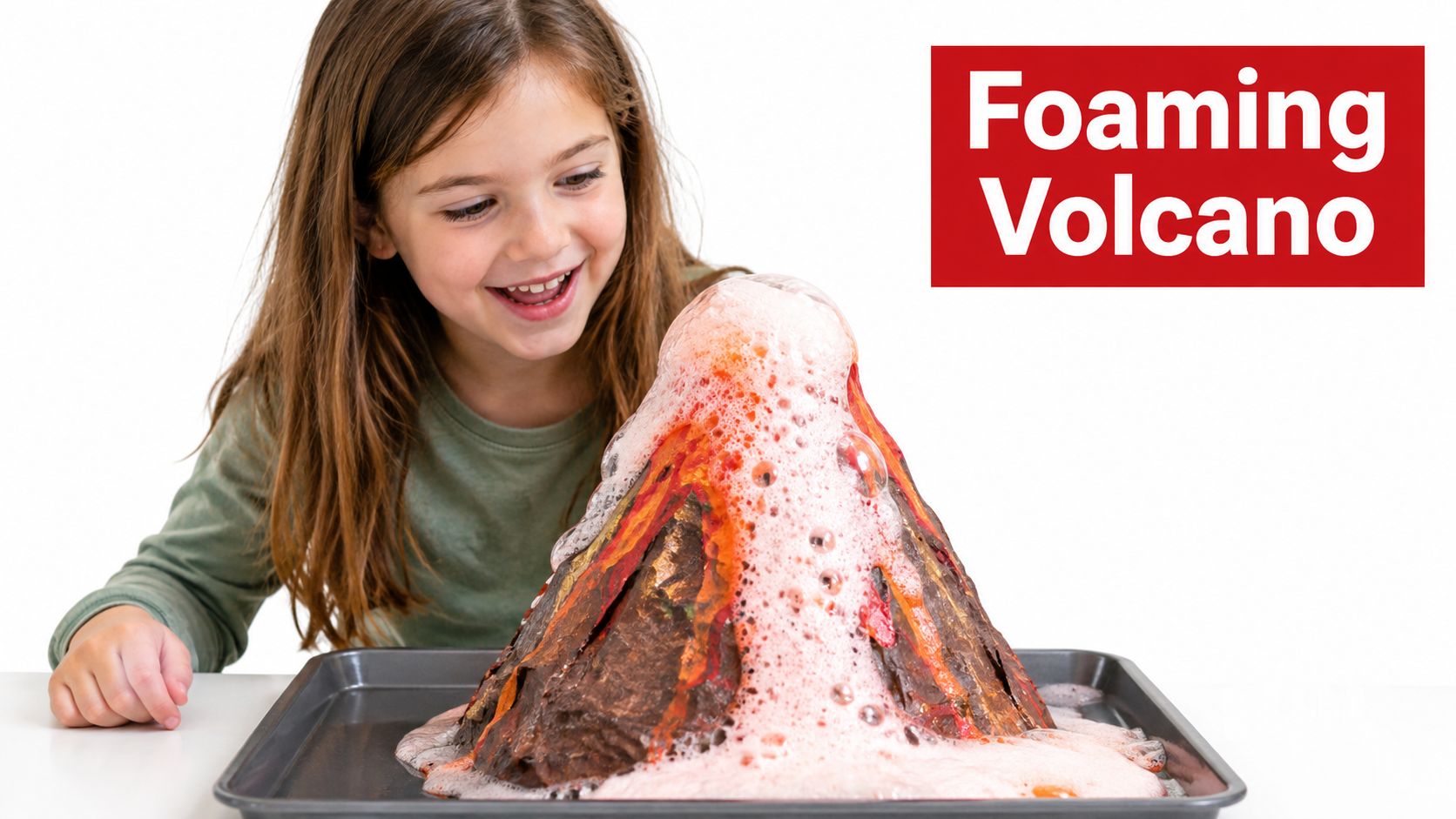
For a 4-year-old, keep the goal on noticing what happens. Ask whether the mixture will bubble, spill, or stop quickly. Add food coloring to the vinegar if you want a clearer “lava” effect, and mix a little dish soap into the setup if you want foam that lingers longer. That makes the eruption easier to watch, but also messier, so use a shallow bin.
For a child around 8 to 10, turn the same pantry ingredients into a fair test. Pre-measure the materials, keep the cup size the same, and change one thing at a time. Compare foam height, color, or how long bubbling lasts. Small paper-cup volcanoes are easier for a group. A larger model works better when an older child wants to build and present the setup. If you want help shaping the volcano itself, use Playz's volcano model guide.
Practical rule: More foam does not always mean more gas. It may just mean more soap or a different container shape.
Never seal this reaction in a rigid container, and stay close enough to manage pouring and splashes.
2. Invisible Ink Messages with Baking Soda
A blank page gets children quiet fast. Mix baking soda with a little water, paint a message with a cotton swab or small brush, and let it dry fully. The words fade from view. Then the chemistry brings them back.
This experiment works well because you can scale it by age without changing the pantry ingredients. For a 4-year-old, keep the message big and simple. A heart, star, or first initial is enough. Brush grape juice over white paper and ask the child to guess where the picture is before the color appears. At this age, the goal is noticing that one liquid can reveal something another liquid left behind.
For a child around 9 to 11, turn the same setup into a sharper investigation. Write a clue in invisible ink, then test what changes the result. Keep the paper type the same, let each sheet dry for the same amount of time, and compare thick strokes with thin ones. Older kids are ready for the chemistry idea too. Grape juice acts as an indicator, and the baking soda solution changes the color response because it is basic.
The revealing step matters. Grape juice is easier to manage at the kitchen table than heat, and it gives a clear result on white paper, though it can stain. Test one corner first if the paper is glossy or colored. If you use a lamp or iron instead, that part belongs to an adult. Paper scorches easily, and children should not handle hot equipment.
Write the clue first, then decide how to hide it. A treasure hunt, coded note, or secret birthday message gives children a reason to write carefully and wait for the page to dry.
If you want another age-matched activity after this one, Playz's fifth-grade science experiments offer a useful next step. Keep the focus on observation and color change, not “magic.”
3. Baking Soda Bath Bombs and Fizzies
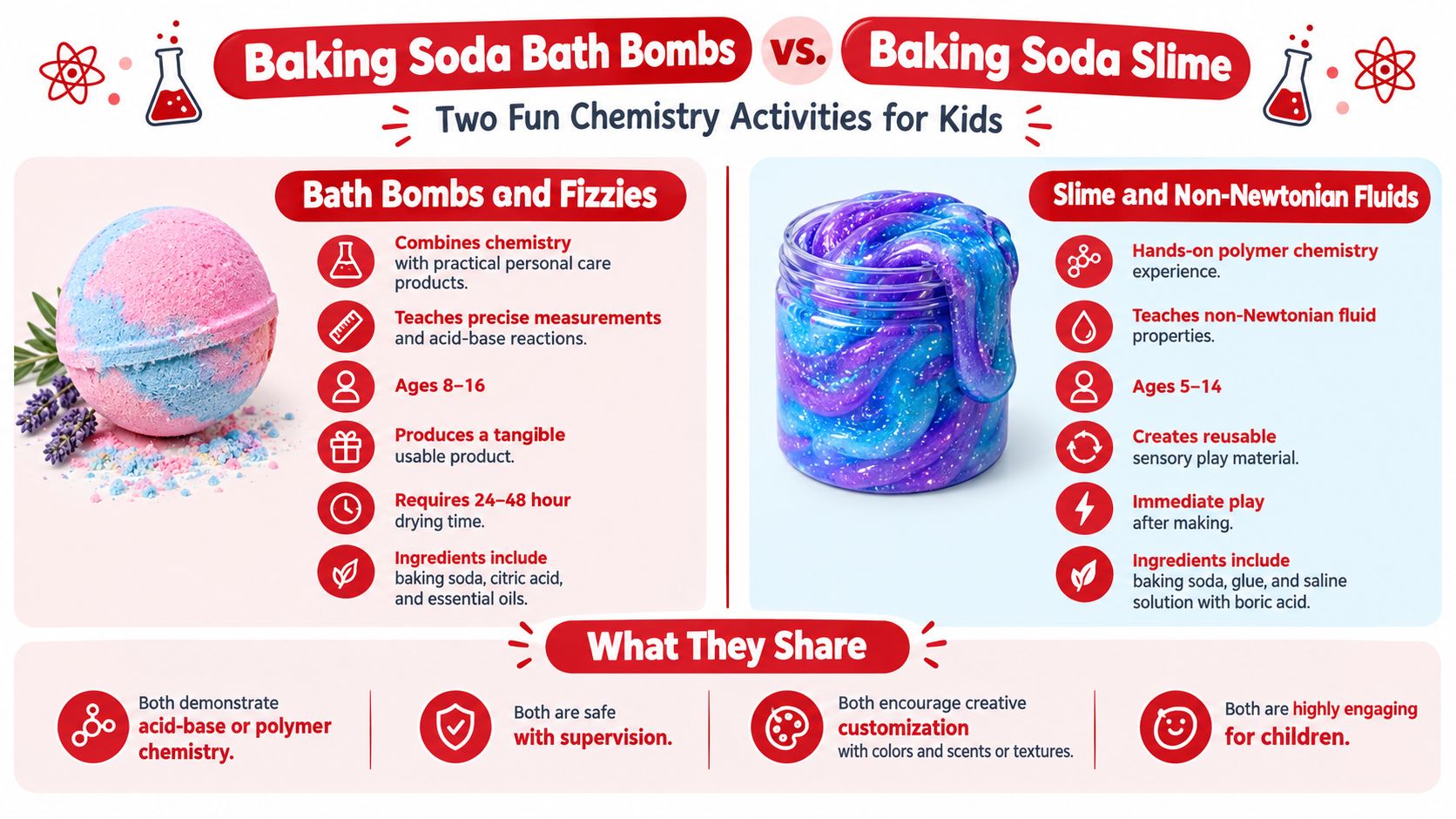
Bath bombs show children that chemistry can create a useful product. Baking soda supplies sodium bicarbonate, while citric acid supplies the acid. When the dry mixture reaches water, the reaction releases carbon dioxide bubbles. The same basic gas-forming chemistry appears in the Jackpot guide to bath bomb fizz.
For a 5-year-old, let the child combine dry ingredients with a spoon, choose a color, and press the mixture into a silicone mold. An adult should handle essential oils, dampening, and final storage. The mixture must stay dry during preparation. Too much moisture starts the reaction before the bomb reaches the bath.
Older children can treat the project as a formulation investigation. Make small batches with different amounts of color, scent, or moisture, then record whether each bomb holds its shape and how quickly it fizzes in water. A muffin tin gives consistent forms, while airtight containers protect finished bombs from humidity.
A useful comparison is bath bomb versus slime. Bath bombs are designed to react and dissolve. Slime is designed to form a flexible polymer network that can be stretched and reused. The first is mainly a reaction and mixture investigation. The second is a materials investigation.
- Keep powders dry: Store baking soda and citric acid separately until mixing.
- Use restraint with scent: Essential oils can irritate skin, so an adult should choose whether they're appropriate.
- Record variations: Have children write down the color, texture, mold shape, and fizzing result.
- Label gifts clearly: A child-made bath product should be identified and used with adult guidance.
Don't describe every fizzy result as proof that one recipe is better. A denser bomb may dissolve differently from a loose one, so shape and packing matter too.
4. Baking Soda Rockets
A baking soda rocket makes gas pressure visible through motion. Place vinegar and baking soda in a suitable snap-lid film canister, move away, and watch the lid release as pressure builds. The reaction creates carbon dioxide. The expanding gas pushes against the container and produces an action-reaction event that can introduce Newton's Third Law.
For a 6-year-old, use the activity as a supervised prediction game. Let the child draw a rocket, guess whether it will stay still or pop upward, and stand well away from the launch area. Choose an open outdoor space. Never aim the container at a person, animal, window, or vehicle.
An older child, such as a 12- or 14-year-old, can compare lightweight rocket bodies, launch angles, or reaction setups. Keep the test fair by changing one variable at a time. Record launch height, distance, or trajectory when you have a safe way to do so. Repeated trials are more useful than one dramatic launch because a loose lid, uneven surface, or inconsistent timing can change the result.
Pressure needs space and respect. A child can help with predictions and observations, but an adult should control the launch setup and inspect every container.
Don't seal an actively reacting mixture in a glass bottle or another rigid vessel. The NOAA carbon dioxide classroom activity demonstrates the gas in a controlled classroom context, including its ability to extinguish a flame. That doesn't make sealed pressure experiments risk-free.
5. Baking Soda Crystallization and Crystal Gardens
Crystal growing rewards children who can wait. Dissolve baking soda in water, allow the solution to cool and evaporate gradually, and watch solid material form again. The project introduces crystallization, evaporation, and molecular arrangement without requiring a dramatic reaction.
For a 4-year-old, make this a daily observation station. Place the container somewhere stable, add a simple drawing sheet, and invite the child to sketch what changes. Colored water can make the growth easier to notice, although food coloring may alter the appearance of the final crystals.
A child around 10 to 14 can document the process like a small research project. Photograph the container each day, note room conditions qualitatively, and compare a shallow dish with a deeper container. More exposed surface can support evaporation, while a loose paper-towel cover helps keep dust out without stopping air movement.
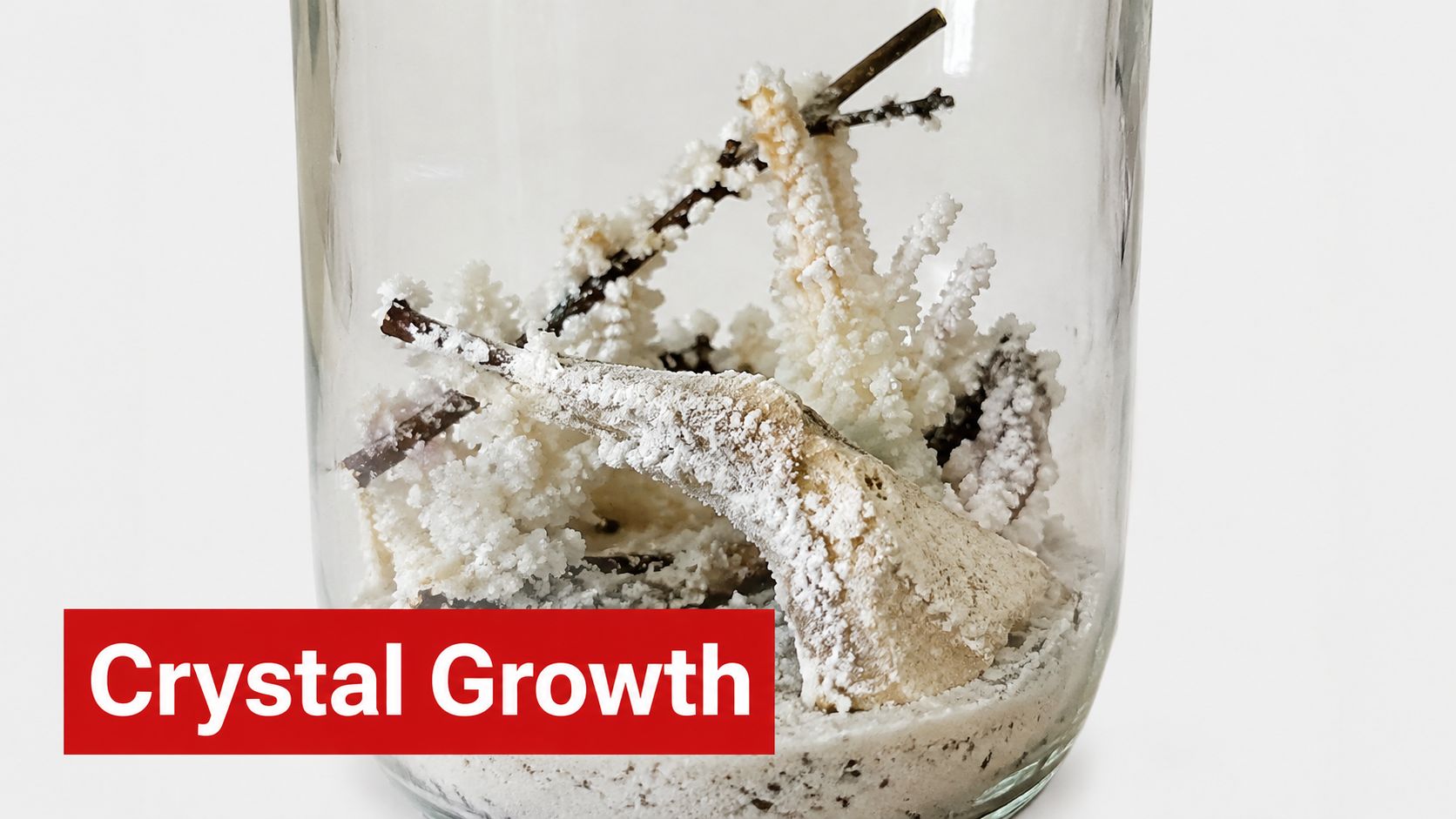
The process won't always produce neat, gallery-like shapes. Temperature, humidity, concentration, container shape, and disturbance all affect what children see. That uncertainty is useful. It gives older learners a reason to ask why two samples grown from similar materials don't look identical.
For a broader set of ideas, explore Playz's crystal-growing experiments. Then use the waiting period to discuss natural crystals, salt deposits, and how dissolved material can become solid again.
Keep containers labeled and out of reach of children who might drink from them. Even familiar pantry materials shouldn't be treated as food once they've been mixed for an experiment.
6. Baking Soda Slime and Non-Newtonian Fluids
Slime is a materials experiment disguised as a sensory activity. Baking soda is combined with glue and contact lens solution to create a stretchy substance. The contact solution must be suitable for the recipe, and the saline solution should contain boric acid as the activating agent. The result can behave differently when pulled slowly, pressed quickly, or left at rest.
For a 5-year-old, start with a small batch and let the child notice texture. Ask whether the slime stretches, tears, flows, or holds a shape. Add food coloring, glitter, or small foam beads only after the basic mixture works, since too many additions can make it harder to understand what changed.
A 14-year-old can investigate ratios and material properties. Keep the glue type and container consistent, then vary the amount of activating solution in separate trials. Record whether each sample is sticky, elastic, stiff, or difficult to stretch. This makes the project more scientific than just adding ingredients until the texture feels right.
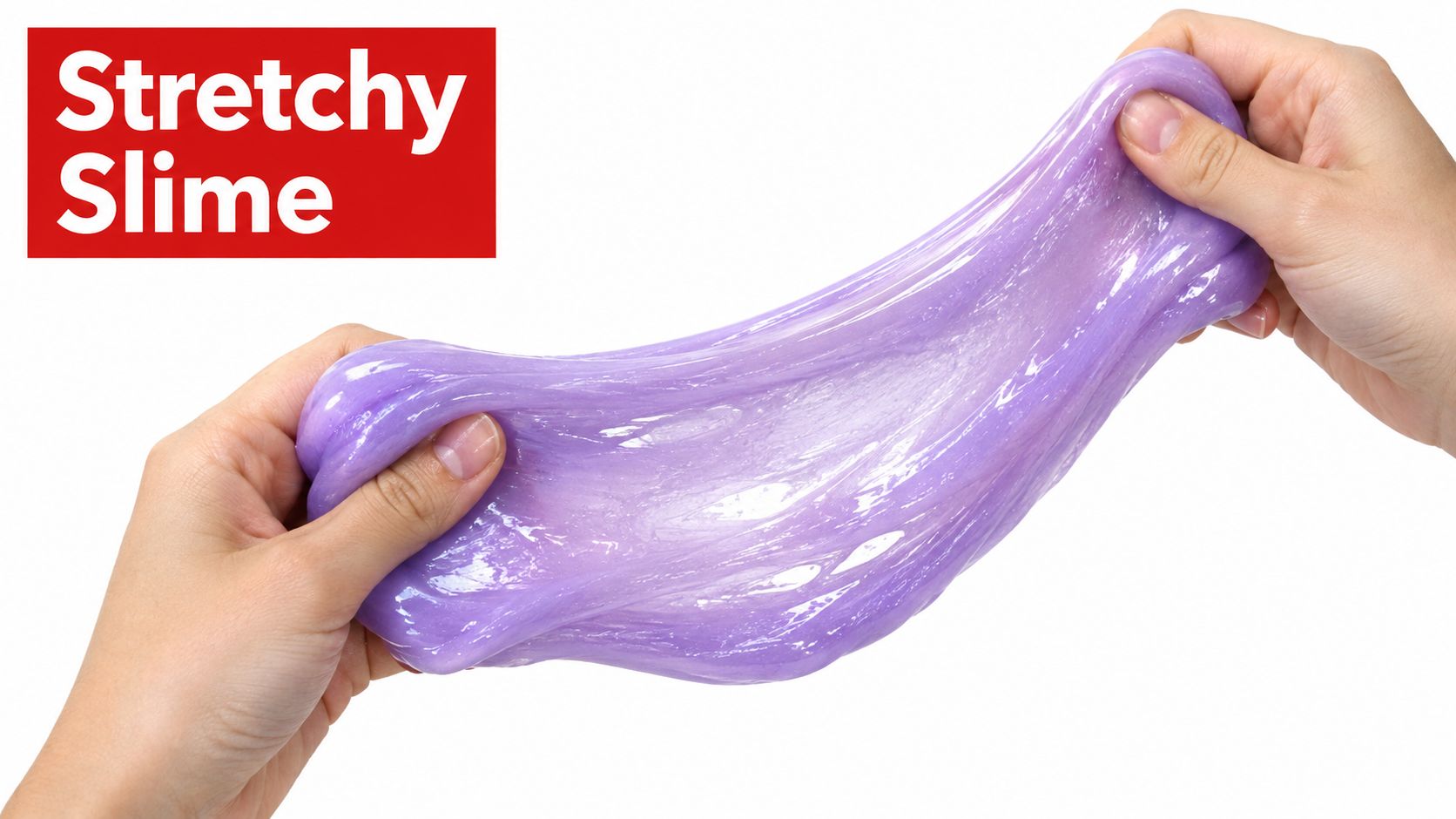
Slime has a clear trade-off. It offers excellent tactile feedback, but it can stain fabric, cling to carpet, and irritate skin. Use a washable work surface, wash hands afterward, and keep the mixture away from mouths and eyes. Store it in an airtight container, then discard it if it develops an unusual smell or appearance.
For a different activator discussion, see Playz's guide to making slime with borax. Don't substitute ingredients casually. Read product labels, follow the recipe's safety guidance, and keep adult supervision in place.
7. Baking Soda Pressure Eruptions and Balloon Inflation
A balloon turns an invisible gas into something children can see and touch. Put vinegar in a bottle and baking soda in a balloon. Fit the balloon over the bottle without dropping in the powder, then lift it so the reactants meet. Carbon dioxide forms and moves into the balloon, causing it to expand.
For a 4-year-old, the main lesson is simple: the balloon grows even though nobody blows into it. Let the child predict whether the balloon will stay flat, become small, or become large. Use a funnel for transferring baking soda, and stretch the balloon first so it fits over the bottle more easily.
Older learners can turn this into a controlled experiment. Carleton College's activity keeps the baking-soda mass at exactly 5.0 grams in every trial and changes only the vinegar amount. Students measure balloon circumference or volume, then compare the results across trials. The Carleton College investigation explains why adding more vinegar eventually stops increasing balloon size. Once the available bicarbonate has reacted, extra acid can't create additional carbon dioxide from that baking soda.
- Control the reaction: Add vinegar consistently and start each trial in the same way.
- Measure the outcome: Use a tape measure to record balloon circumference.
- Repeat the test: Several comparable trials reveal more than one unusually large balloon.
- Discuss the limit: Ask which reactant ran out first and what evidence supports that answer.
A balloon is only a proxy for gas volume. Stretchiness, leaks, mixing, and the balloon's shape can affect the measurement. That's why the best version records the method as carefully as the final circumference.
Use Playz's chemical reaction experiments for related activity ideas, but keep this investigation open and vented rather than attaching a rigid closure.
8. Baking Soda pH Testing and Color-Changing Experiments
Red cabbage juice gives children a visible way to explore acids and bases. Chop cabbage, boil it in water, strain the liquid, and use the colored solution as a natural indicator. Add small amounts of household substances to separate cups, then compare the colors. Baking soda provides a familiar basic material for the comparison.
For a 4-year-old, use only a few safe, adult-selected materials. Let the child predict whether each cup will stay the same color or change. Focus on sorting and describing colors rather than asking for exact pH values. Small clear cups or test tubes make the changes easier to compare.
A 14-year-old can build a color chart and test samples in a planned sequence. Useful questions include whether the indicator changes gradually or sharply, whether dilution affects the visible result, and how a substance's composition relates to its acidic or basic behavior. Older children can connect the activity to gardening, water safety, and food science.
Don't test unknown cleaners or mix household chemicals. Some cleaning products can release harmful gases when combined. Keep the experiment to clearly identified, adult-approved materials, and treat every sample as unsuitable for drinking.
The strongest pH activity isn't the one with the most cups. It's the one where children record the starting material, the color change, and their interpretation.
For a gardening connection, compare the activity with the Leaves & Soul soil pH guide. A soil test has its own method and shouldn't be replaced by a kitchen indicator, but the shared idea is valuable: chemical conditions influence how materials behave.
Baking Soda Experiments: 8-Way Comparison
| Experiment | 🔄 Implementation Complexity | ⚡ Resource Requirements | 📊 Expected Outcomes | 💡 Ideal Use Cases | ⭐ Key Advantages |
|---|---|---|---|---|---|
| Baking Soda and Vinegar Volcano | Low, simple mixing and setup, quick to run | Minimal, baking soda, vinegar, container, optional soap/color | Immediate foamy eruption; demonstrates acid‑base reaction and CO2 production | Young learners, classroom demos, science fair visual exhibits | Highly engaging, safe, low cost, repeatable |
| Invisible Ink Messages with Baking Soda | Low–Medium, prepare solution; reveal methods vary (heat/iodine) | Minimal, baking soda solution, paper; optional iodine/grape juice or heat source | Hidden messages revealed; teaches oxidation, indicators and pH concepts | Treasure hunts, creative play, party or classroom cryptography activities | Encourages creativity, multiple reveal methods, extends engagement |
| Baking Soda Bath Bombs and Fizzies | Medium, accurate measuring, molding, and drying time required | Moderate, baking soda, citric acid, oils, molds; 24–48 hr drying | Fizzy, usable bath products; teaches measurements and acid‑base chemistry | Craft projects, gift making, chemistry‑meets‑craft classroom sessions | Tangible product, sensory appeal, teaches precision in mixing |
| Baking Soda Rockets | Medium, timed loading and safe outdoor launch procedures | Low, baking soda, vinegar, film canister/launcher, outdoor space | Propulsion demonstration; illustrates Newton's Third Law and pressure | Outdoor STEM activities, competitions, physics demonstrations | Exciting, combines chemistry and physics, measurable repeats |
| Baking Soda Crystallization and Crystal Gardens | Medium–High, controlled dissolution and slow evaporation over days | Low, baking soda, containers, controlled environment and time | Aesthetic crystal growth; teaches crystallization, evaporation, molecular order | Long‑term class projects, displays, science fair time‑lapse studies | Gallery‑worthy results, links art and material science, patient observation |
| Baking Soda Slime and Non‑Newtonian Fluids | Low–Medium, mixing with specific activator; manage mess | Moderate, glue, baking soda, contact solution (with boric acid), colors | Reusable tactile material; demonstrates polymers and non‑Newtonian behavior | Sensory play, after‑school STEM, demonstrations of material properties | Highly engaging tactile learning, repeatable, encourages experimentation |
| Baking Soda Pressure Eruptions & Balloon Inflation | Low, straightforward but requires careful setup to avoid pops | Minimal, bottles, balloons, baking soda, vinegar, measuring tools | Balloons inflate from CO2; shows gas production, pressure and measurable change | Classroom races, measurement labs, inclusive demonstrations | Simple visual of gas production, accessible and fun for groups |
| Baking Soda pH Testing & Color‑Changing Experiments | Medium, prepare natural indicators and run systematic tests | Low–Moderate, baking soda, red cabbage juice, cups, test samples | Color changes map pH; teaches acid‑base scale and real‑world testing | Environmental tests, soil/water labs, systematic classroom experiments | Clear pH visualization, uses household indicators, extensible to real samples |
Pick One Experiment This Week and Start Exploring
You don't need to complete all eight activities to create a strong science afternoon. Choose the experiment that matches your child's age, attention span, and tolerance for mess. A 4-year-old usually gets the most from a quick, visible result. The volcano and balloon inflation offer immediate feedback, clear cause and effect, and simple questions about bubbles, foam, and gas.
The invisible ink activity works well when your child enjoys stories, drawing, or treasure hunts. Bath bombs suit children who like mixing and making a finished object, but adults should manage scent, moisture, storage, and skin contact. Slime is tactile and engaging, though it needs more careful cleanup than a cup of vinegar and baking soda.
Older learners need a reason to measure. The balloon activity can become a study of limiting reactants when one ingredient stays constant and the other changes. The rocket adds pressure, motion, and prediction, but it needs outdoor space and stricter supervision. The pH activity is a good choice for a child who enjoys color charts, sorting, and connecting kitchen observations to gardening or water safety.
Crystal growth is the best option when your family can return to an experiment over time. The visible result may not appear immediately, and the crystals may not form as neatly as expected. That uncertainty gives children useful practice with patience, daily records, and explanations based on evidence rather than a predetermined picture.
A simple investigation routine keeps any activity focused:
- Predict first: Ask what the child thinks will happen and why.
- Change one factor: Keep the other materials and steps as consistent as possible.
- Record observations: Use drawings for younger children and tables or graphs for older learners.
- Explain the result: Ask what evidence supports the child's conclusion.
- Treat surprises as data: A flat balloon or weak eruption is a clue to investigate, not a reason to stop.
Safety still matters even with familiar ingredients. Provide adult supervision, use ventilation, protect the work surface, and keep reacting mixtures out of sealed rigid containers. Don't let children taste experimental mixtures. Food-safe ingredients are helpful, but once materials are combined, labeled, or placed in a balloon or model, they belong in the experiment rather than the kitchen.
Playz offers science kits alongside creative toys and play products, including the Explosive Kitchen Chemistry kit with hands-on chemistry activities such as a baking soda volcano. Its learning approach centers on active play and the motto #KidsLearnBestThruPlayz. If your child keeps asking, “What happens if I change this?”, follow that question with a tray, a notebook, and one carefully controlled variation.
Bring the next kitchen chemistry lesson to life with Playz, where science kits and creative toys support hands-on exploration through purposeful play. Choose an activity that matches your child's age, gather a washable tray, and keep building curiosity around the chemistry of baking soda.