


A child turns a knob at the kitchen table, and the gear beside it spins. They turn the knob the other way, watch the neighboring wheel reverse, and try again. For a moment, a handful of plastic parts has become a machine they can control.
That delight is more than a reaction to movement. Research on a gears-assembly task found that children as young as four could recognize the basic relationship between connected gears, even though rebuilding a working gear train was harder for younger participants. With a thoughtful setup, gears for kids can become a hands-on way to explore cause and effect, early math, and engineering, while giving adults a practical reason to think about safety in a shared playroom.
Why Turning a Wheel Feels Like Magic to a Child
A four-year-old turns a crank, pauses, and predicts that the wheel beside it will turn the other way. Then the crank moves, and the child checks the prediction. That small moment turns a hidden mechanical relationship into something visible and testable.
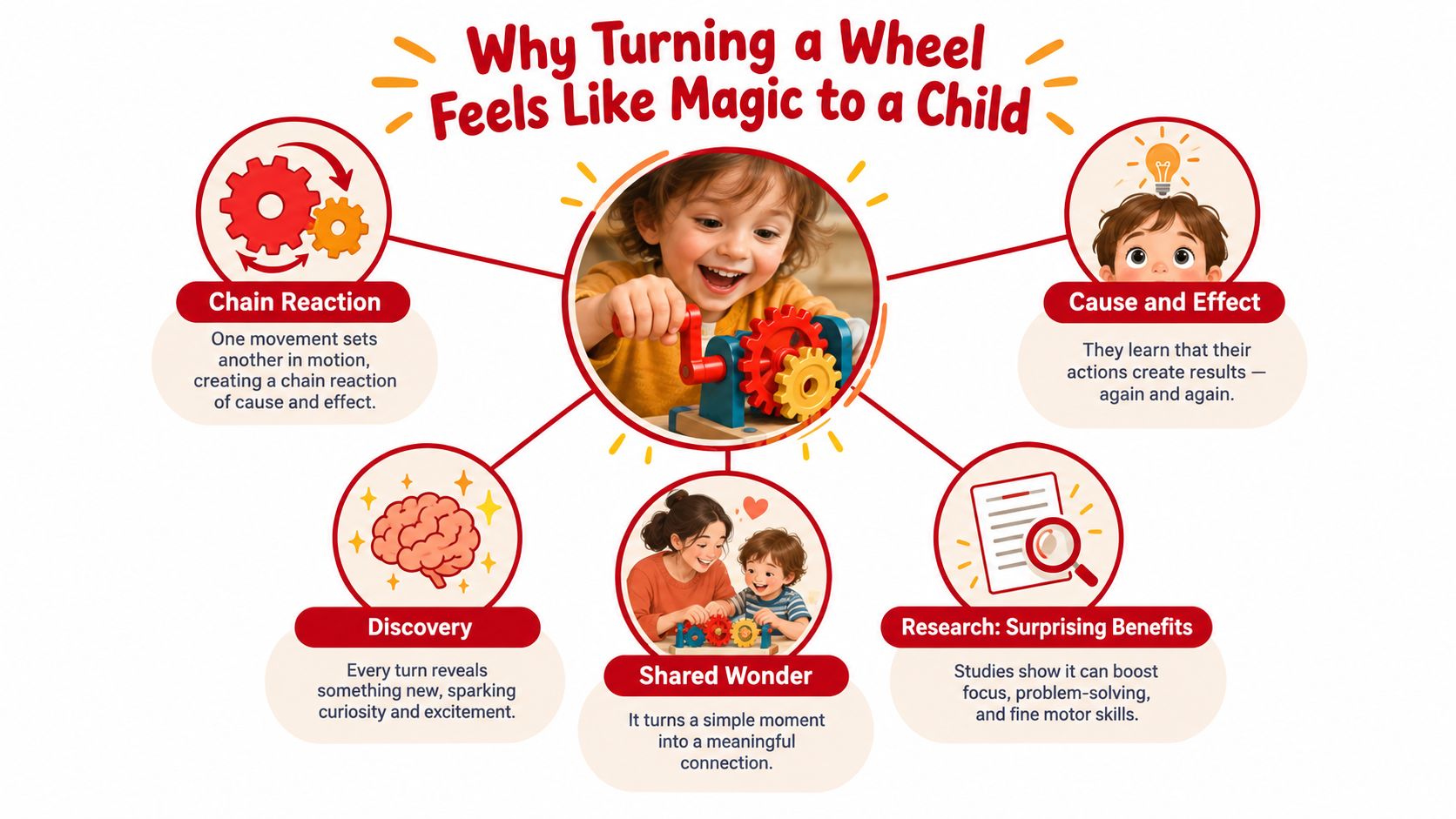
A 2026 gears-assembly study with 48 children aged 4–11 and 10 adults found that children generally recognized how connected gears move, while younger children had more difficulty rebuilding a working gear train (the 2026 gear-task study). Recognizing a pattern and planning a whole arrangement are different tasks, much like spotting a puzzle piece that fits versus assembling the full picture.
At home, a child might watch one wheel turn, then ask to move it and see what happens. Let the movement come first. If rebuilding the setup proves tricky, offer one helpful prompt or place the next gear nearby, then let the child try again. The aim is to make exploration enjoyable, not to expect independent engineering on the first go.
Keep the questions simple: “Which wheel do you think will move?” or “What changed when you turned this one?” A pause before turning gives children time to predict, and the result gives them something concrete to discuss. For more on how curiosity supports discovery, read Igneous AI's take on curiosity. Toys built around cause-and-effect play offer another way to explore how one action can lead to a visible result.
What Gear Toys Are and How They Work
A child turns a crank, and several wheels begin to move. Gear toys make that motion visible, whether they use interlocking wheels on a base plate, a construction kit with axles and connectors, or a model driven by a handle. Each gear is a wheel with teeth around its edge. Those teeth catch the next wheel, passing motion along instead of sliding past it.
At the kitchen table, explain the parts this way: “The driver is the wheel we turn. The driven gear is the wheel that gets pushed along.” Axles hold the wheels in place, while a base plate helps keep them aligned. Once the teeth mesh, each wheel affects the one beside it.
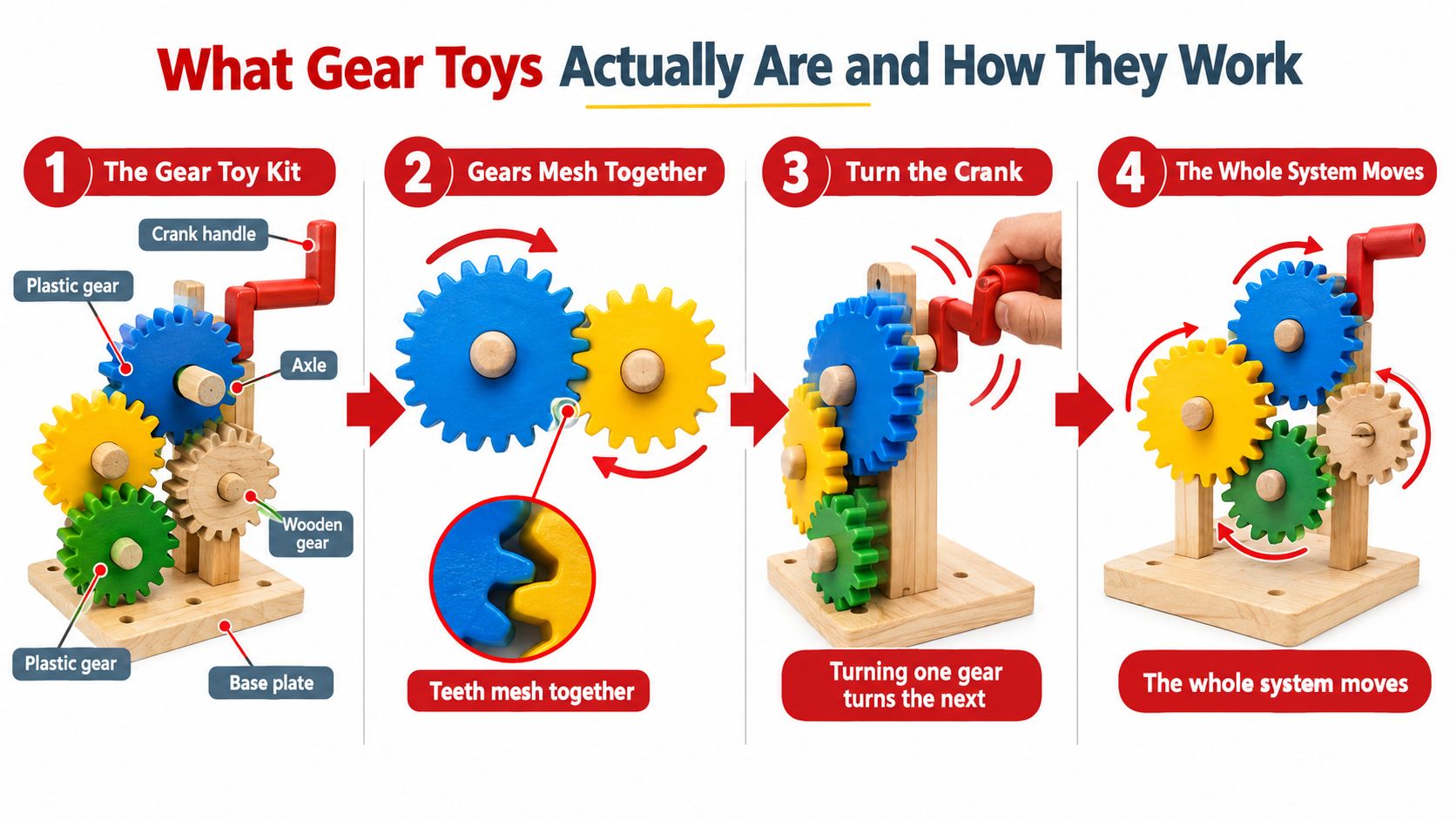
Here's a rule children often find surprising: two meshing gears turn in opposite directions. Turn the first gear clockwise, and the gear touching it turns the other way. Add a third gear, and the direction changes again. Before turning the crank, invite your child to trace the path and predict which way each wheel will go.
Gear size changes both speed and turning force. A small gear driving a larger one turns the output more slowly but provides more turning force. A large gear driving a smaller one makes the output turn faster, with less turning force available. A bicycle offers a familiar comparison: changing gears affects how hard it feels to pedal and how quickly the wheels respond. Ask, “Would you rather make the next wheel spin faster, or make it easier to turn?” Technical terms can wait.
A University of Utah learning activity helps children explore this speed relationship by counting how many times a small gear turns during one complete rotation of a larger gear (the gear-counting activity). For play, focus on whether the gears mesh smoothly and stay aligned. A child should be able to see what changes when they turn a gear or rearrange the parts, making it easier to connect each action with the motion that follows.
To watch a gear mechanism in motion, use this short demonstration:
How Gear Play Builds Real STEM Skills
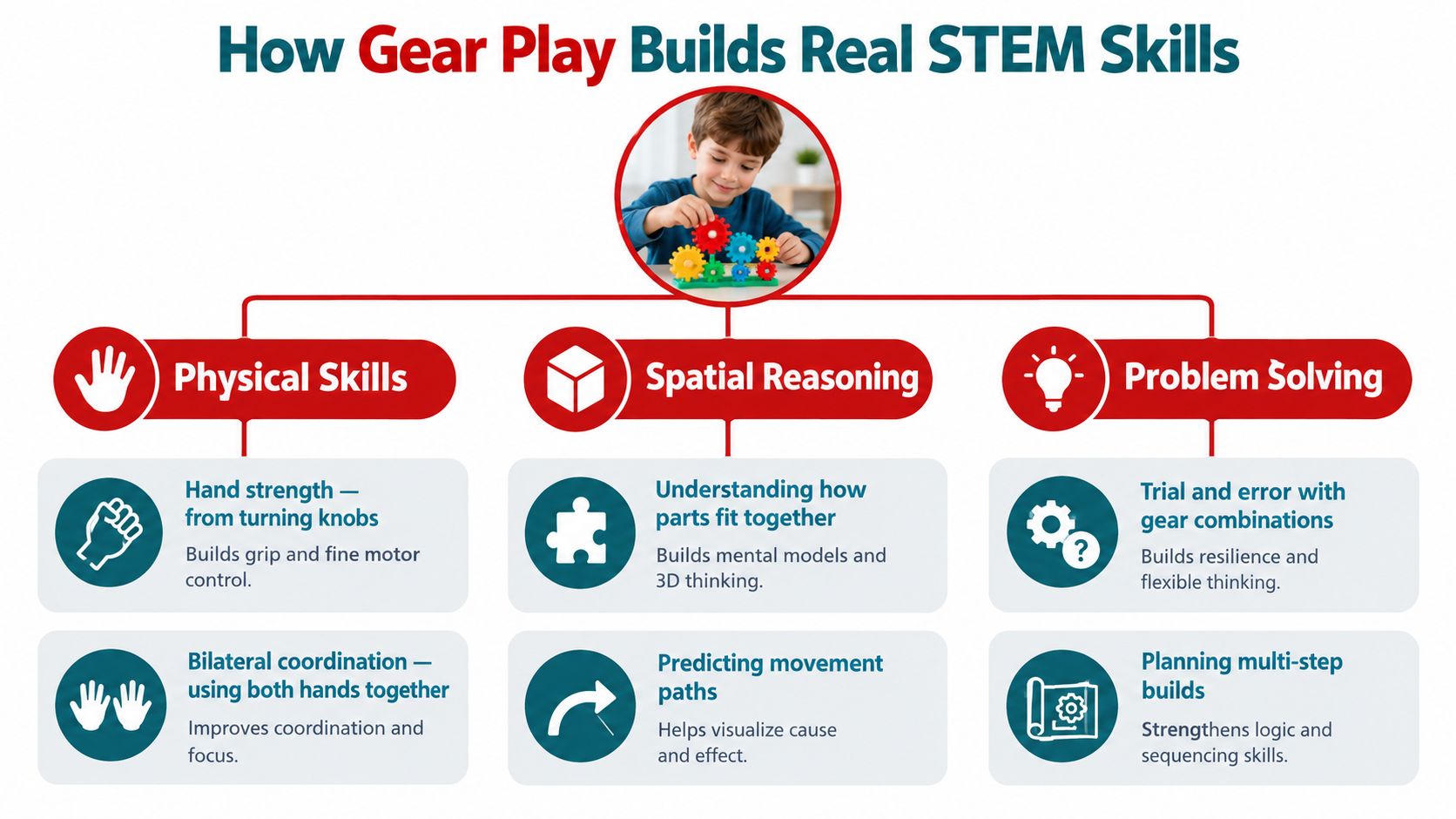
Gear play gives children a concrete task to work through, not just a toy to watch. A child may grip a crank, hold a base steady with the other hand, line up an axle, notice a direction change, and count a wheel's rotations in one stretch of play. Each action is small, but together they connect movement with thinking.
Hand control and coordination
Turning a knob or crank asks a child to control a hand movement while keeping the toy stable. If they use one hand to turn and the other to hold the base, they're coordinating both sides of the body. You can notice how their grip changes as the mechanism gets easier or harder to move. Keep the challenge comfortable, and let the child choose whether to turn, hold, or take a break.
Spatial reasoning and problem solving
A gear assembly invites children to work out how parts fit together. They may rotate a wheel, shift an axle, or try a different gear position to make the system move. Instead of immediately fixing a setup that doesn't work, ask, “What could you change?” The child practices planning and testing while learning that a failed arrangement is information, not a dead end.
Construction play also connects with early math. In a 2023 study of 358 children aged 7–9, construction ability and spatial skills explained 18.9% of the variation in mathematics achievement for children completing concrete construction tasks, and 26.6% for those completing a digital version (the construction-play study). The research used LEGO, not gears, so it doesn't establish a gear-specific effect. But assembling parts, noticing spatial relationships, and translating a model into a working system are relevant similarities.
Cause and effect, then counting
A child can observe that turning one wheel makes another move, then test whether the movement changes when the gears shift. Invite them to count rotations or compare which wheel completes more turns. These activities introduce mathematical language through something visible rather than abstract.
Try asking: “What did you notice?” gives a child room to explain the mechanism in their own words.
You can build on these moments with more problem-solving activities for children, especially when the goal is to help them plan, test, and revise rather than follow a fixed set of steps.
Age-by-Age Recommendations That Match Real Milestones
A child may understand what a gear does before they can build a working gear train. As the earlier gear-task research showed, recognizing connected motion comes sooner than rebuilding the mechanism. Use that difference to set challenges by readiness, not just by the age printed on the box.
Consider what the child can comfortably handle, how they respond when a build does not work, and whether they still put small objects in their mouth. Also consider who else can reach the pieces in a shared playroom.
Toddlers and preschoolers
For toddlers, focus on watching and sharing the movement. An adult can turn a mechanism and describe what moves, while keeping small detachable parts out of reach. With a preschooler, turn the activity into a prediction game: “If I turn this wheel, what do you think will happen?” Then let the child watch and describe the result.
Research on gear design with kindergarten-aged children found that learners around 4 to 7 can construct, test, and change gear arrangements when the materials and activity suit them (the kindergarten gear-design research). Start with a stable, simple setup and offer help when needed. A child can understand the motion without being ready to rebuild the whole arrangement alone.
Early and upper elementary
Early elementary children may be ready to add gears, compare sizes, and rebuild a model after it comes apart. They might need help holding parts in place or planning a build with several steps. Around age six, many children are beginning to apply a mechanical idea in a new setup, though children reach that point at different times.
Older elementary learners can take on open-ended design tasks. Ask them to make a target gear turn in a chosen direction, or change the arrangement and describe what changed. Keep the goal clear, but let them test more than one solution.
Tween builders and a readiness check
Tween builders may enjoy models that combine gears with other mechanical parts. They can document a build, explain a design choice, or compare two arrangements. Choose kits by the child's interests, dexterity, and patience, rather than assuming age alone predicts a good fit. This guide to building toys for children offers more context for matching construction play to a child's stage.
Before introducing a more complex challenge, check whether the child can:
- Notice movement: Describe how one gear affects another.
- Handle the parts: Turn, place, or connect pieces comfortably.
- Try a change: Adjust one part and observe what happens.
- Stay engaged: Ask questions or return to the task after a tricky moment.
These signs help you choose the next step. A child who can explain the motion may be ready to test a small change, while a child who needs help handling the pieces may benefit from a simpler setup and a partner.
Safety, Small Parts, and the Shared Playroom Problem
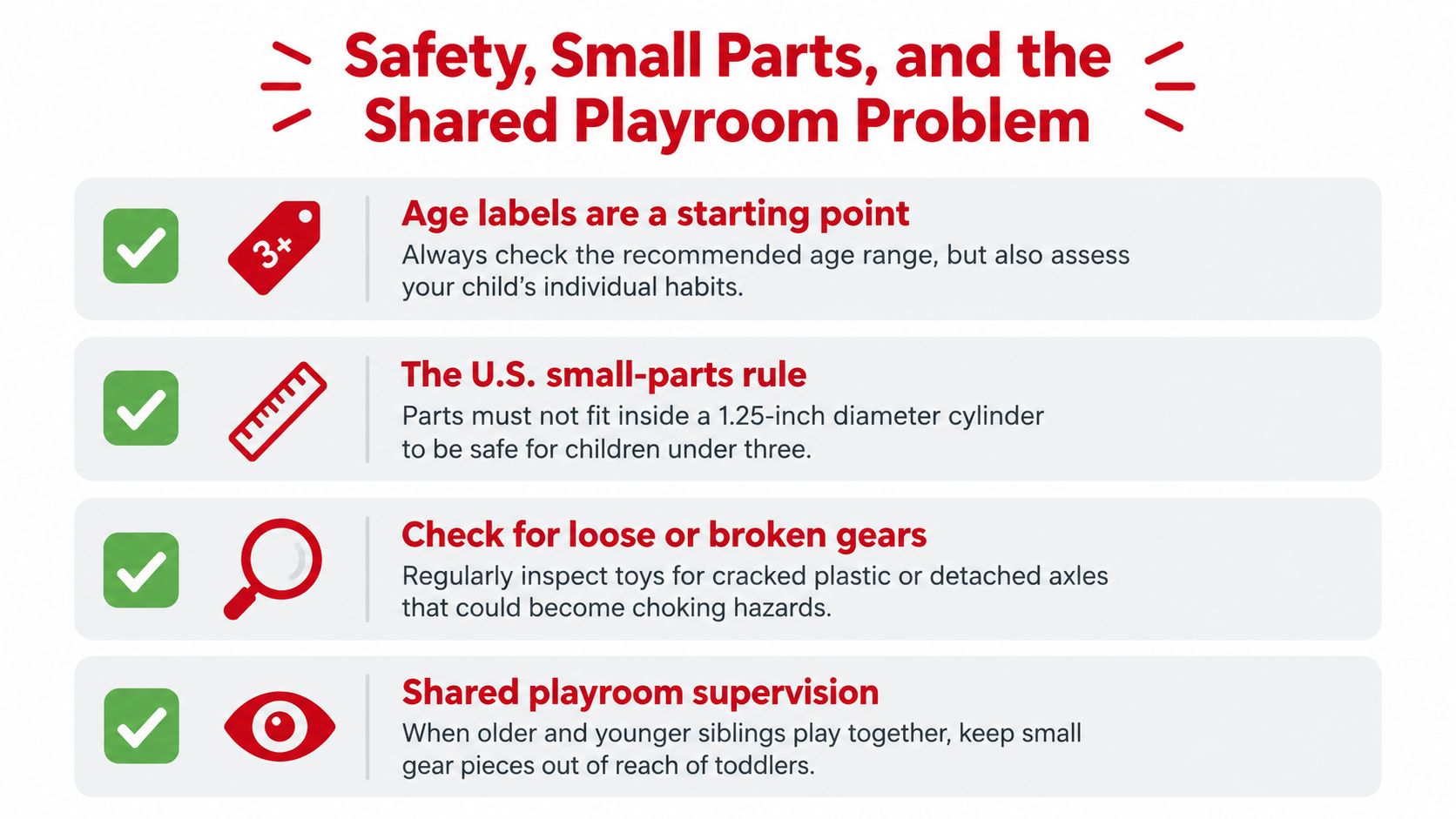
Age labels tell you something about a toy's intended user. They don't tell you whether it's safe to leave the toy within reach of every child in the home. A kit suited to an older child can still create a choking hazard if a toddler picks up a loose gear or axle.
In the United States, federal rules under 16 C.F.R. Part 1501 restrict small parts in products intended for children under 3, and the U.S. Consumer Product Safety Commission advises caregivers to keep older children's small-part toys away from children under three (CPSC toy-safety guidance). Caregivers should consider every child who might access a toy, not only the child named on the box.
A simple shared-playroom routine
Start by identifying which gears, rods, axles, or connectors detach. Put those components in a sealed container when play ends, then store the container where younger children can't reach it. During shared play, keep a responsible adult nearby and gather loose parts before the toddler returns to the room.
Check pieces after play, too. Cracked plastic or a newly loose axle can change the hazard, so reassess the setup if anything breaks or comes apart unexpectedly. The habit is straightforward: check the pieces, supervise the play, then store the kit securely.
Australia also requires special safety standards for toys intended for children up to and including 36 months and warns against small or detachable parts. For another family-friendly activity idea built around shared attention and problem solving, explore the Chronos One Escape Rooms Eltham kids guide. It's a useful reminder that a good play experience depends not only on the activity, but also on how adults set it up for the children involved.
Hands-On Activities and DIY Gear Projects to Try Today
At the kitchen table, a child turns one wheel and watches another move. Start with a question they can test, then let them predict what will happen before turning the gears. A simple setup makes each change easier to see.
Count the turns
Connect a small gear to a larger one. Before turning either wheel, ask your child to predict how many turns the other gear will make. Then rotate one gear through a full turn and compare the result with the prediction. Swap which gear they turn and ask whether their prediction changes. The point is to check an idea, not memorize a rule.
If the prediction misses, ask what they noticed rather than supplying the answer. They can adjust their guess and try again, building a habit of testing and revising.
Build a chain or tower
If the set allows it, connect several gears in a row or arrange them around a base. Turn the first gear slowly and follow the movement through the chain. Ask your child to point out where the direction changes. A short chain is plenty: the useful discovery is how one moving part affects the next.
Predict the final direction
Set up a few meshing gears and ask which way the last one will turn. Have your child point in that direction before testing the setup. If the result is unexpected, trace the chain one neighboring pair at a time. This makes the pattern easier to see than just watching the last wheel.
Make a simple DIY gear board
Draw circles on sturdy cardboard and use bottle caps to represent wheels. An adult can make attachment points with push pins, keeping sharp points out of children's reach. Arrange the caps so their edges meet, then turn one and observe whether the next moves. This is a basic demonstration of linked movement, not a replacement for a well-made gear system.
For children who benefit from adaptations, try larger knobs, high-contrast or color-coded direction cues, tactile markers, or partner roles such as “turner” and “predictor.” The kindergarten gear-design research cited earlier describes target-direction challenges. Children can take part by predicting, turning, explaining what they observe, or suggesting a change to the arrangement. For another mechanical toy activity, explore a hands-on project that invites children to investigate how moving parts work.
Bringing Gears Into the Classroom or Homeschool Routine
Gears can fit into an existing math or science routine without turning the day into a major build project. A small station with a base plate, a few gears, and a prompt gives children a chance to count, compare, predict, and observe. The materials can stay ready for use, so the adult's main job is to invite thinking and listen to the explanations.
Try a short rotation: one learner turns a gear, another predicts what will happen, and a third records or describes the result. In a homeschool setting, a parent can offer the same roles at the kitchen table. Keep each task focused, such as “Find a setup that changes the direction,” or “Compare how these two arrangements feel when you turn them.”
From movement to math language
Ask children to count rotations, compare which gear is larger, or describe whether the next wheel moves faster or slower. These observations give learners a concrete way to discuss comparison and relationships. As they gain experience, introduce language such as input, output, direction, and ratio, but connect each word to a part they can point to.
A haptics-based educational system uses 1:1, 2:1, and 4:1 gear ratios to help students feel a mechanical trade-off. In its 2:1 example, choosing the smaller gear as the input halves the required torque effort compared with the 1:1 case, while the output gear rotates only half as much (the educational haptics system). In child-friendly language, a setup that makes a load easier to turn may give up speed or distance of rotation.
Close a station with a brief reflection: “What did you try? What changed? What would you test next?” That conversation connects hands-on observation with the design thinking children use in other classroom projects. Teachers can adapt these prompts to an engineering design process for kids, using the gears already on hand to make prediction and revision visible.
Choosing the Right Gear Toy and Getting Started
A useful gear toy doesn't need to be complicated. Choose one that lets a child see the connection between movement and outcome, with parts that fit the child's abilities and a storage plan that works for the household.
Use this checklist while comparing options:
- Smooth movement: Gears should mesh and turn without frequent slipping.
- Stable base: A base plate can help keep parts aligned during play.
- Suitable pieces: Consider the parts, the child's habits, and who else can reach the toy.
- Room to experiment: Clear setup guidance is helpful, but open-ended challenges give children a reason to test and revise.
- Practical storage: A sealed container or dedicated box makes it easier to keep loose parts away from younger siblings.
If a child is ready for mechanical model building, Playz offers engine kits including a V8 Combustion Engine Model Building Kit and an Inline 6 Engine Model Building Kit. As you compare toys, think about whether a hands-on model can help make an unfamiliar system easier to explore, much like the visual approach discussed in the AR glasses case study.
You don't need a perfect kit or a long lesson plan to begin. Choose a simple setup, let your child turn one gear, and ask what they think will move next.
Playz offers hands-on toys and kits, including model-building projects that can extend children's interest in how things work. Visit Playz to explore its play options, then try a small gear experiment together this week.