

A group of young explorers has just reached a new dig site. One child wants to unearth a fossil, another is ready to stomp like a T. rex, and a third would rather build a dinosaur's home than touch the sand. Meanwhile, the adults need activities that work for different ages, budgets, spaces, and energy levels.
That's where dinosaur activities for kids can do more than fill an afternoon. Children often arrive with dinosaur names already in their vocabulary, and a familiar interest can open the door to observing, sorting, measuring, and asking questions. The University of California Museum of Paleontology describes dinosaurs as a springboard for teaching how science works, including through experiments and technology. The key is to pair the fun with a chance to notice evidence and explain an idea.
The ten activities below turn that dig site into a screen-free expedition. They range from messy fossil play and simple engineering to movement, art, and imaginative storytelling. Each includes practical setup ideas, an age-aware approach, and an honest trade-off, so you can choose what fits your group instead of preparing a project that looks good only on paper.
1. Backyard Dinosaur Fossil Dig
A fossil dig feels special when children work slowly, rather than sweeping everything out of the tray in a single scoop. Hide plastic bones, clay impressions, or replica fossils in a sandbox, a shallow bin of sand, or a small patch of loose soil. Give each child a brush, spoon, craft stick, and simple recording sheet, then invite them to uncover one area at a time.
The Natural History Museum's Dino Dig workshop frames excavation as palaeontological work, where children carefully uncover fossils. Bring that idea home by marking a grid on paper, noting where each find appears, and sketching the objects before removing them. For more ways to make the process feel like a real discovery, use this guide to how to find a fossil.
Keep the evidence: Ask children to record where a find was buried before they move it. The location is part of the story, not just the reveal.
Best for: Children who enjoy tactile play and can use small tools with supervision. Older children can add measurements or make a labelled site map; younger children can brush away loose sand with an adult nearby.
The payoff is patience, fine-motor practice, and an introduction to observation and documentation. The trade-off is cleanup: sand travels, and damp replicas need to dry fully before storage to avoid mildew. A tray beneath the dig bin and a rinse-and-dry routine make the activity easier to reset.
2. Dinosaur Footprint Trackway Art
A line of footprints can prompt a better question than “Which dinosaur is biggest?” Press toy dinosaur feet into damp clay, play dough, or a patch of sand, then make a short trackway by repeating the prints. Children can also stamp with shoes and compare the marks with toy tracks.
Palaeontologists study trackways to investigate how an animal moved and whether different animals travelled near one another. Ask children to compare the distance between prints, or stride length, and explain whether their dinosaur seems to be walking or moving quickly. Dinosaur Provincial Park in Alberta is known for preserved trackways, an example of how footprint patterns can become evidence about the past.
Start with a prediction: “What might we learn from this line of tracks?” Then let children measure from one print to the next with a ruler or a strip of paper. Keep clay covered with a damp cloth between sessions so it stays workable. If you want to preserve a finished impression, let it dry before applying an appropriate craft sealant.
Why it works: The activity makes movement visible and gives children a concrete way to practise comparison and measurement.
The catch: Soft material can blur the prints if children press too hard or handle the trackway before it sets. Make a test print first, and use a firm board beneath the clay if the work surface shifts.
Preschoolers can focus on making patterns and describing them. Older children can compare their trackways, record measurements, and defend a guess about how the dinosaur moved.
3. Dino Egg Drop Challenge
Can a dinosaur egg survive a fall? Give children a plastic egg, a hard-boiled egg, or a raw egg for a supervised engineering challenge. They'll design a protective container or padding from available materials, make a sketch, and test whether their design protects the egg.
Use a plastic egg filled with sand or water when you want repeat attempts without food waste. If you use a real egg, take the test outdoors or place a large tray beneath the drop zone. Set a modest starting height and adjust it to suit the children and the space. Keep the height consistent between tests so they can compare designs fairly.
Design before dropping: A quick sketch helps children connect their prediction to what happens during the test.
The activity introduces a useful cycle: plan, build, test, observe, revise. Ask each child what they think will protect the egg, then compare the prediction with the result. Afterward, talk about how dinosaur nests and eggs could be protected, keeping the conversation focused on the idea that different animals care for their young in different ways.
You can find more ways to structure the experiment in this egg drop activity guide. The strongest part is the redesign: an unsuccessful first attempt gives children something specific to improve. The less convenient part is mess, especially with raw eggs, so keep paper towels ready and make cleanup part of the experiment.
4. Dinosaur Volcano Eruption Experiment
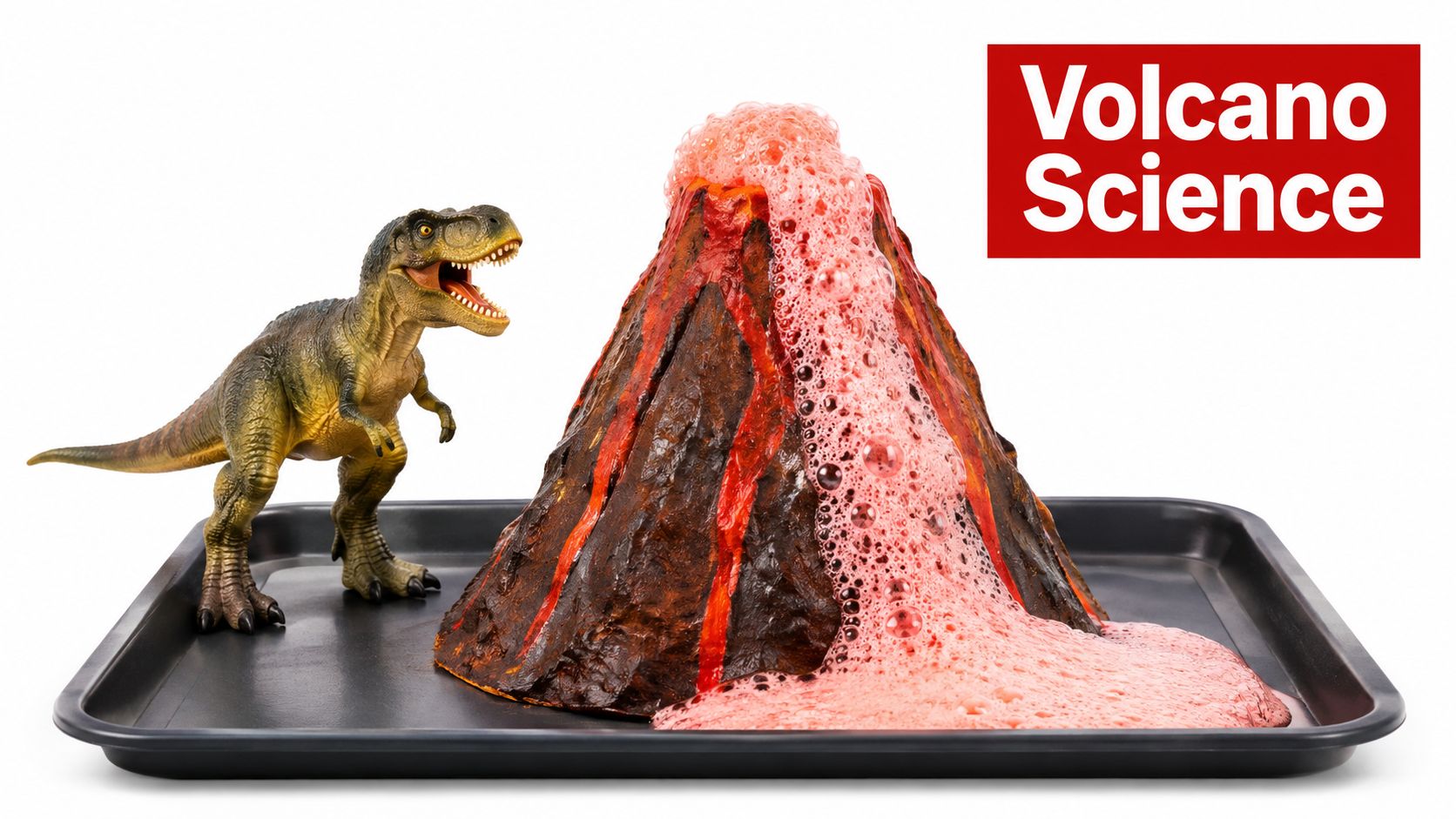
Set a toy dinosaur beside a small model volcano, put the setup on a tray, and let children predict what will happen when baking soda meets vinegar. The fizz is a straightforward way to observe a chemical reaction, while the scene gives the experiment a dinosaur-era setting.
A toy Tyrannosaurus rex makes a handy scale figure beside the model. Keep the focus on what children can see: the mixture bubbles, rises, and spills over the sides. Add a little dish soap and food colouring if you want a more visible flow, but they're optional. For an activity setup with clear building steps, try this guide to building a volcano model.
Make the eruption a science conversation
Before adding vinegar, ask children to predict what they'll observe. Try a smaller pour, then a larger one, and have them describe what changed. The model isn't a literal recreation of an ancient volcano, so say that plainly: it demonstrates a reaction, while volcanoes in Earth's history are a separate topic to explore through books and museum resources.
The Natural History Museum's classroom materials offer ways to discuss rocks, fossils, and prehistoric life. Keep extinction talk simple for younger children: major changes to Earth affected many animals, including dinosaurs. Children who want to know more can follow that question with an age-appropriate explanation.
The activity is exciting and easy to repeat, but it can overflow quickly. Use a tray or take the experiment outdoors, and keep the mixture away from eyes and mouths. A short cleanup plan makes the fizz more fun for the adult running the station, too.
For a visual example of how a homemade volcano can fit into a dinosaur-themed setup, watch the demonstration below.
5. Life-Size Dinosaur Chalk Outline
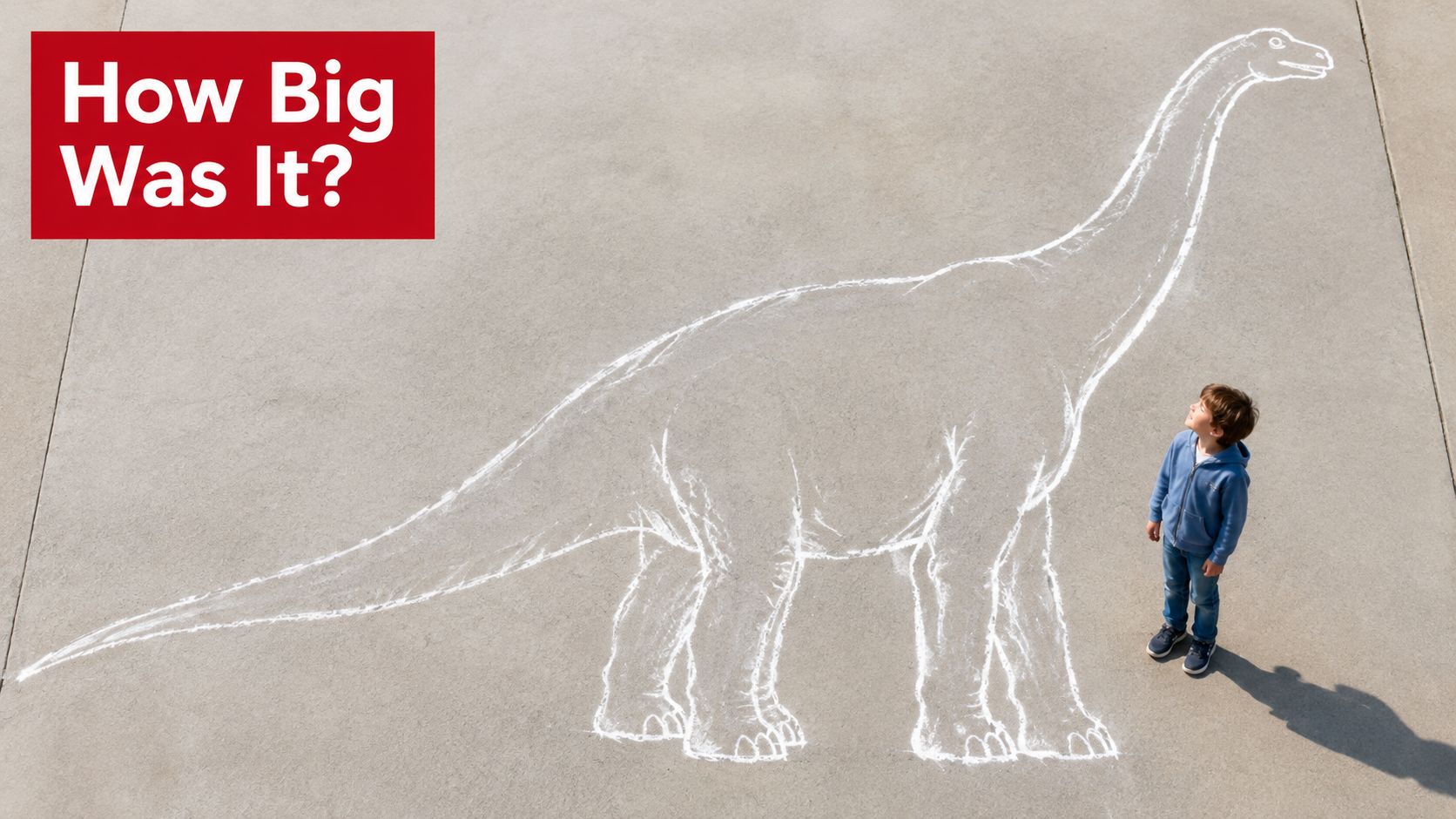
A dinosaur's size is easier to understand when children can stand beside it. Use sidewalk chalk on a driveway, or painter's tape on a gym floor, to mark an outline from a reference measurement. A rope or measuring tape helps keep the length consistent; children can estimate first, then measure and compare.
For scale, Argentinosaurus is estimated at roughly 30 to 35 metres long, while Compsognathus was about the size of a chicken. Those examples make a striking comparison, but avoid drawing a giant outline unless you have enough space. A shorter section of the animal's body, clearly labelled as a scale model, works better in a small area.
Turn measuring into a group project
Have children mark the head, tail, and feet, then use their own height as a comparison. In a classroom, one group can measure while another draws, and a third can label the outline. A museum's life-size skeleton display can inspire the shape, but children don't need a perfect anatomical drawing to understand scale.
Best for: Outdoor play, shared spaces, and children who enjoy drawing or measuring.
Trade-off: Chalk can wash away, and very large animals take more room than expected. Painter's tape provides a temporary indoor option, but test it on the floor first and remove it promptly. Finish by asking children what surprised them about the animal's size.
6. Herbivore vs. Carnivore Sorting and Teeth Detective Game
Put dinosaur figures, food pictures, and tooth shapes on a table. Invite children to sort the evidence into plant-eater and meat-eater groups, then explain what clues they used. Rather than handing them the answer, ask, “What does this tooth tell you about dinner?”
Tyrannosaurus rex had large, serrated teeth suited to tearing flesh, while Triceratops had grinding teeth for chewing plants. Compare those shapes with children's own teeth and ask what each type helps us do. Add an omnivore example, such as Oviraptor or some ornithomimids, to show that a two-category sort doesn't explain every diet neatly.
A tray of figures is enough for a casual play session. For a group, add paper labels for “evidence,” “guess,” and “question,” so children can practise separating what they observe from what they infer. This is a useful distinction: a tooth shape offers a clue, but a child's explanation should still refer to something they can point to.
What works: Let children talk through their reasoning, even when their first guess needs revision. That conversation is where classification becomes scientific thinking.
What doesn't: Treating the game as a speed contest can make children focus on finishing instead of noticing details. Give them time to compare teeth, feet, and food clues before sorting.
For younger children, use familiar figures and simple picture cards. Older children can defend a classification and discuss how one body feature may suggest how an animal lived.
7. Build-a-Dinosaur Skeleton Model Challenge
A skeleton model turns a pile of pieces into a practical anatomy puzzle. Start with a bone-matching warm-up: show a skull, ribs, femur, or tail vertebra and ask children where they think it belongs. Then assemble the model using a reference picture, stopping to name each part as it appears.
A dinosaur skeleton is also a way to talk about reconstruction. Palaeontologists work from fossil evidence, and a model helps children see how separate pieces can form a larger picture. Once it's built, label a few bones with sticky notes and compare the dinosaur's femur or ribs with those in a simple human skeleton illustration.
Make the build accessible: Match a picture to each part before assembly, and let children handle, point, or describe rather than requiring every child to manipulate small pieces.
LEGO Jurassic World builds, as well as skeleton-style figures from brands such as Schleich and Safari Ltd., can suit different kinds of play. Choose a model with pieces your child can manage, and don't rush through assembly. A challenging kit can build persistence, but too many tiny parts may turn the task into a frustrating search.
For children who learn well through visual and hands-on experiences, combine the model with drawing, bone labels, or spoken explanations. This multisensory learning guide for dyslexia offers another perspective on pairing modes of learning. When the skeleton is complete, invite children to give a short “museum tour” of the bones they can identify.
8. Dino Camp Play Tent Adventure
A tent can become a base camp, a ranger station, or a fossil-recording hut. Add a notebook, paper bones, toy dinosaurs, and a magnifying glass, then let children decide what their explorers have discovered. The play can shift naturally from pretend expedition to storytelling: Who is at the camp? What did the team find? What should they investigate next?
A dinosaur camp works well in a classroom corner, during a rainy afternoon, or as a quiet spot at a birthday gathering. Keep props easy to put away, and rotate them when children stop using the setup. A dinosaur book beside the tent gives children a chance to borrow a real name or feature for their pretend world.
Give role-play room to grow
Open-ended questions work better than a fixed script. Try “What did you discover today?” or “How will your team record that find?” Then follow the child's lead instead of correcting every detail. The story may not be scientifically accurate at first, and that's fine; you can gently add a fact when it fits the play.
The practical upside: A tent creates a clear boundary for imaginative play and gives children a screen-free space to settle into a story.
The trade-off: A crowded tent can be hard to share, especially when children want different roles. Offer separate jobs, such as map-maker, fossil recorder, or park ranger, and make sure the space stays easy to enter and exit.
For ideas on choosing a space for indoor adventures, see this guide to kids' tents for indoors.
9. Stomp Like a Dinosaur Freeze Game
Start the music, call out a dinosaur, and let children move like it. They might lumber like a sauropod, take heavy steps as a T. rex, or try quick, light movements for a raptor. When the leader calls “fossil,” everyone freezes in place.
Keep the choices simple for younger children. Three different movements are enough to make the game varied without making it hard to follow. Invite children to invent a movement, too, and ask what body shape or feature inspired it. A quick fact can connect the action to learning, such as noting that Stegosaurus had plates along its back.
The game needs little setup, but it does need a clear space and a walking-only option for children who prefer lower-impact movement. WHO guidance for children and adolescents recommends an average of at least 60 minutes of moderate- to vigorous-intensity physical activity per day across the week, with vigorous aerobic and muscle- and bone-strengthening activity included at least three days weekly. This game can contribute to active play, but it isn't a substitute for a varied routine.
Make every move adaptable: Children can stomp, march, reach from a seated position, or choose a smaller movement within their own space.
The advantage is energy and participation; the drawback is that the game can become chaotic in a cramped room. Play outdoors or move furniture first, use music as a signal, and stop while the group is still enjoying it. For more movement ideas, explore these gross-motor activities for preschoolers.
10. Dinosaur Habitat Diorama Building
A shoebox or tray can become a dinosaur habitat with cardboard, clay, paint, twigs, and rocks. Before children build, ask where a dinosaur might live and what clues could help describe that environment. They can place figures in a forest, swamp, or other imagined setting, then explain what each animal eats and where it finds shelter.
The diorama brings art together with classification and storytelling. Ask children to label a dinosaur's diet and one feature that might help it live in the scene. If a child places a dinosaur in an unlikely setting, treat it as a chance to ask what evidence would support that choice rather than immediately correcting the design.
Try a museum opening: Once the scene is finished, let each child present their habitat to family or classmates. The presenter can point to the animals, describe the setting, and explain one design choice.
Recycled packaging keeps material costs down, and a tray makes the project easier to carry. The trade-off is drying time and the temptation to add more details than the group can finish. Offer a few material choices and let children build a simple version first; they can add details later if interest holds.
Younger children may need an adult to help attach pieces, while older children can plan the layout before building. Reconstructed habitats in natural-history museums can provide visual inspiration, but children can also work from books or their own observations of plants, water, and terrain.
Top 10 Dinosaur Activities for Kids: Comparison Guide
| Activity (Age) | 🔄 Complexity & Resources | 📊 Expected Outcomes | ⭐ Ideal Use Case | 💡 Key Advantage |
|---|---|---|---|---|
| Backyard Dinosaur Fossil Dig (3–10) | Easy; sand or dirt, fossil replicas, brushes, scoops, notebook | Observation, patience, fine motor skills, and recording | Outdoor or covered solo, sibling, or classroom play | Low-cost, adaptable excavation experience |
| Dinosaur Footprint Trackway Art (2–8) | Easy; clay, sand, or play dough, dinosaur feet or stamps, ruler | Measurement, pattern recognition, and simple inference | Quick art-and-science activity for home or groups | ⚡ Fast setup; creates a displayable keepsake |
| Dino Egg Drop Challenge (5–12) | Medium; egg, padding materials, tape, and a safe drop area | Engineering design, testing, and problem-solving | Supervised home, classroom, or party challenge | 🔄 Encourages repeated testing and design improvements |
| Dinosaur Volcano Eruption Experiment (5–10) | Easy–Medium; baking soda, vinegar, volcano model, and tray | Observing chemical reactions and learning about Earth's history | Guided science demonstration or hands-on experiment | ⭐ Highly visual and memorable |
| Life-Size Dinosaur Chalk Outline (4–10) | Easy; chalk or tape and measuring tape; outdoor space preferred | Estimation, measurement, size comparison, and movement | Outdoor learning or group activity about dinosaur scale | 📊 Makes large measurements tangible |
| Herbivore vs. Carnivore Sorting and Teeth Detective Game (4–9) | Easy; dinosaur figures or cards, food cards, and tooth models or images | Classification, observation, and reasoning | Classroom center or small-group learning | 💡 Connects body structure with diet |
| Build-a-Dinosaur Skeleton Model Challenge (5–12) | Medium; skeleton kit, instructions, and bone chart | Anatomy vocabulary, spatial reasoning, and fine motor skills | Independent build, gift activity, or group project | ⭐ Produces a finished model for display |
| Dino Camp Play Tent Adventure (3–8) | Easy; play tent, dinosaur figures, and optional role-play props | Imagination, language, and cooperative play | Pretend-play space at home, school, or a party | 💡 Easily combines with stories and other activities |
| Stomp Like a Dinosaur Freeze Game (3–8) | Easy; no equipment; open space and optional music | Movement, listening, self-control, and dinosaur recall | Indoor or outdoor active play | ⚡ No-cost setup that gets kids moving |
| Dinosaur Habitat Diorama Building (6–12) | Medium; shoebox or tray, recycled materials, clay, and paint | Creativity, planning, and understanding of habitats and ecosystems | Longer home or classroom project with a presentation | ⭐ Combines art, science, and storytelling |
Turn One Dino Idea into a Full Day of Play
The best dinosaur activities for kids do more than entertain. They invite children to ask questions, test ideas, move their bodies, create something visible, and tell stories about what they discovered. Choose an activity that fits the child's age, available space, and energy level, then add a small challenge: find a fossil, measure a footprint, design an egg protector, classify a tooth, build a habitat, or invent a dinosaur movement.
A museum visit can spark interest, but children don't need a special venue or elaborate kit to practise scientific thinking. A homemade dig can introduce careful observation. A trackway can prompt a question about movement. A diorama can lead to a conversation about habitat and diet. The University of California Museum of Paleontology describes dinosaurs as a practical springboard for teaching how science works, especially when children can explore through questions and evidence rather than only memorising names.
Keep adult participation supportive, not controlling. Ask what the child notices before offering an explanation, let them make a guess, and help them find a feature that supports it. After the activity, revisit the discovery: Which footprint was longest? What did the teeth suggest? What would they change about the egg design? A short conversation helps turn excitement into a chance to explain and remember.
Adapt the experience so every child can take part. A dig can become a seated brush-and-sort activity, a messy fossil craft can become a dry paper-impression project, and a movement game can use marching or reaching instead of stomping. For toddlers, offer small bursts of play and plenty of freedom to move. WHO guidance for children under five recommends varied physical activity throughout the day for young children and advises limiting sedentary screen time for two-year-olds to no more than one hour; screen time isn't recommended for one-year-olds. Keep the emphasis on enjoyable movement, with rest and sleep still part of the day.
For an ongoing setup, a Playz play tent can serve as a base camp for stories, fossil finds, and screen-free imaginative adventures. Pair it with a small box of rotating props, a notebook, or a dinosaur book, and children can return to the same setting with new ideas. If you want more inspiration for creative learning at home, browse this art project guide for home educators.
Choose one idea, gather what you already have, and let the child lead the first discovery. The best expedition doesn't need to be perfect. It needs room for curiosity, a little practical support, and time to talk about what happened.
Playz offers play tents, science kits, and creative toys that can support screen-free dinosaur adventures, from building a base camp to trying a hands-on experiment. Explore the options and find a play idea that fits your young explorer at Playz.