

Your child has just asked why an orange floats, how a volcano erupts, or whether a homemade ramp can send a toy car farther. You're ready to encourage that curiosity, but you may not have a plan, the right materials, or a clear way to turn play into learning. A science box for kids can provide that starting point, as long as it offers more than a set of instructions to follow.
What a Science Box for Kids Actually Is
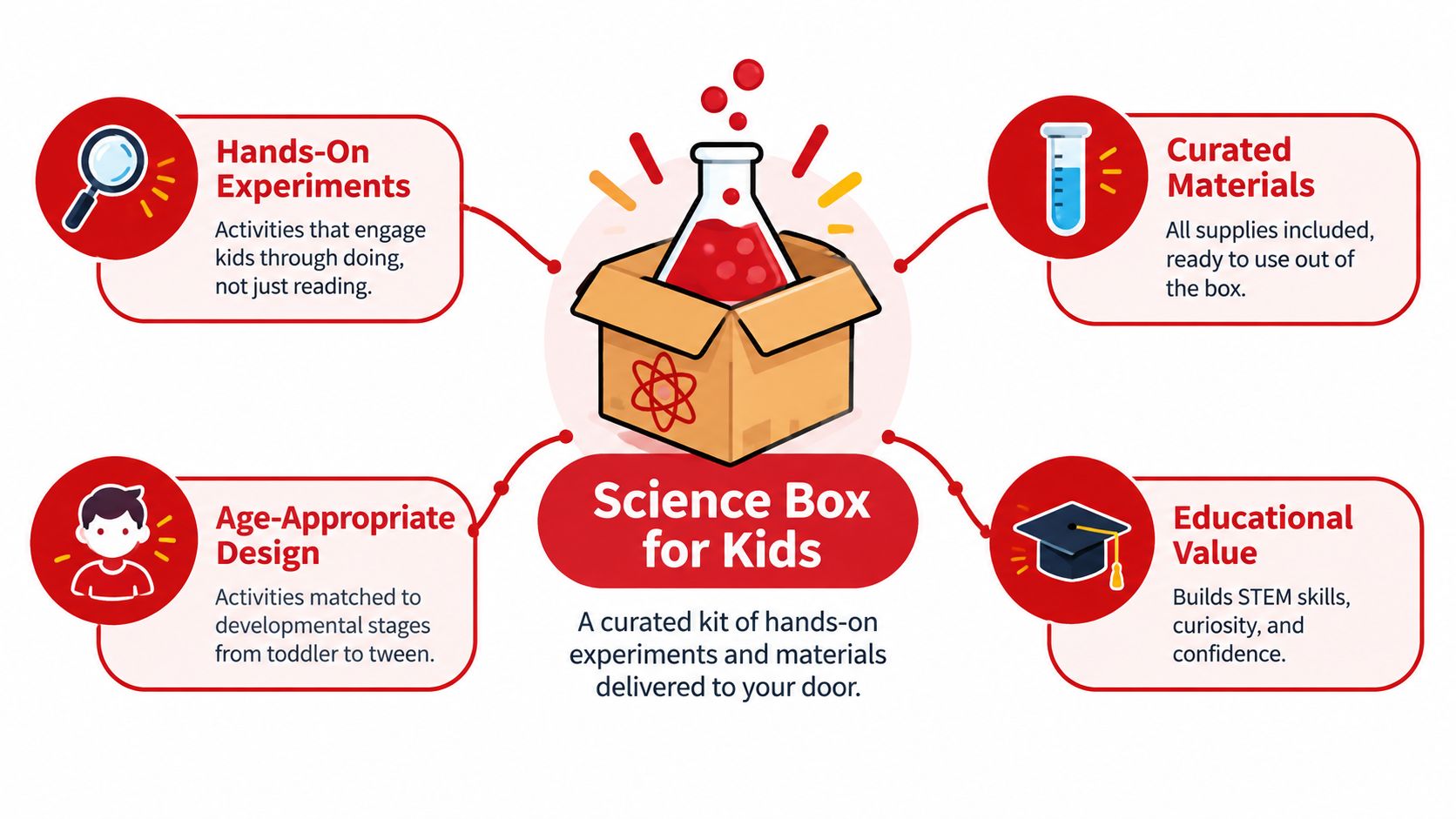
A science box for kids is a deliberately assembled set of materials, activity directions, and questions that helps a child investigate a scientific idea. It gives you a practical way to turn an ordinary afternoon into a small experiment, without having to invent the activity from scratch.
A useful box brings together three core elements:
- A guiding question: What will sink in water? Which material keeps an ice cube cold?
- Materials chosen for the investigation: A bowl, water, test objects, and a way to sort or record results.
- A discussion prompt: What did you notice? Did the result match your prediction? What might explain it?
That final part matters. If a child follows steps and watches something happen, the activity may be entertaining, but the learning can stop there. Asking for a prediction before the experiment and an explanation afterward helps children notice evidence and put their thinking into words.
What belongs in a useful box
The contents depend on the child and the activity. A simple investigation might need only a few household objects, while a themed kit could include tools, prepared materials, illustrated directions, and an activity journal. In either case, the important question is whether the materials help the child test an idea, compare what happens, and talk about what they observe.
A 2009 National Research Council study concluded that children can develop science knowledge and interest outside conventional classroom instruction. It identified six science-learning outcomes, including motivation, understanding scientific concepts and evidence, manipulating and testing ideas, and using scientific language while collaborating (an overview of the National Research Council study). A box can support these outcomes when it invites children to explore real phenomena and return to questions, not just complete a one-time demonstration.
Playz makes science kits designed for hands-on, screen-free play. In that category, a science box is best understood as a ready-to-use invitation to investigate: it supplies a starting point, while the child's questions and an adult's conversation bring the activity to life.
How Children Learn Science Outside the Classroom
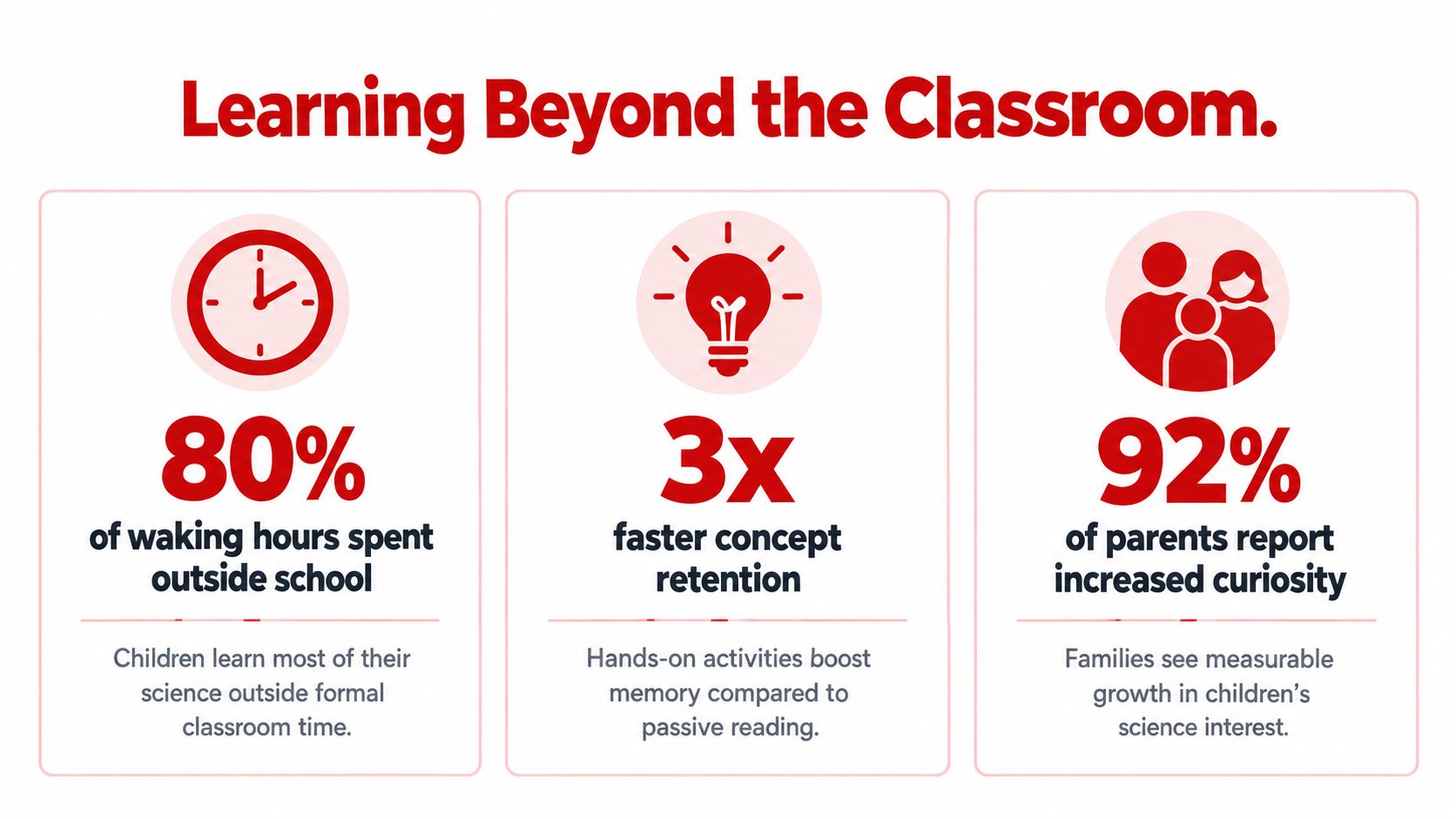
A child drops an ice cube into a warm bowl and watches it shrink. That small moment of curiosity is science learning, and most of it happens far from a classroom. A 2015 National Academies report estimated that school-age children spend 20% of their waking hours in school and 80% outside school. The same report noted that parents said about 70% of available out-of-school programs included STEM activities (National Academies report on out-of-school STEM learning). Home, childcare, after-school settings, and community activities all offer chances to explore.
A science box gives that free time a simple structure. It works like a kitchen paired with a cookbook: the directions help you begin, and the actual learning happens as the child handles ingredients, notices changes, and asks what caused them. Educators call this approach inquiry-based learning, and the cycle stays the same at any age: predict, test, observe, explain. With a ramp experiment, for instance, a child can roll a toy car, change the ramp's angle, and compare how far it travels. The cycle holds whether the materials come from a recycling bin or a prepared kit, though younger children need more adult setup and older children can run the investigation themselves.
Why adult prompts make a difference
Children often need support to turn a surprising result into a useful question. In one fossil-identification study cited in the same National Academies report, children with low parental mediation identified 85% of fossils correctly, while children receiving high mediation identified all of them. The practical lesson: a well-timed prompt helps a child look closely and explain the evidence, while a flat answer ends the thinking.
Try questions such as:
- Before: What do you think will happen?
- During: What changed? What stayed the same?
- After: What evidence helped you decide? What could we try next?
This kind of guided inquiry gives children room to think while keeping the activity manageable. For a water-filtration test, an adult can help a child change only the filter material while keeping the amount of water and the pouring method consistent. The child can then compare results and consider whether the filter made a difference.
Hands-on learning can also support collaboration, whether a child works with a parent, sibling, or classmates. For educators who want to pair science activities with broader group development, these life skills via team activities offer another perspective on learning together. For more practical examples of learning through doing, see Playz's article on the benefits of hands-on learning.
Age-Appropriate Science Boxes from Toddlers to Tweens
The right science box depends on more than the age printed on its packaging. A child's temperament, reading ability, comfort with waiting, and willingness to work with an adult all matter. Use the age range as a starting point, then check what the activity asks the child to do.
Ages 3 to 5
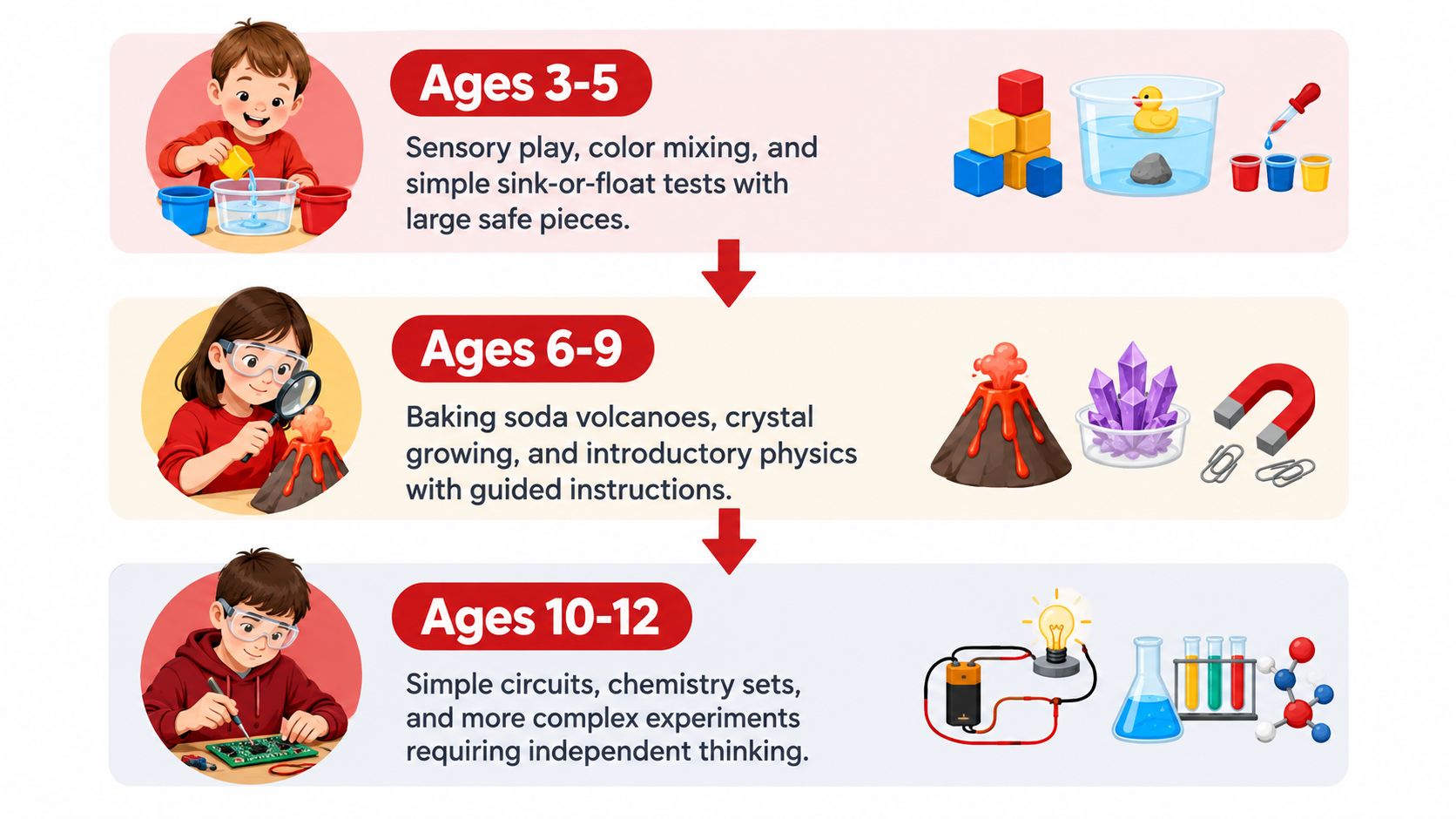
A preschool box should make it easy to explore with the senses. Color mixing, watching ice melt, or testing whether large household objects sink or float can work well with close adult supervision. A four-year-old doesn't need to read a long explanation or record a formal result. They can predict, try the activity, and describe what they see.
Keep small pieces, sharp tools, and activities involving heat out of a young child's reach. An adult should prepare any materials that could be swallowed, splashed into eyes, or handled unsafely. Playz's guide to toddler science toys can help caregivers think about activities suited to younger children.
Ages 6 to 9
Early elementary children can begin comparing results and noticing variables. An eight-year-old might test how a toy car moves down ramps with different angles, or grow crystals while observing changes over time. A good kit uses clear directions but still asks the child to predict, measure, draw, or describe what happened.
This age group can often manage simple recording with adult support. Instead of asking for a formal report, invite the child to make a sketch, sort results into categories, or explain which trial surprised them.
Ages 10 to 12
Tweens may be ready for introductory circuits, more involved chemistry activities, or engineering challenges that require revision. A twelve-year-old might assemble a simple circuit with a battery, wires, and a bulb, then troubleshoot what happens when a connection is loose. Look for activities that encourage independent thinking while keeping any hazardous steps under adult control.
Choosing rule: Pick for the child who'll use the kit, not the age label alone. If the directions are too difficult to read independently, plan to do the activity together.
Classic Experiments That Belong in Every Science Box
A child drops an orange into a bowl of water. It bobs at the surface, and the first question is easy: “What do you think will happen if we try another object?”
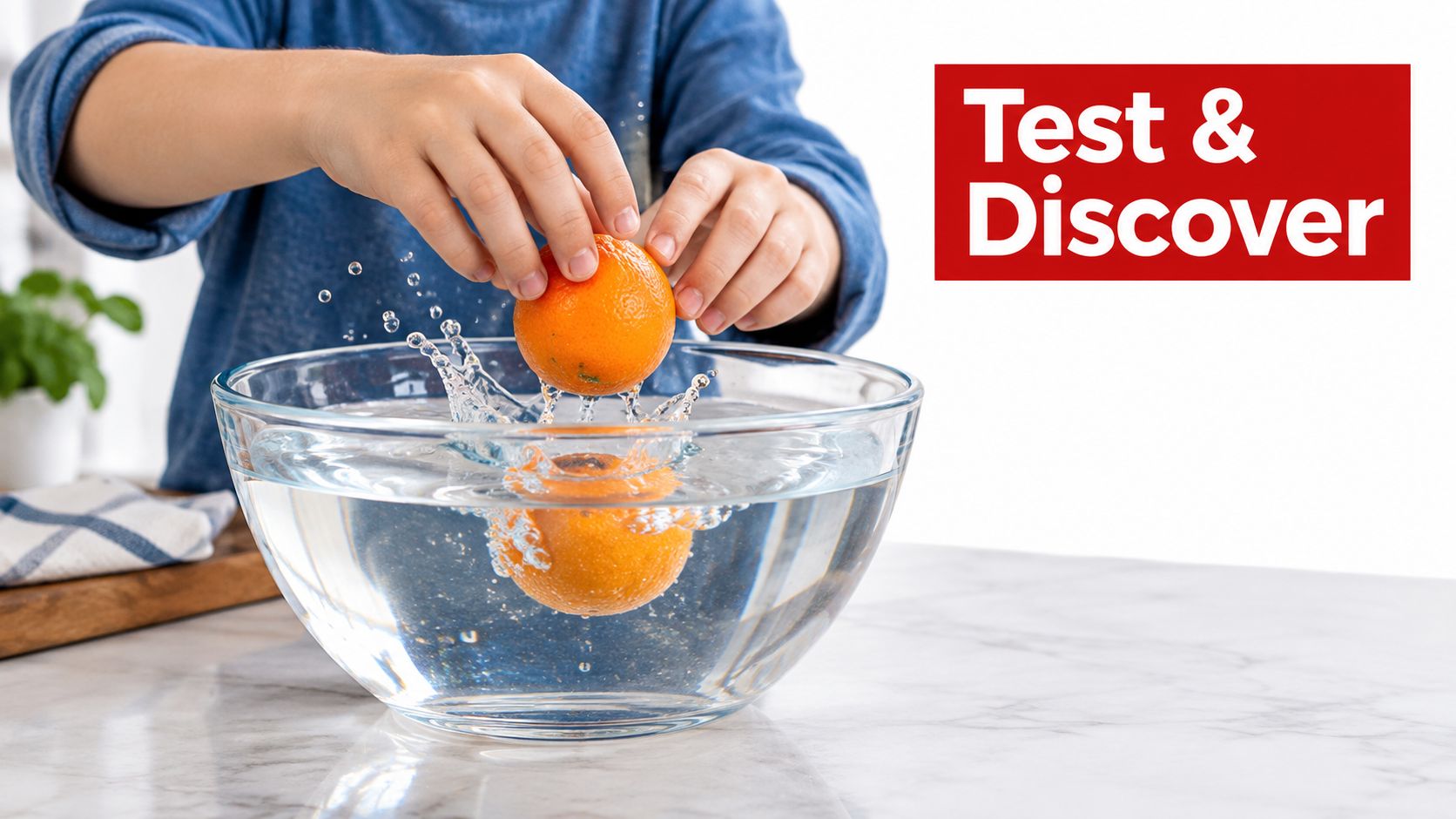
Sink or float
Gather a bowl of water and several objects large enough to handle safely, such as a toy, a spoon, or a large block. Before each test, ask the child to predict whether the object will sink or float. Afterward, sort the objects by result and ask what clues the child used to make the prediction.
The point isn't to guess perfectly. It's to notice that a prediction can be checked against what happens, then revised.
Baking soda volcano
Place baking soda in a suitable container, then add vinegar according to the kit's directions. Ask the child to describe what they see, then invite them to predict what might happen if they change the amount of one ingredient. Use a tray, follow the product's safety directions, and keep the activity away from eyes and mouths.
After the fizzing stops, ask: “What did you observe when the ingredients came together?” For older children, the adult can introduce the idea that the visible bubbles are evidence of a reaction, then connect the vocabulary to what the child saw.
A simple circuit
With an age-appropriate kit, connect a battery, wires, and a bulb as directed. Ask what the child thinks the circuit needs in order for the bulb to light. If it doesn't, help them check the connections rather than fixing it immediately.
For older students ready to build on those skills, these CBE experiential learning ideas for Grades 7-12 provide examples of hands-on activities across subjects. You can also use Playz's guide to the scientific method steps for kids to support a simple routine of predicting, testing, observing, and explaining.
DIY Science Box versus Prepacked Kits
A DIY science box can start with materials you already have at home. A prepacked kit can save you from searching for supplies and planning the directions. Neither is automatically better: the right choice depends on the child, your available time, and how much structure you want.
| Criteria | DIY Science Box | Prepacked Kit |
|---|---|---|
| Cost | Can use household materials, though you may need to buy specific supplies | Price varies by kit and what it includes |
| Prep time | You choose the activity and gather materials | Directions and materials are typically assembled for you |
| Variety | Easy to adapt using objects around the home | Often organized around a theme or set of activities |
| Safety | You're responsible for checking every material and step | Read the label and safety directions; supervision still matters |
| Learning depth | Strong when you add a question, a prediction, and discussion | Strong when the kit supports testing, recording, and explanation |
Which option fits your family
DIY works well when you want to try a simple activity without committing to a particular theme. Testing household objects in water, or comparing how quickly ice melts in different places, can give a child a starting point for asking questions. The adult still needs to choose safe materials and decide how to guide the conversation.
Prepacked kits can be helpful when you want ready-to-use directions, a specific topic, or materials that would be inconvenient to gather. They can also give a less-confident adult a clear path through the activity. But a polished booklet can't replace conversation: pause to ask what the child thinks, rather than treating each step as a recipe to finish.
For a broader look at choosing a kit, browse these science kits for kids and compare the activities with your child's interests and your capacity to supervise.
A practical decision: Start with a DIY activity to see what captures your child's attention. If they want to keep exploring a topic, consider a prepacked kit that offers more structure or materials for continued investigation.
Safety, Materials, and Supervision Essentials
Safe science begins before the first experiment. Check that the activity suits the child's developmental stage, read the directions and labels, and stay close enough to manage any step involving heat, electricity, chemicals, sharp tools, liquids, powders, or small parts. For young children, an adult should control potentially hazardous steps and make sure nothing goes into the mouth or eyes.
Set up a clear workspace with a tray or washable surface, water or cleanup materials nearby, and a plan for disposing of anything the activity produces. Keep materials that aren't in use out of reach. Follow the kit's own instructions rather than improvising with ingredients or equipment.
A quick check before you begin
- Age and ability: Can the child safely handle the materials and follow the activity?
- Parts: Are there small pieces that could be a choking hazard?
- Hazards: Does the experiment involve heat, electricity, or chemicals that require adult control?
- Rules: Have you explained that materials stay away from mouths and eyes?
- Cleanup: Do you know how to contain spills and dispose of materials safely?
A cautious start doesn't make science less fun. It lets the child focus on exploring while the adult stays responsible for the parts a child can't safely manage alone. For activities involving household ingredients, consult the directions in Playz's guide to chemistry experiments at home.
Frequently Asked Questions About Science Boxes
How much does a good science box cost?
Prices vary by the materials, number of activities, and whether it's a one-time kit or recurring delivery. Compare what's included with what you'll use, and consider whether the activities can be repeated.
Can a science box replace screen time?
It can offer a hands-on alternative for some activities, but it isn't a direct measure of equal learning benefit. For children ages 2–5, the American Academy of Pediatrics recommends limiting entertainment media to no more than one hour a day of high-quality programming and encourages adult co-viewing and discussion (AAP guidance on media and young minds).
Is a subscription worth it, or should I buy one kit?
A subscription may suit a child who enjoys a regular new theme and a family that wants activities delivered over time. A one-off kit is a sensible choice if you're testing interest or prefer to choose each topic yourself.
How do we keep the momentum going?
Repeat a favorite activity with a different material, invite your child to change one variable, or keep a simple journal of drawings and observations. The next question can come from the child.
Playz offers science kits for kids focused on hands-on exploration across STEM topics. If you're ready to find a kit that fits your child's age and interests, visit Playz.