

You're standing in the toy aisle comparing a flashing robot with a box of building pieces. Both promise STEM learning, but neither package makes it clear what your child will learn. The useful question isn't which box looks more educational. It's what your child gets to do after opening it.
What STEM Toys Are and Why They Matter
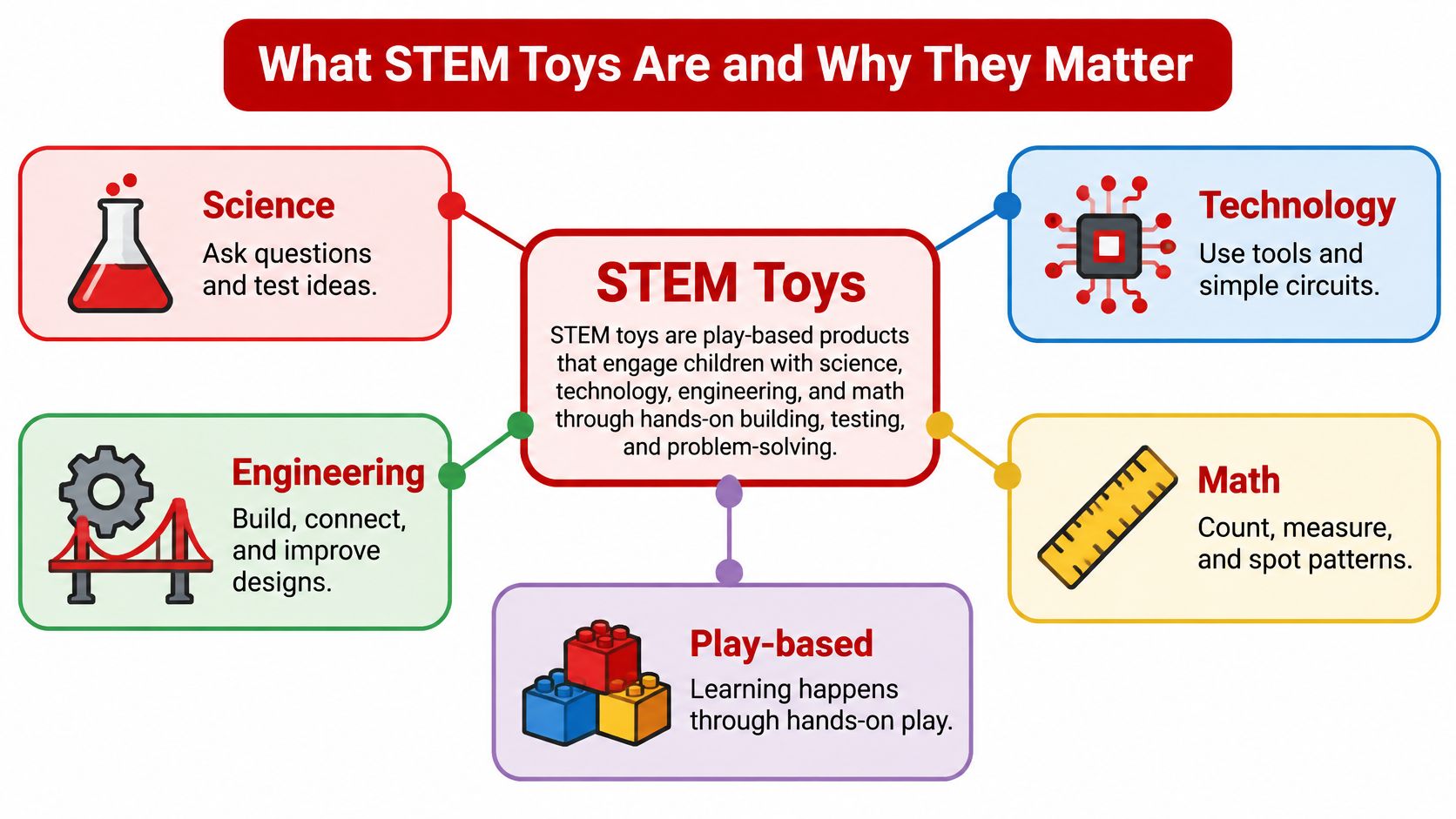
STEM toys are play-based products that engage children with science, technology, engineering and mathematics through building, testing, measuring, coding or problem-solving. A child might investigate why a bridge collapses, program a robot's route or compare how much water different containers hold.
The toy qualifies because it gives the child something to investigate, not because it features planets, laboratory equipment or a correct-answer button. Construction sets, beginner coding tools, robotics activities, experiment kits, measuring games and engineering challenges can all fit this definition.
This concept map connects the subject areas with the actions children take during play.
The subject matters less than the interaction
The U.S. National Science Foundation's history records its adoption of STEM in 2001, replacing SMET and bringing science, technology, engineering and mathematics under a shared label. Those subjects frequently overlap when children play: building a ramp involves engineering, while comparing how objects roll introduces science and mathematics.
You may also encounter STEAM, which includes the arts. This explanation of STEM versus STEAM can help you interpret the terminology without treating either label as a guarantee of quality.
Practical rule: Look for an action the child controls and a result the child can inspect.
A space-themed puzzle may introduce useful vocabulary. A construction challenge goes further when the child can move supports, test a structure and explain why the revised version holds.
Why applying knowledge matters
In the OECD's PISA 2022 assessment, students aged 15 across OECD countries averaged 472 points in mathematics and 485 points in science, according to the OECD's results report. PISA examines whether students can apply knowledge to real-life challenges, rather than relying on memorization alone.
These results don't establish that buying a toy improves achievement. They help explain why giving children meaningful opportunities to use knowledge is worthwhile.
Think of the difference between a recipe card and a working kitchen. The card supplies a finished set of directions; the kitchen lets a child prepare, taste and adjust. Good STEM play makes room for the adjustment.
Skills Each Type of STEM Toy Builds
Read the skills column before the examples column. Each category leads with a main STEM discipline, but the useful match is between what the child enjoys doing and what the activity asks them to practise.
A child who rearranges furniture in a dollhouse may enjoy spatial building challenges. A child who invents routes for toy animals may find programming a floor robot appealing, even without an existing interest in computers.
STEM toy types, the skills they build and examples
| Toy type | Main STEM discipline | Skills built | Example |
|---|---|---|---|
| Construction and building sets | Engineering and mathematics | Balance, stability, spatial reasoning | Interlocking brick sets with gears and beams |
| Beginner coding robots | Technology | Sequencing, debugging, logical thinking | Robots programmed with floor cards or large buttons |
| Experiment and chemistry kits | Science | Observation, controlled testing, recording results | Crystal-growing or colour-change reaction kits |
| Circuit and electronics kits | Science and engineering | Cause and effect, circuit design, troubleshooting | Snap-together circuit kits with lights and motors |
| Measuring and math games | Mathematics | Number sense, estimation, comparison | Balance scales, unit blocks and measuring cups |
| Mechanical model kits | Engineering | Gears, levers, force, following a plan | Model steam engine or vehicle kits |
| Loose parts and tinkering materials | Engineering and science | Design, testing, collaboration, flexible thinking | Tubes, connectors, cardboard and recycled containers |
Watch the child's work, not just the finished object
With construction sets, a child rotates beams, checks connections and decides where a support belongs. The National Association for the Education of Young Children's guidance on STEM play describes tinkering through observing, predicting, testing, balancing, stabilizing and improving designs.
A coding robot makes sequencing concrete. When the robot turns before reaching its destination, the child checks the commands and changes their order. Debugging means finding the instruction that produced the unwanted result, not merely pressing restart.
With an experiment kit, useful work includes noticing a change, drawing what happened and comparing conditions. Keep investigations within the kit's directions; open-ended thinking doesn't mean improvising with chemicals.
A circuit kit makes connections inspectable. If a light won't turn on, the child can trace the path, inspect component placement and test a correction. A balance scale offers a different kind of feedback: the child estimates, adds an object and checks which side drops.
Mechanical models connect moving parts to a visible job. For educators pairing models with written work, Teacher Planner's guide to choosing science worksheets for mixed-grade classes offers a useful planning resource for follow-up tasks about simple machines.
Loose parts leave the purpose open. Children can negotiate whether a cardboard structure needs a doorway, a stronger roof or a longer tunnel.
The categories overlap. A robot can involve construction, circuits and programming, while a model vehicle can involve measurement and mechanics. Choose the skills your child will use, not the longest list printed on the box.
How Play Turns Into Learning Through Testing
A child stacks a narrow tower and expects it to stand. It tips sideways, so the child spreads the bottom blocks farther apart and tries again. The important achievement isn't the taller tower; it's the connection between a change in the design and a change in the result.
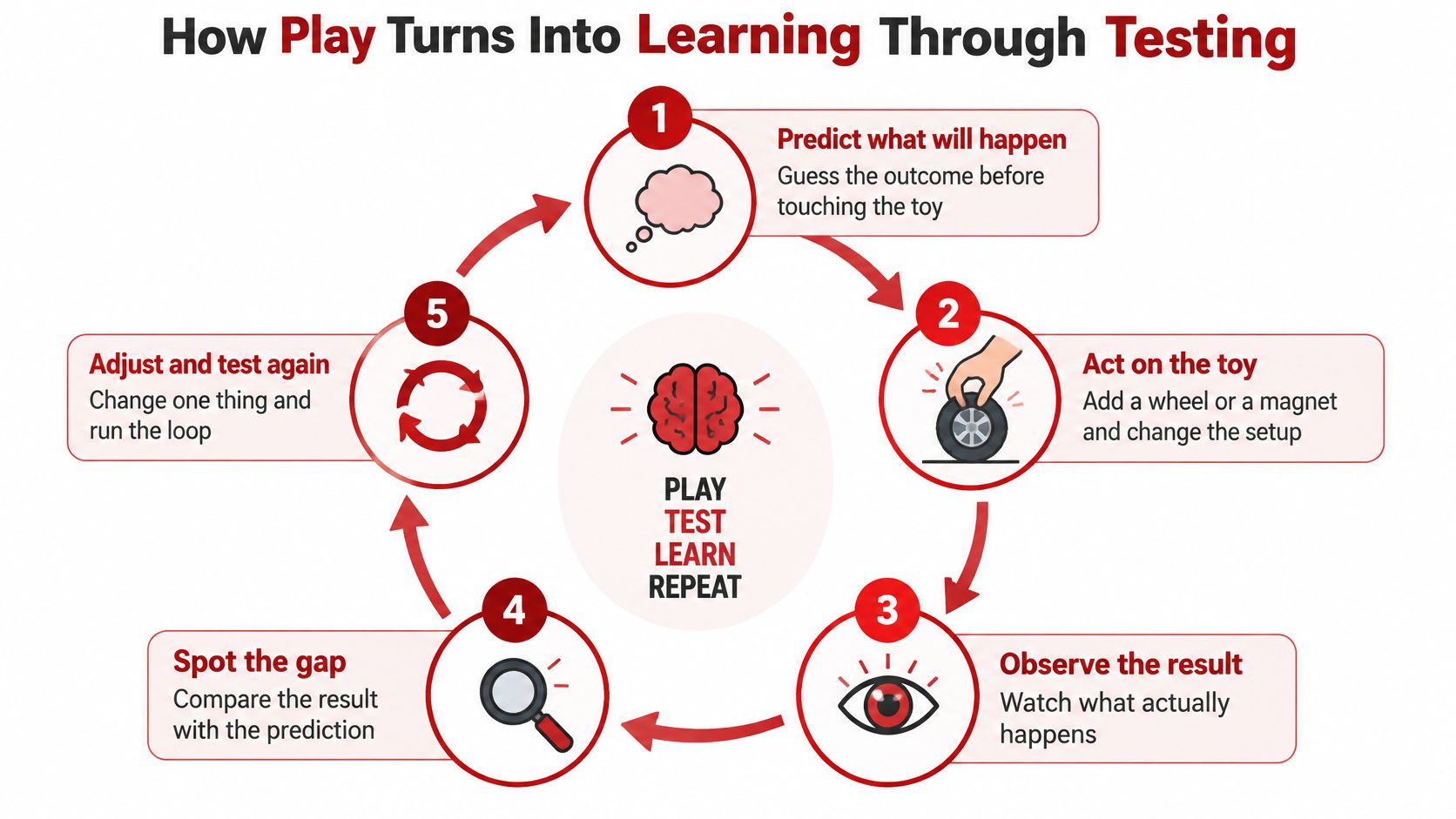
The testing loop makes that connection visible.
Give the child time to notice the surprise
The loop has a simple sequence:
- Predict. Decide what might happen before trying.
- Act. Add a wheel, move a support or change the setup.
- Observe. Watch what happens.
- Compare. Notice the difference between the prediction and the outcome.
- Revise. Change the design and test again.
NAEYC's guidance on classroom STEM projects includes testing solutions and evaluating designs within engineering play. Adults can support that work by pausing before fixing a problem and asking the child to identify what happened.
For the tower, ask whether it leaned, slid or broke at a connection. Each observation suggests a different next attempt. Photographing the original and revised structures can help a child explain a change without needing to write.
A useful benchmark is whether the toy supports design or build, test or measure, and explain or redesign. Also check whether you can introduce a harder challenge without replacing the entire toy.
For a child-friendly way to name these actions, use the scientific method steps for kids.
What loose-parts play adds
In a study of young children's loose-parts play, children constructed structures, explained how objects worked, communicated goals and explored mathematical ideas more often than when playing with toy percussion instruments; their overall STEM Engagement Score was also higher. That comparison supports looking closely at the behaviours materials invite, rather than assuming all hands-on play serves the same purpose.
Try a hypothetical tower challenge: build something that remains standing for 30 seconds. Let the child predict the result, use a timer, inspect any collapse and choose a revision.
Open-ended toys compared with single-outcome kits
| Feature | Open-ended toy | Single-outcome kit |
|---|---|---|
| Number of correct solutions | Many, chosen by the child | One intended result |
| Main action for the child | Constructing, testing, explaining | Following numbered steps |
| Adult role | Asking questions and prompting revision | Checking the finished model |
| Lifespan | Rebuilt again and again | Usually finished after one project |
| Best use | Design thinking and collaboration | Learning one specific mechanism quickly |
These are starting distinctions, not rigid limits. A guided kit can be the better choice when you want to introduce a particular mechanism efficiently, and its finished model can still prompt useful investigation.
Use the video as a shared viewing prompt, pausing to discuss predictions and possible changes.
Think of a baker tasting a loaf and adjusting the recipe. Following directions produces something; examining the result helps the baker decide what to do differently.
Matching STEM Toys to Each Age Band
Start with the row nearest your child's age, then check the actual demands. Can your child grip the connectors, interpret the pictures and stay with the opening task? Age bands are starting points for choosing a challenge, not fixed limits on learning.
Safety labels serve a different purpose. Don't move a child into a product with unsuitable parts just because they understand the underlying idea.
STEM toys by age band
| Age band | Typical focus | Starter toy types | Watch for |
|---|---|---|---|
| Ages 3–5 | Cause and effect, sorting, simple building | Large interlocking blocks, ramps, age-labelled marble runs and magnet sets | Small parts; choose labels that state the age and check for choking hazards |
| Ages 6–8 | Sequencing, measuring, following a build plan | Step-by-step construction sets, tangible block coding, simple circuit kits | Instructions that need more reading than the child can manage |
| Ages 9–12 | Multi-step projects, controlled experiments, programming logic | Experiment kits with logs, text-light robotics, gear and lever models | Kits that give one fixed result and no room for redesign |
| Ages 13 and up | Systems design, text-based coding, electronics, data analysis | Microcontroller kits, Python robotics, advanced engineering sets | Large skill gaps that cause frustration; choose projects with clear milestones |
For preschoolers, make the relationship between action and outcome easy to see. A broad ramp and a large rolling object let the child concentrate on motion rather than struggle with assembly. This guide to STEM toys for preschoolers can help you consider suitable formats.
Keep small parts away from children under age 3, including younger siblings sharing the space. Marble runs and magnet sets need particular care: choose an explicitly age-appropriate product, check for loose components and avoid accessible small magnets.
Adjust challenge without overriding safety
For early school-age children, a visible build plan can provide a satisfying destination. If reading interrupts every step, picture instructions or adult reading support may reveal that the child can manage the construction itself.
Older children can take more responsibility for planning and recording. An experiment log might include a sketch, a prediction and the condition they changed. A teenager starting electronics may still need a beginner project, even if the packaging looks younger than their interests.
Match the intellectual challenge to the child's ability, and keep the product's safety restrictions intact.
Use this challenge check:
- Step up when the child wants more. If they finish a kit in a sitting and ask for another challenge, consider the next band's activities, provided the product remains age-safe.
- Step down when the opening task defeats them. If they abandon the activity before reaching its first meaningful milestone, simplify the task or choose an easier format.
Interest can justify a more ambitious project with support. It can also justify staying with familiar materials and inventing harder goals. Reread the table with your child's current age, favourite activities and recent frustrations in mind.
Myths, Limits and Who Can Use STEM Toys
A STEM label doesn't guarantee learning. A child can complete an impressive-looking model by copying pictures without understanding how it works. Ask them to demonstrate what a component does, rather than treating completion as proof of understanding.
A systematic review of STEM toys identifies potential support for problem-solving, critical thinking and verbal communication while emphasizing teacher preparation and accessible learning opportunities. The practical implication is to choose both the materials and the support the child needs to use them.
Electronics and universal-fit claims can mislead
Lights, sounds and digital rewards may attract attention without giving a child meaningful decisions. Blocks can offer richer investigation than an electronic toy that accepts only predetermined responses. Conversely, a programmable device can be useful when the child controls its behaviour.
The other misleading assumption is that the same toy suits everyone. Work on access and participation in STEM play highlights equity, inclusive interventions and the importance of children seeing themselves as participants in STEM.
Adapt the route into the activity:
- Reduce sensory load. Choose quiet materials or switch off optional sounds so the child can concentrate.
- Ease physical demands. Offer larger connectors and a stable work surface when small fittings create a barrier.
- Lower reading demands. Use picture sequences, demonstrate an action or let the child explain aloud.
- Make collaboration accessible. Share roles such as designer, builder and tester without assigning the same child the least demanding job.
- Use available materials. Clean cardboard tubes and recycled containers can become building resources after you remove sharp edges and unsuitable pieces.
Balance the benefits and costs
Pros include hands-on iteration, opportunities to explain ideas and practice with skills that apply beyond the toy. Cons include purchase cost, frustration when the task is poorly matched and the adult time needed to support some activities.
Use a children's toy-safety checklist alongside your learning criteria. A stimulating activity still needs suitable materials, appropriate supervision and a manageable setup.
A toy can create an opportunity to learn. It isn't an automatic substitute for teaching, conversation or responsive adult support.
Frequently Asked Questions About STEM Toys
Are STEM toys only for children who like science?
No. A child who loves pretend restaurants might enjoy weighing ingredients, while a vehicle enthusiast might prefer designing a bridge. Choose a familiar interest as the entry point instead of asking the child to adopt a science identity first.
Do STEM toys need screens or batteries?
No. Blocks, ramps, loose parts and measuring games can provide useful STEM experiences without electronics. Choose a powered feature when it adds something the child can control or investigate, not because technology appears in the subject's name.
What age should a child start?
Begin with safe materials that match the child's current abilities, rather than waiting for formal school science. Use the age bands as guidance, then increase the challenge when the child finishes eagerly or simplify it when the opening task causes repeated frustration. Never use ability as a reason to disregard a safety age label.
Are STEM toys worth the price?
They can be when the child returns to them, uses their features and finds fresh challenges. Before purchasing, consider what the price provides: reusable components, a mechanism you can't easily reproduce, or convenient experiment materials. Cardboard tubes and recycled containers offer a low-cost way to try building challenges before investing in a specialised set.
Do STEM toys close gender gaps?
Not automatically. Packaging has affected how girls and boys learned a belt-drive principle, so branding shouldn't determine which child receives an engineering opportunity. Offer activities around individual interests and make room for every child to build, troubleshoot and lead.
Buying takeaway: A worthwhile toy gives your child a reason to return, not just a reason to open the box.
Choose Your First STEM Toy With a Simple Checklist
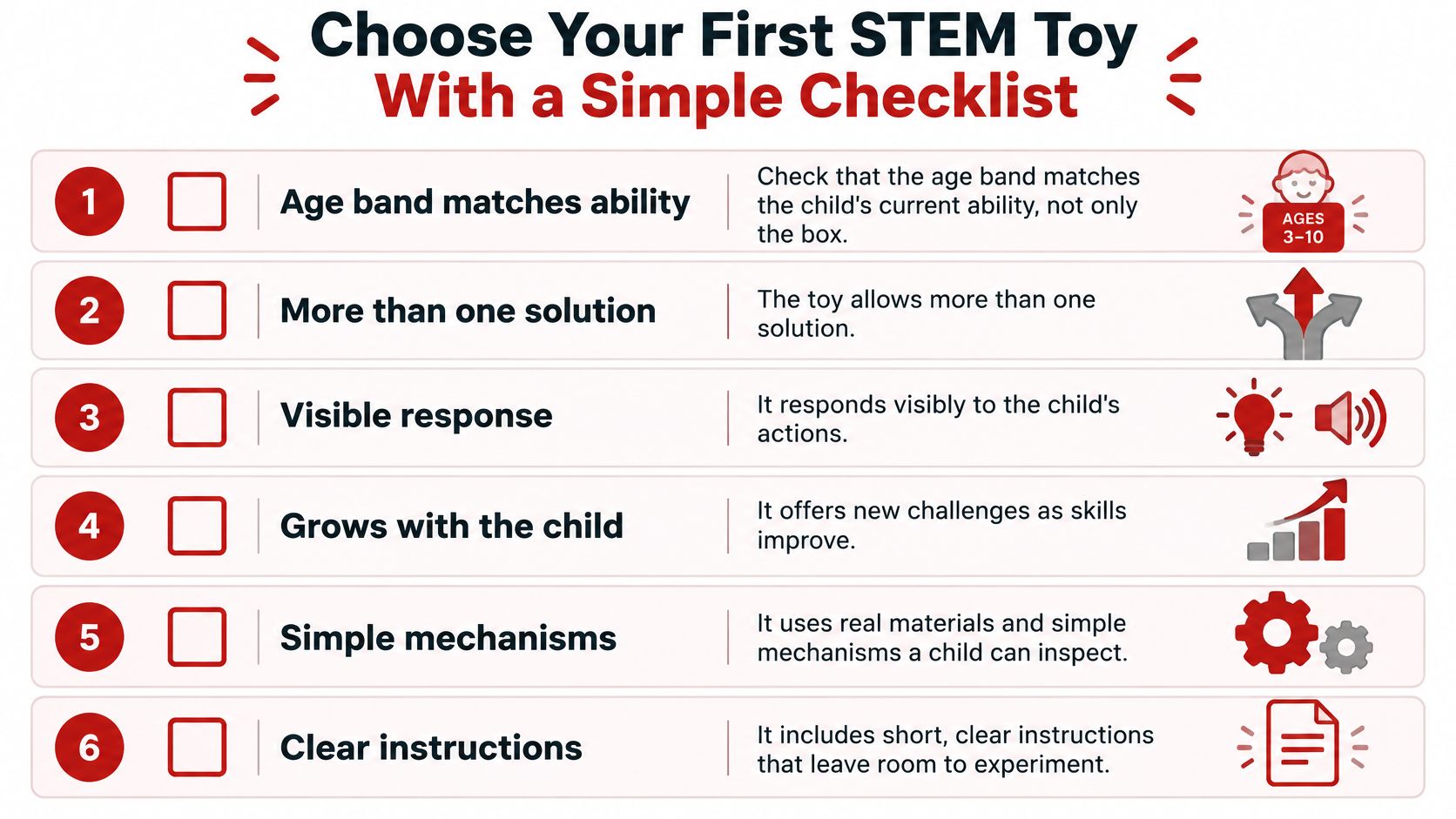
- Match ability and age safety. Check the child's current skills alongside the stated age range. Neither should be ignored.
- Look for more than one solution. Prefer materials that permit an alternative design, route or challenge after the introductory activity.
- Check for visible feedback. The child should be able to inspect what changed when they acted.
- Make room for prediction, testing and revision. Look beyond assembly instructions for opportunities to investigate and improve.
- Follow interests, not gender-coded packaging. A study published in Child Development found that girls learned a belt-drive principle more effectively with the BobbyBlox presentation than GoldieBlox, while boys showed the reverse pattern. Choose the challenge rather than assuming colours or characters identify the right learner.
- Check labels and safety compliance. Read warnings, supervision requirements and setup directions before purchase. Our Playz toys meet and exceed all USA CPSC Toy Safety Guidelines; you should still follow each product's age and use instructions.
Keep this visual checklist nearby while comparing options.
For further selection guidance, explore our guide to educational STEM kits. Our products are designed in the USA, but the most useful purchase decision still starts with the child: choose something they can enter confidently and investigate with growing independence.
We offer Science Kits, Model Kits and Engineering activities at Playz, giving families ways to explore scientific ideas and working mechanisms through hands-on play. Browse the science and model kits, choose a toy to try this month, and use the checklist to judge what your child builds, notices and changes.