

Picture a kitchen table, a row of cups, and a child who has just been told the milk is about to move on its own. You set down a cotton swab touched with dish soap, the colors bolt across the surface, and for one second nobody breathes. That pause is the whole point. Surprise buys attention, and attention is what makes an explanation stick.
Science magic has been doing that job for a very long time. A review of educational magic-based interventions traces the tradition back at least to the first century CE, when Hero of Alexandria built temple doors that opened on cue and vessels that poured wine on command, driven by air pressure, fluid movement, and mechanical linkages. Your kitchen version runs on the same logic: an impossible-looking effect, then a plain-language cause.
Every trick below comes with what it teaches, a prediction prompt to ask before the reveal, an honest time commitment, and a mess-and-safety rating, so you can pick one that fits your afternoon. Some take ten minutes and wipe clean. Two need overnight patience. One needs a stove, with your hands only near the heat. If your child likes holding the evidence rather than just watching it, follow a demo with a hands-on mineral experience for kids and let them crack a real geode open afterward.
1. Elephant Toothpaste Foam Eruption
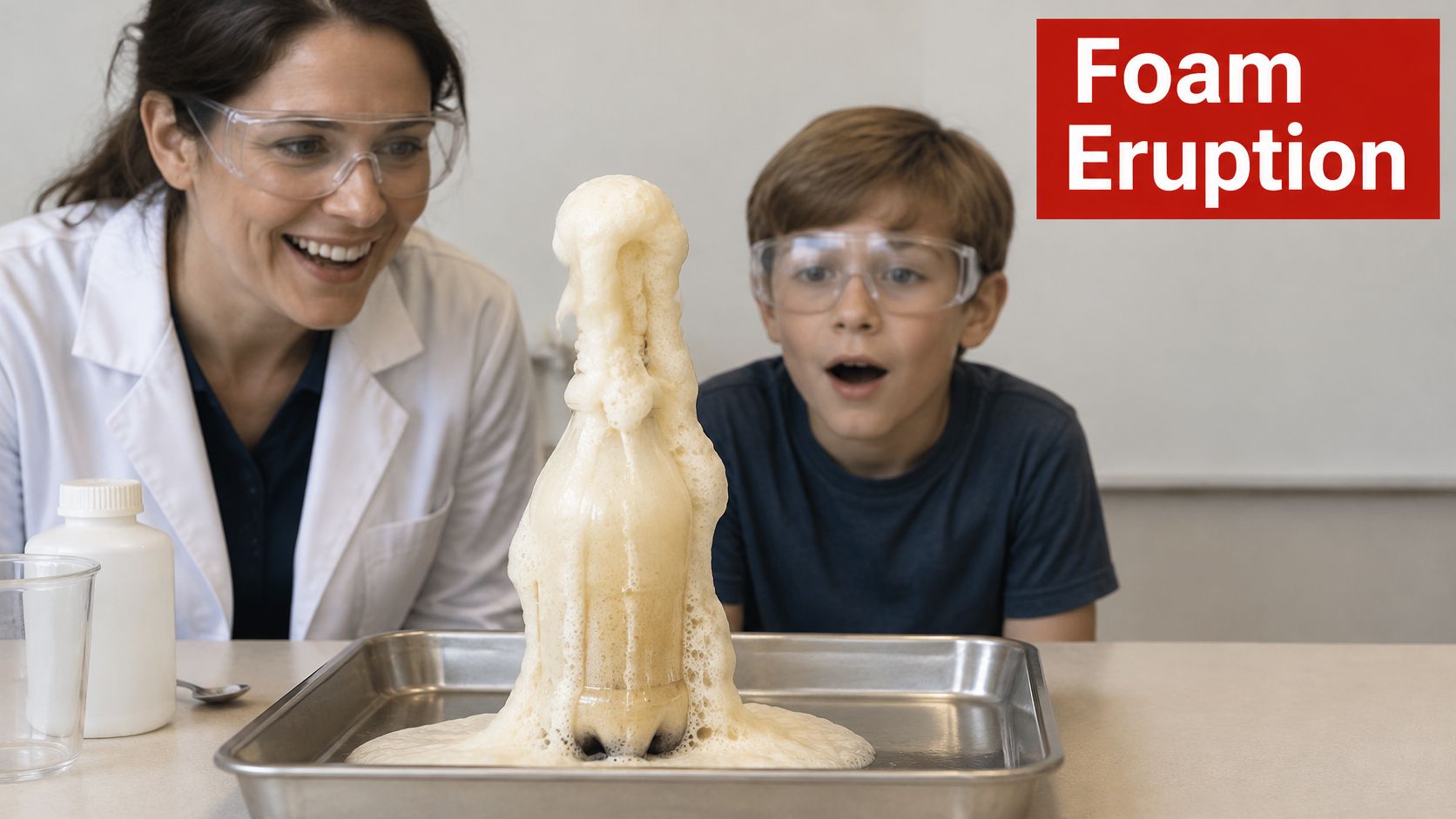
Time: 15 minutes. Mess: high, so set the bottle on a tray. Safety: moderate, and an adult pours.
A warm column of foam climbs out of the bottle in about three seconds. Hydrogen peroxide is breaking down into water and oxygen. A catalyst, either dry yeast slurried in warm water or potassium iodide, speeds that breakdown, and dish soap traps the escaping oxygen into thick foam.
The Setup That Works Every Time
- Use 3% hydrogen peroxide only. Higher concentrations burn skin and eyes, and nothing here needs them.
- Bloom the yeast first. Stir it into two tablespoons of warm water and let it sit 30 seconds so the foam starts on contact.
- Soap goes in before the catalyst. A generous squeeze of dish soap and a drop of food coloring go into the peroxide, not the yeast cup.
Prediction prompt: "Will the bottle feel warm or cool when the foam comes out?" Most children guess cool. The foam is warm, because splitting the peroxide molecule releases energy.
Explain the Reveal, Don't Just Enjoy It
The explanation is what turns a show into a lesson. In a controlled online study of 198 adults, participants watched one of two near-identical videos about the Apollo Moon landings, and one version contained specially designed card tricks. The magic group rated the lesson more interesting, informative, and absorbing, but the two groups did not differ in factual recall, as the PeerJ study on magic in science education reports. Attention and memory are separate doors, and only one of them opens on surprise alone.
For a step-by-step path from this eruption into reaction types and gas properties, work through these chemical reaction experiments for kids.
2. The Naked Egg Osmosis Trick
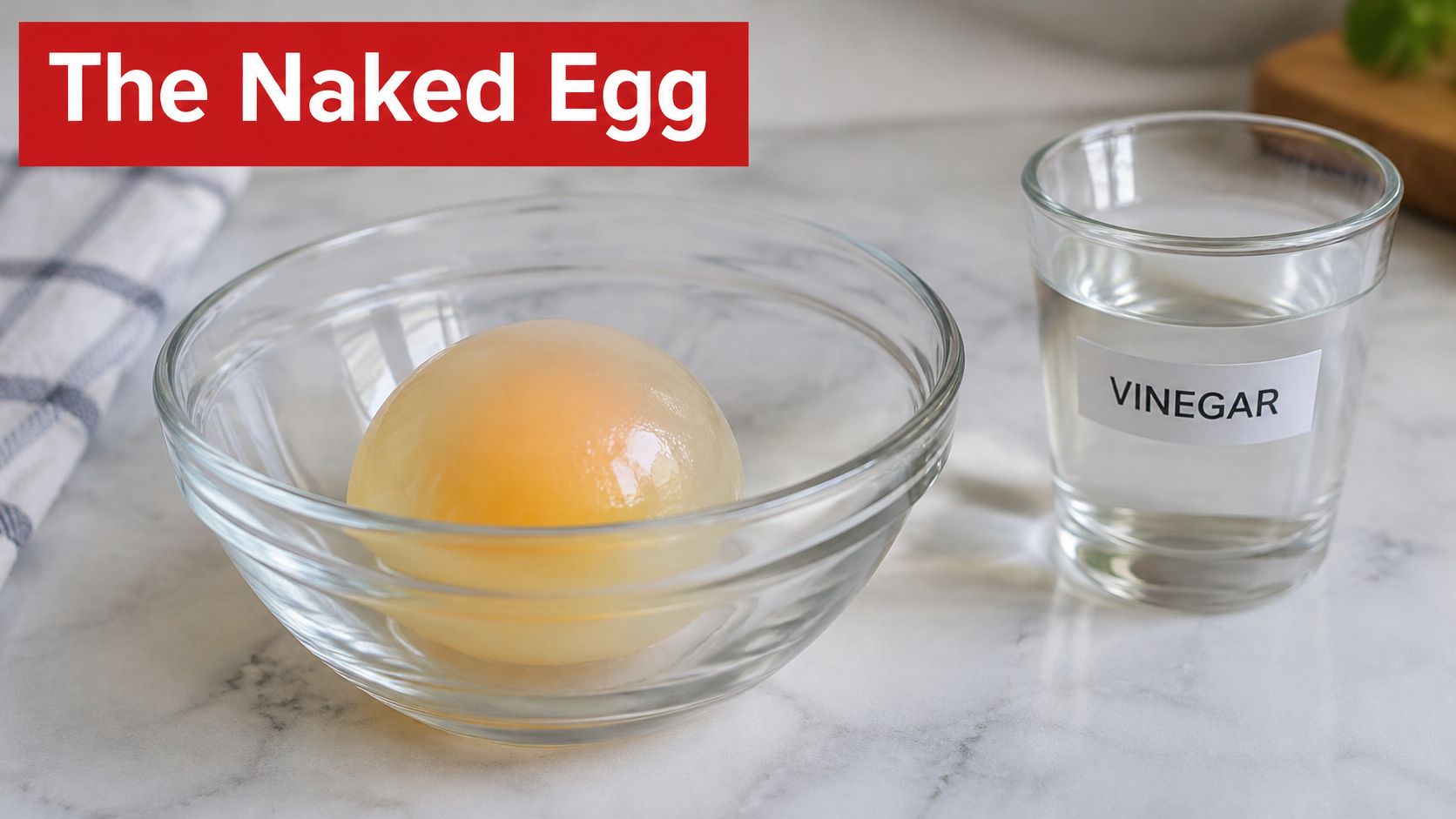
Time: three days, with about ten minutes of real work. Mess: low. Safety: low, though everyone washes hands after touching a raw egg.
This is the trick with the longest wait and the biggest payoff. Cover a raw egg in white vinegar and bubbles start crawling up the shell within minutes. Two days later the shell is gone and a rubbery, translucent egg sits in the bowl, still holding its shape.
What Happens Over Three Days
- Day one. Acetic acid in the vinegar reacts with calcium carbonate in the shell. Change the vinegar after 24 hours if the bubbling slows, so the reaction keeps moving.
- Day two. Rinse the egg gently under a tap. The membrane underneath stays intact, and the egg now feels like a bouncy ball.
- Day three. Measure around its widest point with a string, then drop it in water and measure again the next morning. Water crosses the membrane into the egg and it swells.
Prediction prompt before the second liquid: "If we put the egg in corn syrup, will it get bigger or smaller?" Corn syrup draws water out and the egg shrivels. Plain water pushes it back the other way, which is the visible proof that the membrane is choosing a direction.
Why a Magic Trick Belongs in a Biology Lesson
A controlled high-school science study compared a magic-based analogy for active and passive transport across cell membranes with a conventional story analogy. The two approaches produced comparable learning outcomes, but students reported greater engagement with the magic-based cell transport activity. The lesson lands when the illusion maps to a mechanism, so let the egg stand in for a cell and let the shrinking and swelling carry the idea of osmosis rather than a diagram.
Extend the same reasoning with a gummy bear osmosis lab and compare which material changes size faster.
3. Magic Milk Color Explosion
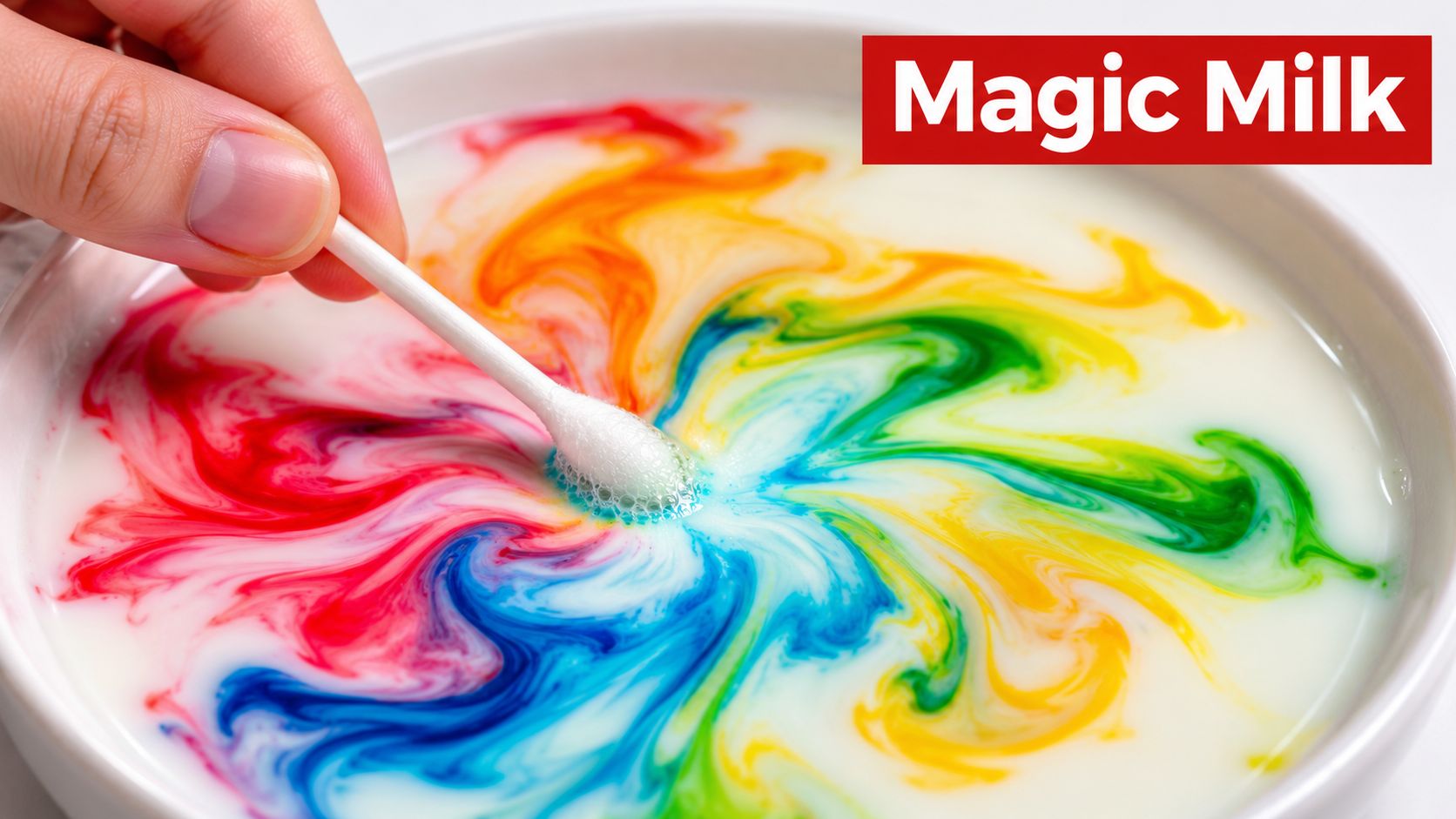
Time: 10 minutes. Mess: medium, so use a rimmed tray. Safety: low, but the bowl stops being a snack the moment soap goes in.
Pour whole milk to cover the bottom of a wide dish and leave it out for ten minutes so it reaches room temperature. Add drops of food coloring in a loose circle, then touch a cotton swab dipped in dish soap to the center and hold it still.
Why the Colors Run
The dye isn't moving under its own power. Dish soap lowers the surface tension where it touches and interacts with the fats in the milk, so the surface shifts and drags the colors along with it. A science activity overview describes the standard children's setup as milk, several drops of food coloring, and a cotton swab touched with dish soap. What you're seeing is invisible flow made visible.
Prediction prompt: "Which way will the colors move, toward the swab or away from it, and which color gets there first?"
Turn It Into a Real Test
Pour three dishes and hold everything constant except the milk: skim, whole, and cream. Same dish size, same volume, same number of dye drops, same touch of soap.
Practical rule: Change one thing per bowl. Swap both the milk and the soap and you get a pretty mess with no explanation.
Whole milk at room temperature gives the boldest swirl, because more fat gives the soap more to work against. Skim milk still moves, just thinner and faster, which is worth pointing out to a child who expects the boring bowl to do nothing.
4. Dancing Raisins Carbonation Trick
Time: 10 minutes. Mess: low, one sticky glass. Safety: none.
Fill a tall glass with cold, clear lemon-lime soda and drop in five raisins. Nothing happens for a beat. Then one rises, hits the surface, drops back, and the whole glass starts to move.
Why the Raisin Dances
Carbon dioxide bubbles need a rough place to start. The wrinkled skin of a raisin is covered in tiny pockets that collect gas, and once enough bubbles cling to one raisin, that raisin plus its bubbles weighs less than the soda it displaces, so it floats. At the surface the bubbles pop, the raisin gets heavy again, and down it goes. It's the same rough-surface physics as the mint-and-soda fountain, where a classroom paper on teaching science with magic identifies the mint's textured surface as the factor that liberates carbon dioxide from the drink. Same mechanism, much gentler glass.
Prediction prompt: "Will the first raisin float the second it hits the soda, or sink first?" Then, after a minute of watching: "What would happen in still water?"
Bubbles need a rough surface to grab. A smooth object gives them nowhere to start.
Two Variations Worth Running
- Swap the liquid. Sparkling water holds less dissolved gas, so the raisins barely lift. Club soda lands in between.
- Change the object. A smooth dried cranberry collects fewer bubbles and moves less than a raisin, which makes the surface texture the star of the experiment.
Drop the raisins in gently and use a tall, narrow glass. A hard drop knocks the bubbles off before they can lift anything.
5. Walking Water Capillary Rainbow
Time: 15 minutes tonight, results by morning. Mess: low. Safety: none.
Line up five clear glasses. Fill the first, third, and fifth with water tinted red, yellow, and blue. Leave the second and fourth empty. Roll paper towels into loose tubes and bridge each pair of neighbors, so every glass touches paper on both sides.
Set It Up Tonight
- Plain paper towels only. Printed or treated towels shed dye and block the flow.
- Equal water levels. Even amounts keep the transfer balanced, so no cup runs dry hours ahead of the others.
- Primary colors in the filled cups. The empty cups turn green and orange, which builds in a color-mixing lesson for free.
Prediction prompt: "Which empty cup will fill faster?" Ask them to sketch the setup and the predicted colors, then check the sketch against what happens in the morning.
Why It Works, and Who It Suits
Water climbs the paper fibers through capillary action, held by adhesion to the paper and pulled along by cohesion between water molecules. That's how a plant draws water from root to leaf. If your child finds fast, loud reveals hard to process, this is the trick to pick. A review in Education Sciences on inclusive science magic notes that magic can support engagement for learners with disabilities because tricks combine visual, auditory, tactile, and kinesthetic elements, and it stresses adapting activities to age and cognitive ability. A quiet, slow, visually clear demonstration removes the surprise pressure and leaves the mechanism in view.
Run the same idea with celery stalks and these celery color experiment ideas.
6. Cartesian Diver Pressure Demonstration
Time: 15 minutes. Mess: low, water only. Safety: low.
Squeeze a sealed bottle and a small diver inside drops to the bottom. Release and it climbs back. No batteries, no moving parts, and the whole thing costs less than a candy bar.
Build a Diver That Behaves
- Start with a pen cap with the clip snapped off, or a ketchup packet from a diner.
- Add modeling clay to the open end until the diver just barely floats at the top, nose up.
- Fill the bottle to the rim with water tinted by a drop of food coloring, then cap it tightly.
Prediction prompt: "Squeeze the bottle. What happens to the diver, and why?" Most children say it will rise. It sinks, and the reason lives in the air inside the diver, not in the plastic.
Why Squeezing Sinks It
Squeezing raises the pressure throughout the sealed bottle and the air bubble trapped in the diver compresses. Its volume shrinks, the diver as a whole becomes denser than the water around it, and it sinks. Let go and the air expands again, displacing more water, so the diver rises. That's Boyle's law in a bottle.
Troubleshooting: If your diver always floats, it holds too much air, so add a little more clay. If it sits on the bottom and won't rise, take some clay off.
Build two divers with different amounts of air and run them side by side. A useful demonstration has one observable variable, one control, a prediction prompt before the trick, and a reveal that names the hidden cause, which is the design standard the study of magic-based educational video sets out.
7. Hot Ice Supersaturated Solution Trick
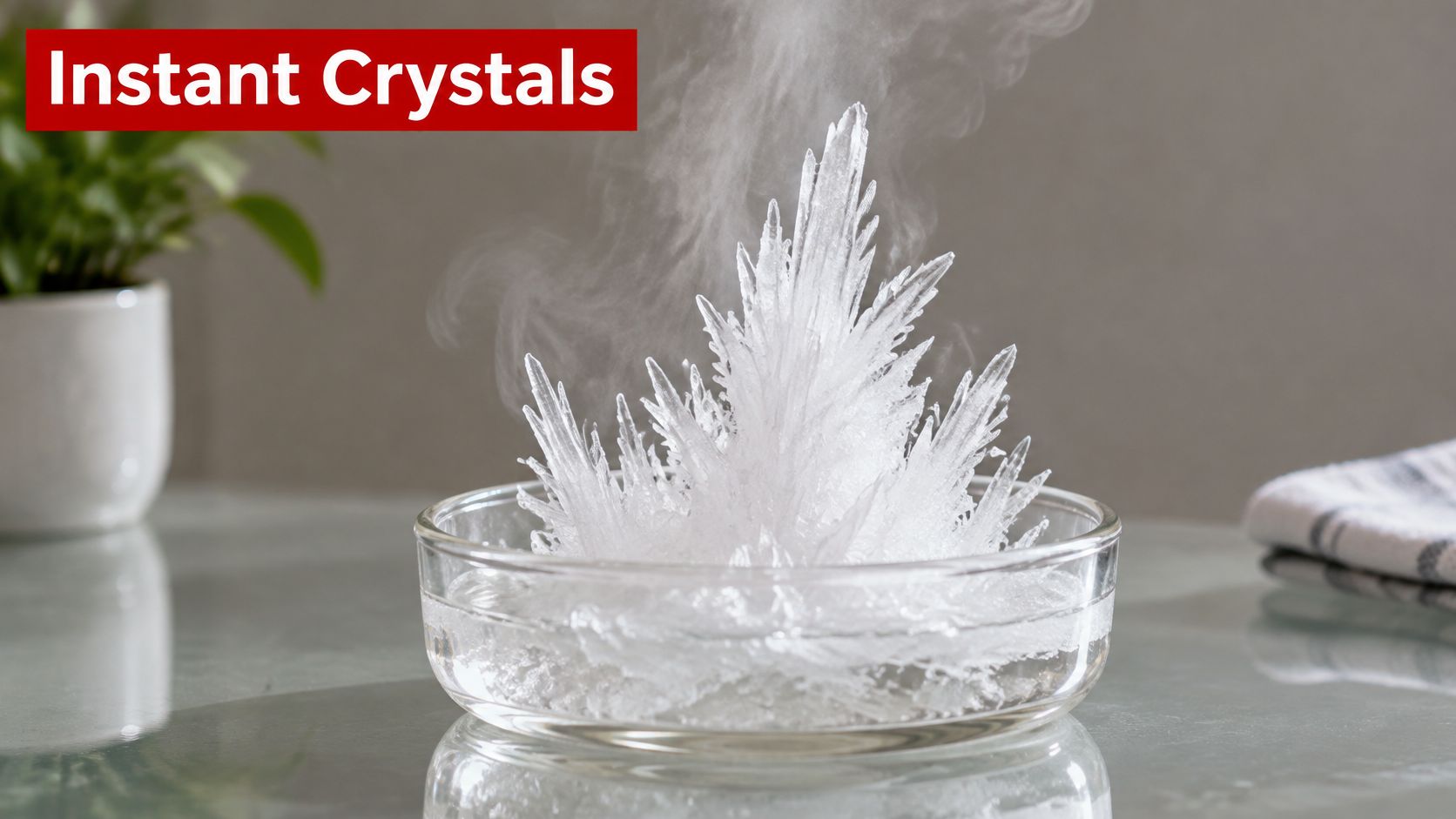
Time: 30 minutes of heating plus 30 to 45 minutes of cooling. Mess: medium, hard crystals that sweep up easily. Safety: high, because of the stove and hot liquid, so an adult handles every step near heat.
Pour a bowl of clear liquid, drop in one tiny crystal, and it spreads solid across the surface in seconds, warm to the touch.
Getting the Solution Right
Sodium acetate trihydrate is the chemical, sold as reusable heat packs and hot ice. Melt it gently in a heatproof glass bowl with a spoonful of water, stirring until the liquid is completely clear and no crystals are stuck to the sides. Then stop touching it and let it cool undisturbed to room temperature. Any jolt or stray grain during cooling starts crystallization early.
The Reveal and the Reason
Supersaturated sodium acetate stays liquid below its normal crystallization point until something offers the molecules a template. One seed crystal does it, and the bowl solidifies outward from that spot, releasing heat as it hardens, which is why the crystals feel warm in your hand. That release is the giveaway that this is an exothermic change and not just freezing.
Prediction prompt: "Will the bowl get warmer or cooler as it turns solid?" Then: "Can we turn it back into liquid?" Gentle reheating resets it, so the trick is repeatable for a second audience.
Safety in plain terms. A state science safety guidance document from Rhode Island's Department of Education requires a responsible adult to supervise activities when the teacher recommends it, and it calls for specific guidance on heated objects, flames, and breakable items, with eye protection for activities involving chemicals. Keep children at arm's length during heating, use a heatproof bowl, and let the crystals cool to merely warm before anyone touches them.
Keep the crystal habit going with these crystal growing experiments.
8. Invisible Lemon Juice Ink Reveal
Time: 20 minutes plus drying. Mess: low. Safety: moderate, because of the heat source.
Hand a child a blank sheet of paper and tell them the birthday message is already on it. Write with lemon juice and a cotton swab, let it dry completely until the paper looks untouched, then warm it and brown letters appear.
Writing and Revealing the Message
- Bottled lemon juice, not fresh with pulp. Pulp clogs the swab and leaves visible flecks.
- Plain white paper. Recycled or glossy stock scorches before the juice browns.
- Dry it fully. A damp patch gives away the message, and wet paper tears under heat.
For heat, hold the paper about ten centimeters above a warm pan, run it under a desk lamp, or press it with a dry iron on low through a towel. Keep an adult on the heat source and keep paper away from an open flame, since a scorched sheet ends the lesson early.
Prediction prompt: "Which part will show up first, the first letter or the last?"
Why the Writing Appears
Lemon juice is citric acid with a little sugar in it. Heat drives oxidation, and those compounds brown at a lower temperature than the paper does, so the message darkens first. It's the same browning you see on a cut apple left on the counter, which makes a good comparison for a child who wants a second example.
A worked example that fills a rainy afternoon: at a birthday party, write a secret word in lemon juice on a card for each guest, hand them out, and let each child warm their own card. They'll spend the rest of the party writing invisible notes to each other.
More fifth grade science experiments give this same treatment to other reaction topics.
How the eight science magic tricks compare at a glance
| Item | Result Speed | Main Science Concept | Mess Level | Best Age Fit |
|---|---|---|---|---|
| Elephant Toothpaste Foam Eruption | Seconds to a minute | Catalysis, decomposition, and exothermic reactions | High; foamy cleanup needed | Elementary and middle school with adult supervision |
| The Naked Egg Osmosis Trick | 24–48 hours | Osmosis and acid-carbonate reaction | Low; careful raw-egg handling needed | Middle school |
| Magic Milk Color Explosion | Under 2 minutes | Surface tension and detergent molecules | Low; food coloring may stain | Toddlers and early elementary with supervision |
| Dancing Raisins Carbonation Trick | Immediate; repeats for several minutes | Density, buoyancy, and carbon dioxide bubbles | Low; soda spills can be sticky | Elementary; suitable for ages 5 and up with supervision |
| Walking Water Capillary Rainbow | About 24 hours | Capillary action, adhesion, and cohesion | Low | Elementary |
| Cartesian Diver Pressure Demonstration | Immediate once built | Boyle's law, pressure, and buoyancy | Low | Middle and high school |
| Hot Ice Supersaturated Solution Trick | Rapid crystallization; preparation takes longer | Supersaturation and crystallization | Low; hot solution needs careful handling | High school with adult supervision |
| Invisible Lemon Juice Ink Reveal | Quick once heated | Oxidation and heat-induced reactions | Low; heating requires caution | Elementary with adult supervision |
Choose Your First Trick and Make the Reveal Count
Match the trick to the afternoon you have. A magic milk swirl or a lemon juice message fits between dinner and bedtime: ten to twenty minutes, low risk, immediate payoff. The naked egg and walking water reward a household that's home for a few days and can check a bowl each morning. Save the elephant toothpaste for a day when nobody minds a tray of foam, and the hot ice for a weekend when you can stand at the stove.
Then run every trick the same three-step way.
The Three Steps That Do the Teaching
- Predict out loud. Ask the question before anything happens and let your child commit to an answer. Wrong predictions teach more than no predictions.
- Perform. Do the reveal cleanly, once, without narrating it, so the effect lands the way it should.
- Explain and transfer. Ask "what do you think caused that?" and then test the answer on something new: another liquid, another surface, another shape.
The test of a good trick: your child explains it to someone else, unprompted, before the week is out.
A trick left mysterious keeps attention on the performer. A trick explained hands attention back to the child, and that's the whole difference between a five-minute wow and a concept that stays put.
What to Say When They Ask How You Did It
Tell them. Then show them. "I touched soap to the milk, and soap breaks the surface tension, so the colors got pushed." Being the person who reveals the secret is part of the role, and children copy that honesty. When a trick stays a secret, the message they take away is that science is something done to them by someone with better information.
Gather the materials the night before, keep a cheap notebook for predictions and results, and let your child draw what happened. A notebook turns a set of one-off tricks into a record they can flip back through, and it's the easiest way to show them how a real investigation accumulates.
Where Kits Fit
Gathering supplies and writing your own explanations takes time, and some weeks there isn't any spare. Playz science kits cover chemistry, biology, physics, and more, and one buyer notes that each experiment comes with "very clear directions and explanations why certain reactions happen." That's the part most demo books skip.
Pick one trick for this week. Gather the materials, make a prediction out loud before the reveal, and ask the reason why afterward. The foam will be gone in seconds, but the explanation is what they carry to the next table.
Science magic works best when the reveal comes with a reason, and our kits are built around exactly that loop: a hands-on reaction, a plain-language explanation of why it happened, and enough experiments to keep a curious kid busy for days. Whether your child wants to erupt a bottle of foam or grow a bowl of crystals in seconds, there's a Playz kit that puts the materials and the why in one box. Browse the full range at Playz and choose the one that matches your kitchen table this weekend.