

Rain taps against the windows, the kids are restless, and your hand's already moving toward the tablet. Before you press play, try putting a bowl on a tray for a kitchen-counter volcano, draping a blanket over sturdy chairs, or handing everyone a picture-based scavenger list.
The difference isn't just keeping children busy. When they pour, build, sort, and explain, they get to make decisions and see what happens next. A collapsing tower gives them a problem to solve. A puppet gives them a reason to speak. Scooping and fastening give their hands purposeful practice.
There's academic value behind the mess, too. A University College London review published in The Curriculum Journal examined 44 peer-reviewed studies and found the strongest improvements from experiential learning in science and mathematics, alongside positive effects on language, problem-solving, and engagement.
The useful shift: Don't ask only what children made. Ask what they tried, noticed, and changed.
These hands on activities for kids pair practical setups with the educational ideas behind them, plus honest downsides. You don't need a classroom cupboard full of equipment. For group challenges, ideas such as KS2 team building activities can also help you think about shared goals and cooperation rather than individual winners.
1. Building Block Engineering Challenges
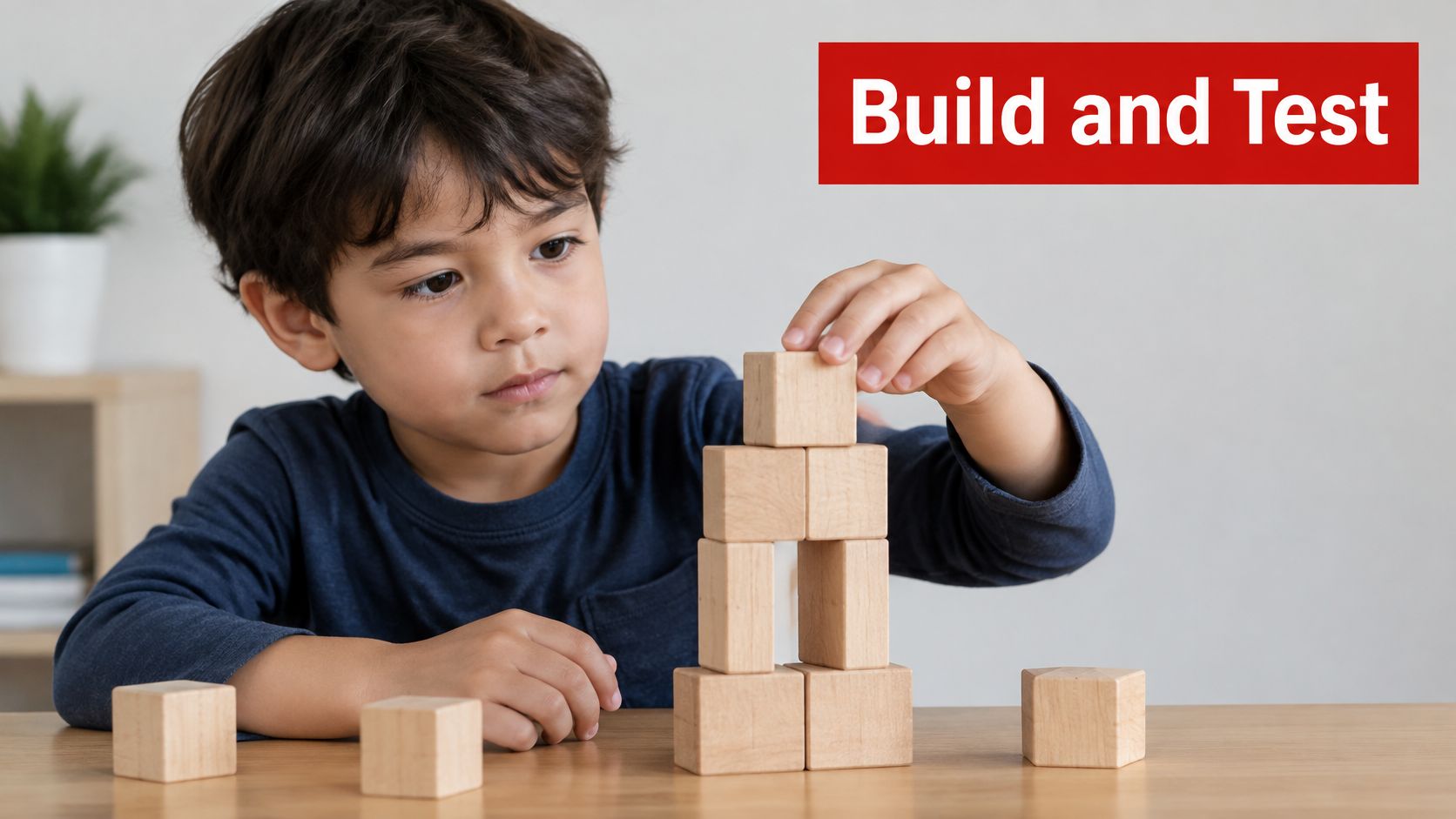
Give a child a pile of blocks and a problem: build a shelter that keeps a toy animal dry beneath a paper roof. Suddenly, stacking becomes engineering. They have to consider the animal's size, the roof's weight, and whether the walls will stand.
This approach echoes Friedrich Fröbel's building gifts, materials designed for exploring shape, pattern, and relationships through play. Wooden blocks, LEGO bricks, and cardboard boxes all offer ways to investigate those ideas.
Make the challenge testable
Start with a clear requirement, such as a bridge that spans a gap between books and supports a toy car. Ask your child to predict where it might bend, then test it without immediately offering a repair.
- For younger builders: Use large blocks and compare wide and narrow bases.
- For older builders: Add a materials limit or ask them to sketch their design.
- For easy restarting: Sort pieces into shallow bins and photograph each version.
The advantage is that children can see exactly what changed between attempts. The drawback is frustration when an ambitious structure collapses. Keep the challenge manageable, and treat rebuilding as part of the work rather than evidence that they got it wrong.
2. Baking Soda and Vinegar Chemical Reactions
The fizz is exciting, but the best learning happens before and after it. Ask your child what they expect, let them observe closely, and help them describe what happened.
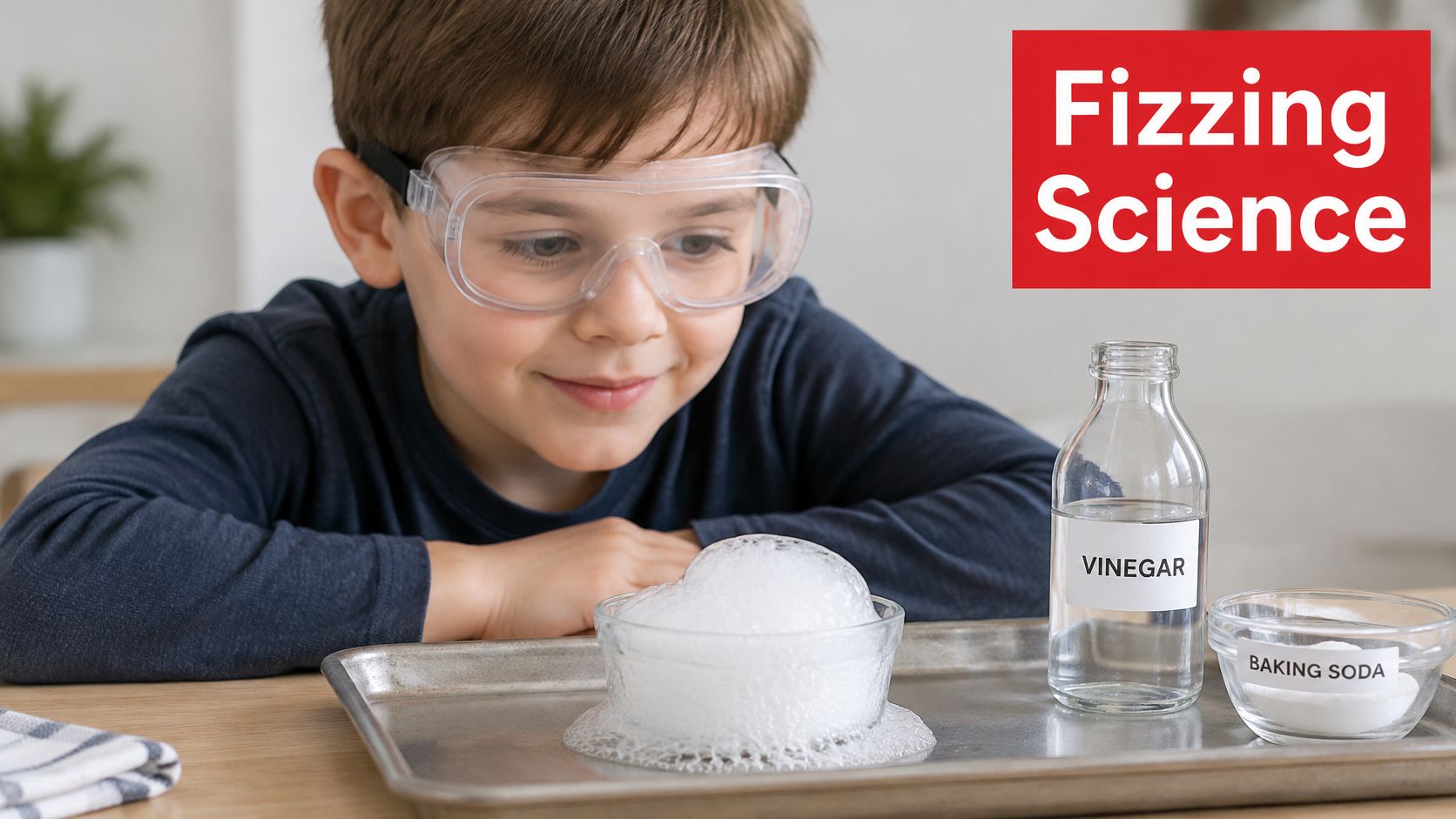
Baking soda, or sodium bicarbonate, reacts with the acetic acid in vinegar to release carbon dioxide gas. The bubbles make that gas visible. This fits an inquiry-based approach: predict, test, observe, and revise.
Build a better kitchen experiment
Put an open cup inside a deep tray. Add baking soda, then slowly pour in vinegar while your child watches from a comfortable distance. Food coloring makes the movement easier to follow; a little dish soap helps trap the gas in foam.
Compare the mixture with vinegar alone. Then repeat the reaction while changing only the amount of baking soda, keeping the container and vinegar amount consistent. Explore more variations through these science experiments using baking soda.
The upside is an immediate, visible reaction using familiar materials. The limitation is that children may remember only the eruption unless you discuss the bubbles. Wear splash goggles, keep ingredients away from mouths, and never seal the reaction in a container, because gas can build pressure.
3. Sensory Bins and Playdough Exploration
A sensory invitation can be as simple as playdough, a rolling pin, and a blunt dough cutter. Your child presses, rolls, and compares while you supply useful words such as smooth, flattened, stretchy, and firm.
The Montessori tradition emphasizes purposeful exploration through the senses and carefully arranged materials. Borrow that principle by presenting a manageable selection rather than filling a tub with everything in the craft cupboard.
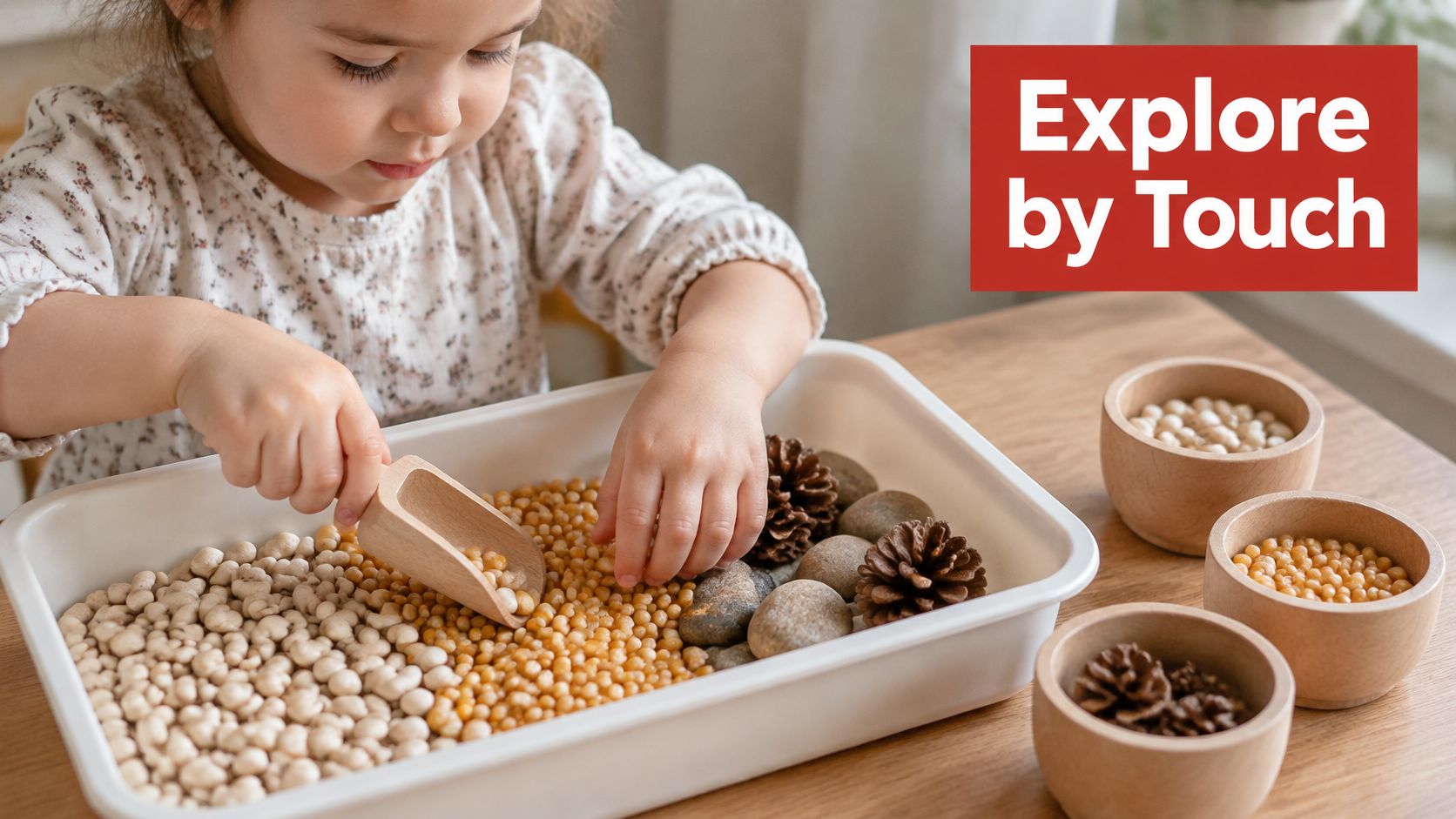
For a kitchen-table activity, ask your child to make pretend bakery rolls from playdough. They can divide the dough, shape pieces, and use tongs to move finished rolls onto a tray. For more ways to connect texture and exploration, see this explanation of what sensory play involves.
- Set up: Put tools on a washable mat, with an empty bowl for finished creations.
- Choose safe materials: Avoid water beads and small loose fillers for children who mouth objects. Supervise closely.
- Respect preferences: Offer a spoon or tool if your child doesn't want to touch a texture.
The benefit is flexible, open-ended practice. The downside is mess, and some children dislike particular sensations. Sensory play doesn't have to be soothing to count as worthwhile, and it should never become forced exposure.
4. Nature Scavenger Hunts and Outdoor Observation
Look for something rough, something curved, and something moving. Those prompts turn an ordinary walk into a lesson in observation and classification, without requiring children to know plant names first.
Nature hunts connect with outdoor-learning traditions and Richard Louv's emphasis on children's relationship with nature in Last Child in the Woods. Keep that spirit of curiosity: the list should invite attention, not become a race to finish.
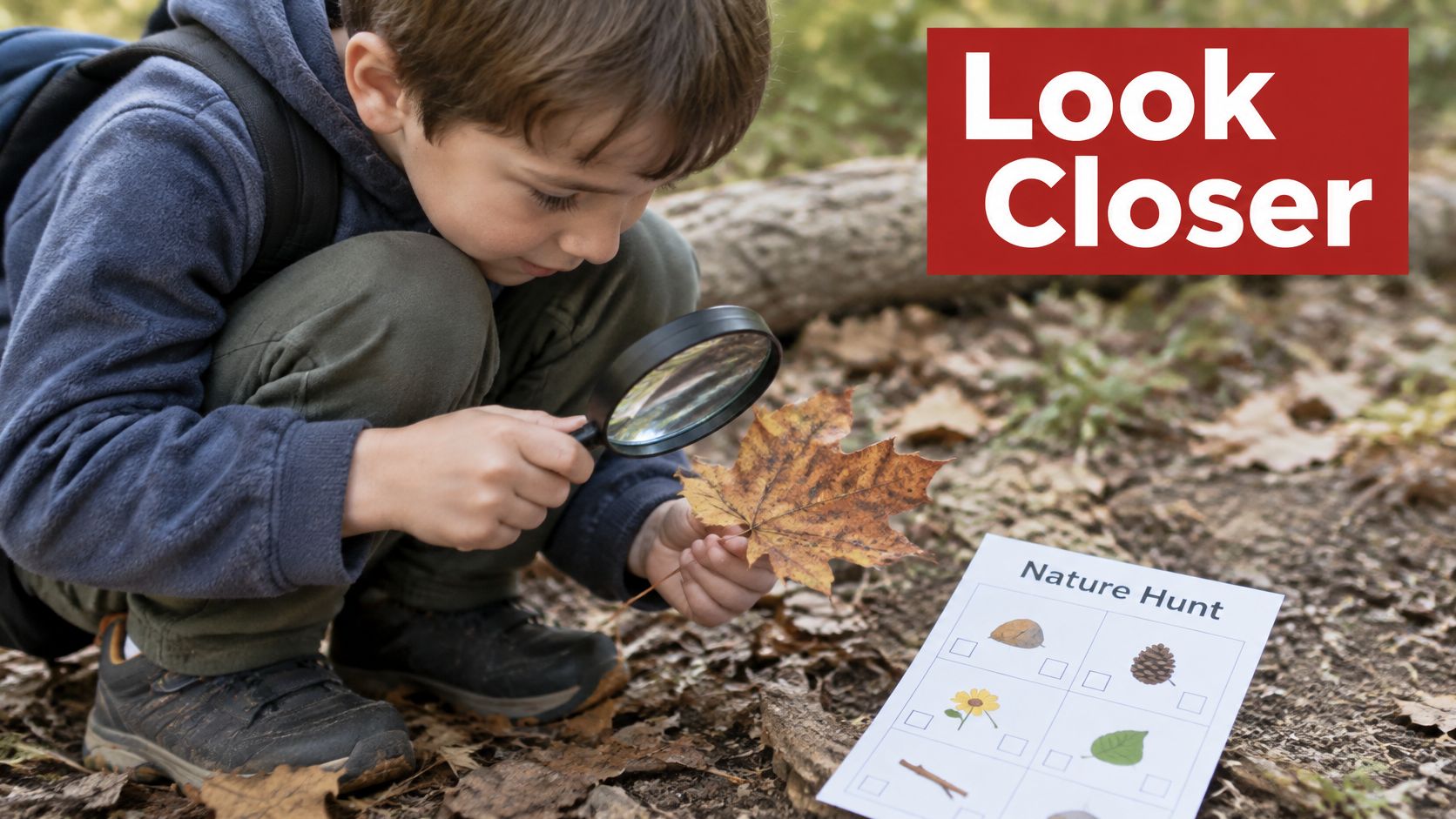
Let children explain their finds
Use picture cards for pre-readers and descriptive clues for confident readers. If a child chooses bark for rough, ask what makes it different from a nearby leaf. Photograph finds rather than removing them, especially when they're part of an animal's habitat.
Outdoor hunts also offer an active alternative to seated entertainment. The World Health Organization's physical-activity guidance recommends that children and adolescents average at least 60 minutes per day of moderate-to-vigorous physical activity across the week. A gentle observation walk won't necessarily meet that intensity, so include energetic play separately.
The advantage is combining movement with close looking. The challenge is weather, access, and supervision. Use an accessible route, establish boundaries, avoid touching unknown plants or fungi, and explore the broader benefits of outdoor play.
5. Indoor Den and Fort Building
A blanket keeps slipping off the chairs. Instead of fixing it immediately, ask your child where it needs support. That small pause turns fort building into a design problem.
Den building combines constructionist learning, making something meaningful to explore an idea, with imaginative play. Children need the structure to work because they want a campsite, reading nook, or space station.
Plan a shelter that stays safe
Ask children to draw their den before gathering blankets, cushions, lightweight sheets, and suitable clips. Build low, use stable furniture, and keep exits visible. Avoid climbing, heavy objects overhead, cords, and fabric near heaters or lamps.
A fort doesn't need to look impressive. It needs to let children test a plan safely and change it themselves.
Say your children want a reading den. They'll need enough room to sit, an entrance that doesn't collapse, and a battery-powered light. Those practical requirements give them reasons to measure space and negotiate decisions.
The strength is its versatility: the same structure can support storytelling, construction, and quiet reading. The drawback is the space it occupies and the temptation to climb furniture. Agree on where building can happen and when materials return to their places.
This guide to fort-building supplies can help you assemble a reusable basket rather than emptying every cupboard whenever inspiration strikes.
6. Puppet Making and Dramatic Storytelling
A paper-bag dragon can say things a hesitant storyteller won't say alone. Let your child draw a face, add paper features, and decide what the character wants before worrying about a polished performance.
Lev Vygotsky's ideas about symbolic play offer a useful lens here. A paper bag stands for a character, while children use language and agreed roles to sustain an imaginary situation.
Begin with a small problem: the dragon wants to join a picnic but keeps scorching the sandwiches. Your child can invent dialogue, choose another character, and work toward a solution.
Keep the story bigger than the craft
- Prepare accessible materials: Use paper bags, crayons, glue sticks, and large paper shapes rather than tiny decorations.
- Offer a starting point: Ask where the character is and what has gone wrong.
- Share the storytelling: Take a supporting role without deciding every line.
- Make performance optional: A private conversation between puppets counts, too.
The advantage is that children can rehearse conversation and explore different perspectives through characters. The drawback is that elaborate crafting can consume all their energy before storytelling begins.
Compared with a scripted retelling, improvisation gives children more control but may need a little prompting. If your child gets stuck, have your puppet ask a question rather than taking over the plot. Record a performance only if they're comfortable with it.
7. Kitchen Math and Cooking Projects
Set out a whole measuring cup and a half-cup measure. Ask your child how they could use the smaller measure to fill the larger one, then let them test the idea with an ingredient from your recipe.
This is concrete-to-abstract learning: children handle a quantity before working with its written symbol. Cooking also reflects Montessori-style practical life activities, where meaningful household tasks provide opportunities for independence.
Choose a recipe with useful jobs
Fruit salad, yogurt parfaits, and pizza faces offer approachable starting points. Use picture recipe cards so younger children can follow the sequence without relying entirely on an adult reader.
- Before preparing: Wash hands, check allergens, and set out ingredients.
- During measuring: Ask children to estimate, then check with the measuring tool.
- While assembling: Compare equal portions or arrange toppings in repeating patterns.
- When finishing: Let children help wipe the table and return tools.
For an older child, adapting a familiar recipe creates a reason to work with fractions. Keep the mathematics connected to the food rather than turning every stir into a quiz.
The benefit is that the result has a clear purpose: something to eat. The limitation is that cooking takes longer with a learner involved. Adults should manage hot appliances and sharp tools, and children shouldn't taste raw flour or uncooked batter.
8. Seed Planting and Mini Garden Projects
Seeds offer a different kind of excitement from fizzing volcanoes. Children have to return, observe, and care for something even when the changes aren't immediately dramatic.
Garden projects draw on experiential education and school-garden approaches such as the Edible Schoolyard model pioneered in Berkeley, California. Planting connects an abstract topic, what living things need, with a responsibility children can carry out.
Make growth visible
For a classroom-style investigation, place a bean against a damp paper towel inside a clear bag. Leave access to air, keep the towel damp rather than soaking wet, and inspect it regularly. Transfer a growing seedling to a suitable pot rather than leaving it indefinitely in the bag.
For a continuing home project, sow beans or radishes in containers with drainage, or grow herbs in a bright windowsill.
- Label clearly: Include the plant name and the child responsible for it.
- Record observations: Draw roots and leaves, or measure height using the same method each time.
- Connect cause and care: Check soil moisture before watering instead of adding water automatically.
The advantage is sustained observation and ownership. The drawback is uncertainty: seeds may fail, and neglected plants may die. Treat those outcomes as questions to investigate, not personal failures. Discard moldy material safely, and wash hands after handling soil.
9. Unplugged Coding with Movement and Cards
Become a human robot and follow your child's instructions exactly as given. If they tell you to move forward without explaining how far, pause and ask for a more precise command.
That playful mismatch introduces algorithms, clear sequences of instructions. CS Unplugged, developed at the University of Canterbury in New Zealand, provides a foundation for exploring computing ideas without relying on screens.
Build a floor-grid challenge
Use removable painter's tape to mark a grid on a clear floor, checking first that it won't damage the surface. Add a start, a destination, and a cushion obstacle. Make cards for moving forward and turning, then ask your child to arrange a route before you walk it.
When the route goes wrong, return to the relevant card and revise it together.
Praise the repair: Finding the instruction that caused the problem is part of successful coding, not a detour from it.
The advantage is that children can physically experience a sequence and inspect mistakes. The limitation is that left, right, and changes in direction can be confusing. Stand beside your child to model orientation, and offer a tabletop version for children who prefer or need seated play.
Bee-Bot can provide a later bridge to programmable devices. For additional starting points, explore how to teach coding to kids.
10. Marble Runs and Simple Machines
A cardboard tube, a sloping book, and a receiving box can become a physics investigation. Challenge your child to send a ball into the box without pushing it along the track.
This follows an inquiry-based engineering cycle: design, test, observe, and adjust. Children explore gravity and friction through visible changes rather than starting with definitions.
Change the track, then compare
Tape cardboard channels securely to low supports. Mark a release point so children start the ball consistently, then change the slope while keeping the ball and track surface the same. Ask whether it reaches the box, stops early, or overshoots.
A randomized study of Dutch pupils reported in this spatial-training study indexed by PubMed found comparable gains from physical manipulatives, virtual manipulatives, and practice without materials, while video demonstrations generally produced smaller gains. Watching isn't a substitute for doing the thinking and testing.
Use this video as a starting prompt, then return to building and experimenting.
The strength is visible feedback after every release. The drawback is that loose balls roll away and small marbles present a choking hazard. Use larger, age-appropriate balls around younger children, supervise closely, and contain the track inside a clear play area.
Extend the activity with a ruler balanced on a support as a lever. Compare how changing the support position affects the effort needed to lift a lightweight object.
10 Hands On Activities for Kids at a Glance
| Activity | Main Skill Developed | Setup Time | Best Age Range |
|---|---|---|---|
| Building Block Engineering Challenges | Spatial reasoning and problem-solving | Quick | Toddlers to older children |
| Baking Soda and Vinegar Chemical Reactions | Scientific observation and hypothesis testing | Quick, usually under 15 minutes | Young children with supervision to elementary-age children |
| Sensory Bins and Playdough Exploration | Fine motor skills and sensory exploration | Quick | Preschool-age children and older; close supervision for under threes |
| Nature Scavenger Hunts and Outdoor Observation | Observation and classification | Minimal | All ages, with age-adapted prompts |
| Indoor Den and Fort Building | Planning and imaginative play | Moderate | Preschool-age children and older |
| Puppet Making and Dramatic Storytelling | Language and narrative skills | Moderate | Preschool-age children and older |
| Kitchen Math and Cooking Projects | Measurement and sequencing | Recipe-dependent | Preschool-age children with supervision and older |
| Seed Planting and Mini Garden Projects | Plant science and responsibility | Quick to start; ongoing care required | Preschool-age children and older |
| Unplugged Coding with Movement and Cards | Sequencing and computational thinking | Easy | Elementary-age children; younger children with guidance |
| Marble Runs and Simple Machines | Physics and design problem-solving | Variable; longer for complex builds | Elementary-age children and older |
Make Hands On Learning a Weekly Habit
You don't need to recreate a science museum at home. Choose two activities to try this week, preferably something easy to repeat and something your child already finds intriguing. Blocks and seed planting make a useful pairing: one offers immediate testing, while the other invites patient observation.
Prepare a small activity basket before you begin. Include the core materials, a washable mat where needed, and somewhere to put unfinished work. Keeping the setup manageable makes it easier to say yes when your child wants another attempt.
Match the challenge to the child
For toddlers, prioritize large materials, simple actions, and close adult involvement. Preschoolers may enjoy a pretend bakery, a low fort, or picture-based nature prompts. Older children can plan a fair test, record measurements, or explain why they revised a design.
The World Health Organization's guidance for children under five recommends at least 180 minutes of physical activity spread throughout the day for children ages 1–4. Seated crafting isn't a replacement for movement, so balance table activities with walking, dancing, climbing safely, and active pretend play.
Keep a simple photo log of your child's work. Photograph the first bridge and its replacement, or a seedling beside your child's drawing. Add their explanation in their own words so the record shows their thinking, not just the finished object.
- Repeat before replacing: Offer familiar materials with a fresh question.
- Adjust the support: Demonstrate a difficult action, then hand control back.
- Notice the process: Comment on careful observation, persistence, or a useful change.
Use ready-made options when preparation is the barrier
Our Playz science kits cover chemistry, biology, physics, and more. The Kaboom! Explosive Science Kit for Kids has a 4.4 out of 5 rating from 2,550 reviews, and the Mega Kaboom! version is on sale for $59.94. Choose according to your child's interests, the stated age guidance, and the supervision you can provide.
The guiding idea is #KidsLearnBestThruPlayz, with room for questions, mistakes, and another try. Whether you use household materials or a prepared kit, start small enough that you'll begin.
Our science kits, story-driven play tents, and creative toys offer ways to bring hands-on discovery into everyday play. Visit Playz to explore options matched to your child's age and interests. Choose an activity, gather your materials, and start your first hands-on learning session today.