

The wrapping paper is everywhere, the cardboard box is fascinating, and your four-year-old is delighted. By lunchtime, the toy itself may be abandoned under the sofa. A week later, you're stepping over it, wondering how a present that looked perfect in the shop became clutter so quickly.
Choosing a 4 year old birthday gift works better when you look beyond the birthday reaction. At this age, a present can encourage a child to move, talk, pretend, solve problems, and play with other people. The strongest choices also have enough flexibility to change as the child's skills develop. This guide connects developmental fit with practical buying questions, including safety, storage, replay value, and whether a gift is likely to earn attention long after birthday morning.
Why the Right 4 Year Old Birthday Gift Matters More Than You Think
A four-year-old doesn't judge a gift the way an adult does. The bright packaging may create the first burst of excitement, but lasting interest usually comes from what the child can do with the object. A cardboard box can become a shop, a tunnel, or a rocket because pretend play gives children room to direct the story themselves. A set of blocks can become a bridge today and a zoo tomorrow.
That flexibility matters because age four is a particularly active stage of social and imaginative growth. In one birthday-research summary, receiving gifts was named by 32% of parents as the highlight of a child's birthday party in one survey year, with later age-group or survey snapshots showing 39%, 48%, 44%, and 43%. The figures come from a party-entertainment company, so they aren't a measure of toy quality, but they do show that gifts are a defining part of many young children's birthday experiences. Read the birthday-research summary
The useful question isn't “Will my child love this at the moment they open it?” It's “What can my child do with this after the novelty fades?” A dress-up cape can support storytelling, language, and cooperative play. A ball can be kicked, thrown, rolled, or used in a simple game with a parent. Art materials can produce pictures, pretend menus, signs, and gifts for friends.
A practical test: If a toy has only one correct way to use it, expect attention to depend heavily on novelty. If a child can combine it with other materials and invent new uses, it has stronger replay potential.
Families who prefer meaningful or values-led presents may also appreciate collections of faith-inspired first birthday presents, especially when they're thinking about keepsakes, books, or gifts with personal significance. For a fourth birthday, that same instinct can be paired with a toy or experience that invites active participation rather than sitting untouched on a shelf.
A good present, then, isn't only entertaining. It becomes part of the child's everyday practice. The child rehearses taking turns with a game, strengthens hand control while shaping playdough, or builds confidence by navigating a small obstacle course. That's why developmental fit and long-term play value belong in the same buying decision.
What Is Happening Developmentally at Age Four
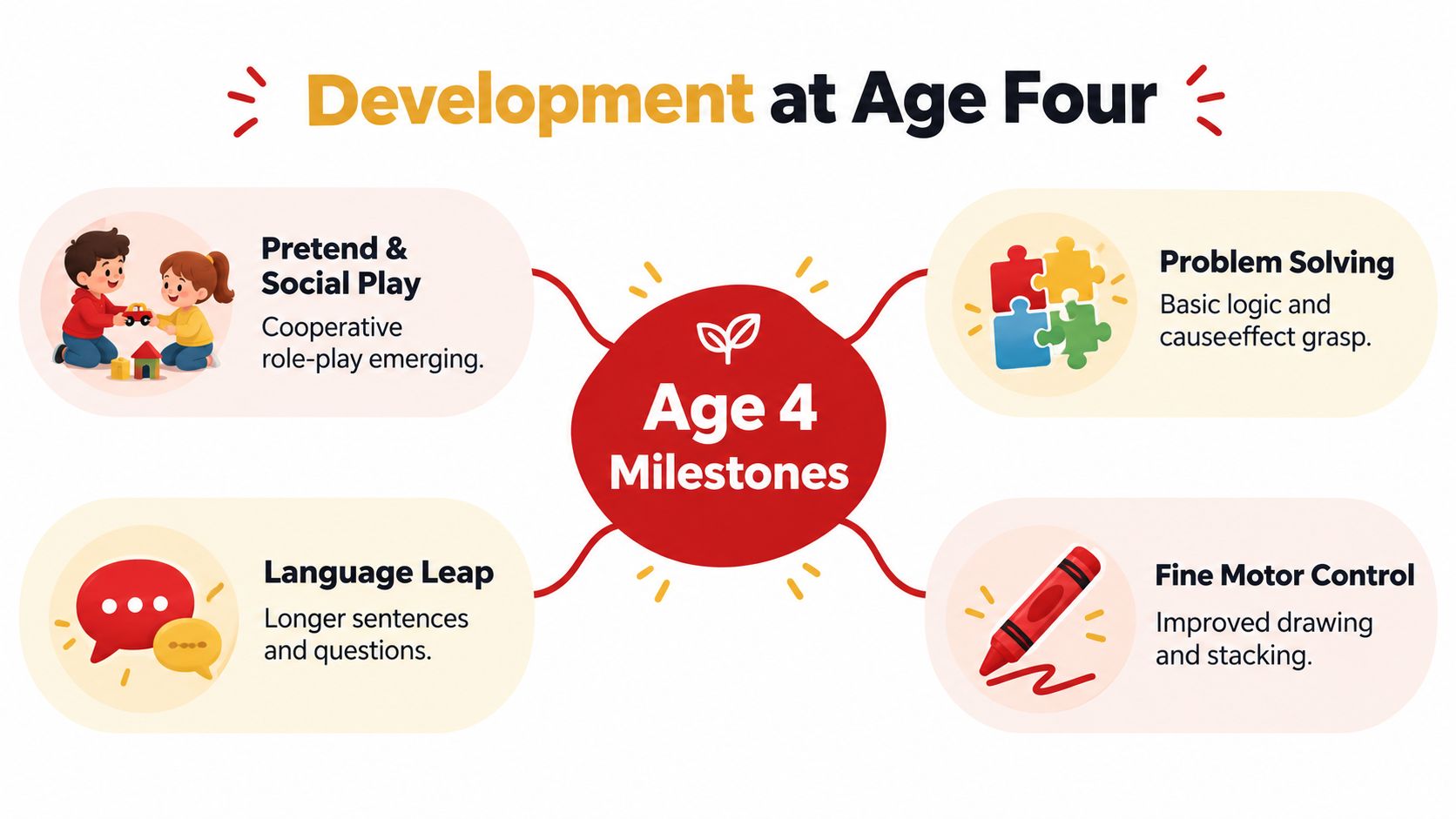
Age four is a bridge between toddler play and more organized preschool play. Children still enjoy repetition, but they're increasingly able to invent a role, follow a simple rule, explain an idea, and invite someone else into their game. A child may announce, “You're the patient and I'm the doctor,” then change the plan five minutes later when a stuffed animal needs rescuing.
The CDC's four-year milestone guidance says children commonly pretend to be something else during play, ask other children to play, comfort peers who are hurt or sad, and avoid danger such as jumping from tall playground heights. These milestones point toward gifts that allow role-play, cooperation, and safe physical challenge rather than toys that demand passive watching.
Pretend play becomes a shared activity
At earlier ages, pretend play may be brief or focused on copying an adult. By four, children often build longer scenarios and assign roles to other people. A pretend kitchen, doctor kit, shop counter, play tent, or collection of costumes gives them props for language and social negotiation.
The child isn't merely “playing house.” They're practicing how to start a conversation, respond to another person's idea, and keep a story going. A gift with several connected pieces can support this better than a single flashing object because the child has to decide what each item means.
Movement is part of the learning
Four-year-olds are physically busy. They often enjoy running, dancing, climbing, hopping, and other active games throughout the day. Australian health guidance recommends about three hours of physical play per day for this age group, as noted in the CDC-linked developmental guidance above.
That doesn't mean every birthday gift needs to be large or athletic. A soft ball, beanbag, stepping stones, movement cards, or a foldable tunnel can turn a living room or garden into a place for coordination practice. The right level of challenge lets the child repeat an action, adjust their body, and feel successful without making the activity unsafe.
Language and reasoning start working together
Four-year-olds can usually use sentences with four or more words, and many ask questions because they're trying to understand how things work. They're also beginning to explore cause and effect more deliberately. What happens if a wheel is larger? Why did the tower fall? Which piece fits? What can make the ramp steeper?
A four-year-old is like a little scientist crossed with a drama teacher. They want to test objects, but they also want to give those objects characters and stories. That combination explains why construction sets, simple STEM activities, picture books, and pretend-play materials can all be strong choices.
For a broader overview of how play connects with emerging abilities, this guide to childhood development milestones offers useful background.
The practical takeaway is simple. The most developmentally aligned gifts combine movement, imagination, and simple social play. A present doesn't need to teach a formal lesson. It needs to give the child something meaningful to do.
Gift Categories That Match Four-Year-Old Skills
The best category depends on the child, the available space, and the kind of play you want to make easier. A lively child may need an active gift, while a child who loves stories may use a puppet set or picture-book bundle every day. The recommendations below connect each category with the skill it naturally invites.
Active play gifts
Balls, beanbag toss sets, movement games, and bikes with training wheels support gross-motor coordination. Choose a soft ball for indoor use, a target game for a child who enjoys a challenge, or a balance-focused activity for a child who is always climbing and jumping.
These gifts work particularly well when an adult or sibling can join in. Rolling a ball back and forth develops turn-taking at the same time as hand-eye coordination. A short obstacle route made from safe stepping pieces encourages planning, balance, and physical confidence.
Art and sensory supplies
Playdough, washable paint, chunky crayons, large stickers, and child-safe collage materials strengthen fine-motor control while giving children a way to represent ideas. A child may make a face, a pretend pizza, a map, or a birthday card. The value comes from the process, not from producing a polished result.
Look for supplies that can be used in several ways. A tub of playdough supports squeezing, rolling, cutting, and sculpting. A small art kit can become a writing station, a prop-making station, or a place to draw characters for pretend stories.
Construction and STEM gifts
Wooden blocks, magnetic construction sets, matching games, threading activities, and beginner STEM kits support problem-solving and cause-and-effect reasoning. Child-development guidance specifically includes blocks, clay, playdough, matching activities, stringing tasks, and Magna-Tiles-style construction sets among useful options for this age. Explore construction ideas for four-year-olds
Choose a construction gift when the child enjoys taking things apart, arranging objects, or asking why. A good set doesn't need to produce one model. It should let the child build, test, knock down, and try again.
Pretend-play sets
Dress-up clothes, puppets, play tents, toy food, and doctor or repair kits support imagination, language, and cooperation. They're especially useful for children who naturally imitate adults or turn ordinary household objects into props.
A small basket of scarves, hats, fabric bags, and sturdy pretend tools may offer more replay value than a highly detailed set with one fixed scenario. Children can become firefighters one day, shopkeepers the next, and explorers after that.
Picture books and story props
A picture-book bundle is an excellent choice for a child who asks questions, loves repetition, or enjoys being read to. Add puppets, felt-board pieces, or a simple drawing pad so the child can retell the story in their own way.
Books support vocabulary and conversation, but they can also become movement and social gifts. A story about animals may lead to a hopping game. A book about cooking can inspire pretend recipes. Choose subjects that connect with the child's current interests rather than chasing a supposedly perfect theme.
Experience gifts
Swim lessons, a museum visit, a zoo outing, or a child-friendly class can work well when the family has limited storage space. Experiences also give an adult a clear way to participate, which can be more valuable than adding another object to a crowded playroom.
For more age-specific inspiration beyond this birthday, these gift ideas for five-year-old girls can help families think ahead while still choosing for the child they have today.
| Gift Category | Skills Built | Example Gift | Typical Budget |
|---|---|---|---|
| Active play | Balance, coordination, turn-taking | Soft ball or beanbag toss | Low to moderate |
| Art and sensory play | Hand strength, creativity, focus | Playdough and washable art supplies | Low to moderate |
| Construction and STEM | Planning, testing, cause and effect | Wooden blocks or beginner science kit | Moderate |
| Pretend play | Language, cooperation, imagination | Dress-up basket or play tent | Moderate |
| Books and story props | Vocabulary, listening, narrative play | Picture books with puppets | Low to moderate |
| Experiences | Participation, confidence, shared memories | Swim lesson or museum visit | Moderate to higher |
The table is a starting point, not a ranking. A low-cost box of playdough may become a daily favorite, while an expensive kit may be ignored if it doesn't match the child's interests or the family's routine.
Safety Rules Every Gift Buyer Should Know
A bright package can hide a weak hinge, loose magnet, or battery compartment a child can open. Before choosing a 4 year old birthday gift, inspect how it is built, what can detach, and whether it suits the space where the child will play.
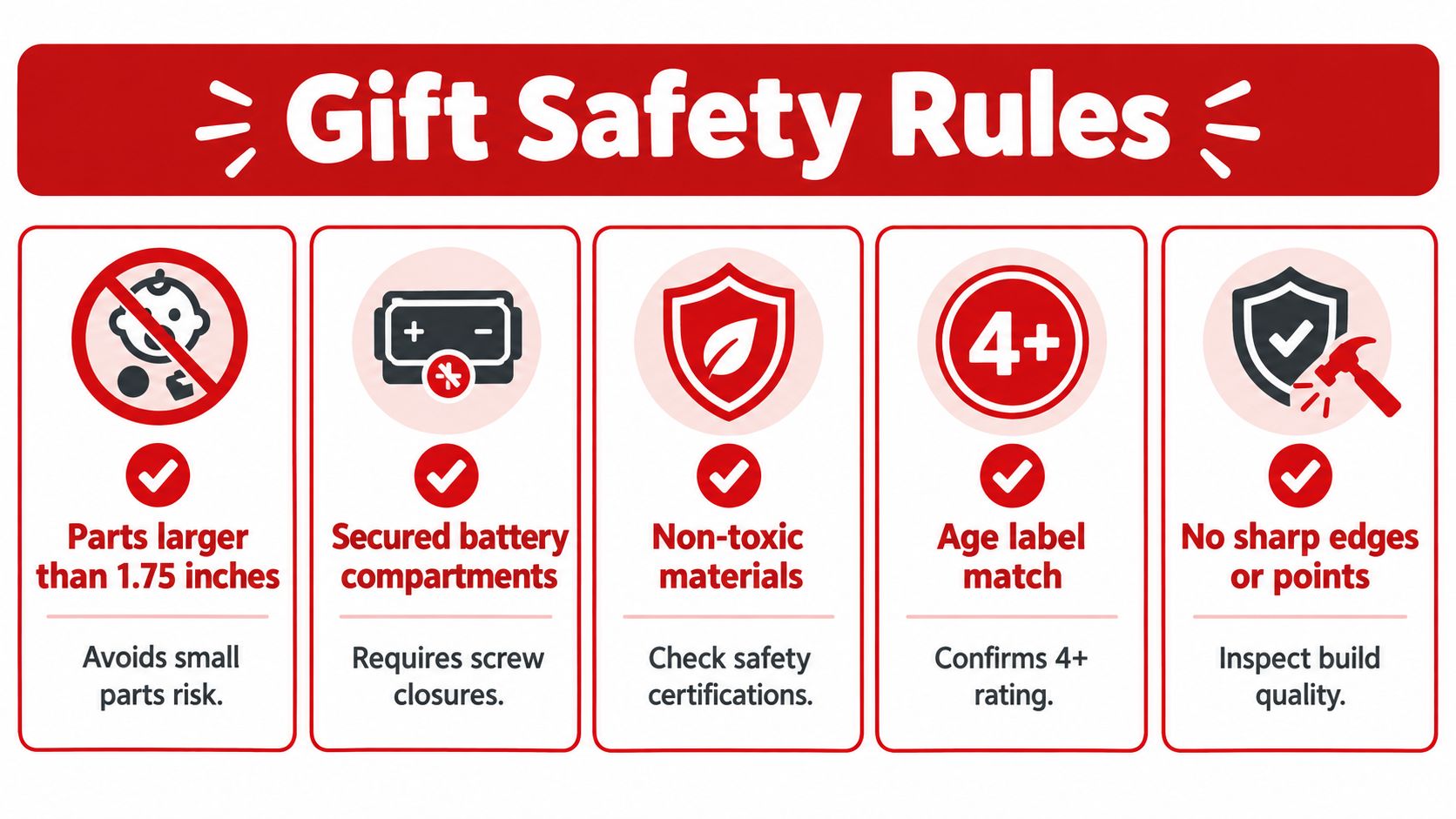
Independent pediatric guidance recommends toys at least 1¼ inches, or 3 cm, in diameter, and 2¼ inches, or 6 cm, in length. It also recommends battery compartments secured with screws. In the United States, toys for children 12 and under must be third-party tested and certified to meet children's product safety regulations, including the ASTM F963-based toy safety standard. Review the pediatric toy-safety guidance
Apply the size and construction test
Look for pieces that could detach and fit into a child's mouth. Removable eyes, wheels, buttons, decorative parts, and small accessories need close inspection. Secure attachments and sturdy construction usually handle ordinary play better than fragile details that snap off during a pretend game or building project.
Guidance for children in the four-to-five age range also advises avoiding magnets, long strings or cords, sharp edges, and objects that can break into small pieces. Choose art supplies labeled non-toxic, and select scissors with blunt tips. For material-specific guidance, see this overview of non-toxic toys for babies. Use this toy-safety shopping guide when comparing unfamiliar products.
Read age labels correctly
An age label is not an intelligence rating. It mainly indicates safety and developmental fit. A “4+” label does not promise that every four-year-old will enjoy the toy, and an older child may still find it worthwhile. The Toy Association explains that age grading is based largely on safety. A child's interests, abilities, and usual play setting still matter. Learn how toy age grading works
Red-flag scan: Reject the gift if it has loose magnets, exposed batteries, long cords, sharp points, or parts that can easily break away.
Check the home setup before wrapping the present. A large indoor climbing item may be safe with supervision in a clear room, yet burdensome in a small apartment. A science kit may work well with an adult nearby, but it may be unsuitable for unsupervised birthday-morning play. For broader guidance on safe, sturdy materials, see toys and play for children ages three to five. These checks protect the child and reduce the chance that a gift becomes a storage problem after one use.
Choosing Gifts That Last Beyond Birthday Morning
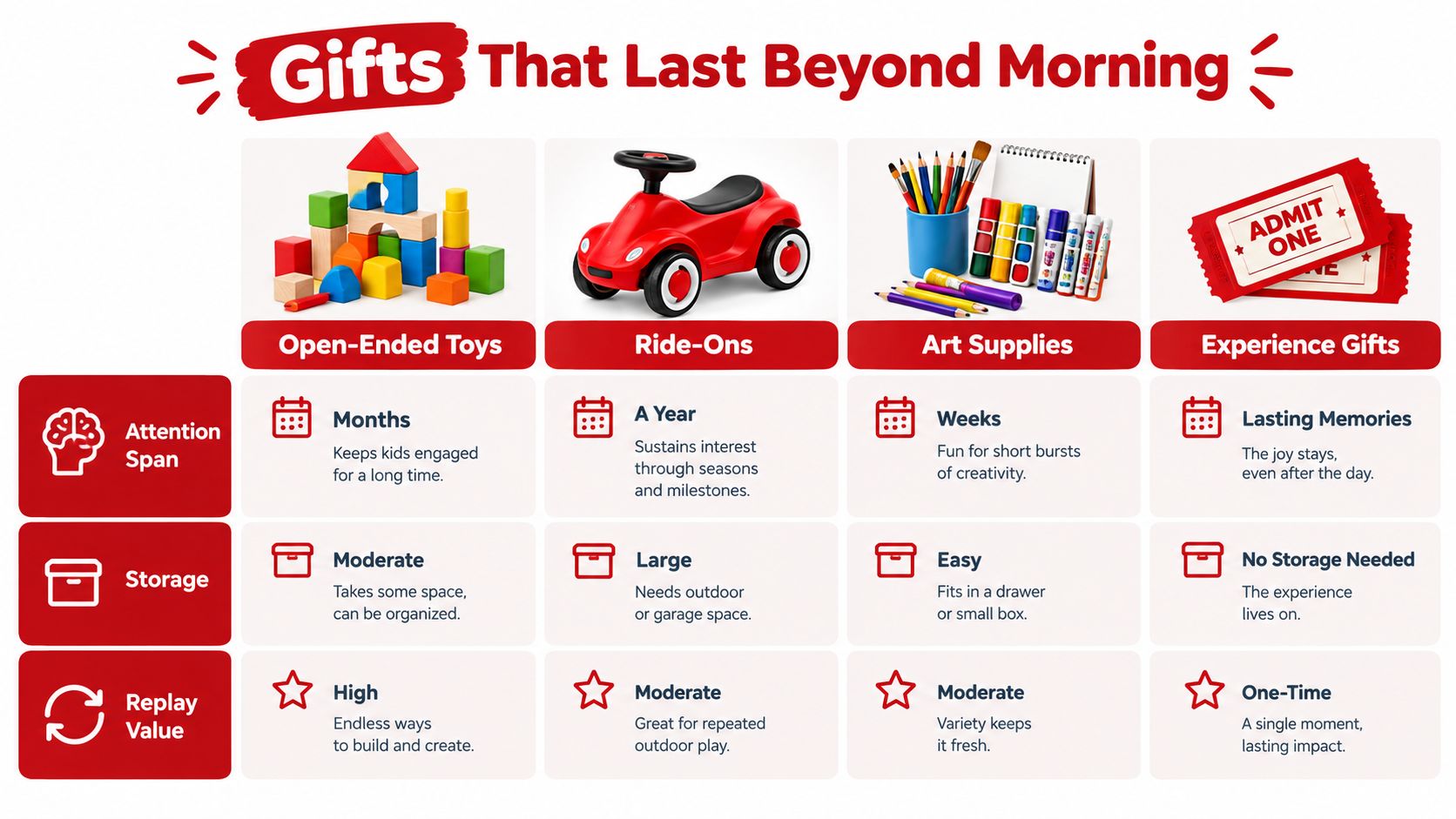
A four-year-old may tear into a gift, play with it intensely, and leave it untouched by the next weekend. Educational value alone does not prevent that pattern. A better test asks whether the gift supports repeat play, creates manageable storage, and can be reused in new ways as the child's ideas and skills develop. Open-ended materials often last because the child can change the challenge, combine pieces, and place the same objects in different stories.
Recent gift guidance favors open-ended toys over battery-powered novelty and recognizes that four-year-olds have plenty of energy to use. It does not always explain which features help a gift stay useful, so compare each option by play longevity, storage burden, and reusability. See the discussion of long-tail gift choices
Open-ended toys
Blocks, magnetic tiles, playdough, dress-up pieces, and loose art materials invite many outcomes instead of directing the child toward one finished result. A block set can become a garage, bridge, animal pen, or apartment building. These materials work for solo play, sibling play, and shared games with a caregiver.
Their tradeoff is storage. Small pieces vanish easily, and creative play can cover the floor. Use one labeled basket, a shallow building tray, or a simple limit of one project's worth of materials at a time. Construction sets and educational STEM kits can also support repeated problem-solving when activities remain adjustable rather than following one fixed sequence. Explore educational STEM kits
Ride-ons and active equipment
A balance-focused ride-on, a bike with training wheels, or a safe outdoor movement toy can remain useful as confidence grows. These gifts need space and usually call for supervision, yet they give children a reason to practise movement regularly rather than use the item once.
Match the equipment to the child's current ability. A toy that is too difficult may stay in the corner, while one that offers a manageable challenge can become part of the weekly routine. Storage matters here too. Before buying, identify where the item will live between uses.
Art supplies
Art materials store easily and can return whenever a child wants to make a sign, card, mask, map, or pretend menu. They may not hold attention every day, but their reusability gives them a longer life than a craft project with one prescribed result.
Choose a smaller collection of practical supplies instead of a large kit filled with tiny components. Washable markers, large paper, playdough, and blunt-tip scissors can support drawing, cutting, planning, and pretend play without creating a difficult cleanup job.
Experience gifts
Experiences use little shelf space and can become shared family rituals. Swim lessons, museum visits, classes, and outdoor outings suit children who already have many toys, as well as relatives who want to contribute without adding clutter.
An experience depends on travel, scheduling, and adult availability, and it may not be replayable like a construction set. Pair it with a small physical prompt to extend the idea at home, such as an animal book before a zoo visit or a notebook for drawing observations.
Low-cost ways to improve longevity
A gift can offer months of possibilities without a large budget.
- Build a DIY obstacle course: Use cushions, painter's tape, cardboard boxes, and safe household objects for crawling, balancing, and hopping routes.
- Make a dress-up box: Add washable scarves, old hats, fabric bags, and adult-supervised costume pieces from home or a thrift shop.
- Rotate materials: Store part of an art or construction collection and bring it back later, so familiar materials feel newly available.
- Add a social prompt: Include cards such as “build a bridge for the animals” or “act out a trip to the moon.”
- Give time with the object: Ten minutes of parent participation can show a child uses they might not discover alone.
The flashiest box is not automatically the strongest choice. A flexible gift that fits the child's interests, available storage, and daily routine is more likely to outlast a novelty toy with one use.
How Playz Toys Support Learning Through Play
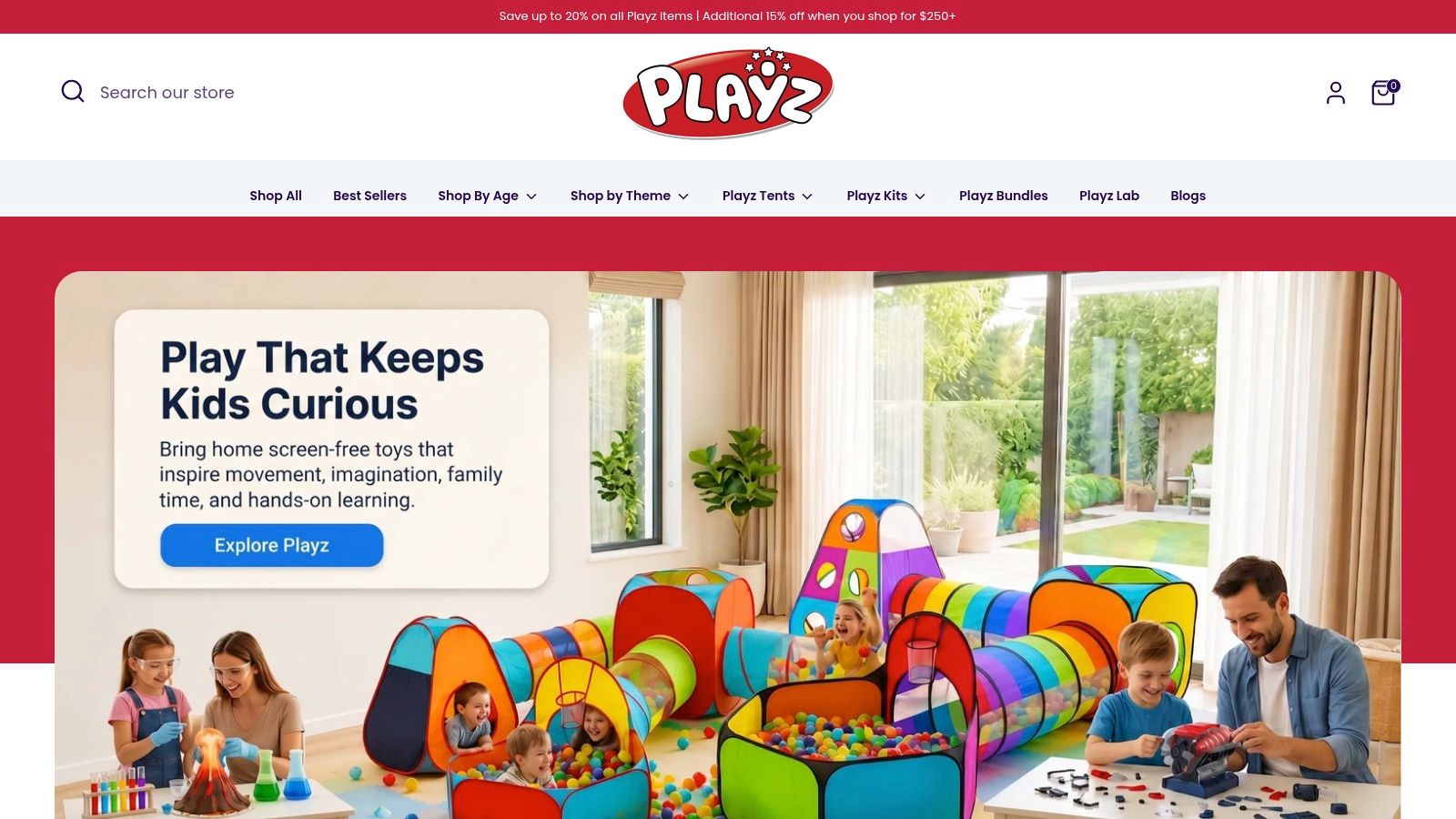
The criteria above become easier to apply when you examine a real product range through them. Playz offers play tents, science kits, and creative toys that can be matched with several of the age-four needs already described, including pretend play, active movement, cause-and-effect exploration, and fine-motor work.
A play tent can become a shop, reading nook, campsite, clinic, or spaceship. It supports imaginative play without requiring a child to follow a fixed script, and it can encourage movement when the child crawls in, out, around, and through connected play spaces. For a child who prefers cooperative stories, a tent also creates a defined setting where siblings or caregivers can take roles.
A beginner science kit suits a different learner. Children who ask why objects move, change, mix, or balance may enjoy activities that let them make a simple prediction and observe what happens. The adult's role is important here. Rather than rushing to explain the answer, ask the child what they notice and what they think might happen next.
Creative toys provide another route into learning. Drawing, shaping, sorting, and assembling let children practise hand control while expressing ideas. The best match depends on the child. A child who loves movement may use a creative activity to design signs for an obstacle course, while a child who loves stories may make props for a puppet show.
The brand presents this range around screen-free learning and the mission #KidsLearnBestThruPlayz, and its publisher information identifies over 5 million satisfied customers as a trust signal. Those points don't replace checking a specific product's age guidance, construction, and storage needs. They provide context for a collection built around purposeful play.
For the developmental reasoning behind this approach, learn about play-based learning benefits. The useful buying principle is to select the category that matches the child's natural invitation to play, then check whether the product is safe, flexible, and realistic for the household.
Your Four-Year-Old Gift Checklist and Final Thoughts
Before you buy, pause for a quick shelf-side review. A gift doesn't need to satisfy every question, but it should pass the safety checks and fit the child's actual life.
- Match a real interest: Does the child enjoy movement, stories, making things, experiments, or playing with others?
- Name the skill: Will the gift invite motor practice, language, social cooperation, pretend play, or early problem-solving?
- Check the construction: Are pieces large and sturdy, with no loose magnets, long cords, sharp edges, or exposed batteries?
- Inspect the battery compartment: If the gift uses batteries, does the compartment close with screws?
- Look for flexible use: Can the child invent more than one game, build different results, or combine the gift with existing materials?
- Consider the room: Is there a practical place to use and store it?
- Plan the first invitation: Can you suggest a simple game or join the child briefly after they open it?
- Choose an appropriate budget: A smaller gift used often is more valuable than an expensive object that creates storage stress.
The physical-toy-versus-experience question doesn't have one universal answer. A construction set or play tent may offer repeated independent play, while swim lessons or a museum visit may create a shared routine and leave no permanent clutter. The right decision depends on whether the family needs more opportunities for open-ended play, more time together, or less stuff.
The central idea remains steady: developmentally aligned, open-ended gifts are more likely to outlast flashy alternatives because children can keep changing the challenge. A four-year-old doesn't need a present that performs for them. They need materials that let them move, imagine, communicate, test, and try again.
Browse Playz for play tents, science kits, and creative toys that turn a 4-year-old birthday gift into an invitation for screen-free discovery. Choose a safe, flexible option that matches the child's interests and gives birthday excitement a chance to become months of learning through play.