


You step into the playroom and find a small mountain of pieces across the rug: wooden blocks, magnetic tiles, plastic bricks, and a few gears that seem to belong to no visible machine. Your child, however, isn't seeing a mess. They're testing balance, rebuilding after a collapse, and trying to make one idea work in a new way.
That kind of focused, screen-free exploration is why building kits for kids have become valuable at home and in classrooms. The right kit can support creativity, spatial thinking, language, collaboration, and persistence, but the box age is only a starting point. Parents also need to consider readiness, safety, learning goals, and what the child can do after the first model is complete. For more ideas about purposeful play, explore this STEM toys guide for kids.
Introduction to Building Kits for Kids
A building kit can be as simple as a basket of large blocks or as involved as a model with gears, circuits, or programmable parts. The important question isn't whether the package looks educational. Ask whether the child can handle the pieces, understand the instructions, and stay engaged when the first attempt doesn't work.
A preschooler might build a tower and narrate its story. An older child might study a blueprint, notice that a connector is reversed, and rebuild the structure. Both children are learning through action, but they need different levels of complexity and adult support.
This guide covers the main types of kits, the developmental benefits behind construction play, practical safety checks, and ways to extend a finished model into new projects. The aim is simple: help you choose a kit that fits the child in front of you, not just the number printed on the package.
Understanding Building Kit Categories
Building kits fall along a broad spectrum, from open-ended stacking to construction combined with electronics. Comparing the categories helps you identify how a child will use the set.
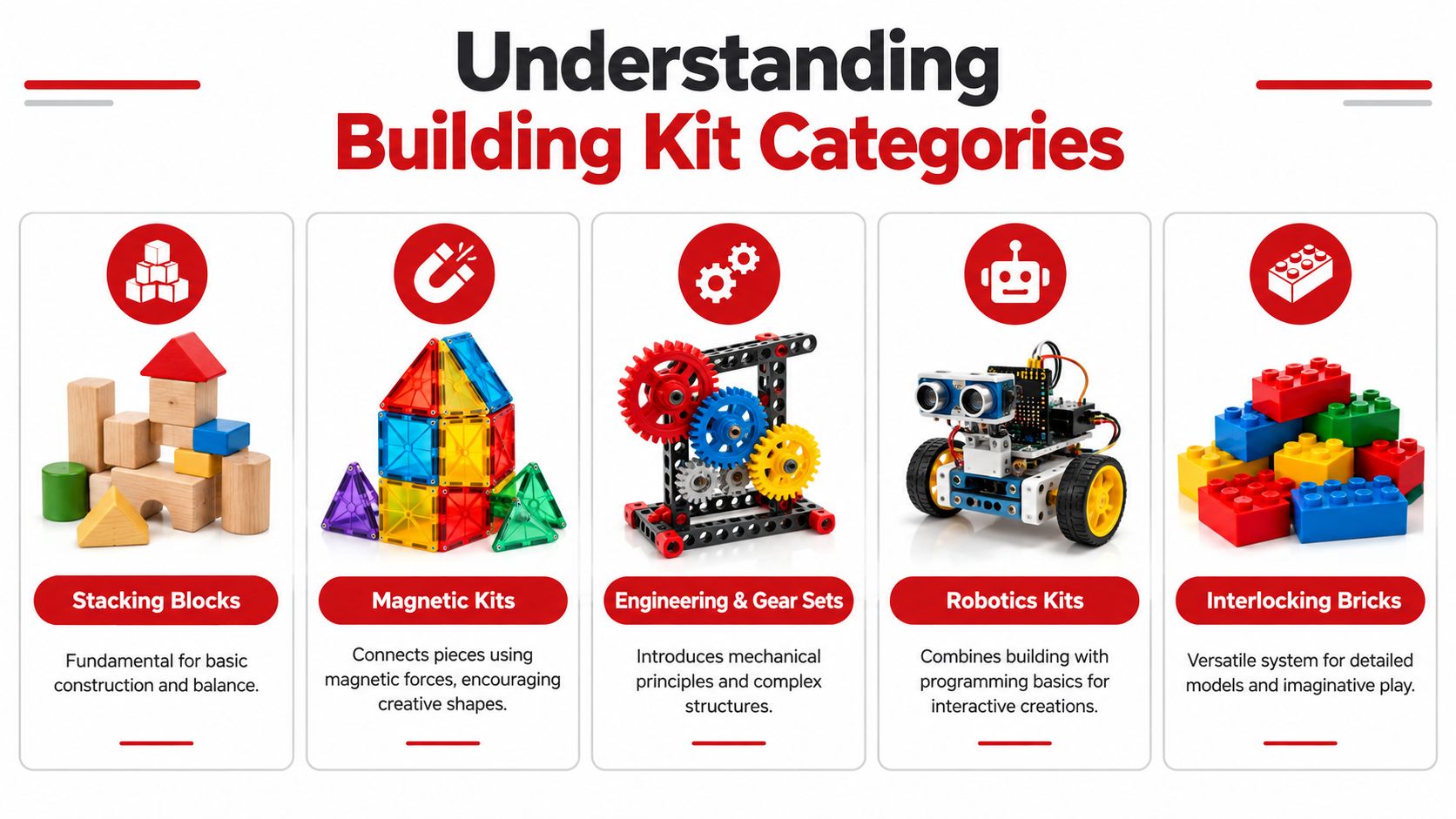
Stacking blocks
Large wooden or foam blocks support early balance, size comparison, symmetry, and basic construction. They usually offer the most open-ended play because children aren't required to copy a particular model. A child can make a bridge, a house, or an imaginary animal with the same pieces.
Magnetic kits
Magnetic tiles, rods, and panels connect through magnetic attraction. Children can quickly experiment with flat shapes, enclosed forms, and tall structures, which makes these kits appealing to builders who like immediate results. Adults should inspect magnetic pieces regularly, because a damaged casing can expose a loose magnet.
Engineering and gear sets
These kits add beams, axles, wheels, pulleys, gears, and connectors. They introduce cause and effect in a visible way. When one gear turns another, children can observe a mechanical relationship rather than only looking at a finished shape. The play becomes more structured as the number of interacting parts grows.
Robotics and STEM electronics
Robotics kits combine physical construction with motors, sensors, batteries, or coding interfaces. They suit children who want their creations to move, light up, or respond to input. These sets typically require more reading, sequencing, troubleshooting, and adult guidance than basic blocks.
Interlocking bricks and craft-based construction
Interlocking plastic bricks work well for detailed models and imaginative rebuilding. Craft-based construction may use cardboard, paper tubes, wooden sticks, fabric, or recyclable materials alongside kit components. It often produces less polished models, but it gives children greater control over materials and encourages inventive problem solving.
The market context reflects the growing role of construction in educational play. The global STEM toys market was estimated at USD 1.20 billion in 2024 and is projected to reach USD 1.83 billion by 2030, with a 7.2% compound annual growth rate from 2025 to 2030. Engineering toys represented about 38% of the market in 2024, while children ages 8 to 12 accounted for about 41% of use in 2025, according to this STEM toys market analysis.
For a broader look at imaginative options, compare these creative building toys with more instruction-led engineering sets.
Benefits of Building Kits for Kids
Building play works like a small laboratory. A child forms an idea, chooses materials, tests the result, notices a problem, and changes the design. The learning doesn't depend on getting the model right on the first attempt. It grows through the cycle of trying and revising.
Construction also gives adults a useful window into thinking. Listen to a child explain why a tower fell or why a vehicle needs larger wheels. That conversation turns physical play into language practice, planning, and reasoning.
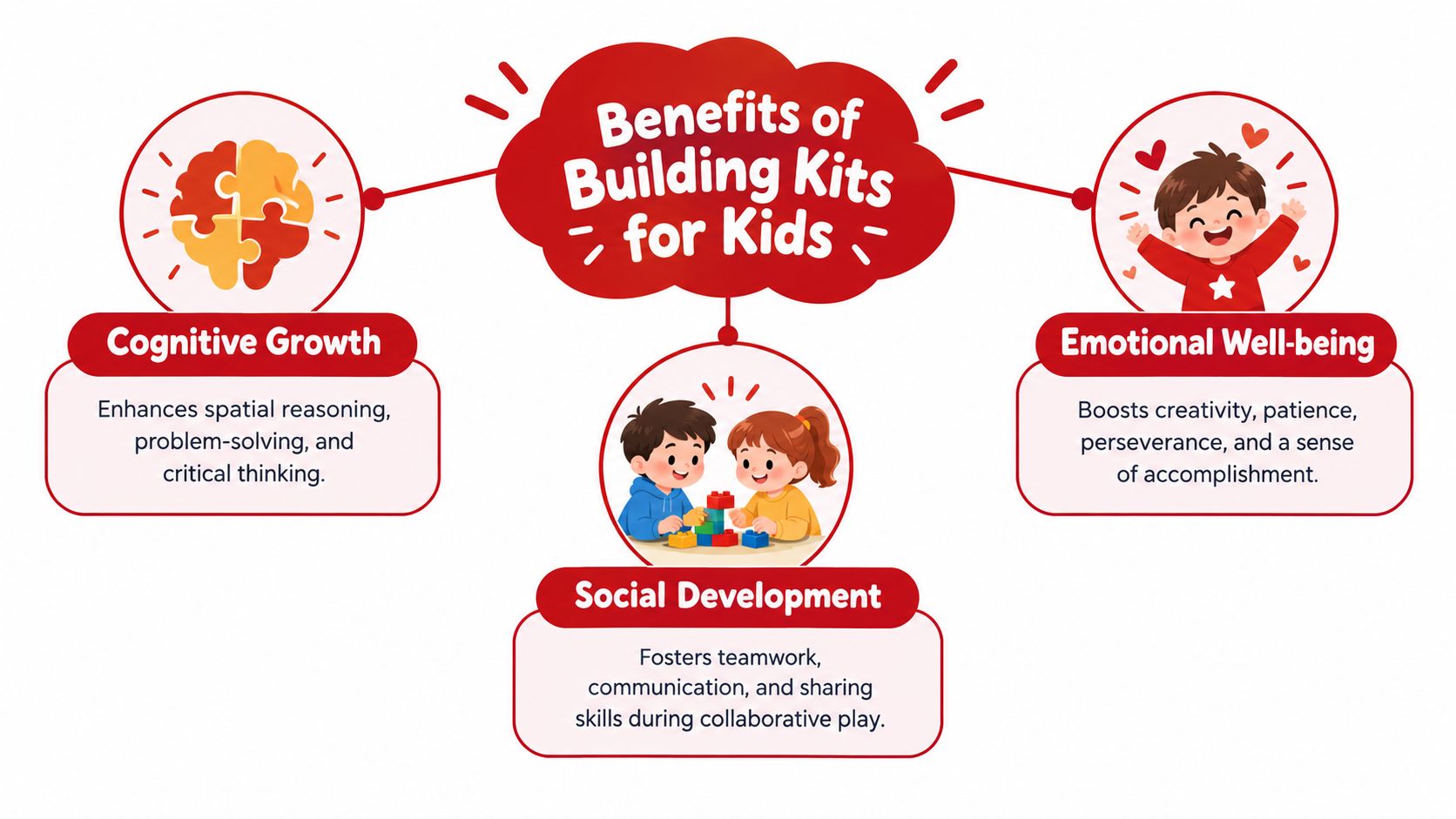
Cognitive growth through construction
Block construction has been associated with math, science, and general reasoning skills across the first four years of life. A 2007 clinic-based study involving 175 families found that children in the block-play intervention group had block play recorded in diaries at a much higher rate than controls, 59% compared with 13%, and the intervention was associated with statistically significant language gains among low-income children. The findings and later review are discussed in this peer-reviewed block-play research.
Structured models add another layer. When children follow diagrams, they must hold a visual plan in mind, compare the model with their own structure, and correct errors. That practice resembles mental rotation and plan execution, while free-form construction gives more space for original ideas.
Social and emotional learning
Two children building together have to negotiate space, materials, and roles. One might sort pieces while the other assembles them. They learn to explain an idea, listen to an alternative, and cope when a shared structure collapses.
The emotional benefits are just as practical. A child who rebuilds a bridge after it fails practices patience and persistence without completing a worksheet. A finished creation provides a concrete sense of accomplishment, while an unfinished model leaves room for curiosity rather than signaling failure.
Watch the process, not just the product: A child who changes a design, explains a choice, or asks for a different piece is showing active learning.
Hands-on classroom research has also connected construction activities with deeper understanding, active participation, and collaboration. These findings support the use of building as meaningful learning rather than a reward after “real” work. Parents can find additional context in this guide to the benefits of hands-on learning.
Ask children to describe what they built, what changed, and what they might try next. Those questions turn a quiet activity into a rich exchange of ideas.
Assessing Readiness Safety and Materials
A box age can help you screen options, but it can't measure patience, fine-motor control, previous building experience, or a child's willingness to follow repeated steps. A child may be old enough for a miniature model but still need a simpler kit with larger connectors and fewer sequential instructions.
Start with observation rather than a test. Can the child use both hands together, press pieces into place without excessive force, and follow an illustrated step while checking the result? Can they tolerate rebuilding part of a model, or do they immediately abandon it when a piece doesn't fit?
A practical readiness check
Look for these signs before introducing a small-part or highly structured kit:
- Fine-motor control: The child can pick up, rotate, align, and connect pieces with reasonable control.
- Instruction readiness: They can follow illustrated steps with an adult nearby and understand that order matters.
- Frustration tolerance: They can pause, try another approach, or ask for help when a structure fails.
- Attention and independence: They can stay with a short task and complete at least part of it without constant physical intervention.
- Interest in the theme: Cars, animals, buildings, space, or machines can provide the motivation needed for repeated attempts.
Safety begins with mechanical and physical hazards. Under ASTM F963, construction and building sets intended primarily for children 12 years or younger are treated as children's toys, with attention to hazards such as small parts, connector strength, and age grading. CPSC guidance says most block sets are appropriate for children 19 months and older, but supervision is recommended for children under 8 because parts that fit the standardized small-parts cylinder can create choking risks. Review the CPSC age-determination guidance before choosing a kit for a younger child.
Inspect the environment and materials
Check for cracked plastic, sharp edges, loose fasteners, peeling coatings, and magnets that move inside their casings. Use a washable tray or floor mat so you can see missing pieces, and keep small components away from younger children who aren't the intended users.
Furniture matters too. A stable table, rounded storage container, and clear building surface reduce avoidable falls and clutter. Families setting up a dedicated play area may find this guide to family furniture in Northern NJ useful when planning safe, durable spaces.
For battery-powered kits, follow the manufacturer's battery instructions and inspect compartments for damage or corrosion. This guide to 9-volt and lithium-ion batteries can help adults understand why battery handling deserves its own safety routine.
Choosing the Right Building Kit for Learning Goals
The strongest choice begins with a learning goal, not a brand or piece count. “I want my child to learn STEM” is too broad to guide a purchase. “I want my child to practice spatial planning,” “I want a younger learner to build hand strength,” or “I want a tween to explore simple programming” gives you a workable direction.
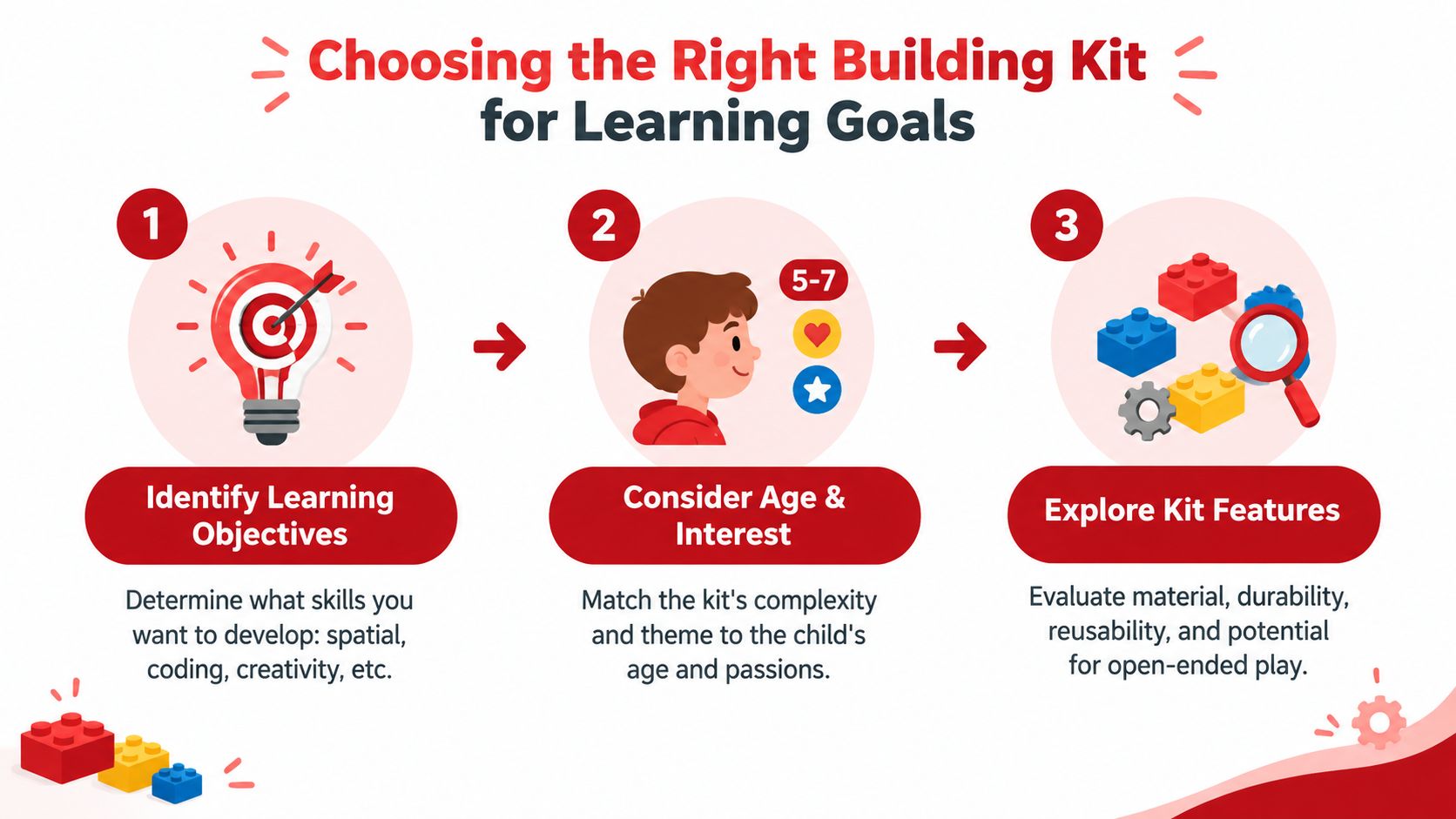
Start with the skill
For spatial reasoning, choose pieces that form structures from multiple angles and instructions that include diagrams or blueprints. For fine-motor practice, look for connectors that offer manageable resistance and pieces large enough for the child to grip. For mechanical thinking, gears, axles, wheels, and levers make movement visible.
For creative expression, favor open-ended blocks or interlocking bricks that don't require a single final model. For coding basics, a robotics or electronics kit should provide a clear progression from physical assembly to simple programmed actions.
Match complexity with interest
A child who loves vehicles may persist with a gear-driven car but lose interest in an abstract building challenge. A space enthusiast may wholeheartedly engage with a solar system model, while another child may prefer designing a cardboard habitat for imaginary creatures.
Use a simple comparison before buying:
| Learning goal | Useful kit features | Adult role |
|---|---|---|
| Spatial planning | Diagrams, models, rebuildable structures | Ask the child to explain orientation and sequence |
| Fine-motor development | Grippable pieces, manageable connectors | Demonstrate once, then let the child try |
| Mechanical reasoning | Gears, axles, wheels, movable parts | Encourage predictions before testing |
| Coding introduction | Sensors, motors, visual programming steps | Help troubleshoot without taking over |
| Creative expression | Mixed pieces, reusable parts, open-ended prompts | Offer materials and ask open questions |
Think beyond the first build
Families increasingly want a developmental ladder, beginning with free-form blocks and progressing toward structured, screen-based coding modules as skills advance. This coverage of construction and building toys describes that movement toward kits that continue offering challenges instead of becoming one-use activities.
Look for modular instructions, multiple build ideas, compatible parts, and opportunities to combine the kit with household materials. Playz Model Kits, for example, include model-building projects, while its V8 Combustion Engine Model Building Kit is described for ages 12 and older and focuses on mechanical engineering concepts. Treat those details as starting points, then compare them with the child's readiness and support needs.
Hands On Activities and DIY Extension Projects
The first completed model should be the beginning, not the finish line. Put the instructions aside and give the child a fresh problem that uses familiar pieces in an unfamiliar way.
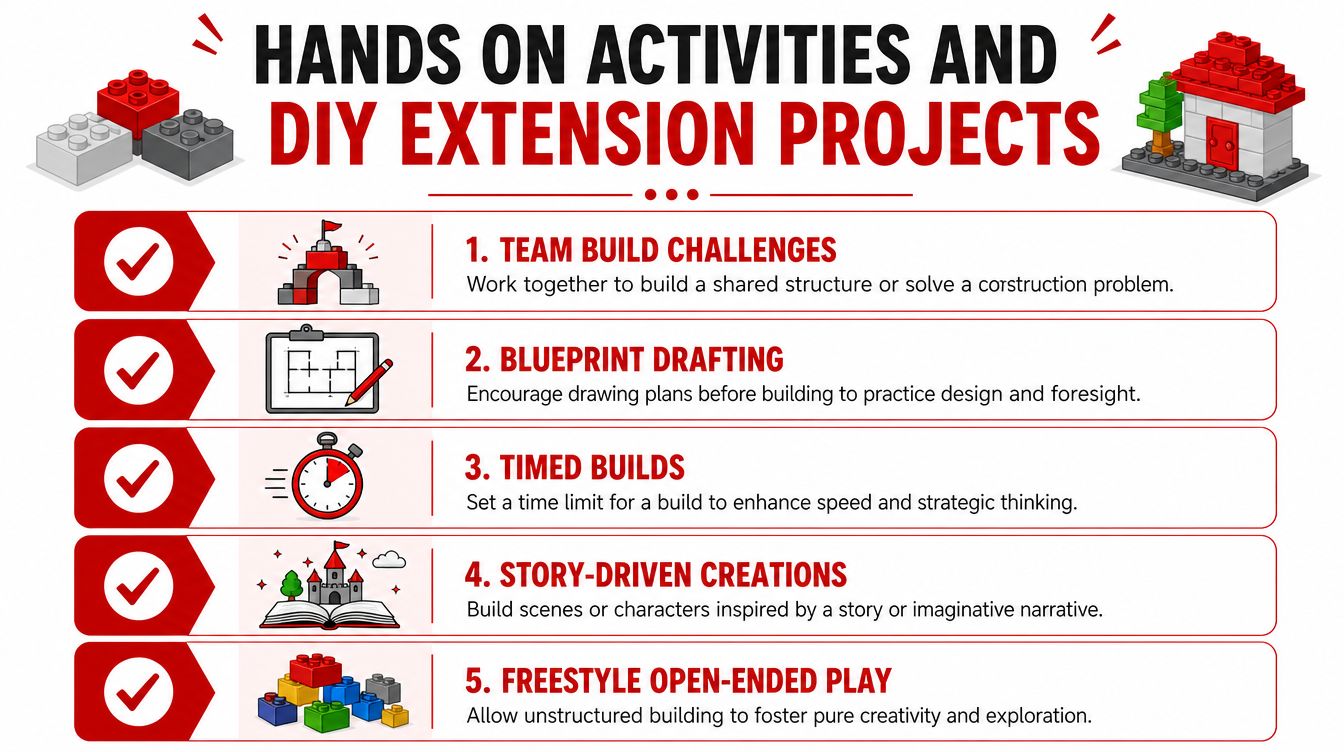
Five ways to reuse the kit
- Team build challenge: Two children design one structure together. Give each child a separate role, then ask them to agree on the final plan.
- Blueprint drafting: Before touching the pieces, have the child draw a top view or side view. They can compare the drawing with the finished model and revise the plan.
- Timed build: Set a short, friendly time limit and offer a specific goal, such as making a bridge that stands independently. Focus the discussion on choices rather than speed alone.
- Story-driven creation: Build a setting for a favorite story, then add a vehicle, character, or obstacle. The child can narrate what happens and change the structure as the plot develops.
- Freestyle mashup: Combine parts from different kits or add safe household materials. The purpose is to explore what connects, balances, rolls, or moves.
Following models and blueprints encourages goal-oriented design, mental rotation, pattern repetition, design testing, and iterative problem solving. That connection between building play and engineering-style behavior is described in this video-based construction research.
Three DIY extensions
Cardboard adapter. Cut cardboard into panels, mark connection points, and use paper fasteners or tape to create doors, ramps, roofs, or walls around the kit's existing structure. Ask which materials bend, hold, or collapse, then reinforce only the weak areas.
Recycled-material vehicle. Gather cardboard tubes, bottle caps, craft sticks, and the kit's wheels or axles. Challenge the child to build a vehicle that carries a small object, then change the wheel placement and compare how the movement changes.
Paper engineering challenge. Provide paper, tape, and the kit's blocks as supports. Invite the child to build a freestanding tower or bridge, draw the design first, and test the structure by adding small objects one at a time. The lesson is not about winning. It's about noticing where the load changes the design.
For a more involved moving-structure idea, use a marble roller coaster project as inspiration. Children can extend the track, alter slopes, and test how structure affects motion.
Storing and Maintaining Building Kits
Good storage protects more than the pieces. It makes the next building session easier to start, which matters when children have limited patience or a short window for play.
Choose transparent containers when possible. Sort large blocks, connectors, wheels, gears, figures, and electronic components into separate sections. A child who can see the available parts is more likely to choose independently than one who must search through a deep mixed box.
Build a simple storage system
- Use labeled containers: Add words and small drawings so emerging readers can identify categories.
- Keep special parts separate: Store magnets, batteries, motors, and fragile accessories where adults can inspect them.
- Create a project tray: Leave an unfinished model on a shallow tray so it can move without being dismantled.
- Photograph complex sets: A quick image of the completed model can help children rebuild it after sorting.
- Rotate rather than remove everything: Keep some kits available and store others for a later return.
Clean plastic and coated wooden pieces with a method appropriate for the material, then let them dry fully before storage. Don't soak electronic parts, battery compartments, or pieces with openings that can trap moisture.
Inspect connectors, axles, hinges, magnets, and battery covers during regular sorting. Replace damaged components instead of allowing a child to keep using a part that has cracked, split, or released a magnet.
A useful routine: Spend a few minutes at the end of each session sorting by type, not by color alone. Children learn classification while making the next session less frustrating.
To prevent burnout, change the prompt rather than assuming the kit has been exhausted. A model can become a bridge, a stage, a habitat, or part of a larger collaborative world.
Next Steps and Conclusion
Building kits for kids work best when adults look past the package. Choose for developmental readiness, not age alone. Match the construction system to a clear learning goal, whether that's spatial planning, mechanical reasoning, coding, fine-motor practice, or creative storytelling. Then protect the kit's long-term value by adding blueprints, challenges, recycled materials, and open-ended rebuilds.
A child doesn't need a perfect model to learn. They need safe materials, enough time to test ideas, and an adult who asks thoughtful questions without taking over. Explore Playz's building, model, and science-focused options, and make hands-on discovery part of the regular play routine.
Choose a Playz kit that matches your child's interests and current readiness, then plan one extension activity before the first model is finished. Visit Playz to explore purposeful building and science play that supports screen-free learning through the #KidsLearnBestThruPlayz approach.