

The holidays can turn a living room into a lively laboratory. Children handle decorations, stare at glowing lights, build with leftover boxes, and notice how winter weather changes from day to day. Christmas STEM activities turn that natural curiosity into purposeful investigations across engineering, electronics, chemistry, coding, meteorology, physics, renewable energy, and geometry.
The projects below use a consistent, practical format. You'll find materials, implementation steps, age adaptations, safety guidance, learning outcomes, trade-offs, and extension prompts, so you can choose an activity that fits your home, classroom, time, and available supplies. Holiday STEM enrichment also fits naturally into school-break programs, which commonly use multi-day learning experiences, collaborative projects, inquiry, and mentoring to keep children engaged during seasonal breaks, as described in this Australian STEM education review.
Some activities take only a short setup, while others reward repeated testing and observation. A reusable science kit, such as a Playz option, can also support purposeful, screen-light play when families want a more organized alternative to passive holiday entertainment.
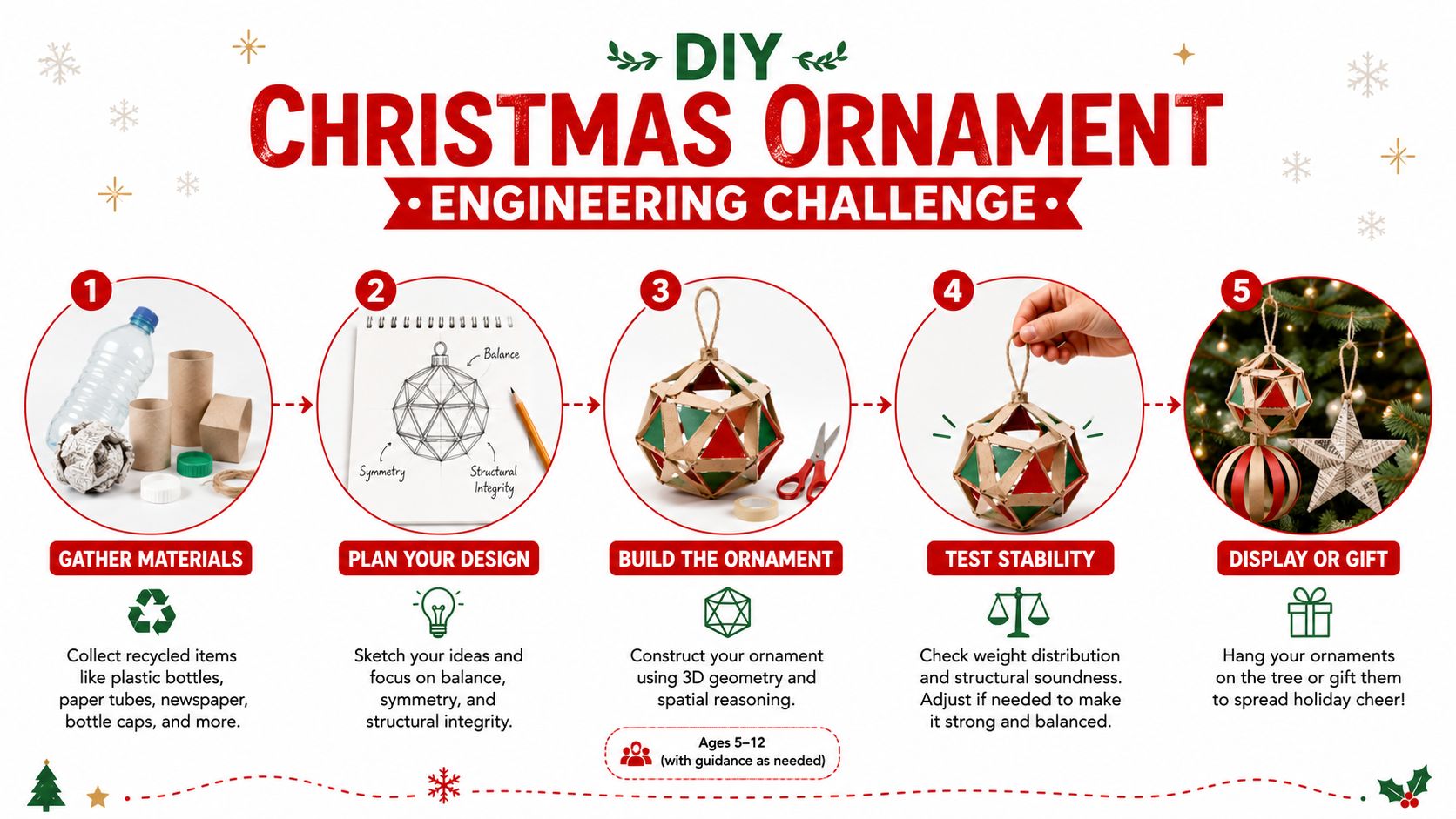
1. DIY Christmas Ornament Engineering Challenge
A Christmas ornament looks decorative, but it also has to solve several engineering problems. It must hold its shape, distribute its weight, attach securely to a branch, and remain attractive from different angles. Children can explore those constraints while designing a decoration from recyclable materials.
The historical connection is meaningful. Early glass Christmas tree decorations are associated with bead garlands made by the Greiner family in Lauscha, Germany, during the 16th century. That tradition connects holiday making with materials, symmetry, structure, and design, ideas that now fit naturally into hands-on STEM learning, as explained in this festive science guide from Twinkl.
Materials and steps
Use cardboard, paper, pipe cleaners, foam balls, clean plastic containers, string, tape, scissors, markers, and lightweight recycled packaging. Begin with a planning sheet showing the front, side, and hanging points of the proposed ornament. Children can then build, test its balance, and revise the design before decorating it.
Paper snowflakes can become folded geometric structures. Foam balls can support crystal-growing experiments, while recycled plastic bottles can become hanging planters for winter arrangements.
- Younger builders: Pre-cut card and plastic, and let children focus on folding, joining, and decorating.
- Older builders: Challenge them to create the lightest, most symmetrical, or most stable ornament.
- Classroom extension: Photograph finished designs and display the planning sheet beside each ornament as a mini engineering portfolio.
Learning and safety
Children learn about symmetry, center of mass, material properties, balance, and structural failure. Scissors need age-appropriate supervision, and hot glue should be handled by an adult or used only with close supervision.
Practical rule: Ask children to test the hanging loop before adding decoration. A beautiful ornament still fails if its attachment point can't support the finished weight.
2. Christmas Light Circuit Building and Electricity Exploration
A glowing paper snowflake gives children an immediate reason to understand a circuit. The light turns on only when electricity has a complete path from the battery, through the conductive components, and back again. That visible result makes abstract ideas such as current flow and circuit completion easier to discuss.
Start with battery packs, LED lights, conductive tape or wire, card, paper, and clips. Battery holders with pre-soldered connections reduce frustration, especially for younger learners. Before construction, children should draw a simple circuit diagram and test each component separately.
Build from one light to a holiday display
Begin with one LED and one battery pack. Once the circuit works, children can create a paper snowflake garland with a series connection, an illuminated gingerbread house with parallel lighting, or an interactive advent calendar with light-up numbered doors.
Explain the trade-off between creativity and troubleshooting. A larger decoration has more visual impact, but additional connections create more possible failure points. Encourage children to test after every added LED rather than waiting until the entire display is assembled.
- Ages for younger children: Use color-coded wires, large clips, and one light.
- For older students: Compare series and parallel layouts, then record what happens when one LED is removed.
- For classroom teams: Assign roles for diagramming, building, testing, and explaining.
For a clear introduction before this project, use Playz's guide to building simple circuits.
This visual process can help children follow the design sequence:
For a guided demonstration, use the following video:
Keep battery packs away from water and inspect wires for damaged insulation. Children should never connect batteries directly with loose wire, since that can create heat.
3. Crystal Growing Science Experiment for Holiday Decorations
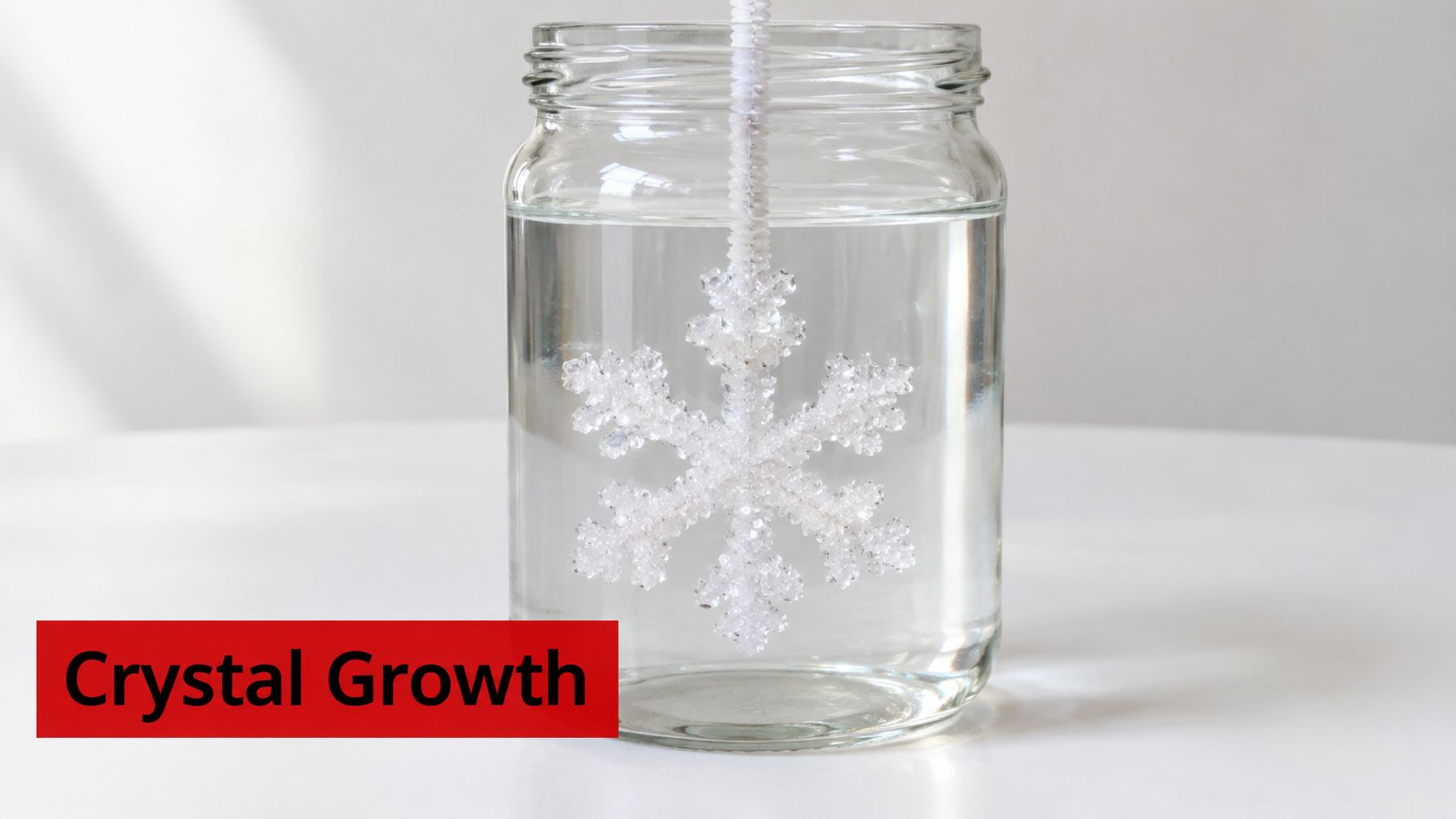
Crystal growth rewards patience. Instead of producing an instant craft, children prepare a solution, suspend a shape, observe gradual changes, and record what they see. That makes a snowflake ornament a useful introduction to supersaturation, evaporation, concentration, and crystallization.
Choose pipe cleaners or string to form snowflakes, jars, water, and a crystal-forming material such as salt, borax, or sugar. Adults should prepare hot-water solutions for younger children. Children can shape the ornament, lower it into the solution without touching the sides, and leave the jar in a stable place.
Turn decoration into an investigation
A simple observation journal can include a sketch, a description of the liquid, the appearance of the ornament, and a question for the next observation. Children can compare starting solutions, color, or placement, but they should change one factor at a time when possible.
- Younger children: Draw the ornament before and after growth and describe changes aloud.
- Older children: Record daily observations and explain how evaporation may affect the visible crystals.
- Family extension: Display the finished ornaments beside the journal pages and discuss why results may differ.
This crystal-growing experiments guide from Playz can provide additional activity context.
Safety and trade-offs
Hot water requires adult handling. Borax solutions must be kept away from children's mouths, food preparation areas, and pets, and children should wash their hands after the activity. Salt and sugar are more accessible alternatives, although their crystal results can differ in appearance and may require more patience.
The strongest learning outcome isn't the decoration itself. It's the habit of watching a process, recording evidence, and resisting the urge to change several variables at once.
4. Gingerbread House Architectural Design and Construction
A gingerbread house gives architecture an edible testing ground. Children must think about foundations, wall alignment, roof angles, load-bearing elements, and the order of assembly. When a wall slides or a roof collapses, the failure creates a concrete reason to revisit the design.
Use pre-baked gingerbread pieces, cardboard templates, royal icing, a ruler, paper, and decorations. Have children sketch a plan before construction. They can prototype a complicated design with cardboard or foam, then transfer the strongest ideas to the edible structure.
Build for stability before decoration
Royal icing works like mortar, but decorative candy shouldn't carry the same structural responsibility as a wall or support. Discuss the difference between a load-bearing element and a visual feature. A multi-story house may need reinforced candy support beams, while a team-built village can introduce roads, shared spaces, and simple urban planning.
- Early learners: Assemble a small house from pre-cut pieces and identify walls, roof, and foundation.
- Older children: Calculate material needs, compare roof angles, and explain why a design failed.
- Group challenge: Give each team a different architectural style or a shared village plan.
Safety and learning outcomes
Check for food allergies, supervise young children around hard candies, and keep tools and food surfaces clean. The main learning outcomes include spatial planning, geometry, structural reasoning, and iterative design.
A collapsed gingerbread roof isn't wasted work. It gives children evidence about alignment, support, and the limits of a material.
The trade-off is that edible construction creates motivation but also introduces mess, food concerns, and variable results. Cardboard offers a more controlled version when the lesson needs to focus on architecture rather than eating.
5. Holiday STEM Coding Challenge with Programmable Robots
Coding becomes easier to understand when children can see the result of each command. A robot that turns too soon, misses a decoration, or delivers a “present” to the wrong location gives immediate feedback about sequencing and debugging.
Begin without a device. Draw a holiday map on paper, mark a starting point and destination, and ask children to write directional cards for forward, backward, left, and right. They can test the sequence with a partner acting as the robot. Later, use Ozobot, Bee-Bot, or Dash to bring the same algorithm into a physical space.
From unplugged commands to robot testing
Create a route that visits decorations in a required order. An Ozobot can follow a marked path to deliver holiday gifts, a Bee-Bot can visit a Christmas tree and a snowman in sequence, and a Dash robot can perform a light pattern after reaching its destination.
- Younger coders: Use large arrow cards and short routes.
- Older coders: Add obstacles, reduce the number of commands, or require a repeatable pattern.
- Team roles: Let one child write commands, another operate the robot, and another record errors.
Playz's resource on teaching coding to children can help adults introduce sequencing and debugging in age-appropriate ways.
The learning outcomes include algorithmic thinking, spatial reasoning, collaboration, and failure recovery. The main trade-off is access to hardware. If a programmable robot isn't available, paper maps and human role-play preserve the core computational thinking without requiring a screen.
Safety is straightforward, but keep routes clear of trip hazards and supervise small robot accessories around young children.
6. DIY Holiday Weather Station and Climate Monitoring Project
Winter weather offers a daily reason to collect data. Children can build a simple weather station and connect readings to real decisions, such as whether outdoor play is comfortable, whether rain may affect a holiday event, or how wind changes the movement of decorations.
Use clear bottles, paper, straws, cups, clay, cardboard, markers, a thermometer, and a notebook. A bottle with measurement markings can serve as a rain gauge. A paper arrow mounted on a straw can show wind direction, while cups attached to a simple frame can form an anemometer.
Establish a repeatable routine
Place the station outdoors in an open, unobstructed area. Take readings at consistent times and record temperature, rainfall, wind direction, and anemometer movement. The point isn't to create a professional forecast. It's to teach children that useful data depends on careful observation and consistent recording.
- Ages for younger children: Use picture symbols for sunny, cloudy, rainy, and windy conditions.
- Older students: Create graphs, compare indoor and outdoor temperatures, and look for relationships between weather and holiday activities.
- Classroom extension: Display a shared chart where students add observations and explain changes.
Children learn measurement, data collection, graphing, environmental science, and interpretation. The trade-off is that the project becomes more meaningful over repeated observations, so it isn't the best choice when you need an instant finished product.
Use adult judgment for outdoor placement, especially during storms, freezing conditions, or strong winds. Children can observe from indoors when conditions aren't safe.
7. Reindeer Flight Physics Challenge
A paper rocket turns the story of reindeer flight into a testable question. How do fins affect stability? How does launch force influence distance? Why does a design travel straight in one trial and veer sideways in another?
Choose paper, straws or paper tubes, tape, scissors, lightweight foam, optional fins, and a stomp launcher or other age-appropriate launch method. Children predict a flight path, decorate a rocket as a reindeer, launch it, measure the result, and modify one design feature before trying again.
Make every launch useful
A classroom can mark a launch zone and landing area with tape or chalk. Students can test paper tube rockets, straw rockets, foam rockets aimed at a “North Pole” target, or, with suitable adult supervision and an appropriate outdoor setting, water-pressure bottle rockets.
- Younger children: Compare rockets with and without fins and describe which travels straighter.
- Older students: Graph distance, evaluate trajectory, and justify a redesign.
- Team challenge: Score accuracy or distance with a festive “Nice List” chart.
The activity teaches force, motion, thrust, trajectory, aerodynamics, prediction, and iteration. Its advantage is strong physical engagement. Its limitation is the need for clear space and careful launch control.
Never aim rockets at people, animals, windows, or fragile objects. Use soft materials indoors, establish a launch boundary, and reserve pressurized bottle activities for responsible adult-led outdoor sessions.
8. Renewable Energy Holiday Light Project
Holiday lights provide a practical context for asking where electrical energy comes from. Children can build a small solar-powered display or a simple wind turbine and then investigate how placement, weather, and design affect the system's performance.
Use a student-scale solar panel kit, small LED lights, recycled cups, straws, bottle tops, cardboard, tape, and a simple meter if available. A solar panel can power a small LED display, while a cup-and-straw turbine can demonstrate how moving air turns blades. Children should first sketch the energy path from sunlight or wind to movement or light.
Compare position and power
Place the solar panel at different angles and observe changes in LED brightness or meter readings. For a wind turbine, alter blade size, number, or angle. Record the conditions and compare results rather than treating one trial as a final answer.
- Younger learners: Identify the energy source and observe whether the LED lights.
- Older learners: Track production across changing weather and design a solar-and-battery backup system.
- Design extension: Create a holiday display that prioritizes low material use and stable lighting.
You can connect the project with Playz's solar oven activity, which offers another child-friendly way to explore energy from the sun.
The learning outcomes include renewable energy, engineering optimization, sustainability, and systems thinking. Small panels may not power a full-size outdoor display, so keep expectations focused on demonstration and comparison. Never connect a homemade circuit to household mains electricity.
9. Festive Engineering Bridge Building Challenge
A bridge spans a gap and carries a load, so its success depends on structure rather than appearance. Children can use marshmallows, toothpicks, popsicle sticks, and straws to build a bridge for a toy reindeer, wrapped gift, or consistent test load.
Set a clear span, height, load requirement, and material allowance for each team. Before construction, students sketch a design, mark likely weak points, and predict how much weight it will hold. Test the finished bridge gradually, recording when and where it bends or breaks.
Use failure as evidence
A classroom version can give each team or student 20 gum drops and 40 toothpicks, with amounts adjusted for age and group size, as described in this Christmas STEM experiment resource. Other versions include marshmallow-and-toothpick bridges, popsicle-stick bridges across a “river,” or straw bridges that carry wrapped gifts.
- Younger builders: Make a short bridge and compare wide and narrow bases.
- Older students: Explain tension, compression, load distribution, and material efficiency.
- Class display: Photograph each bridge before and after testing, then create a bridge hall of fame for load capacity or efficient design.
Use Playz's engineering design process guide to support planning, testing, and redesign discussions. The value lies in explaining why a structure failed and how the next version could improve.
Check materials before building. Toothpick points and small pieces require supervision, and food allergies may affect the choice of supplies. Age adaptations can also replace toothpicks with craft sticks or drinking straws for safer handling.
10. Holiday Ornament Geometry and Kaleidoscope Pattern Design
Geometry can make holiday decoration more precise without making it less creative. Children can design snowflakes, mandalas, kaleidoscopes, tessellations, and repeating ornament motifs while exploring angles, symmetry, transformations, and patterns.
Start with paper, cardstock, pencils, rulers, compasses, scissors, markers, and optional digital tools such as GeoGebra or Desmos. Demonstrate folding before cutting so children understand how repeated folds create rotational symmetry. Unfolding the paper reveals a direct connection between the construction process and the final pattern.
Build from simple symmetry to complex design
Younger children can use pre-printed templates and identify lines of symmetry. Older students can create four-fold, six-fold, or eight-fold designs, measure angles, and explain how a small shape repeats across a larger pattern.
- Paper activity: Fold and cut a snowflake, then compare the repeated sections.
- Design activity: Create a mandala with rotational symmetry and turn it into an ornament.
- Digital extension: Build a fractal or tessellating holiday motif, print it, and display it beside the hand-drawn version.
Use sturdy cardstock when delicate cuts could tear. Scissors require supervision, and compasses should be handled according to age and classroom policy.
The learning outcomes include spatial reasoning, angle measurement, symmetry, tessellation, and mathematical communication. The trade-off is that precision takes time, but children can work at different levels within the same project. Finish with a mathematics gallery where each child labels the symmetry or transformation used.
Christmas STEM Activities, 10-Item Comparison
| Activity | 🔄 Implementation Complexity | 📦 Resources & ⚡ Time | 📊 Expected Outcomes | 💡 Ideal Use Cases | ⭐ Key Advantages |
|---|---|---|---|---|---|
| DIY Christmas Ornament Engineering Challenge | Medium, simple builds with some tool supervision | Low materials (recycled bottles, paper tubes, glue); ⚡ 45–90 min | Tangible ornaments; basics of balance, symmetry, structural integrity | Classroom craft stations, sustainability lessons, family workshops | Low cost; promotes creativity and eco-friendly thinking |
| Christmas Light Circuit Building & Electricity Exploration | Medium–High, basic electronics and safe handling required | Medium components (LEDs, batteries, wires, switches); ⚡ 60–120 min | Working circuits; understanding conductivity, series/parallel behavior | Makerspaces, introductory electronics, holiday displays | Reusable components; strong visual feedback; foundation for electronics |
| Crystal Growing Science Experiment | Low, simple chemistry prep, long observation period | Low-cost ingredients (borax, salt, sugar, pipe cleaners); ⚡ 15 min prep + 24–72 hrs growth | Observation-based understanding of crystallization and variables | Long-term classroom experiments, science journals, decorative projects | Inexpensive; visually striking results; scalable for groups |
| Gingerbread House Architectural Design & Construction | High, planning, structural challenges, and time-intensive steps | Medium–High (ingredients, royal icing, templates); ⚡ 3–5 hrs (may span days) | Load-bearing and architectural planning; iterative design practice | Project-based learning, advanced STEM weeks, holiday competitions | Memorable, multisensory learning; integrates math and physics |
| Holiday STEM Coding Challenge with Programmable Robots | Medium, platform-dependent learning curve and debugging | Medium–High (robots/kits, chargers, software); ⚡ 45–120 min | Computational thinking, sequencing, debugging skills | Coding clubs, team challenges, unplugged-to-robot progressions | Highly engaging; reusable tech; clear progression path |
| DIY Holiday Weather Station & Climate Monitoring | Medium, requires consistent methodology and outdoor setup | Low materials (bottles, cups, thermometers); ⚡ 60 min setup + ongoing observations | Data collection, graphing, basic meteorology understanding | Ongoing science projects, outdoor learning, environmental units | Authentic scientific investigation; minimal material cost |
| Reindeer Flight Physics Challenge (Rocket Propulsion) | Medium, safety and outdoor launch management | Low–Medium (paper, bottles, stomp launchers); ⚡ 60–90 min | Hands-on lessons in thrust, trajectory, aerodynamics | Outdoor physics demos, competitive design challenges | Dramatic, immediate feedback; fosters iterative improvement |
| Renewable Energy Holiday Light Project (Solar & Wind) | High, system design, installation, and measurement | Medium–High kits (small solar panels, turbines, meters); ⚡ 90–150 min setup + ongoing | Renewable energy concepts, measurement and comparison skills | Sustainability units, outdoor holiday displays, STEM fairs | Teaches modern energy use; practical, eco-friendly application |
| Festive Engineering Bridge Building Challenge | Medium, design constraints and destructive testing | Low-cost materials (marshmallows, popsicle sticks, straws); ⚡ 60–120 min | Load-bearing analysis, material properties, iterative design | Quick engineering labs, team competitions, design iterations | Cheap materials; rapid testing cycles; clear success criteria |
| Holiday Ornament Geometry & Kaleidoscope Pattern Design | Low–Medium, precision work; digital optional | Low materials (paper, compass, scissors, digital tools); ⚡ 45–90 min | Understanding symmetry, tessellation, angles; precise visual results | Math-art lessons, quiet focused activities, gallery displays | Minimal cost; makes abstract math tangible; attractive results |
Choose a Challenge and Keep the Curiosity Going
The best activity depends on the child and the setting, not on which project looks most impressive in a photograph. For a quick indoor activity, choose a paper circuit, symmetry design, unplugged coding route, or ornament balance test. For a longer investigation, choose crystal growth, weather monitoring, renewable energy, or a bridge challenge that gives children time to collect observations and redesign.
Materials also matter. A classroom with limited supplies can use paper, cardboard, straws, recycled containers, and simple drawing tools. Families with a science kit may prefer crystals, circuits, or solar energy. Mixed-age groups can work well when the same challenge has different levels of responsibility. Younger children can sort, build, observe, and describe, while older children can measure, graph, explain, and lead testing.
Space should guide the choice. Rocket experiments need a controlled launch area, and weather stations need a safe outdoor location. Circuits, geometry, crystal journals, and gingerbread prototypes work better indoors. If food allergies or sensory concerns are present, replace candy-based materials with cardboard, foam, paper, or reusable construction pieces.
Every project becomes more educational when children follow a simple investigation cycle. Ask them to predict what will happen, build or set up the test, observe carefully, record what changed, explain a failure, and improve the design. Don't rush to fix a collapsed bridge or a circuit that won't light. Ask which connection, shape, material, or measurement they want to examine first.
The finished object is only part of the learning. The explanation of why it worked, failed, or changed matters just as much.
Try pairing one quick project with one extended investigation. A child might build a paper snowflake circuit in one sitting, then monitor a crystal ornament or weather station over several observations. That combination keeps the holidays lively while showing that STEM includes both immediate problem-solving and patient evidence gathering.
Guided support can make a difference for families who want more structure. Research on guided STEM kits for preschool children found that the guided-kit group reported more sustained use, greater confidence in supporting STEM learning at home, and stronger parent-rated child STEM-skill gains over a 10-week period, compared with basic kits, according to this study of guided home STEM materials. Clear steps, prompts, and adult guidance can help a festive activity become a repeatable learning routine rather than a one-time craft.
Digital or hybrid support can also work when it serves the investigation. In a remote parent-child STEM intervention, satisfaction averaged 1.79 on a five-point usability scale, where lower scores indicated better usability, and more than 90% of respondents said the program was helpful at posttest, according to this parent-child STEM intervention report. The lesson isn't that every activity needs a screen. It's that clear explanations and guided support can help adults participate confidently.
When you're ready for a reusable option, explore Playz science kits and creative toys at Playz. Choose a project that fits your materials and space, then let children make the first prediction, test the first design, and decide what they want to improve next.
Playz offers science kits, creative toys, and hands-on play resources that can support screen-light Christmas STEM activities at home or in the classroom. Visit Playz to find a purposeful activity that gives children more opportunities to build, investigate, and learn through play.