


You're standing in a toy aisle with a birthday coming up, comparing a volcano kit, a beginner microscope, and a brightly packaged robotics set. Every box promises discovery. The core question is which one your child will still use after the first afternoon.
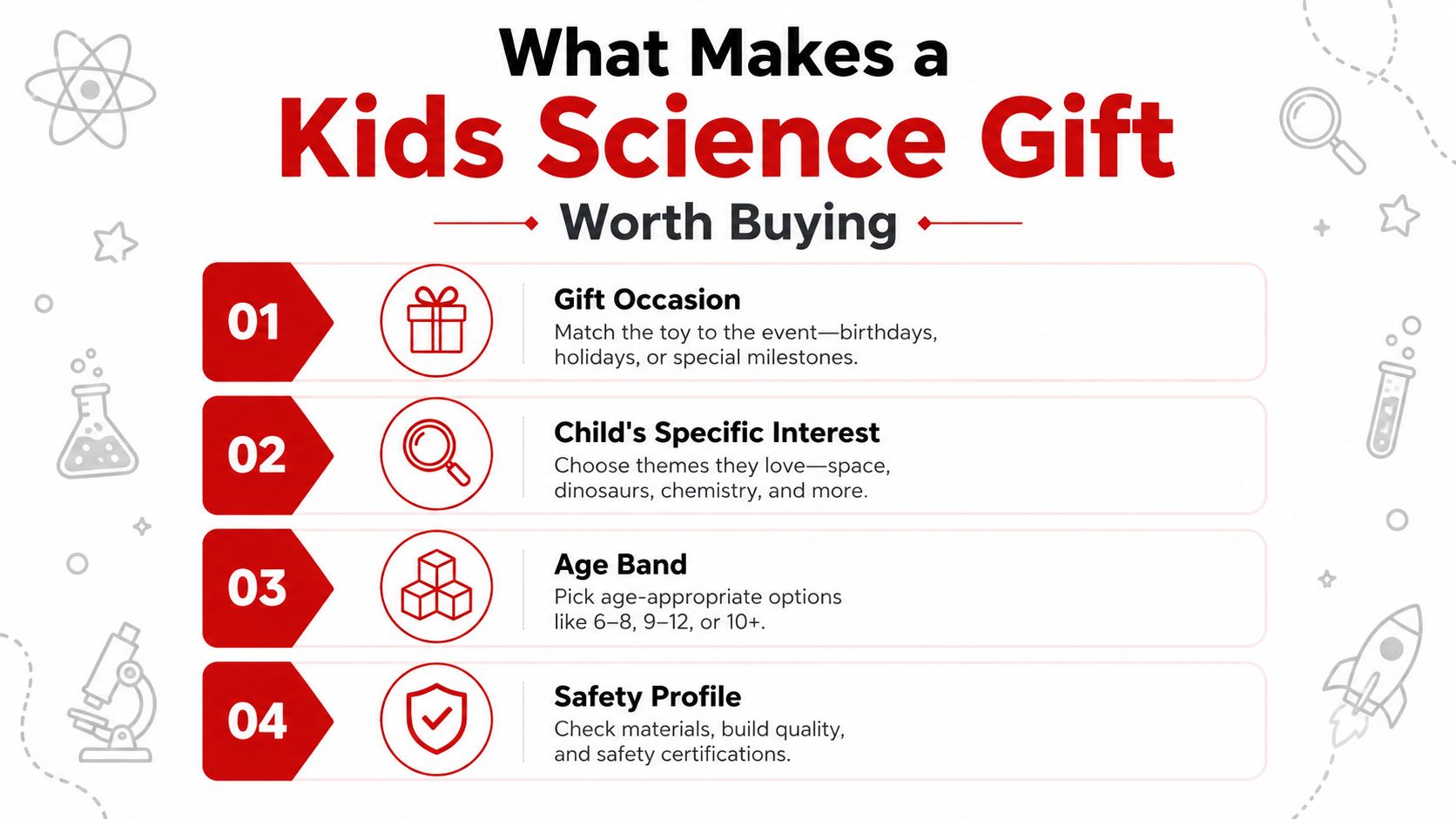
The label science kit covers very different experiences. Some deliver one dramatic reaction, some invite weeks of building, and others work only when an adult is ready to supervise. The right choice depends on four decisions: the occasion, the child's interest, the age band, and the safety profile.
The category deserves careful attention. One market estimate places the global STEM toys market at USD 1.20 billion in 2024, with a projection of USD 1.83 billion by 2030, representing a 7.2% CAGR from 2025 to 2030. North America accounted for about 35% of the market in 2024, and the United States represented 80% of North American share, according to Grand View Research's STEM toys market analysis. Parents have plenty of choice, but more choice makes screening essential.
What Makes a Kids Science Gift Worth Buying
A worthwhile science gift clears four hurdles. It should connect with something the child already notices, fit the skills they can use independently or with reasonable help, pass a basic safety check, and offer enough flexibility to justify taking it off the shelf again.
Start with the occasion
A wrapped birthday present needs immediate appeal and a satisfying first activity. A holiday gift can support a larger project, while a classroom resource needs clear instructions, durable components, and easy storage. Don't buy a complex robotics platform for a child who needs a quick, rewarding experience at a party.
Follow the child's curiosity
The child who collects rocks needs a different gift from the child who dismantles remote controls. Space fans may respond to astronomy tools, while builders usually need modular parts and a way to change the design. A kit that reflects an existing question has a better chance of becoming an activity rather than clutter.
Match the age band, not just the box
Printed age guidance matters, but the deeper question is what the child must do. Can they read several steps, measure accurately, sort tiny components, or troubleshoot a failed build? A gift that demands skills far beyond the child's current ability becomes an adult project.
Screen the safety profile
Check small parts, chemicals, batteries, magnets, sharp edges, and required supervision before comparing educational value. The guide to educational science toys is useful background, but no article replaces reading the product label and manual for the specific kit.
Practical rule: Judge a kit by its replay value, not by the number of accessories visible through the box.
The strongest kids science gifts leave room for a second question. A child might repeat an experiment with a different variable, rebuild a structure, record a new observation, or explain why the result changed. That open loop is where a novelty product becomes a useful learning tool.
The Main Categories of Science Gifts Explained
You can sort most kids science gifts into four practical categories. Choose the category that fits the child's current motivation, then add a smaller item from another category only if it complements the main gift.
Hands-on experiment kits
Chemistry sets, crystal-growing projects, and volcano labs create visible results quickly. They suit children who enjoy mixing, observing, and asking what will happen next. Their weakness is often limited replay value, especially when the materials are consumed during one activity.
Look for clear procedures, measurement tools, observation prompts, and experiments that vary more than one outcome. A chemistry kit should feel like a sequence of investigations, not a single colorful reaction.
Construction and engineering toys
Snap-circuit systems, magnetic building tiles, and robotics platforms reward repeated tinkering. A child can change the structure, identify a failure, and try again. These gifts teach systems thinking because the result depends on how parts interact.
A modular robotics platform has more staying power than a build that can only produce one finished model. The STEM building kits guide can help parents compare construction-led options with more conventional experiment sets.
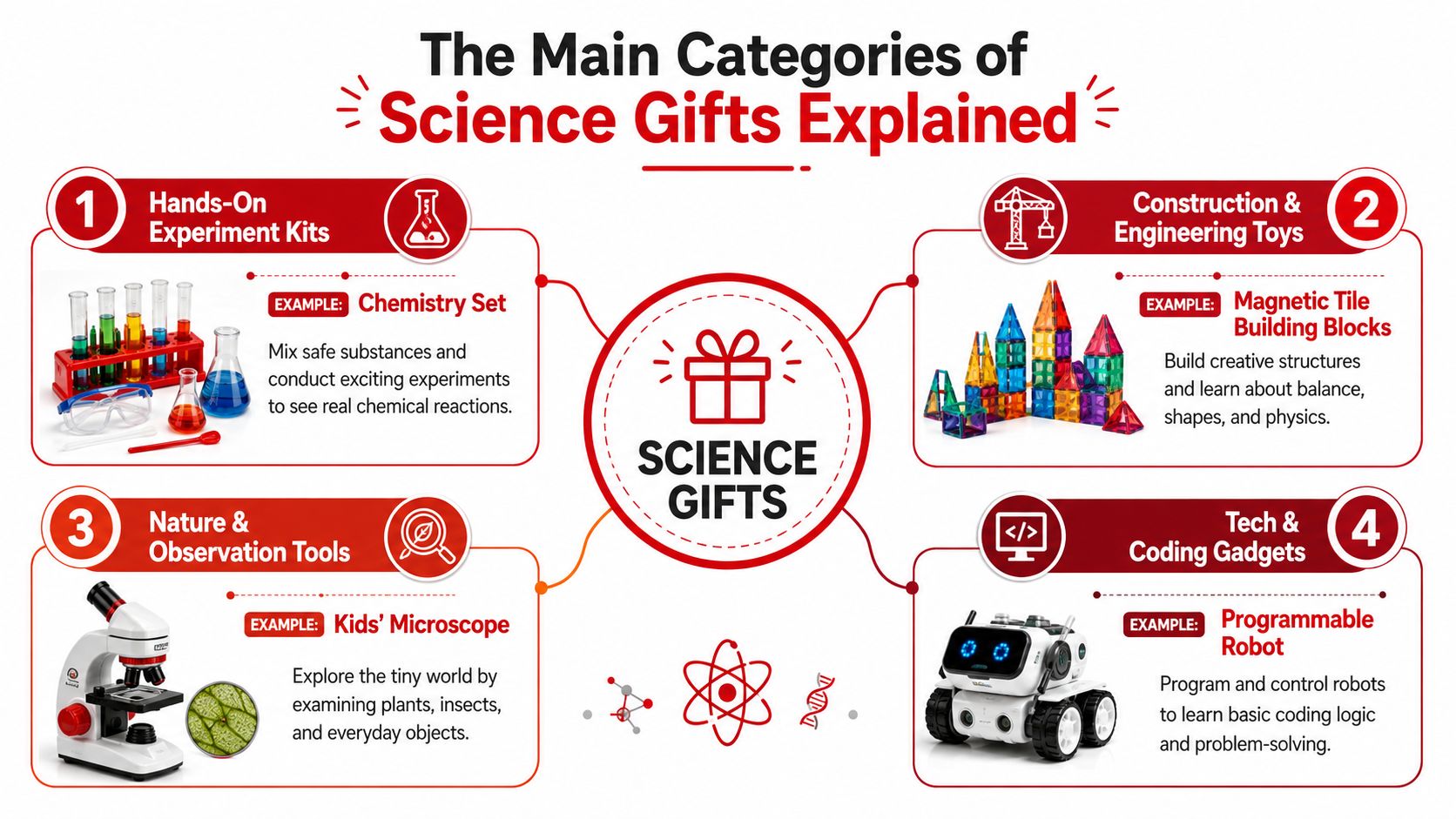
Nature and observation tools
Bug catchers, starter telescopes, rock and mineral sets, and children's microscopes move science outdoors or into close observation. They're a strong fit for children who lose interest at a table but stop to inspect leaves, insects, shells, or stones.
The best versions include ways to record findings, compare samples, or return to the same subject. A tool that supports observation beyond the initial unboxing usually outlasts a decorative science object.
Technology and subscription gifts
Programmable robots, coding gadgets, and monthly boxes add fresh challenges. Subscription services may include video lessons, apps, QR instructions, or other digital layers. Market reporting says digital features appear in 60% to 70% of new launches in the United States and about 40% in the United Kingdom, while subscriptions account for 12% to 15% of UK revenue and are growing 18% to 22% annually, as outlined in IndexBox's kids science kit market analysis.
Use subscriptions when novelty keeps the child engaged. Avoid paying for an app that adds animations but no meaningful data collection, planning, or feedback.
Matching Science Gifts to Your Child's Age
Age matching is really engagement matching. Younger children need immediate cause and effect and larger components. Older children need a kit that lets them alter variables, make mistakes, and debug a result rather than just complete more steps.
A recent review of technology-enhanced toys found that children showed curiosity-driven behaviors such as manipulating objects, exploring functions, and forming informal hypotheses. The strongest STEM effects appeared when toys combined programmable features with free play, rather than forcing one fixed outcome, according to the review published in PMC.
Four to six
Choose large parts, simple cause-and-effect activities, and results that appear quickly. Water movement, color changes using child-safe materials, basic building, and observation tools can work well. Adult guidance should be close, because the child is learning how to follow a sequence as much as learning the science itself.
Seven to nine
Children in this band can often manage multi-step instructions, basic measuring, and short reading loads. Beginner chemistry sets, simple electronics, crystal projects, and structured nature investigations become more suitable. Pick kits with clear diagrams and a manageable number of tools.
Ten to twelve
This is the point where open-endedness matters more than a larger component count. Choose kits that support troubleshooting, variable changes, recording results, and several possible builds. A child who can complete a model but can't alter it may outgrow the gift quickly.
Teens
Teens benefit from authentic instruments, programming interfaces, and kits tied to a genuine interest. A beginner microscope, electronics platform, coding robot, astronomy tool, or project linked to environmental science can feel more respectful than a toy-like package.
| Age Band | Core Skills | Best-Fit Gift Types | Parent Involvement |
|---|---|---|---|
| Four to six | Cause and effect, sorting, basic observation | Large-part experiment kits, simple building sets, nature viewers | Close guidance |
| Seven to nine | Sequencing, measuring, following short instructions | Beginner chemistry, crystal growing, starter electronics | Setup and periodic help |
| Ten to twelve | Troubleshooting, recording, changing variables | Modular engineering, robotics, microscopes, earth science | Available for difficult steps |
| Teens | Independent planning, coding, technical investigation | Authentic instruments, advanced electronics, programming platforms | Safety oversight and mentoring |
The best science kits for kids guide can support comparison, but treat the printed age range as a starting point. A child's reading ability, fine-motor control, patience, and prior experience matter just as much.
Real Learning Benefits of Quality Science Kits
A quality kit turns a child from a spectator into the person making the prediction, changing the setup, and interpreting the result. That distinction matters because active manipulation gives children a reason to remember what happened.
A classroom study found that 90% or more of teachers observed increased interest or better understanding of science after using kits, while 88% reported improved overall science achievement. The report also connected kit use with voluntary participation, more science discussion, and a stronger ability to apply concepts to real-world situations, according to the ERIC classroom study.
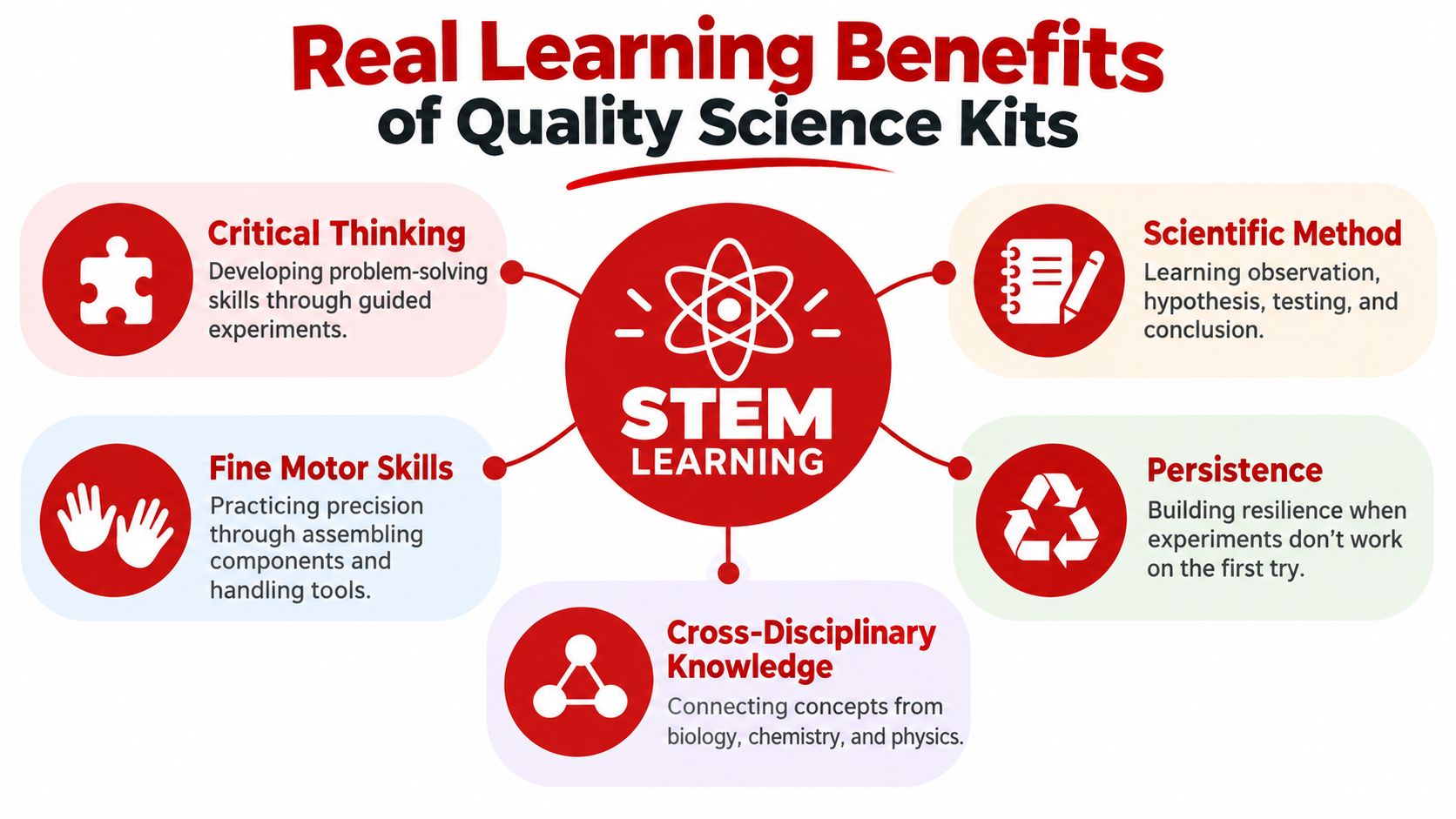
Five outcomes to look for
- Procedural understanding: Children practice predicting, testing, observing, and explaining. They learn the sequence of inquiry instead of memorizing a definition of the scientific method.
- Cause-and-effect reasoning: Chemistry and physics kits make relationships visible. A child can change one condition and compare what happens.
- Data literacy: Observation logs, measurement tools, result charts, and simple tables teach children to record evidence rather than rely on memory.
- Persistence: Failed builds and unexpected results create opportunities to troubleshoot. The adult's response matters here. Ask what changed and what they might test next, instead of fixing everything immediately.
- Vocabulary and concepts: Repeated use of terms such as circuits, ecosystems, reactions, force, and variables gives children language for their observations.
A 2025 systematic review found that STEM toys can improve young children's problem-solving, critical thinking, collaboration, and verbal communication, as reported in the review of STEM toy efficacy. These benefits are more likely when the gift supports multiple investigations rather than one impressive demonstration.
For younger children, adult facilitation helps connect action to explanation. For older children, reusable components and open-ended challenges create the repetition needed to move from following instructions to designing an investigation. The principles in designing immersive learning with Studio Liddell offer useful context for thinking about interaction, feedback, and meaningful participation in learning experiences.
You can find a practical companion perspective in the benefits of hands-on learning, especially when deciding whether a kit gives children enough to do themselves.
Safety and Age-Appropriateness You Should Always Check
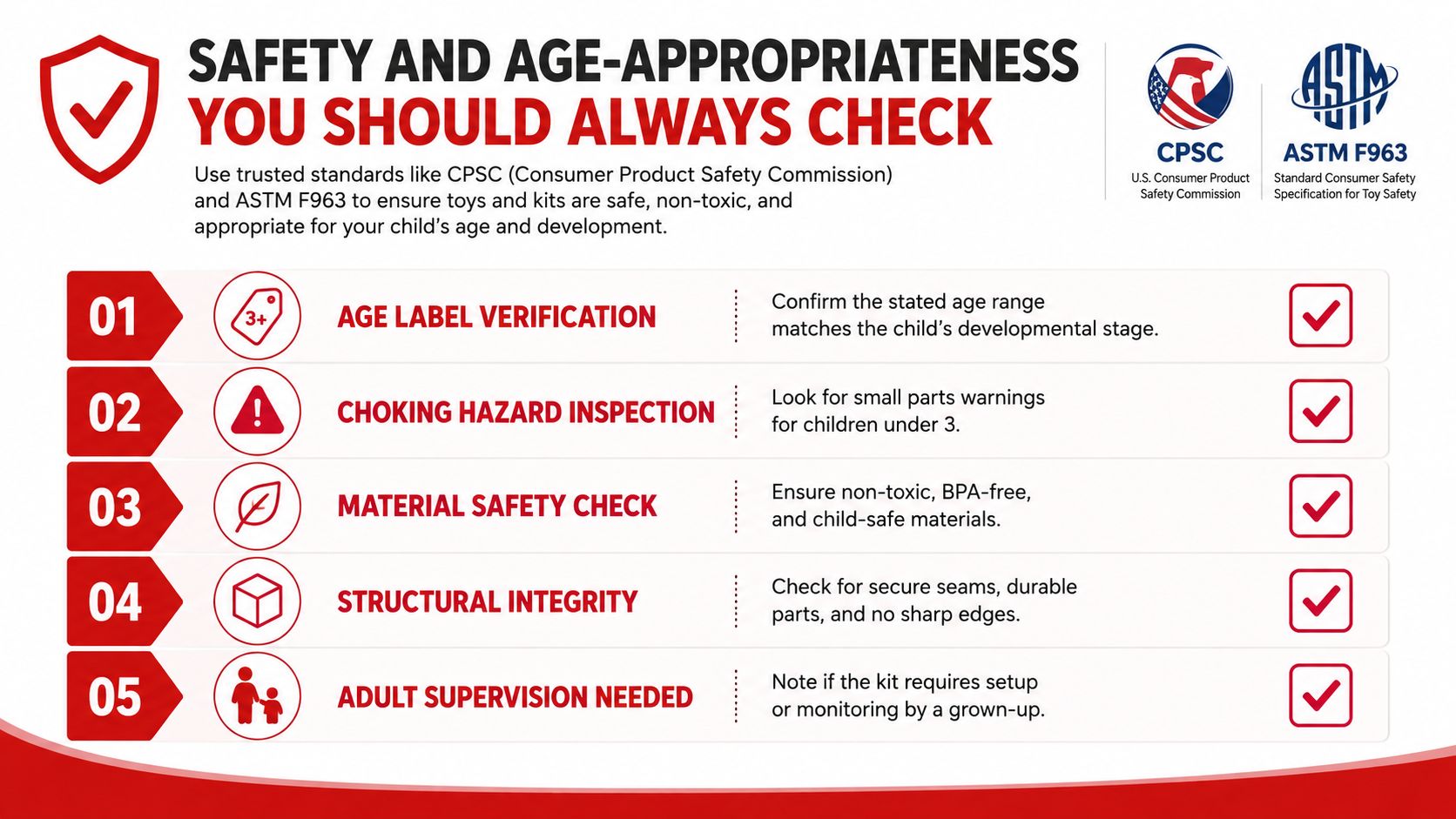
Safety screening comes before learning value. The U.S. Consumer Product Safety Commission's age-determination guidance connects age labels with developmental skills, play behavior, and hazards such as small parts. Its age-determination and toy-safety guidance is a better reference than a retailer's short product description.
Use this purchase checklist
- Verify the age label: The stated age should match or exceed the child's developmental stage. Age guidance isn't only about difficulty. It also reflects foreseeable hazards and the skills needed to use the product safely.
- Inspect small parts: For children under three, small parts present a serious choking concern. Don't assume adult supervision makes an unsuitable kit appropriate.
- Read chemical instructions: Chemistry and slime-style kits should identify materials and explain whether gloves, ventilation, eye protection, or adult handling is required. If the manufacturer hides the material information, remove the product from your shortlist.
- Check electronics details: Look for battery type, voltage limits, exposed contacts, and whether soldering is required. A kit that assumes soldering skills needs a different supervision plan from a snap-together circuit set.
- Treat magnets carefully: High-strength magnets deserve extra scrutiny because ingestion can cause serious harm. Keep them away from young children and follow the manufacturer's age and supervision guidance.
Go beyond the packaging. Read recent user feedback for reports of sharp edges, fragile parts, missing protective equipment, or components that don't fit. Confirm that the manufacturer offers a customer-support channel for replacement parts. A durable kit can still become unsafe if a cracked container or damaged wire gets reused.
Safety concerns also influence materials and packaging. Reporting on Australia says eco-friendly packaging and certified child-safe chemical formulations are shaping sourcing decisions, while nearly half of UK buyers would switch brands for recyclable or plastic-free packaging, according to IndexBox's Australia kids science kit analysis. The practical lesson is simple: screen first, then compare educational features among the products that remain.
One-Time Kit vs Subscription Box Trade-Offs
A one-time kit gives you depth immediately. A subscription gives you a recurring reason to try something new. Neither model wins automatically, because the better choice depends on whether the child has a focused interest or is still exploring.
| Factor | One-Time Kit | Subscription Box |
|---|---|---|
| Upfront commitment | One purchase | Recurring commitment |
| Learning pattern | Deeper focus on one theme | Broader exposure across themes |
| Reusability | Often depends on durable tools and refill availability | Consumables may limit replay |
| Digital layer | May be optional or absent | May include apps, videos, QR instructions, or progress features |
| Gift occasion | Strong fit for birthdays and holidays | Works as an extended gift over time |
A one-time kit is the safer choice when you already know the child loves crystals, circuits, volcanoes, or astronomy. It lets you select a coherent project and evaluate whether the components can support a second build or experiment.
Subscriptions make more sense when the child enjoys surprise, hasn't settled on a subject, or needs a regular prompt to return to science. The trade-off is breadth. Monthly boxes may sample chemistry, biology, and physics without giving any one topic enough time to develop.
Consider screen time before buying
Digital layers can add useful demonstrations, instructions, data collection, or progress tracking. They can also turn a hands-on gift into another video activity. Ask whether the app helps the child plan and interpret an experiment or just supplies animations that could have been printed.
Subscription services also create an ongoing household decision. You'll need storage for incoming projects, a plan for unused materials, and a clear understanding of cancellation terms. Review monthly science kits for kids before choosing recurring delivery.
Choose a one-time kit for a specific interest and deeper practice. Choose a subscription for exploration, novelty, and a child who is ready for a continuing challenge.
Choosing by Your Child's Interests
Start with the question your child asks most often. The subject that already holds their attention should determine the kit type, because motivation carries a child through confusing instructions and failed attempts.
If chemistry catches their attention
Choose reaction-based activities, crystal growing, or safe household-material investigations. Quality signals include clear material disclosures, reusable glass-style beakers or sturdy measuring tools, and several distinct experiments rather than one foaming demonstration.
Don't confuse bright colors with chemical depth. A strong kit asks the child to observe texture, temperature, timing, or color and record what changed.
If space is the obsession
Look for telescope-adjacent tools, constellation projects, and activities that connect observation with explanation. Glow-in-the-dark constellation work can create an accessible entry point, while an astronomy app is useful when it maps the night sky from the user's location and supports actual observation.
A star-themed decoration is not the same as an astronomy gift. Favor tools that send the child outside to compare the sky, identify objects, or track a pattern.
If they build robots and machines
Choose modular parts, expandable sensors, and coding paths that become more complex with practice. Snap-together construction is a good beginning, but older children need the ability to alter inputs, test movement, and debug a program.
A programmable robot that supports more than one finished model has a stronger quality signal than a kit that produces a single decorative machine. Look for documentation that explains why a change affects the result.
If nature and earth science win
Consider crystal growing, soil testing, rock and mineral observation, prepared-slide microscopes, and outdoor collection tools. The best feature is a way to compare findings, such as a classification guide, recording sheet, or magnification that reveals details the child can't see unaided.
For this interest, portability matters. A tool that travels into the garden, park, or backyard turns a gift into an ongoing habit rather than a one-time indoor project.
Your Quick Shortlist and Next Steps
Before checkout, answer four questions:
- Gift occasion: Does the kit deliver the right kind of first experience for a birthday, holiday, classroom, or extended gift?
- Child interest: Does it connect with chemistry, space, robotics, nature, or a question the child already asks?
- Age band: Can the child read, measure, manipulate, and troubleshoot at the level the kit requires?
- Safety profile: Have you checked small parts, chemicals, batteries, magnets, sharp edges, and supervision requirements?
The market is moving toward a larger STEM toy category. One long-range estimate places the global market at USD 6 billion in 2024 and projects USD 13.8 billion by 2034, an 8.8% CAGR, while STEM-themed product lines represented over 41% of new educational toy launches globally in 2025, compared with roughly 27% in 2019, according to Global Market Insights' STEM toys analysis. Science kits represented approximately 14.2% of the product-type market in 2025, with an estimated 8.3% CAGR through 2034, according to the same source.
For a practical starting point, explore Playz science kits covering chemistry, slime, volcano, and earth science themes for elementary-aged children. Then save the CPSC age-label guidance before checkout and plan to join your child for the first experiment, because a short parent-led conversation can turn a colorful activity into genuine observation, prediction, and explanation.
Playz offers hands-on science kits built around themes such as chemistry, biology, physics, astronomy, and engineering, including options for children interested in volcanoes, fossils, and the solar system. Visit Playz to compare age-relevant kits and choose one that matches your child's curiosity, safety needs, and preferred way to learn.