

Several children are ready to run, two want to touch everything, one is watching from the edge, and another needs extra support to join in. You need an activity that brings them together without demanding identical energy levels, language skills, attention spans, or sensory preferences.
The best group activities for preschoolers aren't one-size-fits-all entertainment. They give children a shared purpose while leaving room to participate by moving, talking, observing, building, pretending, or creating. Research on preschool peer play supports that approach. A 2025 meta-analysis screened 7,074 articles and included 14 studies, finding that designed physical activities produced a significant benefit for preschoolers' social skills, with a standardized mean difference of 0.63 and p < 0.0001. The review also reported a significant effect for 12-week interventions. Read the research summary
This collection turns ten broad formats into more than 30 practical ideas. Each one includes the objective, materials, steps, suggested group size, duration, developmental skills, safety considerations, and a quick variation. You'll also find realistic notes about mess, space, supervision, inclusion, and ways Playz tents, science kits, and creative toys can support hands-on learning without taking over the activity.
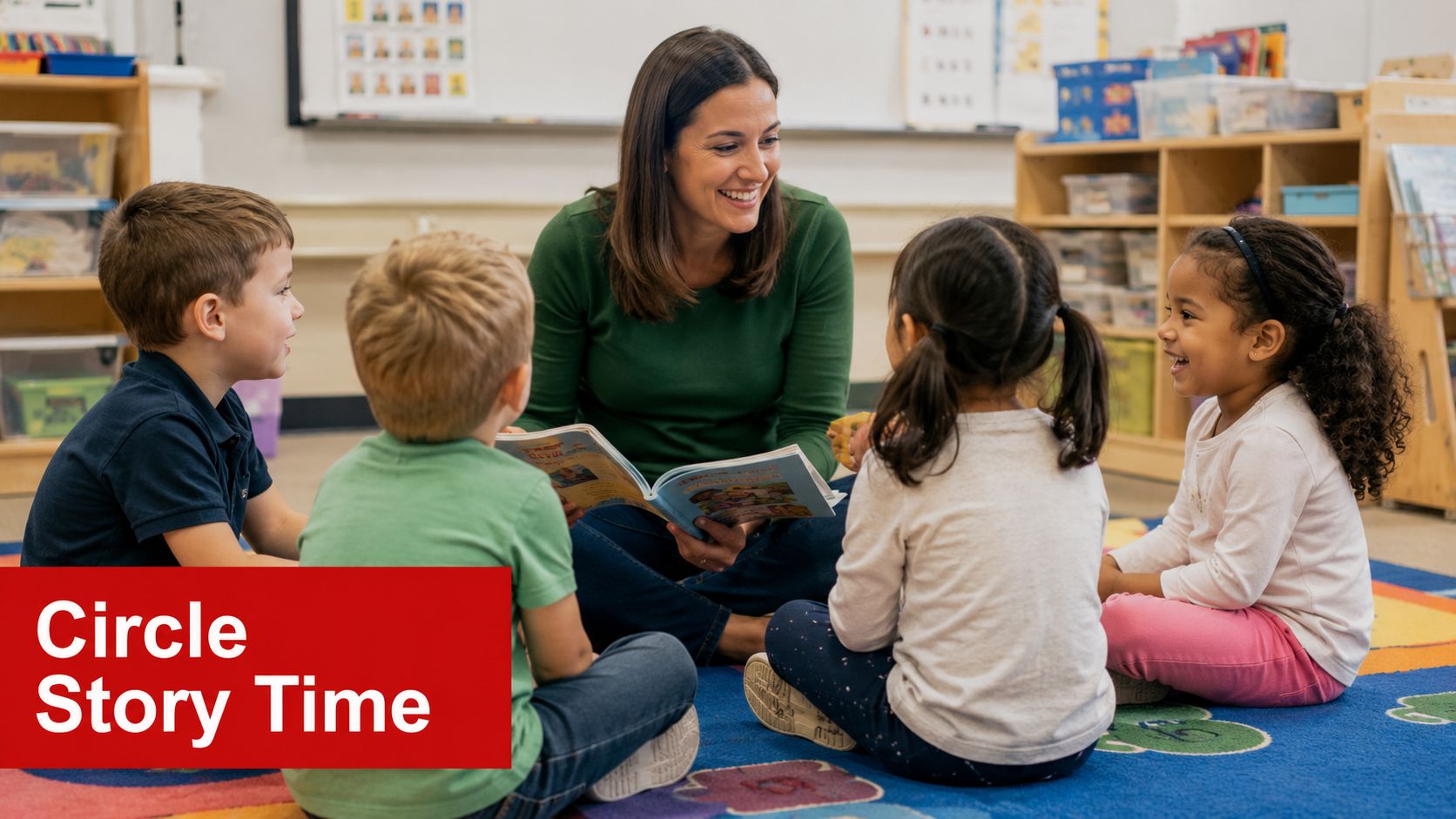
1. Circle Time Story Sessions
Circle time works because children share a predictable space and a common story, but they aren't limited to sitting silently. A teacher can use a picture book, stuffed animals, felt-board pieces, or movement prompts to develop listening, vocabulary, emotional understanding, and classroom connection.
Choose a story with repetition and invite children to supply a familiar word, sound, or gesture. With The Very Hungry Caterpillar, children might curl up like a caterpillar, stretch like a butterfly, or count pretend foods as the story progresses. A prop box containing toy fruit, leaves, and a butterfly can make the narrative easier to follow for children who benefit from visual or tactile cues.
Keep the main story to 5 to 10 minutes, matching common preschool attention spans. Use animated voices, exaggerated expressions, and predictable questions such as “What do you think happens next?” Rotate who sits closest to you so the same children aren't always receiving the most direct interaction.
How to run it
- Prepare the space: Mark a comfortable circle with a rug, cushions, or a Playz tent entrance that gives the group a clear gathering point.
- Invite participation: Let children hold a prop, repeat a phrase, make an animal sound, or just watch.
- Extend the story: Follow the reading with a related painting, puppet scene, or dramatic-play invitation.
- Support inclusion: Offer a chair, standing spot, or edge-of-circle position for children who find close seating uncomfortable.
The objective is shared attention, not perfect stillness. Children can contribute through movement, facial expression, pointing, or a short answer.
Practical rule: End the story while children are still interested. A brief, successful session builds better group habits than stretching the activity through visible fatigue.
For more interactive ideas, explore circle time activities for toddlers.
2. Sensory Play Stations
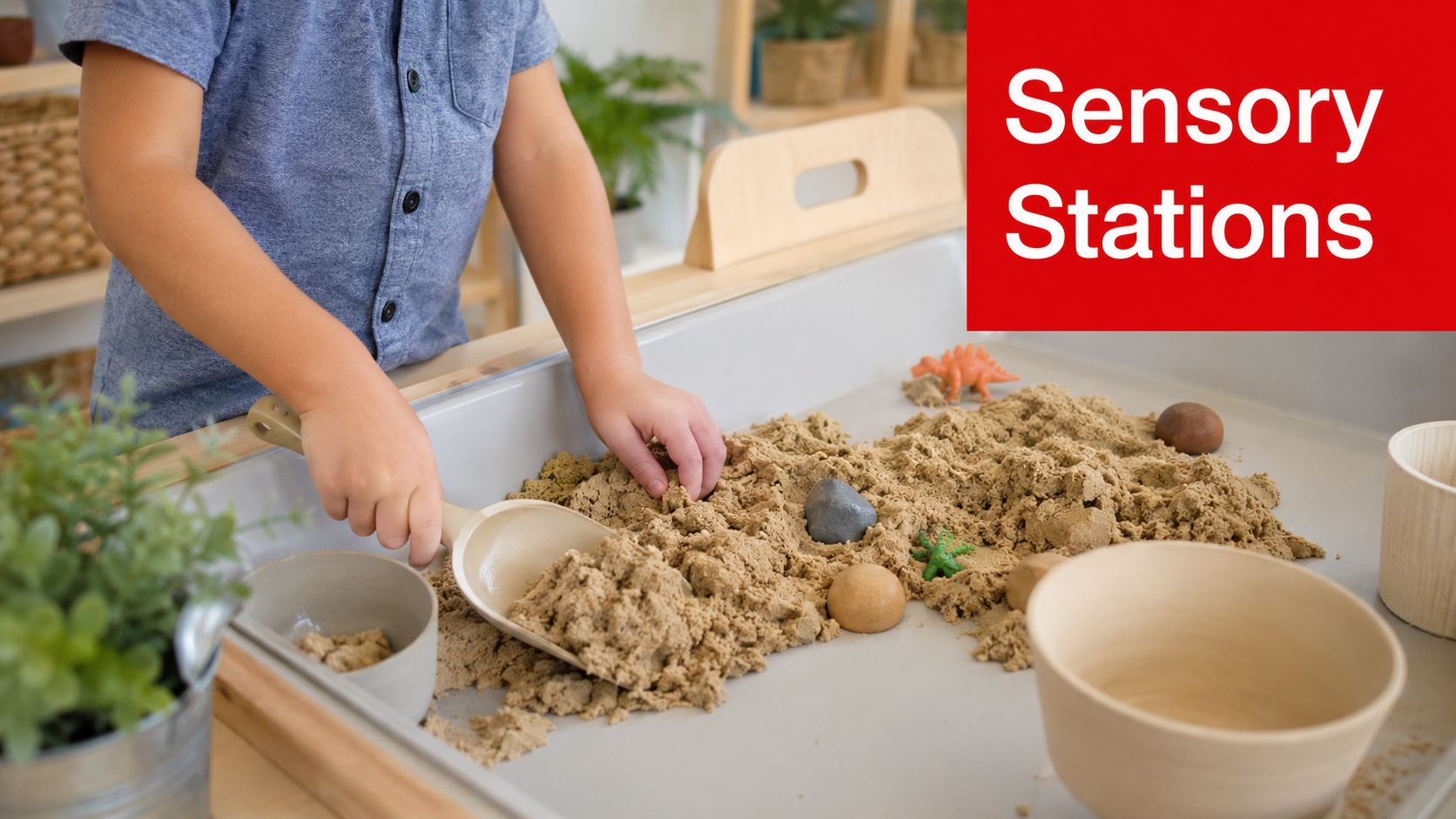
A preschool room can become a small testing lab when children pour, squeeze, scoop, and compare materials. Sensory stations let children investigate wet, dry, soft, crumbly, smooth, or foamy textures at their own pace. One child may fill a cup with rice, another may shape kinetic sand, and a third may watch before touching. That flexibility supports mixed-ability groups and different sensory preferences. For a fuller explanation, read what sensory play means for young children.
Station ideas
Set up a water table with funnels, cups, and floating toys. Offer playdough with rolling tools and cookie cutters nearby. A dry rice bin with large hidden objects creates a searching game, while kinetic sand, foam, and simple containers add further choices. Creative toys can support scooping, shaping, and pretend cooking without requiring every child to use the same material.
A simple station plan
Use picture labels so children can choose without reading. Add aprons, defined play areas, scoops, spoons, bowls, and containers. For a small group, let children explore one station together for a short turn before rotating. In a busy room, divide children between two or more supervised areas instead of crowding every texture onto one table. Rotate materials gradually, especially for children who rely on predictable routines.
Developmental targets include:
- Fine motor control: Scooping, pinching, pouring, rolling, and molding.
- Language: Describing textures, actions, quantities, and changes.
- Self-regulation: Repeating calming actions such as pouring or kneading.
- Problem-solving: Testing which tools move, hold, or shape materials best.
Water and foam can spread quickly, so choose washable flooring, keep towels nearby, and mark clear boundaries. Check materials for age suitability, supervise closely, and clean and sanitize reusable tools and surfaces. Avoid forcing contact with a texture. A child can watch a peer, hold a tool, or begin with a dry alternative. Give children enough space to work without knocking over another child's container, and adjust tools for children who need larger grips or extra stability.
3. Music and Movement Activities
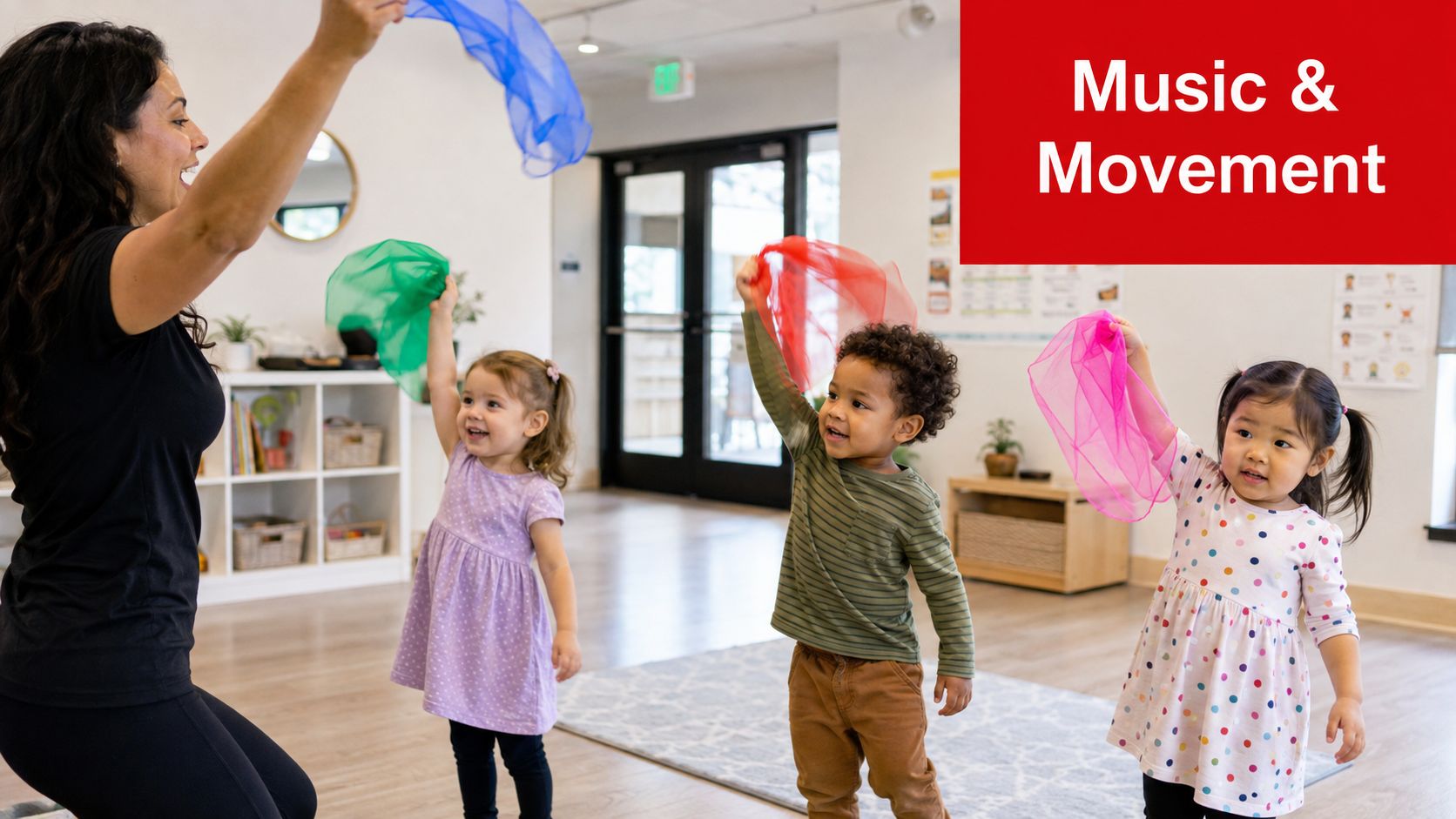
Music gives children a shared rhythm before they have the language to negotiate every interaction. A group can freeze, sway, clap, march, or play instruments together, making the activity useful for physical coordination, listening, impulse control, and joyful social participation.
Start with Freeze Dance. Play a child-friendly song, invite free movement, and pause the music for a freeze. Children who don't want to dance can hold a scarf, tap a drum, or act as the person who signals the pause. Follow energetic music with a slower song so the group has a clear path back to calm.
Other variations include Head, Shoulders, Knees and Toes, If You're Happy and You Know It, and “This Is How We Play Our Drums.” Use scarves, ribbons, or a parachute for visual movement. Connect the songs to animals, seasons, or emotions. Children can stomp like elephants, flutter like birds, or show how their bodies move when they feel excited or sleepy.
Make participation accessible
Demonstrate each movement before asking children to copy it. Keep lyrics repetitive and easy to remember. Don't treat observation as failure. Some children need time to understand the rhythm, while children with sensory sensitivities may prefer quieter music, a greater distance from instruments, or a non-moving role.
A group of four to eight children ages 3 to 4 can be easier to manage for active participation, while older preschoolers may handle a larger group when waiting and coordination are manageable. Circle-time guidance recommends 15 to 20 minutes for circle time, ending sooner if attention drops. Use that as a ceiling for a structured music session rather than a requirement.
For families exploring movement beyond the classroom, a first dance class for little ones can offer another age-appropriate example.
4. Arts and Crafts Exploration
A shared art table doesn't need to produce matching pictures. It works best when children make individual choices within a common invitation, such as “Create a garden,” “Show a weather feeling,” or “Build a collage of things you love.”
Cover a washable table with large paper and offer finger paints, sponges, cotton swabs, leaves, tissue paper, magazine pieces, stickers, and glue sticks. Children can paint separately on one large sheet or contribute to a collaborative mural. Playdough sculpting adds a three-dimensional option for children who don't enjoy wet paint.
Nature collages create a natural bridge between outdoor exploration and art. Children can arrange leaves, twigs, and flowers, then describe what they notice. A Playz creative toy can add tools for shaping, assembling, or experimenting with color, but the adult should focus on children's decisions rather than reproducing a model.
Keep the process open
Use washable, non-toxic materials and provide smocks or old clothes. Limit the number of colors or materials at first if choices feel overwhelming. Keep wet wipes nearby and assign a clear drying area so children know where finished work belongs.
- Shared goal: Give the group one theme or large surface.
- Individual agency: Let each child choose colors, textures, and placement.
- Language extension: Ask, “Tell me about your creation,” instead of guessing what it is.
- Confidence building: Display every child's contribution with equal attention.
For a group of three to five children, a shared poster board encourages communication without forcing children to work in the same spot. Allow enough time for setup and cleanup, and expect that glue, paint, and loose materials will require adult support. Children with fine-motor challenges can use larger collage pieces, thicker tools, or pre-torn paper.
Find more ideas for art and craft activities for preschoolers.
5. Dramatic Play and Pretend Scenarios
Pretend play turns ordinary props into a social language. One child becomes a doctor, another brings a stuffed animal to the clinic, and a third writes on a pretend clipboard. As children take roles, they practice dialogue, perspective-taking, emotional expression, and flexible problem-solving.
Create a doctor's office with a toy stethoscope, bandages, and a patient clipboard. On another day, arrange a grocery store with labeled items, a shopping basket, and a checkout area. A post office can use envelopes, stamps, a mailbox, and a delivery bag. A veterinary clinic works especially well with stuffed animals because children can care for familiar, non-threatening patients.
Let children direct the story
Offer a theme, then avoid writing a script. Children should decide whether the doctor is treating a teddy bear, a dinosaur, or a friend. Provide open-ended materials such as scarves, hats, empty food containers, boxes, and toy tools. A Playz tent can become a clinic, shop, campsite, or family home, giving the play area a physical boundary that helps children organize the scenario.
Rotate themes to maintain interest and represent diverse careers and family structures. Connect pretend play to a book, neighborhood visit, or current classroom topic. If conflict develops, intervene gently with language children can reuse: “The store has one basket. How can two shoppers use it?” or “You both want to be the doctor. What other job could help the clinic?”
A study of preschool peer dyads found that a playful, child-directed building task produced more complex structures, more observational learning, and more positive joint communication than a more adult-driven task. The effect continued into a later joint task. See the controlled study.
Learn more about the benefits of pretend play, especially when adults provide support without taking over.
6. Outdoor Exploration and Nature Play
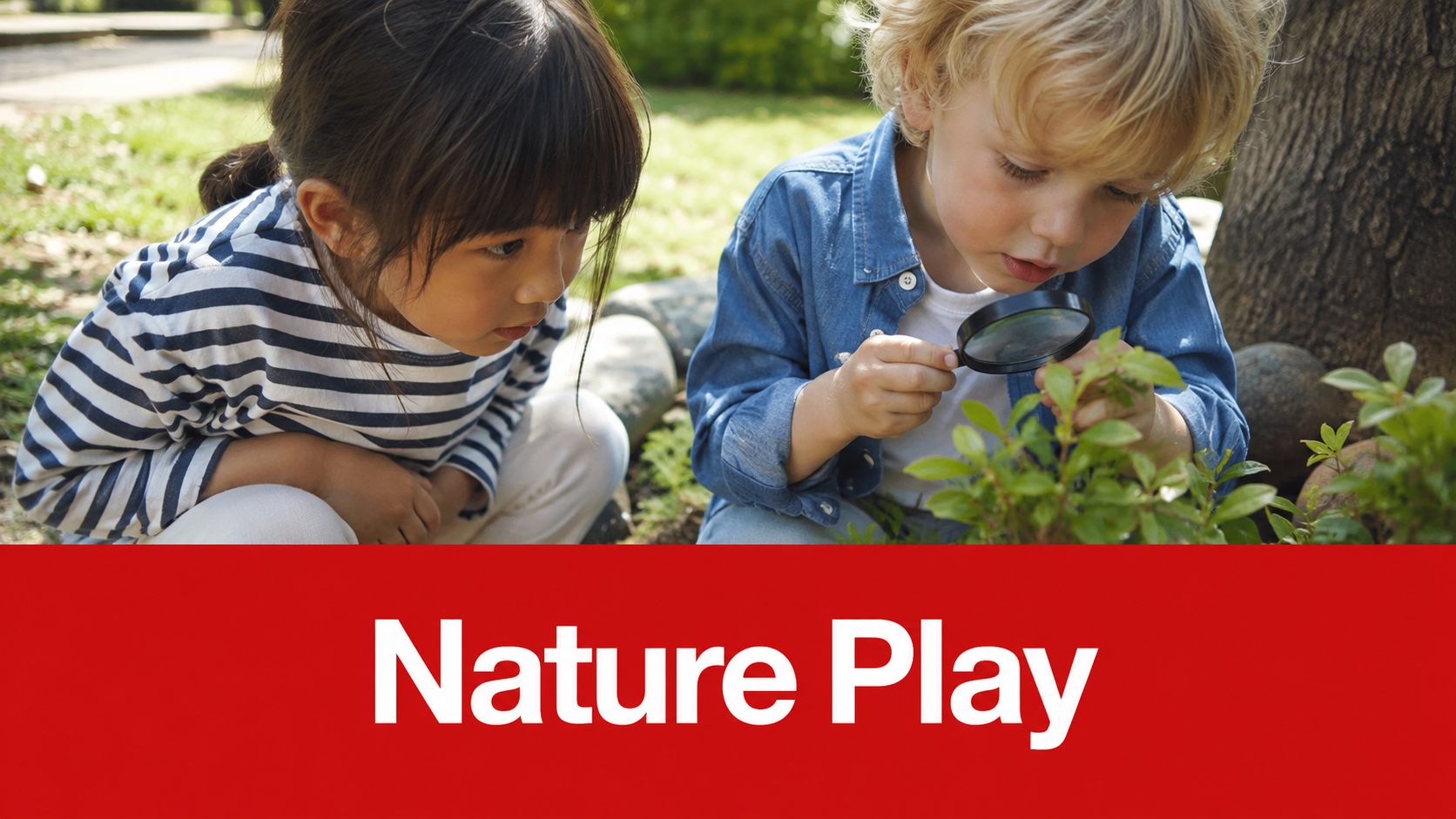
Take the group outside with a question instead of a worksheet. “What can we find that feels rough?” “Where might an insect hide?” or “How many different leaf shapes can we notice?” These prompts create a reason to observe while leaving children free to move, collect, compare, and wonder.
Set up a mud kitchen with pots, spoons, soil, water, and leaves. On a nature scavenger hunt, children can search for colors, textures, or shapes rather than collecting every item they see. Provide magnifying glasses for bug observation, collection containers for safe natural objects, and clipboards or paper for simple nature journals.
Children can also use a balance beam or climbing structure, create nature faces with leaves and stones, form letters from sticks, make leaf prints, or build patterns with rocks and twigs. A walk at different times can reveal changes in light, sound, insects, or plant life.
Protect exploration without removing the fun
Establish boundaries before children begin. Explain which plants and insects must remain untouched, where children may run, and how to carry tools. Check the area for hazards, provide sun protection and water, and wash hands after outdoor play.
Flexible space matters. Observational research on 277 naturally occurring preschool free-play episodes linked greater flexibility in space and materials with stronger interpersonal dynamics and collective-goal focus. Read the observational research. Let children move a collection tray, rearrange loose parts, or create a temporary digging area instead of fixing every object in place.
Outdoor play can become messy, especially with mud and water. That trade-off is part of the sensory value, but families need advance notice about clothing. Indoors, preserve the learning by displaying collected objects, drawing discoveries, or retelling the walk with photos.
7. Building and Construction Projects
Construction play gives children a shared problem they can solve in many ways. A tower may fall, a bridge may need a wider base, or a cardboard house may need a doorway large enough for a toy bear. Those moments invite communication, planning, persistence, spatial reasoning, and early mathematical language.
Begin with open-ended materials such as unit blocks, foam blocks, large LEGO DUPLO bricks, magnetic tiles, cardboard boxes, tubes, and fabric. Ask the group to build a city, a shelter for toy animals, a road system, or a structure that can hold a selected object. Inspiration pictures can spark ideas, but children shouldn't need to copy them.
Build cooperation into the challenge
Give each child a role without making one child the permanent designer. One child might collect pieces, another might test stability, another might place blocks, and another might describe the plan. Rotate roles during the activity so children practice different kinds of participation.
Use words such as foundation, stable, balance, taller, wider, and symmetry while children work. Ask, “What happened when that block moved?” rather than immediately fixing a collapsed structure. Photograph creations before cleanup so children can revisit their plans and explain changes.
Construction can become noisy and crowded, so use low shelving, a defined building zone, and enough floor space for structures. Large pieces are safer for younger children, while smaller pieces require close supervision and age-appropriate judgment. Children with motor challenges can design, select materials, or give instructions while peers handle difficult placements.
A Playz tent can become the destination for a cooperative build, such as a shelter connected to a block road. The product supports the story, but the learning comes from the children's shared decisions.
8. Group and Cooperative Games and Physical Activities
Preschoolers don't need a winner and loser to experience challenge. A shared target, such as keeping a parachute moving or completing a group puzzle, gives children a reason to coordinate without removing anyone from the activity.
Try Red Light, Green Light for speed control, a parachute lift and shake, balloon taps, crawling or hopping relays, Duck, Duck, Goose, Freeze Dance, Follow-the-Leader, or a group balance path using foam logs. Cooperative musical chairs can keep the music and movement while removing elimination. Children can work together to fit puzzle pieces, carry a soft object across a space, or complete a group construction task.
Choose mechanics that include everyone
Explain one rule at a time and demonstrate it with volunteer children. Begin with lower-energy movement before adding speed. Use visual cards for stop, go, wait, and switch. Give children meaningful roles, such as music starter, equipment helper, route guide, or parachute caller.
- Shared participation: Choose activities where children can act at the same time or move quickly into the next turn.
- Flexible rules: Change crawling to walking, reduce distance, or offer seated participation.
- Regulation breaks: Provide a quiet edge, water, or a short observation role.
- Positive reflection: Ask what helped the group cooperate after the activity.
Avoid elimination games when the purpose is social learning. Parent guidance recommends shared-goal activities such as treasure hunts, construction toys, jigsaw puzzles, mural painting, sand castles, dress-up role play, and turn-taking games, while advising against games with clear winners and losers or eliminated players, including musical chairs. Compare cooperative and competitive play.
Keep the youngest groups smaller and shorten the session if waiting, crowding, or frustration rises. Children usually begin joining cooperative play around age four or five, while cooperative play is also commonly staged at 4+ years. Review the stages of play and adapt the mechanics for children who are still developing shared-play skills.
9. Science Discovery and Hands-On Experiments
Science activities work best when children can predict, test, observe, and talk. The adult doesn't need to deliver a formal explanation. Your job is to protect the materials, ask useful questions, and give children enough time to notice what changed.
Start with sink or float. Fill a clear tub with water and offer safe objects such as a sponge, plastic toy, feather, crayon, coin, and rock. Before testing each object, ask children what they think will happen. Sort the tested objects into “sink” and “float” groups, then try a follow-up challenge such as making foil support a toy.
Other ideas include primary-color mixing, magnet exploration, bubble science, plant-growth observation, a baking-soda and vinegar reaction, and ice discovery with toys frozen inside. Use “I notice” language: “I notice the blue water changed when we added yellow.” Accept uncertainty and unexpected results as useful observations.
Keep experiments safe and social
Use large enough materials to reduce mouthing risks, avoid unsupervised chemical handling, and keep water away from electrical equipment. Children can take turns pouring, holding a picture card, making a prediction, or recording what happened. A child who doesn't want to touch water can draw the result or hold the prediction sign.
A Playz science kit can organize tools and prompts for hands-on investigation, but everyday materials are enough for many discoveries. Explore science kits for kids for ways to extend the activity beyond one experiment.
Here's a simple recording format:
- Prediction: Children point to a sink, float, or unsure picture.
- Test: One child places the object in the water.
- Observation: The group describes what happened.
- Extension: Children suggest a new test.
Show the video only if it supports the live investigation, and don't let a screen replace handling, observing, and discussing the materials.
10. Snack Time and Food-Based Learning Activities
Snack can become a small group lesson in conversation, independence, culture, sensory vocabulary, and cooperation. Children can wash produce, arrange ingredients, mix, assemble, taste, and describe food while sitting together.
Make “ants on a log” with celery, a suitable spread, and raisins only after checking allergies and substitutions. Offer a fruit and vegetable tasting with words such as crunchy, soft, sweet, salty, and juicy. Children can assemble sandwiches, roll wraps or pinwheels, create a no-bake trail mix, wash vegetables from a garden, or sample foods connected to cultures represented in the group.
The objective isn't to make children eat unfamiliar foods. Present new foods beside familiar options and allow children to look, smell, touch, or decline. A child with dietary restrictions can participate by arranging safe ingredients, describing textures, or preparing a separate approved version.
Make the routine part of the learning
Wash hands before food preparation. Gather detailed allergy information before planning the activity, clean surfaces carefully, and use tools children can handle safely. Adults should supervise cutting, spreading, and any choking-risk food preparation according to the setting's policies.
- Language: Invite children to describe smell, texture, color, and temperature.
- Math: Compare pieces, sort ingredients, and count servings without turning snack into a test.
- Social skills: Practice passing bowls, requesting materials, and waiting for a turn.
- Cultural learning: Invite families to share safe food traditions and stories.
- Literacy extension: Read a food-related book before or after preparation.
Food activities create cleanup and allergy-management demands, so they aren't always the best choice for a rushed gathering. For simpler planning at home, you can also browse fast meal suggestions for home cooks.
10-Activity Comparison: Preschool Group Activities
| Activity | 🔄 Implementation Complexity | ⚡ Resource Requirements | 📊 Expected Outcomes | Ideal Use Cases | ⭐ Key Advantages / 💡 Tips |
|---|---|---|---|---|---|
| Circle Time Story Sessions | Low–Medium, predictable routine, needs group management | ⚡ Low, picture books, few props, seating space | 📊 Listening, vocabulary, attention, SEL | Morning meeting, transitions, community-building | ⭐ Strong community & language gains; 💡 Keep stories 5–10 min and use animated voices |
| Sensory Play Stations | Medium, station setup, rotation, close supervision | ⚡ Medium, varied materials, aprons, cleanup supplies | 📊 Fine motor, regulation, exploratory learning | Calm-down areas, small-group exploration, free play | ⭐ Excellent for sensory integration; 💡 Rotate materials monthly and supervise for safety |
| Music and Movement Activities | Low, simple facilitation, space planning | ⚡ Low–Medium, music player, instruments, open area | 📊 Gross motor skills, language, memory, mood | Energizers, transitions, group rhythm sessions | ⭐ High engagement and cognitive boost; 💡 Mix high/low energy songs and allow optional participation |
| Arts and Crafts Exploration | Low–Medium, prep and cleanup, manage materials | ⚡ Low–Medium, paints, paper, smocks, drying/display space | 📊 Fine motor, creativity, self-expression, confidence | Process art sessions, thematic units, keepsake projects | ⭐ Promotes creativity and fine motor control; 💡 Use washable, non-toxic supplies and limit color choices |
| Dramatic Play & Pretend Scenarios | Medium, themed areas, prop maintenance, facilitation | ⚡ Medium, costumes, props, dedicated space | 📊 Social skills, language expansion, empathy, problem-solving | Role-play centers, social-emotional lessons, storytelling | ⭐ Builds empathy and cooperative play; 💡 Rotate themes and include diverse representations |
| Outdoor Exploration & Nature Play | Medium, safety boundaries, weather planning | ⚡ Low, outdoor access, basic tools (magnifiers, containers) | 📊 Gross motor, attention restoration, curiosity, sensory learning | Nature walks, mud kitchens, seasonal exploration | ⭐ Rich sensory & physical benefits; 💡 Set safety rules and ensure sun/water protection |
| Building & Construction Projects | Medium, storage/organization, supervising complex builds | ⚡ Medium, blocks, magnetic tiles, shelving, durable materials | 📊 Spatial reasoning, STEM foundations, problem-solving | STEM prep, collaborative builds, engineering challenges | ⭐ Strengthens math and persistence; 💡 Provide inspiration photos and document creations |
| Group & Cooperative Games & Physical Activities | Low–Medium, clear instructions, skilled facilitation | ⚡ Low, open space, simple props (parachute, balloons) | 📊 Teamwork, gross motor, inclusion, turn-taking | Whole-group activities, PE-style sessions, bonding exercises | ⭐ Promotes cooperation over competition; 💡 Avoid elimination and use visual cues |
| Science Discovery & Hands-On Experiments | Medium, prep, timing, safety monitoring | ⚡ Low, household materials, simple tools, prep time | 📊 Observation skills, curiosity, basic STEM concepts | Small-group experiments, inquiry centers, thematic science lessons | ⭐ Sparks inquiry and critical thinking; 💡 Emphasize predictions and "I notice" language |
| Snack Time & Food-Based Learning Activities | Low–Medium, allergy management, hygiene protocols | ⚡ Low, food items, utensils, handwashing station | 📊 Independence, nutrition knowledge, cultural awareness | Life-skill lessons, nutrition units, cultural celebrations | ⭐ Teaches life skills and social routines; 💡 Collect allergy info and model safe food handling |
Build a Play Routine That Grows With the Group
The strongest routine doesn't rely on one favorite activity. It gives children repeated chances to communicate, move, explore, make choices, solve problems, and recover from small frustrations. Choose the format according to the group in front of you, not according to what looks most impressive on a planning sheet.
Start with the practical conditions. A small indoor room may suit circle storytelling, a sensory tray, cooperative collage work, or construction on a defined mat. A large outdoor space can support movement games, nature hunts, mud kitchens, and balance challenges. If preparation time is short, use songs, follow-the-leader, a story with stuffed animals, or a simple building invitation. If you have more preparation time, set up science materials, multiple sensory stations, or a themed dramatic-play area.
Group size changes the experience. One childcare guidance source recommends conducting two smaller groups when space or waiting time creates a problem, and it recommends 15 to 20 minutes for circle time, ending early if attention drops. Another play guide suggests that children ages 3 to 4 do best in groups of 4 to 8, while children ages 5 to 6 can manage groups of 8 to 12. Review the group-size guidance before expanding an activity.
Match the format to the moment
- Low-prep choices: Songs, movement prompts, story props, Follow-the-Leader, and simple sorting. These start quickly and need little equipment, but they can lose momentum if children repeat them without variation.
- Active choices: Parachute play, Freeze Dance, relays, and outdoor obstacle paths. They support movement and group energy, but they require clear boundaries, space, and close supervision.
- Sensory choices: Water, rice, playdough, kinetic sand, and foam. They offer rich tactile exploration, but mess, sanitation, and sensory preferences need planning.
- Creative choices: Painting, collage, nature printing, and object-based art. They support expression and fine-motor practice, but setup and cleanup take time.
- Imaginative choices: Doctor's office, grocery store, post office, veterinary clinic, and tent-based scenarios. They build language and perspective-taking, but adults may need to coach sharing and role changes.
- Outdoor choices: Scavenger hunts, bug observation, mud kitchens, and nature patterns. They provide flexible movement and real-world discovery, but weather, clothing, sun protection, and site safety matter.
- Construction choices: Blocks, magnetic tiles, DUPLO bricks, and cardboard builds. They encourage planning and persistence, but crowded materials can create conflict and structures need a safe building zone.
- Science choices: Sink or float, magnets, bubbles, color mixing, plants, and ice. They build questioning and observation, but adults must control materials and avoid unsafe substances.
- Food-based choices: Tasting, assembling, washing, mixing, and describing. They connect social learning with daily routines, but allergies, hygiene, dietary needs, and cleanup make preparation essential.
Adult support is a design factor, not an optional extra. A review of early childhood group size and adult-child ratios links smaller groups and more favorable ratios with more positive adult-child interaction, more developmentally appropriate activities, and outcomes including lower anxiety, less aggressive behavior and distress, stronger social competence, and stronger receptive and expressive language skills. Read the review. In practice, divide a crowded group when adults can't respond warmly and promptly to children who need help.
Keep inclusion visible
Preschoolers don't all enter cooperative play at the same point. The Iran preschool study surveyed 546 children across urban preschool centers and found that most had only a moderate level of social skills according to parents and teachers. It also reported higher social skills for girls than boys at home and significant associations between children's social-skill domains and factors including birth rank, father's age and job, teacher characteristics, number of children, and classroom type. Review the preschool social-skills findings. The practical message is clear. Social participation develops through intentional classroom design and responsive adult guidance.
Offer more than one way to join. A child can hold a prop, point to a visual, observe from the edge, take a helper role, use adapted materials, or work beside the group before joining the shared task. For children with language delays, model short phrases such as “my turn,” “help please,” and “your turn.” For children with sensory sensitivities, reduce noise, provide tool-based participation, and avoid forcing messy contact. For mixed developmental stages, give younger children simpler actions while older children take planning or explaining roles.
Safety stays constant across every format. Supervise closely, check materials, follow allergy procedures, adapt movements and tools for abilities, and remove elimination whenever possible. Stop or change the activity when children show signs of overload, rising frustration, unsafe movement, or loss of attention. A successful group experience ends with children feeling capable of participating, not with every planned step completed.
Choose one activity for your next gathering. Write down what children noticed, which roles they preferred, where waiting or conflict appeared, and what adjustment might help next time. When a tent, science kit, or creative toy can extend that shared play, explore the hands-on options available from Playz at Playz.
Playz offers play tents, science kits, and creative toys that can support imaginative, cooperative, and hands-on group activities for preschoolers. Choose a product that matches your next learning invitation, then visit Playz to extend screen-free play with materials children can explore together.