

Welcome to the tactile, transformative world of clay! More than just mud pies, working with clay is a powerful way for kids to develop fine motor skills, boost creativity, and learn scientific principles—all while having a blast. This guide explores ten incredibly cool things made out of clay, offering practical projects that cater to various ages and skill levels. We'll move beyond simple pinch pots to showcase ideas that spark imagination and create lasting keepsakes.
At Playz, our motto is #KidsLearnBestThruPlayz, and these hands-on activities are the perfect embodiment of that mission. Get ready to roll up your sleeves, get a little messy, and discover the endless possibilities that a simple block of clay holds. We'll provide everything you need to get started: materials lists, difficulty ratings, step-by-step highlights, and the amazing learning benefits behind each creation. From functional pottery and miniature garden scenes to stop-motion animation characters and paleontological fossil models, this list is packed with actionable projects that turn a simple lump of earth into something truly extraordinary. Let's dive in and start sculpting.
1. Hand-Building Pottery & Ceramic Sculptures
Hand-building is a timeless method for creating cool things made out of clay without a pottery wheel. It's a foundational technique where artists use only their hands and simple tools to shape clay into three-dimensional forms. This approach is perfect for beginners and children, making it a staple in settings from Montessori classrooms to professional ceramic studios.
Core Techniques and Benefits
The three primary hand-building methods are pinch pots, coil building, and slab construction. Each offers a unique way to explore form and function, from simple bowls to intricate sculptures. This process is more than just making objects; it’s a powerful developmental activity with clear benefits.
- Fine Motor Skills: Squeezing, rolling, and pinching clay strengthens hand muscles and improves dexterity.
- Spatial Reasoning: Children learn to think in three dimensions as they transform a lump of clay into a structured object.
- Creative Expression: It provides a tangible outlet for imagination, allowing kids to bring their ideas to life.
Actionable Tip: For durable, long-lasting creations with air-dry clay, always seal the finished and completely dried piece with a clear acrylic sealant or varnish. This protects it from moisture and chipping, preserving your artwork.
The hands-on nature of sculpting directly engages the sense of touch, making it an excellent activity for kinesthetic learners. This aligns with the principles of tactile learning, where physical engagement deepens understanding and retention. You can discover more about the tactile learning style and how it benefits childhood development.
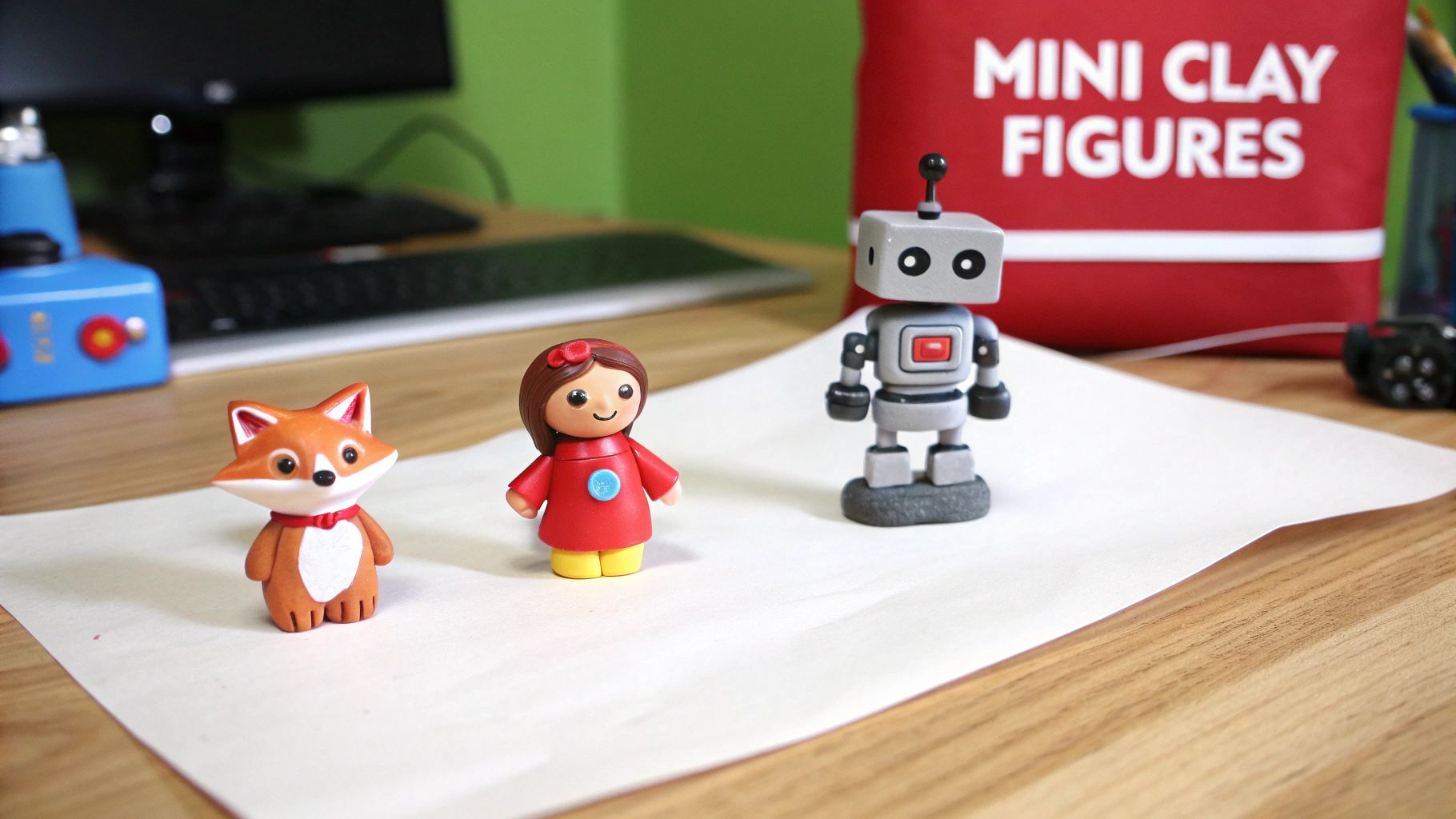
2. Polymer Clay Mini Figurines & Characters
Polymer clay is a versatile, oven-bake medium that allows artists to create detailed, colorful figurines and character sculptures right at home. Brands like Sculpey and Fimo offer a vibrant spectrum of mixable colors that, unlike traditional clay, require no kiln to harden. This makes it an accessible and exciting way to craft personalized toys, gaming miniatures, and collectible characters.
Core Techniques and Benefits
Working with polymer clay involves conditioning (kneading) the clay to make it soft, sculpting it into a desired shape, and then baking it in a standard oven. The process is fantastic for developing fine motor control and attention to detail. This craft is one of many cool things made out of clay that fosters both artistic and technical skills.
- Detailed Sculpting: Its firm yet pliable texture holds fine details well, perfect for creating facial expressions, clothing textures, and tiny accessories.
- Color Blending: Children can learn about color theory by mixing different clays to create unique shades and marbled effects.
- Patience and Planning: Successfully creating a complex character requires thinking through the steps from building an armature to adding the final details.
Actionable Tip: To ensure your polymer clay creations are strong and not brittle, avoid baking them at too high a temperature. Always follow the manufacturer's instructions precisely and consider using an oven thermometer for accuracy.
The ability to create durable, playable toys from scratch provides a huge sense of accomplishment. This type of hands-on project is excellent for encouraging imaginative play and storytelling. You can explore other creative crafts for preschoolers that similarly blend artistic fun with developmental benefits.
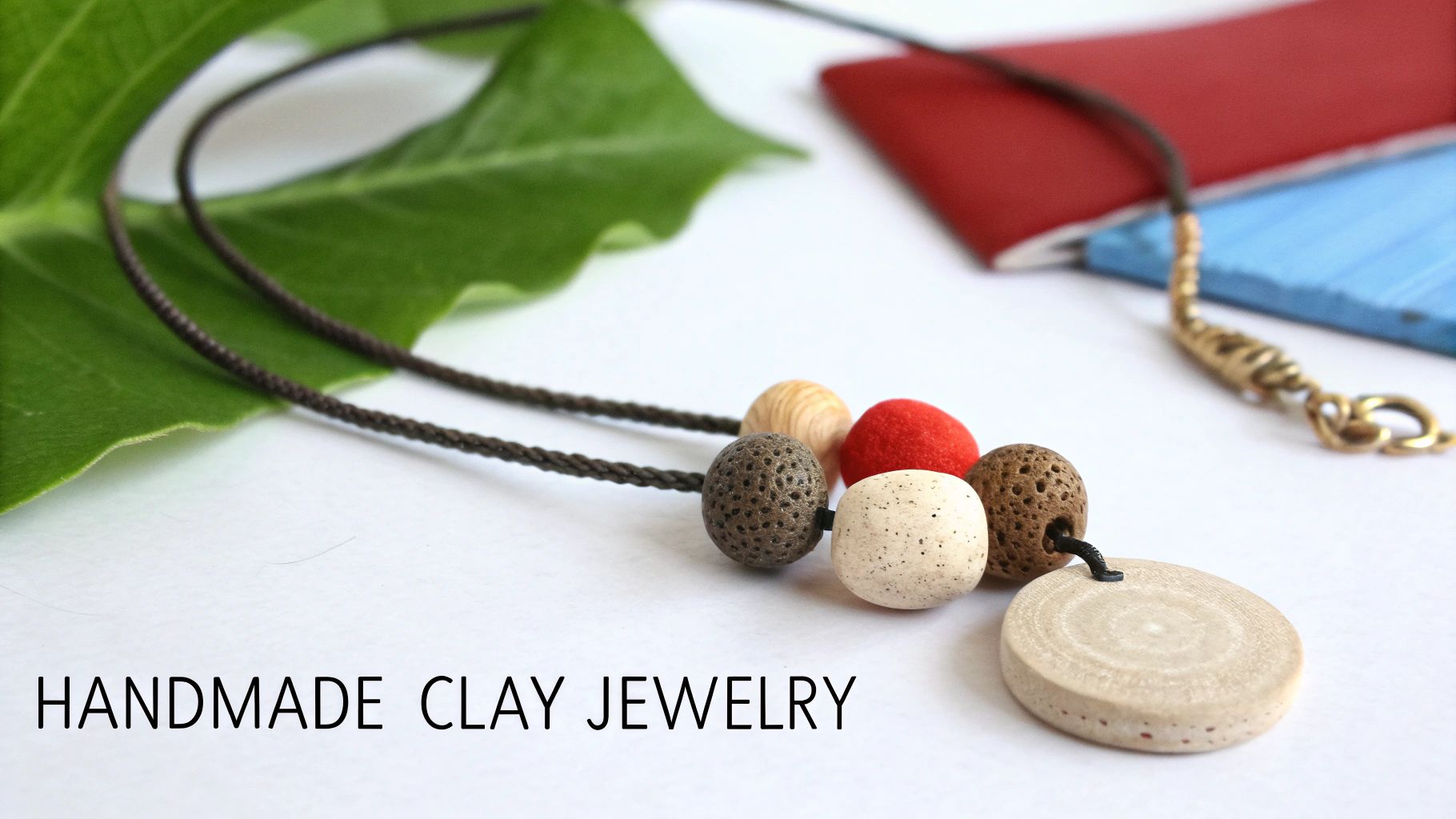
3. Air-Dry Clay Jewelry Making
Creating jewelry is one of the coolest things made out of clay, especially with air-dry varieties. This lightweight, pliable medium is perfect for children as it requires no kiln or oven to harden, making it a safe and accessible craft. Kids can design and create unique wearable art, from colorful beads and intricate pendants to custom rings and bracelets.
Core Techniques and Benefits
Making clay jewelry involves rolling, shaping, and piercing clay to create components that can be strung or assembled. This activity is fantastic for developing patience and attention to detail. Once you've mastered the basics of forming clay into wearable art, you might explore integrating other elements. Learn more about choosing pendants for your clay creations to add unique flair.
- Patience and Focus: The small scale of jewelry making requires concentration and steady hands.
- Design Skills: Children learn about color theory, patterns, and composition as they design their accessories.
- Personalized Gifting: Kids can create heartfelt, personalized gifts like friendship bracelets for friends and family.
Actionable Tip: Before the clay dries, use a toothpick or skewer to pierce holes in your beads and pendants. This crucial step ensures you can easily string them once they have hardened completely.
The process of turning a simple block of clay into a professional-looking piece of jewelry provides a huge confidence boost. It allows children to see a project through from concept to a finished, wearable product, fostering a sense of accomplishment and pride in their creative abilities.
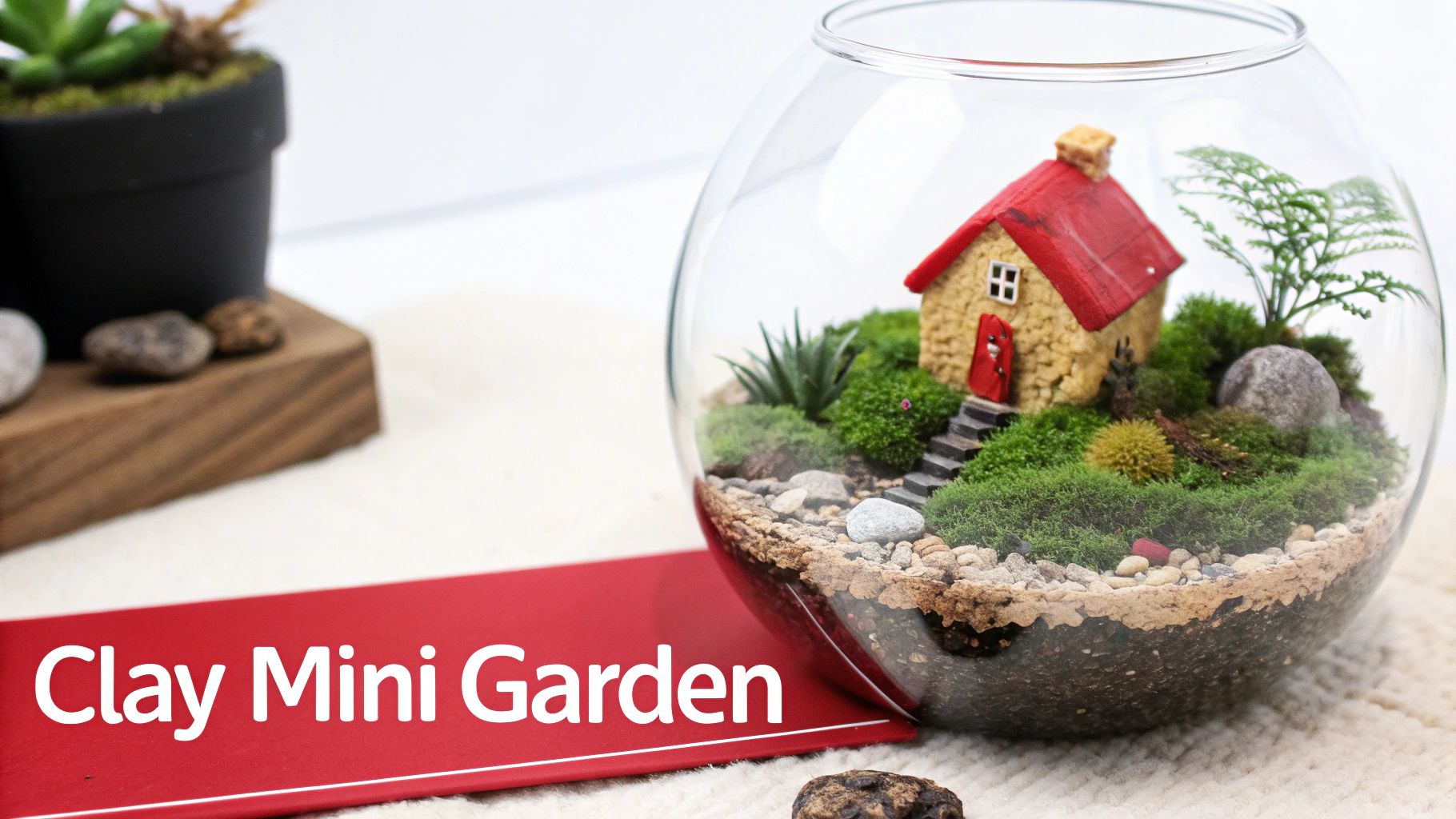
4. Clay Terrarium & Miniature Garden Scenes
Creating a miniature world in a jar is a magical activity that combines clay crafting with basic principles of ecology and design. Children can form hills, pathways, and tiny structures like houses or castles from clay to build a base for their own living terrarium or fantastical diorama. This activity transforms a simple container into a vibrant, self-contained ecosystem.
Core Techniques and Benefits
The primary approach involves designing a landscape and then sculpting the key elements from clay before assembling them with natural materials like moss, stones, and small plants. This project is more than just a craft; it's an immersive lesson in environmental science and creative planning.
- Ecology & Biology: Kids learn about creating a simple ecosystem, understanding what plants need to survive, and the role of different environmental layers.
- Design & Planning: They practice spatial awareness by designing a layout in a confined space, deciding where to place hills, paths, and tiny clay figures.
- Patience & Nurturing: Maintaining a living terrarium teaches responsibility as children learn to care for the plants through watering and observation.
Actionable Tip: Use polymer or waterproof air-dry clay for any elements that will be in contact with soil and moisture. This prevents the clay from dissolving over time and keeps your miniature scene intact.
Building these miniature worlds provides a tangible connection to nature and science. The process is similar to constructing models for larger projects, offering a fantastic introduction to design thinking. You can even expand your miniature world with cardboard creations to build larger structures around the terrarium.
5. Clay Mask & Ceremonial Art Projects
Creating clay masks and ceremonial art is a fantastic way to blend artistic expression with cultural education. This project invites children to explore traditions from around the world by designing and sculpting their own expressive pieces. From Venetian Carnival styles to masks inspired by Japanese Noh theater, these cool things made out of clay serve as both creative outlets and powerful learning tools.
Core Techniques and Benefits
The process typically involves shaping a clay slab over a form or mold to create a symmetrical base. From there, artists add features and decorative elements inspired by their cultural research. This hands-on activity offers a unique combination of historical learning and artistic development.
- Cultural Appreciation: Kids learn to respectfully engage with and appreciate the traditions and stories behind global art forms.
- Three-Dimensional Design: Sculpting facial features and complex patterns on a curved surface enhances spatial awareness and design skills.
- Symbolic Expression: Children explore how colors, shapes, and symbols are used to convey emotions, status, and narratives in different cultures.
Actionable Tip: Before beginning, guide children through respectful research on the cultural origins of the masks they wish to create. Emphasize appreciation over appropriation, focusing on the history and meaning behind the art.
This project is a perfect tool for interdisciplinary learning, connecting art with social studies, history, and anthropology. It encourages children to see art not just as decoration, but as a vital part of human culture and communication. You can learn more about the educational value of multicultural art projects from resources like the National Art Education Association.
6. Functional Clay Pottery (Bowls, Cups, Dishes)
Creating functional pottery introduces children to the joy of making cool things made out of clay that have a practical purpose. This activity transforms a simple lump of clay into usable bowls, cups, and dishes through hand-building or wheel-throwing techniques. It's a deeply rewarding process where art meets utility, often taught in school art programs, family workshops, and pottery camps with kiln facilities.
Core Techniques and Benefits
The focus here is on creating vessels that are not only beautiful but also functional. Children learn to consider elements like wall thickness for durability, smooth rims for comfortable use, and balanced forms that won't tip over. This blend of artistry and practicality offers significant developmental advantages.
- Practical Skills: Kids learn about food safety, glazing techniques, and the science of firing clay in a kiln.
- Sense of Accomplishment: Using a self-made bowl or cup provides a tangible sense of pride and achievement.
- Patience and Process: Pottery teaches the importance of following steps, from shaping and drying to glazing and firing.
Actionable Tip: When creating a pot or vessel intended for plants, remember to poke a small drainage hole in the bottom before the clay dries. This simple step is crucial for preventing root rot and keeping plants healthy.
The process of designing a functional object from scratch is a fantastic exercise in applied science. It requires planning, precision, and an understanding of material properties, much like foundational engineering. You can explore more engineering-based projects for children to see how these skills connect across different disciplines.
7. Clay Fossil & Paleontology Models
Creating clay fossils and paleontology models is an exciting way to transform a simple art project into a hands-on science lesson. This STEM-focused activity lets children sculpt replicas of dinosaur skeletons, prehistoric creatures, and ancient fossils. It merges artistic expression with scientific discovery, making abstract concepts like extinction and geology tangible and engaging.
Core Techniques and Benefits
The main techniques involve sculpting models around a wire armature for support and creating fossil imprints by pressing objects like shells or toy skeletons into flattened clay. These cool things made out of clay offer a fantastic deep dive into prehistoric life, from sculpting a T-Rex skull to making an ammonite impression.
- Scientific Literacy: Children learn about anatomy, evolution, and paleontology by recreating scientifically accurate models.
- Attention to Detail: Following reference images of skeletons or fossils encourages focus and precision.
- STEM Integration: This activity perfectly blends science, technology, engineering, art, and math (STEAM).
Actionable Tip: For realistic fossil imprints, gently press a plastic dinosaur toy or a real seashell into a soft clay slab. After removing the object, let the clay dry completely before painting it with earthy tones to mimic ancient stone.
This project turns learning into an adventure, allowing kids to become paleontologists in their own homes. It connects them directly to the natural world and the incredible history hidden beneath our feet. You can even get inspired to find real fossils after making your own clay versions.
8. Clay Architectural Models & Structure Building
Creating architectural models is one of the most intellectually engaging and cool things made out of clay. This project invites children to design and build scaled structures, from replicas of ancient pyramids and coliseums to imaginative fantasy castles or modern skyscrapers. It's a fantastic blend of art, history, and engineering that transforms a simple block of clay into a detailed miniature world.
Core Techniques and Benefits
The process involves planning, measuring, and constructing three-dimensional forms, often using slab or block building techniques with air-dry or polymer clay. Kids can create detailed historical models for school projects or design their own futuristic cities. This activity provides a robust, hands-on learning experience that builds crucial STEM and creative skills.
- Spatial Reasoning: Visualizing and constructing a 3D building from a 2D plan or idea enhances spatial awareness.
- Engineering Principles: Children learn basic concepts of structural integrity, support, and scale as they build.
- Historical Understanding: Recreating historical monuments offers a tangible connection to history and different cultures.
Actionable Tip: For complex models, encourage building in modular sections. Constructing walls, towers, or floors separately and then assembling them once dry can prevent the entire structure from collapsing during the building process.
This project is a powerful tool for visual and kinesthetic learners, turning abstract architectural and historical concepts into concrete, physical objects. It requires foresight and planning, teaching children valuable project management skills as they bring their structural designs from paper to physical form.
9. Clay Animation & Stop-Motion Film Projects
Clay animation, or claymation, is a captivating method for creating cool things made out of clay that literally come to life. This multimedia project merges sculpture, storytelling, and digital filmmaking. Artists create characters and sets, then photograph them frame-by-frame, moving them slightly between each shot to create the illusion of movement when played back as a sequence. It’s an incredibly engaging way to introduce children to animation, narrative creation, and collaborative project management.
Core Techniques and Benefits
The process begins with creating sturdy clay figures, often built around a wire armature for stability. These characters are then placed on a miniature set and filmed using a stop-motion app or software. This dynamic activity blends artistic skill with technical knowledge, offering numerous developmental benefits.
- Patience and Planning: Stop-motion requires meticulous planning through storyboards and a step-by-step approach, teaching kids persistence.
- Storytelling Skills: Children learn to develop a plot, build characters, and convey a narrative arc visually.
- Digital Literacy: It introduces basic concepts of filmmaking, editing, and using digital creative tools.
Actionable Tip: Keep lighting consistent between every shot to avoid a flickering effect in your final animation. Use a tripod for your camera or smartphone to ensure the frame stays perfectly still.
The combination of hands-on sculpting and digital technology makes this a powerful STEAM activity. It connects the tactile world of clay with the principles of filmmaking and animation, as seen in beloved classics from Aardman Animations like Wallace & Gromit.
10. Clay Tile & Mosaic Art Projects
Creating clay tiles and mosaics is a wonderful way to transform simple clay slabs into stunning works of art. This process involves shaping, decorating, and often combining individual clay pieces to form a larger, cohesive design. It’s an incredibly versatile project, drawing inspiration from historical traditions like Portuguese tile art to contemporary community murals.
Core Techniques and Benefits
The fundamental process involves flattening clay into uniform slabs, cutting them into tiles, and then decorating them using relief carving, stamping, or painting with glazes. These tiles can stand alone as decorative coasters or be assembled into a larger mosaic. This activity is fantastic for developing both artistic and planning skills.
- Pattern Recognition: Designing repeating patterns or complex mosaic scenes strengthens logical thinking and an understanding of symmetry.
- Patience and Planning: Larger projects require kids to plan their design on paper first, teaching them foresight and project management skills.
- Collaborative Skills: Group mosaic projects encourage teamwork, communication, and a shared sense of accomplishment.
Actionable Tip: For consistent tile shapes, use a cookie cutter or a pre-made mold. Before firing or air-drying, lightly score the back of each tile to help it adhere better if you plan to mount it later.
The art of tile-making introduces children to functional art that has been used for centuries. Beyond small-scale crafts, clay can be utilized for more robust applications, such as understanding everything about Terracotta floor tiles for larger installations. This connection helps kids see how their small creations relate to real-world architecture and design.
10 Cool Clay Creations Comparison
| Project | Implementation Complexity 🔄 | Resource & Equipment ⚡ | Expected Outcomes ⭐📊 | Ideal Use Cases 💡 | Key Advantages ⭐ |
|---|---|---|---|---|---|
| Hand-Building Pottery & Ceramic Sculptures | Low → Medium; basic hand techniques, structural learning | Basic clay tools; clay; kiln access optional (air-dry possible) | Foundational ceramic skills; improved fine motor control; tangible 3D pieces | Intro art classes, Montessori, makerspaces | Highly accessible; low startup cost; confidence-building |
| Polymer Clay Mini Figurines & Characters | Low → Medium; fine-detail work requires patience | Oven, polymer clay, sculpting tools; colorful palettes | Finished durable figurines after baking; strong color/detail | Gift-making, character design, small-group crafts | Quick curing; vibrant colors; no kiln needed |
| Air-Dry Clay Jewelry Making | Low; simple shaping and finishing | Air-dry clay, paints, varnish, jewelry findings; no oven/kiln | Lightweight wearable items; quick turnaround (24–48 hr) | Craft fairs, classroom kits, gift projects | Safe and mess-free; no firing; wearable outputs |
| Clay Terrarium & Miniature Garden Scenes | Medium; combines planting and clay planning | Clay (air-dry/polymer), plants, containers, drainage materials | Living, evolving displays; cross-disciplinary learning (ecology + art) | Ecology lessons, long-term classroom projects, dioramas | Integrates gardening + art; sustained engagement |
| Clay Mask & Ceremonial Art Projects | Medium → High; research and advanced sculpting | Clay, mixed media (fabrics, beads), molds/forms, research sources | Expressive display pieces; cultural awareness; advanced technique | Cultural studies, museum education, advanced art classes | Deep cultural learning; strong expressive outcomes |
| Functional Clay Pottery (Bowls, Cups, Dishes) | Medium → High; form, function and firing expertise | Clay, kiln, glazing supplies, wheel or hand-building tools | Usable, durable dinnerware if properly fired and glazed | Pottery studios, family workshops, practical art courses | Produces functional keepsakes; real-world skills |
| Clay Fossil & Paleontology Models | Medium; requires anatomical accuracy and support | Clay, armatures, reference material, casting tools, finishers | Accurate models for STEM displays; research-based learning | Science fairs, museum programs, paleontology camps | Strong STEM engagement; develops research & observation |
| Clay Architectural Models & Structure Building | Medium → High; planning, measurement, structural stability | Clay, measuring tools, internal supports, blueprints/references | Scaled architectural models; improved spatial & engineering skills | History projects, architecture lessons, STEM competitions | Integrates math/history/design; portfolio-quality work |
| Clay Animation & Stop-Motion Film Projects | High; sculpting + animation workflow and tech skills | Clay, durable armatures, camera/software, consistent lighting | Shareable stop-motion films; storytelling & technical media skills | Media classes, collaborative film projects, festivals | Extremely engaging; multidisciplinary digital skills |
| Clay Tile & Mosaic Art Projects | Medium; shaping plus glazing/firing adds steps | Clay, tile molds, kiln, glazes, workspace for large layouts | Permanent decorative tiles or murals; pattern & color skills | Classroom murals, community art installations, décor projects | Teaches glazing/finishing; excellent collaborative outcomes |
From Imagination to Creation: Your Clay Adventure Starts Now
As we’ve journeyed through this diverse landscape of creativity, it’s clear that a simple block of clay holds a universe of possibilities. From the intricate details of polymer clay figurines and air-dry clay jewelry to the scientific exploration of clay fossils and architectural models, we've uncovered far more than just "cool things made out of clay." We've discovered a powerful medium for learning, expression, and developmental growth. Each project, whether it's functional pottery or a whimsical stop-motion character, is a testament to the versatility of this ancient art form and its profound relevance in modern, hands-on education.
The most crucial takeaway from our exploration is the immense value found in the process of creation. The tactile sensation of squishing, rolling, and shaping clay is not just fun; it's a fundamental learning experience. It engages multiple senses, strengthens fine motor skills, and provides a tangible way for children to transform abstract ideas into three-dimensional realities. This process teaches patience, perseverance, and the critical skill of problem-solving. When a sculpture collapses or a design doesn't turn out as planned, it’s not a failure; it's a valuable lesson in physics, structural integrity, and creative adaptation.
Your Actionable Next Steps
Feeling inspired to get your hands dirty? Here’s how you can turn that inspiration into action and start your own clay adventure today:
- Start Small and Simple: Don't feel pressured to create a masterpiece on your first try. Begin with a straightforward project like the air-dry clay jewelry or a simple pinch pot. Success with a smaller project builds the confidence needed to tackle more complex creations later on.
- Gather Your Core Materials: You don't need a professional studio. A small batch of air-dry or polymer clay, a few basic sculpting tools (even a toothpick and a plastic knife will do), and a clean workspace are all you need to begin most of these projects.
- Embrace Imperfection: Remind your young artists that the goal is exploration, not perfection. The unique quirks and imperfections in a handmade piece are what give it character and charm. Celebrate every creation for the effort and imagination it represents.
By providing these opportunities, you are doing more than just facilitating a craft project. You are nurturing an innovator, a scientist, and an artist. You're helping them build a foundation of creative confidence that will empower them in every aspect of their lives, from solving a complex math problem to designing a future masterpiece. The journey from a lump of clay to a finished creation is a powerful metaphor for learning itself: it’s messy, it requires effort, but the end result is always something new and uniquely beautiful. The cool things made out of clay are not just the finished objects, but the skills and memories forged along the way.
Ready to bridge the gap between artistic fun and scientific discovery? Playz creates innovative kits that blend hands-on creativity with core STEM principles, turning every project into an unforgettable learning adventure. Explore our collection and find the perfect kit to ignite your child's curiosity at Playz today