


You're probably standing in a living room or classroom right now, looking at a toy pile and wondering which pieces will hold a child's attention. A dollhouse looks simple at first, but the right one can turn scattered play into a tiny world where children sort, talk, negotiate, and invent stories again and again.
That's why dollhouse toys still matter. They began as baby houses in late-16th-century Europe, first appearing around the 1550s to 1600s as miniature display cabinets for wealthy adults, not children's toys, and a surviving 1558 Nuremberg dollhouse shows how deep that history runs, roughly 400+ years before modern mass-market play. The Strong National Museum of Play notes that these early pieces displayed finely made furnishings and accessories, then German toy makers adapted the idea for children in the 17th and 18th centuries as the form shifted from status object to plaything. The Strong National Museum of Play's dollhouse history helps explain why the toy still feels special, it has always sat at the intersection of design, storytelling, and daily life.
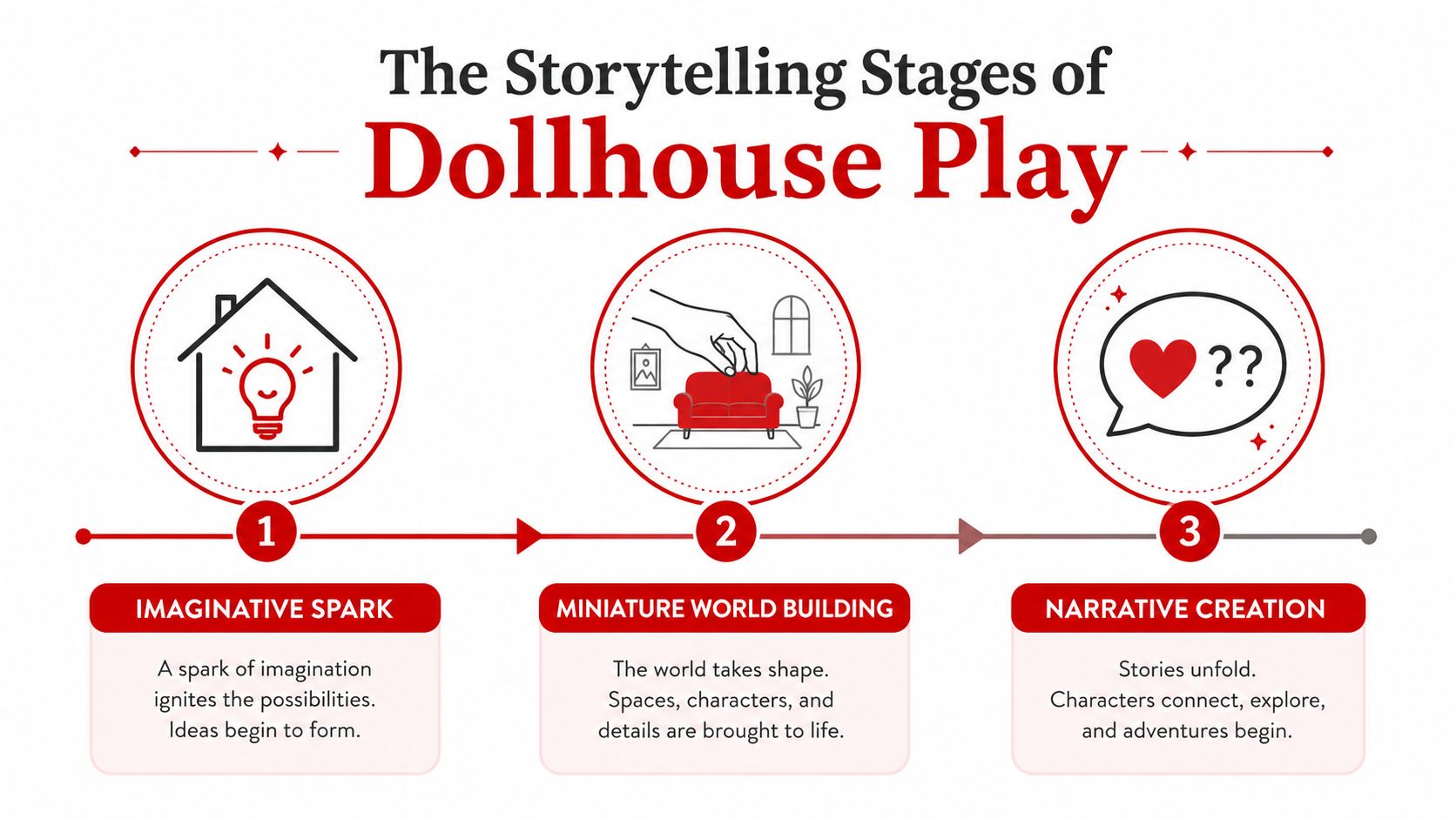
Parents often compare dollhouses to other pretend-play toys, but the difference is the built-in setting. A dollhouse gives children walls, rooms, and furniture placement, so the play naturally becomes about sequencing, nesting, and social roles. That same open-ended quality is why miniature holiday display pieces, like freestanding holiday houses for sewing from B-Sew Inn, can feel so appealing too, they invite the same small-world storytelling even when they're made for decorating rather than daily play.
What Dollhouse Toys Are and Why Kids Love Them
A child kneels on the floor, slides a tiny chair into a tiny kitchen, then moves a little figure toward the door and says, “I'm late for dinner.” That moment is the heart of dollhouse play. The house isn't just a toy object, it's a stage for talking, planning, and trying out everyday life in miniature.
A small world that invites big stories
A dollhouse toy is a miniature toy home. In later periods, historical sources describe them as mostly made for children to play with, which is a useful reminder that the modern toy grew out of adult display culture and became child-centered over time. That shift matters because children don't usually want to admire a dollhouse from a distance, they want to move pieces, change rooms, and act out scenes.
The staying power is easy to understand in a home or classroom. One child uses the living room as a school, another turns the bedroom into a hospital, and a third rearranges the kitchen to “serve” lunch. That kind of repeated, open-ended use is different from a toy that only does one thing.
The category's long life also tracks with wider toy history. Dollhouses moved from rare luxury items into ordinary households as industrialization enabled mass production, which lowered cost and broadened access. That same historical shift helped make dollhouses durable enough to survive into today's toy aisles and collector shelves. A short history of the dollhouse and mass production captures that transition clearly.
Practical rule: if a toy makes a child ask “What happens next?”, it's doing real work for imagination.
By the turn of the 20th century, manufacturers in Germany, England, and the United States were supplying dollhouses in multiple scales to fit different budgets and tastes, which is one reason collectors and families still approach them differently today. The modern market reflects that split, with dollhouses living both in toy rooms and in hobby collections. The dollhouse as a collector's category shows why adults still care about them, while children keep using them for play.
Types of Dollhouse Toys and Scale Explained
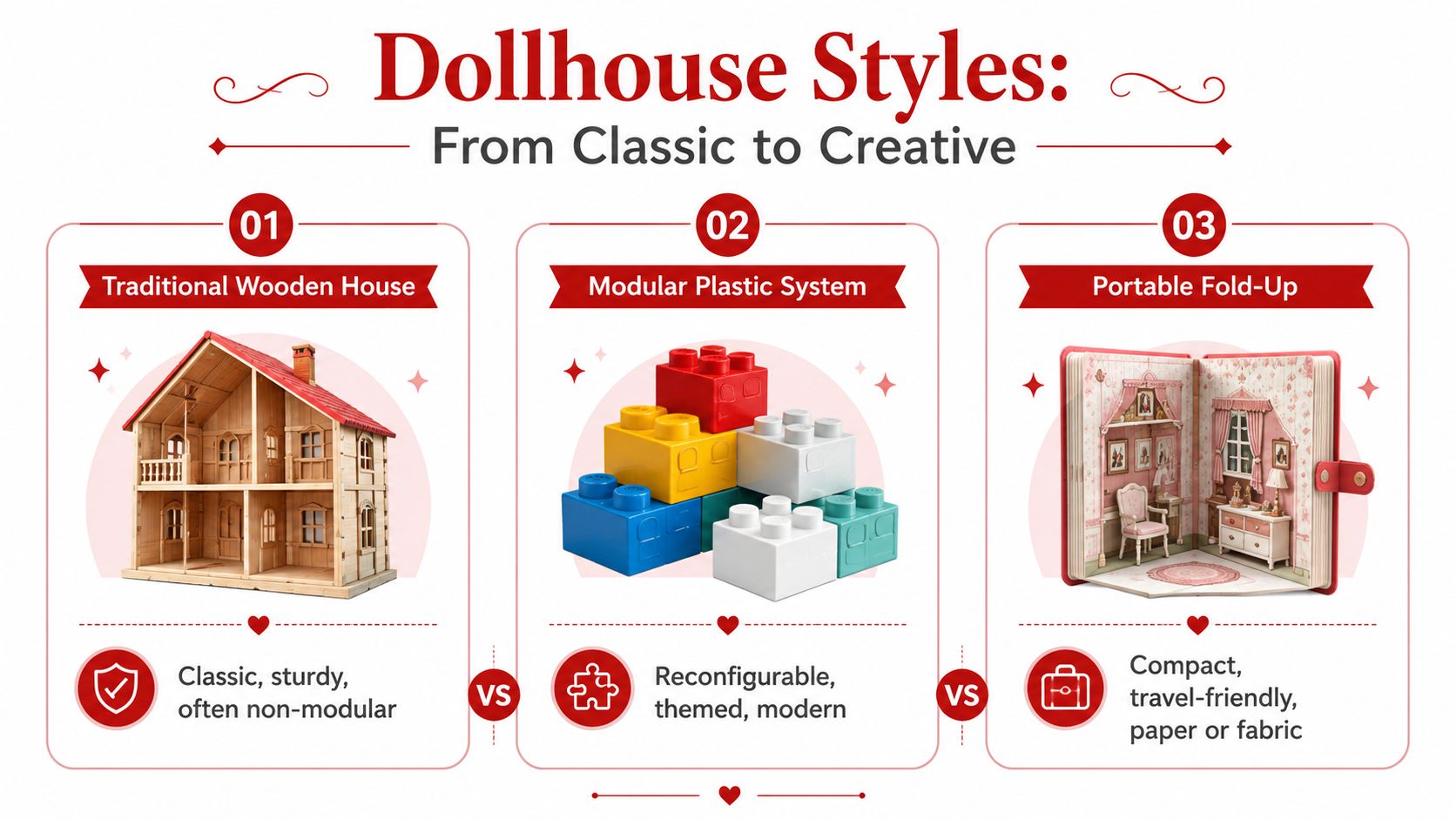
The first decision is usually not color or theme, it's structure. A family with a large playroom, a classroom with shared use, and a grandparent buying a gift may all need a different dollhouse style even if they're shopping at the same price point.
The main styles buyers actually meet
Traditional wooden houses usually feel sturdy and familiar. They often stay in one layout, which works well when a child wants a reliable “home base” for repeated stories.
Modular plastic systems are more reconfigurable. They can feel more like a set of connected parts than a fixed house, so kids can change the layout and theme more often. Portable fold-up designs, including paper or fabric versions, are the easiest to move and store, which makes them useful for travel, small homes, or shared spaces.
Scale affects the toy more than many buyers expect. Modern play dollhouses commonly use 1:18 or 1:12 proportions, and 1:12 is the dominant collector scale because 1 foot in real life equals 1 inch in the model. That simple rule changes everything from figure size to how many pieces a child can reasonably handle. This scale overview of dollhouses is helpful for translating real objects into miniature ones.
Why scale changes play
In 1:12 scale, a 7.5-foot doorway becomes about 15 inches tall, and an adult doll is typically about 5 to 6 inches tall. In 1:24 scale, that same doorway shrinks to about 3 to 4 inches tall, which changes accessory size, finger dexterity needs, and compatibility across sets. The smaller the scale, the more careful children have to be with parts.
The internal link below is useful if you want to compare pretend-play options more broadly before narrowing in on a dollhouse style: best pretend play toys.
Buying shortcut: if a child has bigger hands or a shorter attention span, a larger scale usually feels easier to use because the pieces are less fussy.
Age Ranges and Safety Considerations
A dollhouse can look soft and harmless, but the tiny furniture, doors, and accessories can make it a poor fit for very young children. Parents usually notice the age question first, because safety and day-to-day use matter more than the house's style.
What age grading really means
Retail dollhouses are commonly marked 3+ or older because miniature furniture and accessories can include small parts. That guidance matters most in homes with toddlers who still mouth objects or throw pieces across the room. The central question is whether the child can use the toy safely and independently enough to enjoy it.
Material changes the safety picture too. Large wooden or MDF dollhouses sold in major retail channels commonly weigh about 20 to 24 pounds and measure roughly 27 to 32 inches in height. That weight helps the house stay steady during play, but it also means adult assembly and setup are usually part of the process. A representative retail listing for a wooden dollhouse shows how these products are often marketed with age grading and adult assembly in mind.
The main styles buyers meet
A simple rule helps families decide. If the house is heavy, tall, accessory-rich, and filled with small furniture, it belongs in the “older child or supervised play” category. If the toy sits on a low shelf, uses oversized parts, and doesn't demand precise finger control, it is easier to treat as a toddler-friendly playhouse.
Plastic modular houses can be lighter and easier to reconfigure, but they may also include electronic pieces. Some retail accessories list LED lighting, audio functions, or WiFi compatibility, which means battery management and small-parts warnings matter more. The goal is to match complexity to the child's age and your supervision level, so the toy supports play instead of creating constant frustration.
Safety rule of thumb: if you're asking whether a toddler can “grow into it,” the toy may already be better suited to an older child.
The internal link on family toy safety is a good companion read when you're comparing age fit across categories: non-toxic toys for babies.
Developmental and STEM Benefits of Dollhouse Play
A child lines up three chairs in a row, pushes one through a doorway, and stops to see whether the table still fits beside it. That pause is spatial reasoning in action. In a dollhouse, small moves like these give children repeated practice with space, sequence, and cause-and-effect, all through play they already want to keep doing.
What each play move builds
Arranging rooms supports spatial reasoning because children have to notice fit, orientation, and balance. A chair that blocks the door or a table that makes the kitchen hard to move through teaches through feedback, not lecture. That kind of problem-solving is useful because it happens naturally during play.
Narrating a scene supports language development. Children practice sequencing when they say what happened first, what happens next, and who is speaking. Role-play dialogue also pushes them to use different voices, ask questions, and keep a story moving.
Sharing props and deciding who gets the baby, the car, or the bed encourages social-emotional learning. Kids negotiate turn-taking, compromise, and perspective-taking when they use the same miniature world together. A dollhouse gives them a safe place to try out those social rules before they need them in larger group settings.
The benefits of pretend play article gives a broader look at why these moments matter across different toys.
Classroom prompt: ask, “What room needs to be fixed first?” and watch how quickly children start planning, justifying, and collaborating.
STEM is hiding in plain sight
Dollhouse play also supports early STEM foundations. Measurement appears when a child compares furniture sizes, proportion shows up when a figure won't fit through a door, and structural planning comes into play when they stack, balance, or redesign a room. Children do not need formal lessons for those ideas to begin taking shape.
You can extend the learning with one small question at a time. Ask which room is bigger, which piece needs to move, or how to make the stairs work better. The point is not to quiz the child. It is to give their thinking a new surface to work on.
Choosing Dollhouse Toys for Parents, Educators, and Gift Buyers
Parents, educators, and gift buyers each prioritize different features when choosing a dollhouse. The right choice depends on how the toy will be used, who will handle it, and how much setup the child or adult is willing to manage.
A parent in a busy home often needs a house that stands up to frequent play and cleans up easily. An educator needs a model that supports shared use without turning every session into a fight over space. A gift buyer usually wants something attractive enough to feel special, but still practical enough that the child can open it, assemble it, and use it without frustration.
Dollhouse buying priorities by audience
| Buyer | Top Priority | Best Scale | Material Preference | Assembly Tolerance |
|---|---|---|---|---|
| Parent | Durability and easy cleanup | 1:12 or 1:18, depending on age | Wood or sturdy MDF | Medium to high |
| Educator | Open-ended use for multiple children | Larger, easy-to-handle scale | Lightweight wood or plastic | Low to medium |
| Gift buyer | Visual appeal and easy gifting | 1:12 for display value, 1:18 for younger kids | Wood for a premium feel, plastic for lighter shipping | Medium |
How those priorities play out
Parents often do best with fewer tiny accessories and a stable frame. A dollhouse that wipes down quickly and stays upright when a child presses on it gets used more often than a showpiece that feels delicate in daily play.
Educators usually need a house that can handle group use. Wide openings, fewer fragile add-ons, and a layout that lets several children reach in at once make the toy easier to share in a classroom or childcare setting. That kind of design supports play without forcing constant resets.
Gift buyers often want the house to look polished as soon as it comes out of the box. Presentation matters, especially when the dollhouse is meant to feel like a special present. A beautiful set still needs to match the child's age and patience level, because a gift that is hard to assemble or awkward to use loses appeal quickly.
The internal link below is useful if you are comparing pretend-play products across categories and ages: cardboard craft ideas.
Imaginative Play Activities and DIY Customization Ideas
One of the best things about dollhouses is how quickly they become whatever the child needs that day. A kitchen scene can turn into a family dinner, then into a restaurant, then into a school lunch line, all without buying a new toy.
Five simple play scenarios
A family dinner scene is the easiest starting point. Children can set plates, assign voices, and practice greetings, thanks, and cleanup language while the story unfolds.
A moving-day scene works well for sequencing. Kids decide what gets packed first, what stays out, and where each item belongs in the new house. That gives them a natural reason to talk through order and change.
A shop scene adds early math thinking. Children “sell” furniture, sort items by type, and count pieces as they move between rooms.
A repair scene pushes problem-solving. A broken chair, a stuck door, or a missing wall becomes the reason to invent tools and test fixes.
A redesign scene opens the door to creative writing. Kids can rename rooms, change the story of the household, or imagine who lives there and why.
Good play question: “What should change if this house belongs to a chef, a teacher, or a space explorer?”
DIY details that keep interest alive
Add a cardboard rooftop garden, fabric scraps for miniature rugs, or paper labels for rooms that change with the season. Those small updates give the child a reason to come back to the toy instead of treating it as finished.
If you want more hands-on making ideas that fit this kind of play, the internal resource on cardboard craft ideas pairs well with simple dollhouse customizations. For themed inspiration, the EYFS-friendly, space-centered ideas in Nursery Advice's early years space activities can also spark a good moon-base or rocket-home version of a dollhouse scene.
Setup, Maintenance, and Storage Tips
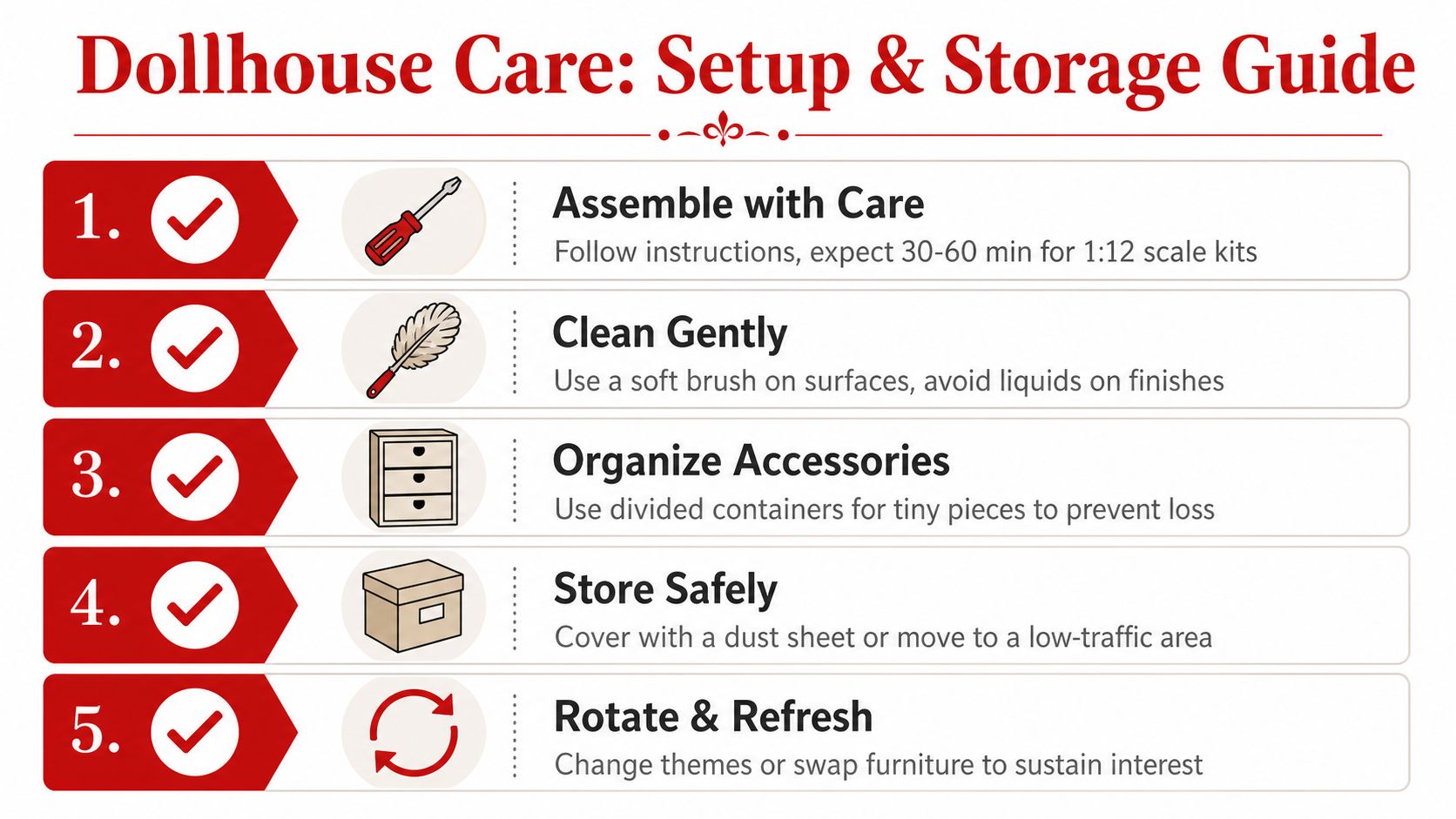
Start with assembly. Wooden dollhouse units in this range often need an adult to put them together, especially when the frame is tall and the parts come in many pieces. Once it is built, place it where a child can reach it without climbing, and secure taller pieces in shared rooms if they sit near busy walkways.
A good setup supports play instead of getting in the way of it. If children can see the rooms, reach the furniture, and return items without help every time, they are more likely to use the house for stories, role-play, and problem-solving.
Cleaning should stay simple. Use a soft brush or dry cloth for dust, and avoid soaking wood or MDF finishes. Plastic pieces can handle a more direct wipe-down, but tiny parts still belong in a separate cleanup basket so they do not vanish during a rushed reset.
Storage matters for the same reason. A house that is easy to pack away and easy to reopen gets used more often, especially in smaller homes or classrooms. If your playroom tends to swallow loose parts, a guide to toy storage solutions for small spaces can help keep furniture, figures, and accessories sorted without turning cleanup into a project.
Five quick fixes for common problems
- Loose hinges: tighten them with a small screwdriver before they start scraping.
- Stuck doors: check for paint buildup or warped edges, then ease the friction point gently.
- Faded stickers: replace them with paper labels or removable decals instead of forcing the old ones to stay.
- Missing accessories: store tiny items in divided containers, not loose bins.
- Dusty rooms: keep a hand vacuum or soft brush nearby so cleanup takes minutes, not a full reset.
A simple rhythm works best. Set the house up once, tidy lightly after play, and do a deeper sort when pieces start drifting into other rooms. That keeps the toy ready for hands-on play without making care feel like homework.
Smart Picks for 2026 and Frequently Asked Questions
The smartest dollhouse purchase usually comes down to three choices. Pick a scale the child can physically manage, choose materials that match your cleaning and supervision reality, and favor a layout that encourages repeat play instead of one-time display.
Three buying tips worth keeping
- Choose scale for the child, not the shelf: larger pieces are easier for small hands and group play.
- Choose material for your space: wood and MDF feel sturdy, while lighter plastic can fit better in smaller rooms.
- Choose accessory count carefully: more pieces look exciting, but fewer, better-used items often create better play.
FAQs
Are dollhouse toys good for toddler siblings?
They can be, but only if the pieces are large, the setup is stable, and the small accessories stay out of reach. In mixed-age homes, a simpler house with fewer tiny parts usually works better than a detailed collector-style set.
How do I introduce a dollhouse in a classroom with limited space?
Use a compact model, keep the accessory set small, and store everything in one labeled bin. A shared dollhouse works best when children can access it without crowding the room or waiting too long for a turn.
What should I look for if I want one dollhouse to last across multiple children?
Look for sturdy construction, replaceable accessories, and a design that doesn't depend on one fixed storyline. The more open the layout, the more likely different children will use it in their own way.
If you want a toy lineup that keeps children building, moving, and imagining instead of defaulting to screens, visit Playz and explore play options that support hands-on learning at home, in classrooms, and in gift lists. Dollhouse toys are at their best when they invite children to tell their own stories, and that's exactly the kind of play worth bringing home.