


A child reaches for a magnet on the kitchen fridge, then wonders why it sticks to the door but not the wooden cabinet beside it. Move that same magnet into a classroom, and the question can turn into an experiment: Which objects will it attract? Can it point the way? Can it make something move?
These projects with magnets take that everyday curiosity from simple exploration to building and testing. The activities progress from easy, playful investigations to builds that connect magnetism with electricity and motion. Each includes materials, a short plan, a learning takeaway, and practical safety notes, so parents and educators can choose a good fit for the child in front of them.
For a gentle start, pair magnet play with other hands-on science activities for kindergarten. A magnet, a few household materials, and time to make predictions can turn screen-free play into a chance to notice, test, and explain. Keep small or loose magnets away from young children, and treat safety as part of the activity, not a note to read afterward.
1. DIY Magnetic Compass
A floating compass makes an invisible influence easier to notice. The magnetized needle turns until it aligns roughly north to south, responding to Earth's magnetic field. The USGS describes this directional response as the basis of compass navigation, a useful connection for children who are curious about how people found their way before electronic navigation tools.
Materials: A sewing needle, a small bar magnet, a cork or foam disk, a shallow bowl of water, and a marker.
Make and test the compass
Stroke the needle along the magnet in one direction, lifting it before each return stroke. Repeat the motion several times, then place the needle on the cork and float it in the bowl. Let the water settle and watch the needle turn.
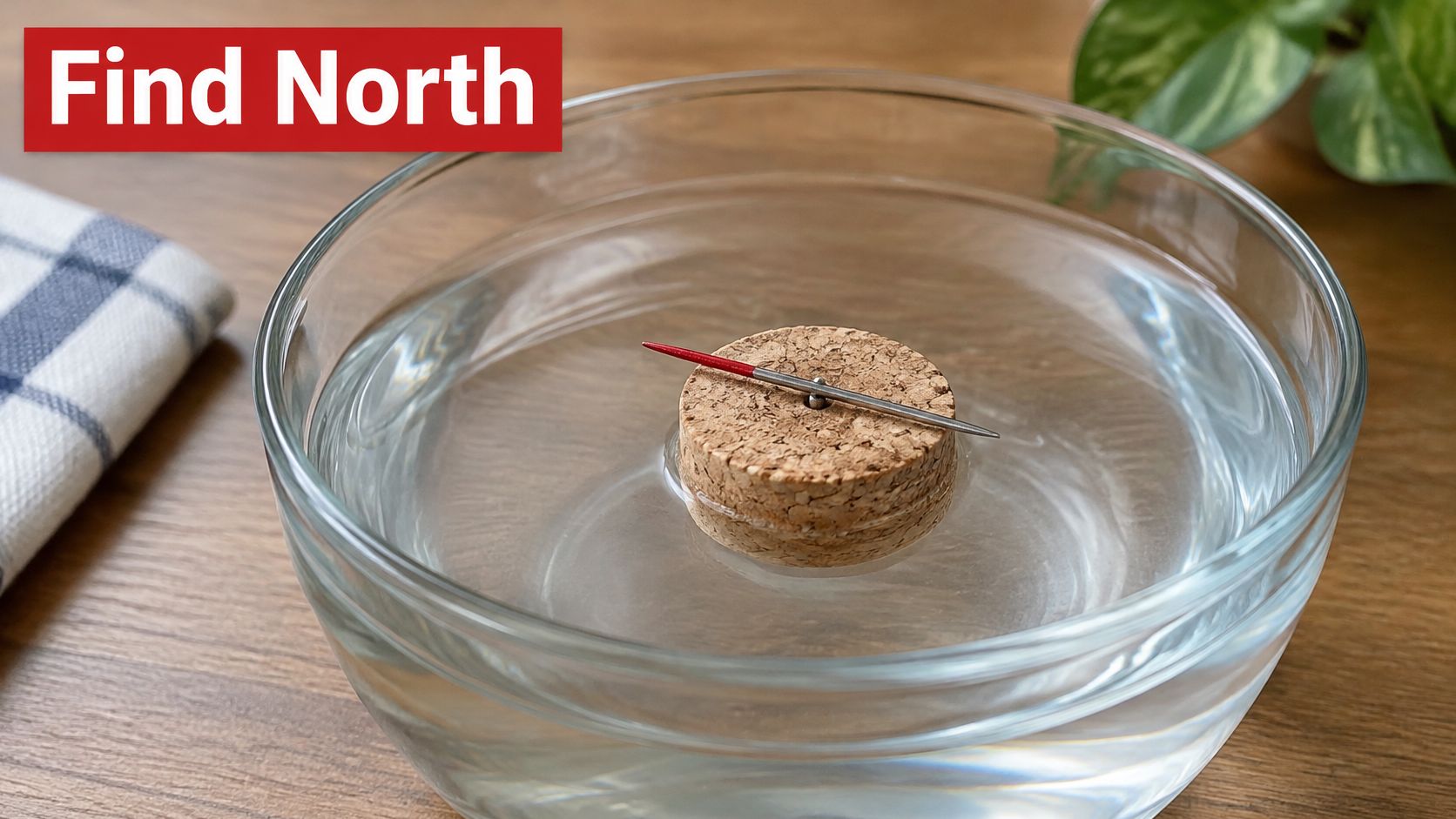
Try the compass away from metal objects and speakers, which can interfere with the demonstration. Compare the needle's direction with a known north direction, and mark the orientation on paper. The needle may not point exactly north, so treat any offset as something to observe rather than a mistake.
Try this: Ask children to predict which way the needle will turn before moving a magnet nearby. Then have them record what changes.
The learning takeaway is that a compass needle acts like a small magnet and responds to a field it can't see. It's a good fit for an Earth science activity or a home discussion about navigation. An adult should handle the sharp needle, and the small parts should be put away when the experiment ends.
2. Magnetic Levitation Model
Two ring magnets can seem to float when their like poles face one another. The demonstration is simple, but the effect depends on getting the orientation right: if the magnets attract instead, flip one over and test again.
Materials: A pencil or smooth dowel, ring magnets made for children's projects, labels for identifying poles, and a stable base.
Set up the floating magnet
Stand the pencil upright in its base and slide on a ring magnet. Add another with the same poles facing so the magnets repel. The upper magnet should hover above the lower one rather than rest directly on it. Label the poles before assembly to make the arrangement easier to explain and reproduce.
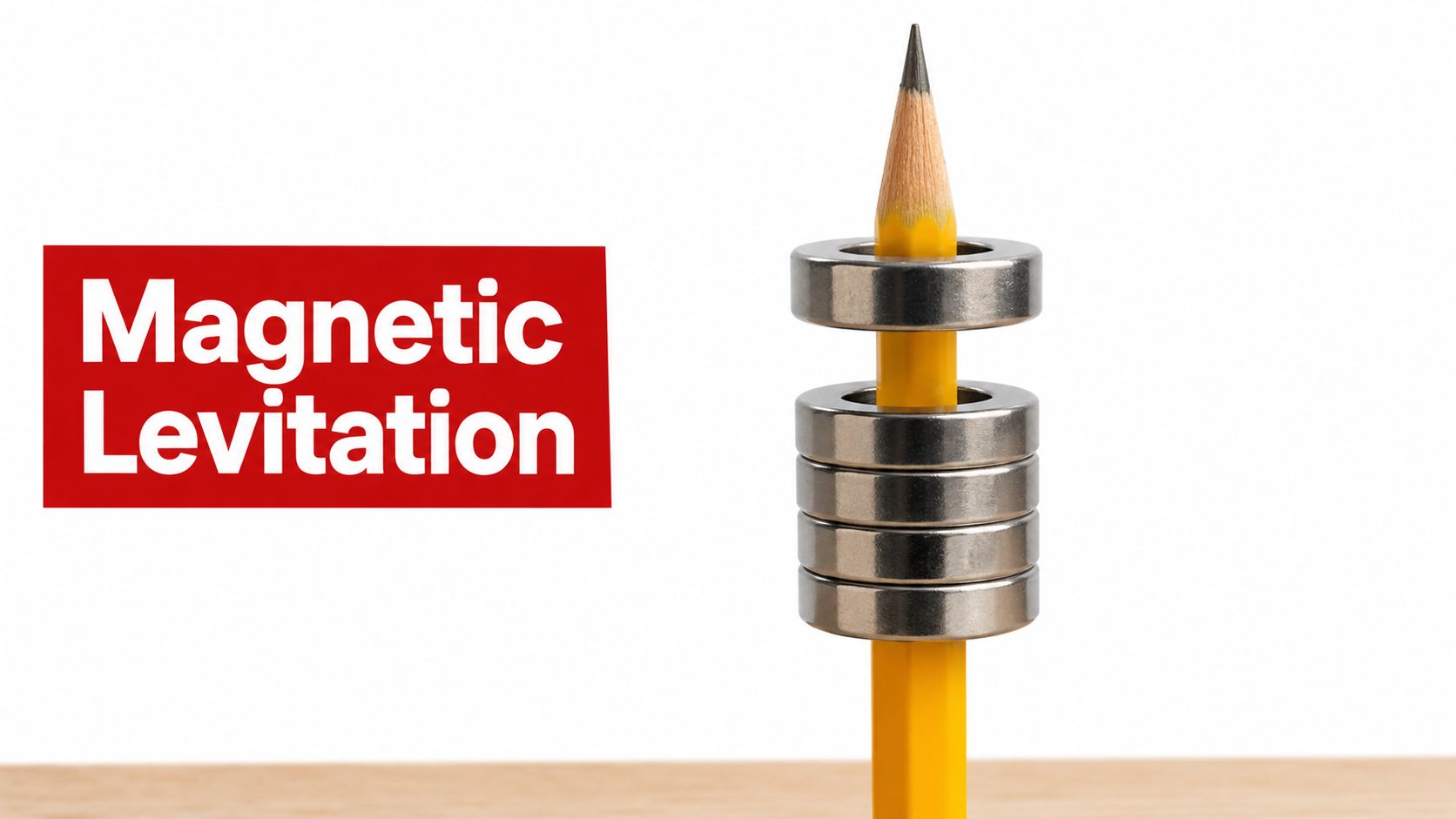
Children can compare what happens when they change the orientation or spacing. Add weight only if the setup is stable and an adult is supervising; too much can bring the magnets together, ending the levitation. The demonstration models the basic idea of magnetic repulsion, while real maglev systems use more complex engineering. For a related science-fair direction, explore physics projects for a science fair.
The main learning outcome is recognizing that like poles push apart and that arrangement matters. This project can be visually satisfying, but loose ring magnets aren't a good choice around children who might put objects in their mouths. Choose age-appropriate, securely controlled components, supervise closely, and store the magnets as soon as the demonstration is over.
3. Homemade Electromagnet
A nail that picks up paper clips only while connected to a battery offers a clear contrast with a permanent magnet. It shows children that an electric current can create a magnetic effect, and that switching off the current changes what the nail can do.
Materials: An iron nail, insulated copper wire, a low-voltage battery, and paper clips. An adult should prepare the wire ends and supervise the circuit.
Build and test
Wrap the wire around the nail in a single direction, leaving enough wire at both ends to connect to the battery. Touch the ends to the battery terminals briefly, then see whether the nail attracts paper clips. Disconnect the circuit between tests. If the result is weak, check that the wire is wound neatly and the connections are secure before changing the setup.
Count the paper clips lifted in each trial, changing one feature at a time, such as the coil arrangement. That makes the activity an experiment rather than a guessing game. A coil electromagnet also creates a natural connection to other electricity experiments for kids.
Learning takeaway: Current flowing through a wire produces a magnetic field, and a coil can make that effect easier to investigate. Children can record what happens when the circuit is connected and disconnected, then explain the difference in their own words.
Safety note: Use a low-voltage battery, never household mains electricity, and disconnect the wire between trials. A wire connected continuously can heat up. Adults should handle connections and stop the activity if the battery or wire becomes warm.
4. Magnetic Fishing Game
For younger children, a pretend fishing game turns testing into play. Make paper fish, add a securely attached metal tab or paper clip to each one, and let children try to catch them with a magnet tied to a short string or attached to a stick.
Materials: Paper or plastic fish, paper clips or metal tabs, strong tape or glue, a large age-appropriate magnet, and a short piece of string or a stick.
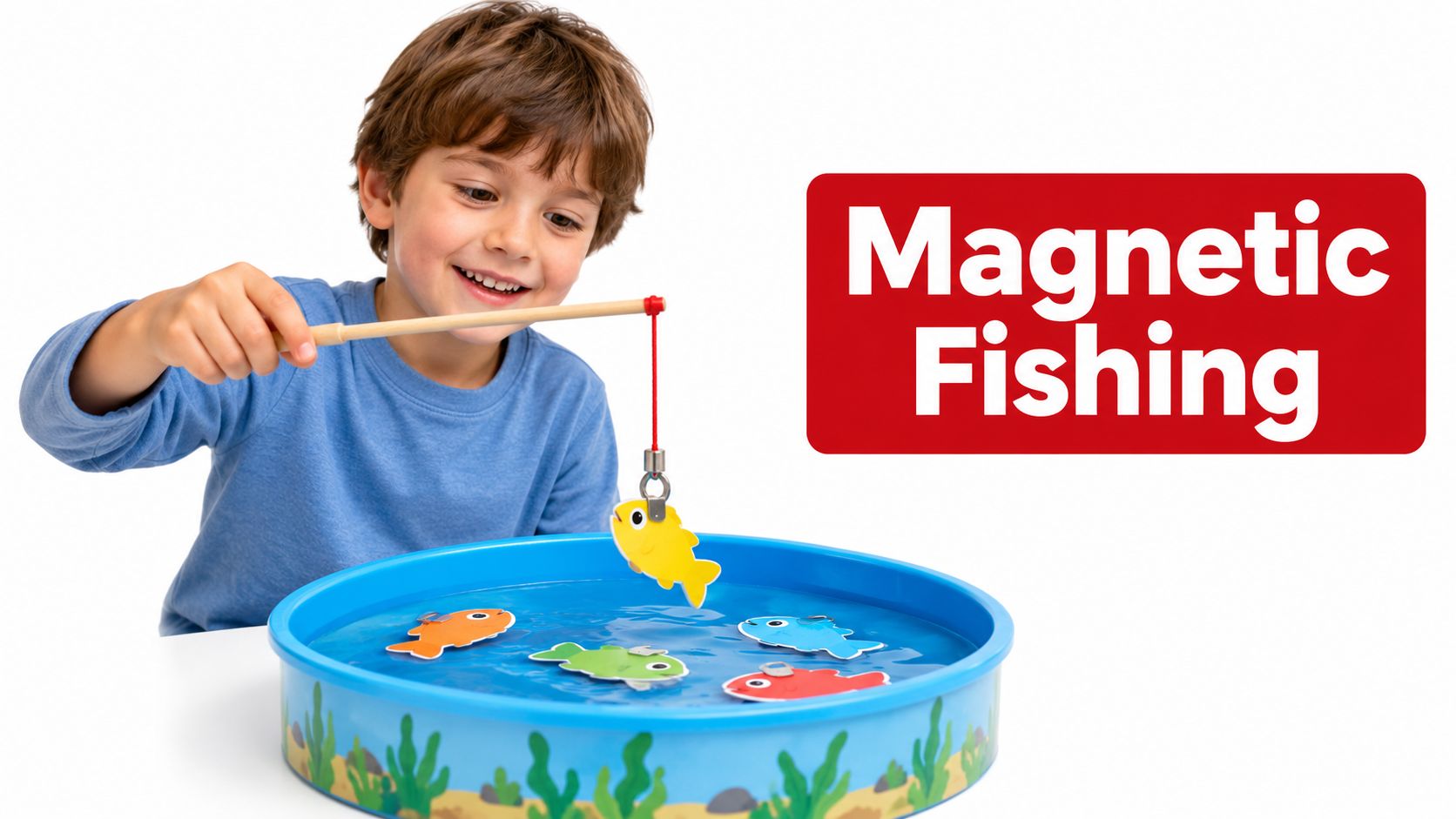
Before play, check that every metal piece stays firmly attached. Scatter the fish across a mat or low-sided box, then invite children to predict which ones the magnet will catch. Add a sorting round: separate the catches from fish without metal, or ask children to explain why one fish moves and another doesn't.
The game works well as a classroom activity station or rainy-day play because children can take turns making predictions and testing them. It builds hand-eye coordination, but it's also a simple way to introduce the idea that a magnet attracts some materials, not everything around it. A Playz activity guide includes magnetic fishing among its suggested magnet experiments, alongside activities such as sorting and compass-making.
Keep the magnet too large to swallow and supervise play, especially when the game includes loose metal pieces. If children are young enough to mouth objects, use a secured, age-appropriate version or choose a demonstration without loose parts.
5. Magnetic Marble Maze
A maze turns magnetic attraction into a steering challenge. Children move a magnet beneath a board to guide a steel ball above it, adjusting their hand movements when the ball slows, catches on an edge, or takes an unexpected path.
Materials: A shallow cardboard maze or thin wooden board, a steel ball large enough to avoid a choking risk for the child using it, a magnet, and tape or craft sticks for maze walls.
Build the path
Make a simple route with a clear start and finish. Put the ball on top, hold the magnet underneath, and move it slowly to pull the ball along the path. If the board is too thick, the attraction may be too weak to control the ball; a thinner surface usually makes the movement easier to manage.
Try changing the path before making the magnet stronger. A tight corner may be more challenging than a long straight route, and children can compare which design is easiest to follow. For a building extension, connect the maze to ideas in marble roller coaster projects, where a path also shapes how a moving object travels.
This project develops problem-solving and hand-eye coordination while showing that a magnet can act across a barrier. The trade-off is that a small steel ball can be a hazard for young children. Select a ball that's appropriate for the child, keep it under close adult supervision, and put it away immediately after the activity.
6. Magnetic Building Tiles and Construction Sets
A bridge that tips when one tile moves gives children an immediate reason to rethink the design. Magnetic construction sets make that kind of trial and adjustment easy, while introducing patterns, balance, and basic geometry through hands-on building.
Materials: A magnetic construction set with securely enclosed magnets, a clear floor or table, and a divided storage bin.
Begin with squares and triangles laid flat, then build upward into a tower or across into a bridge. Ask children to change one feature at a time, such as the base shape or height, and describe how that affects stability. Magna-Tiles and Magformers are familiar examples. For related ideas that pair building with guided STEM play, explore Playz STEM building kits.
Open-ended sets suit different skill levels: younger builders can make flat patterns, while more experienced children can test taller structures and wider spans. A divided bin helps keep pieces sorted and makes damaged tiles easier to spot.
Choose a set labeled for the child's age, and check that magnets remain fully enclosed. In the United States, the CPSC magnet safety guidance describes a flux-index limit below 50 kG²·mm² for covered loose or separable magnets that fit within the small-parts cylinder, measured under ASTM F963 procedures. Follow the product's safety instructions as well.
Building can hold a child's attention for a long stretch, but the set still needs regular inspection. Remove damaged components, keep tiles away from children who mouth objects, and store them safely after play. The trade-off is straightforward: more pieces allow larger builds, but they also take more sorting and supervision.
7. Simple DC Motor with Magnets
A coil that turns on paper-clip supports makes an electric current's effect visible. This project builds on electromagnet work, but needs careful setup and a little patience to get the coil spinning.
Materials: A battery, insulated copper wire, two paper clips, tape, and a magnet. An adult should prepare the wire ends and help secure the supports.
Bend the wire into a small coil, leaving two straight ends to rest on the paper-clip supports. Place the magnet beneath the coil, then connect the supports to the battery. If the coil does not turn, disconnect the battery before adjusting its balance or position.
A simple motor turns electrical energy into motion when a wire coil spins in a magnetic field.
The key idea is that a current-carrying coil can move in a magnetic field. Have children change one feature at a time, such as the coil's balance or the magnet's position, then sketch the setup and describe what changed. For an engineering connection, explore the principles behind a one-horsepower motor. Iron-rich meteorites can also prompt a conversation about materials and objects from space, with browse Gebel Kamil meteorite fragments.
This build takes more adjustment than the fishing game or tile construction. Use a low-voltage battery, disconnect it between tests, and stop if any part becomes warm. Keep small components away from young children.
8. Iron Filing Magnetic Field Art
Iron filings can trace the shape of a magnetic field, but loose filings need careful handling. For a controlled demonstration, keep the filings sealed beneath a clear cover rather than letting children handle or scatter them.
Materials: A bar magnet, paper, a clear sealed field-viewing container or enclosed iron-filings display, and a clean work surface.
Place the covered filings over the magnet and observe how they arrange themselves. Move the magnet or change its orientation to compare patterns. If using an enclosed display, gently reposition it as the manufacturer directs; don't open the container to pour out filings.
The pattern gives children a visual model of a field that they can't otherwise see. Ask them to draw what they notice, compare the arrangement around different magnet positions, and explain how the pattern changes. This links science with art, but the drawing is a representation, not the field itself.
Safety matters here: Loose iron filings can be difficult to clean up and shouldn't be handled or placed near a child's face. Use a sealed demonstration, supervise throughout, and follow the product's instructions. If a container leaks, stop the activity and keep children away while an adult manages cleanup.
8 Magnetic Projects Compared Side by Side
| Project | 🔄 Implementation Complexity | ⚡ Resource Requirements | 📊 Expected Outcomes | ⭐ Ideal Use Cases | 💡 Key Advantage |
|---|---|---|---|---|---|
| DIY Magnetic Compass | Low; magnetizing the needle takes patience | Very low; magnet, needle, float, bowl of water | Demonstrates Earth's magnetic field and basic navigation | Classrooms, scouting, outdoor activities | Connects magnetism to real-world navigation |
| Magnetic Levitation (Maglev) Model | Moderate; stable alignment can be tricky | Low to moderate; ring magnets and a guide rod | Shows magnetic repulsion and levitation | STEM demonstrations, older children, engineering projects | Visually engaging and expandable into a transport model |
| Homemade Electromagnet | Low to moderate; requires careful wire and battery connections | Low; insulated wire, iron nail, battery | Demonstrates how electric current creates controllable magnetism | Physics lessons and introductory engineering activities | Strength can be tested by changing coil turns or power |
| Magnetic Fishing Game | Low; quick to assemble | Very low; paper or foam fish, clips, string, magnet | Introduces magnetic attraction, sorting, and turn-taking | Preschool play, parties, classroom activity centers | Combines hands-on science with social play |
| Magnetic Marble Maze | Moderate; requires a suitable board and maze design | Low to moderate; board, steel ball, magnet, maze materials | Builds spatial reasoning and shows magnetic force at a distance | Puzzle challenges, makerspaces, fine-motor activities | Combines magnetism with problem-solving and play |
| Magnetic Building Tiles and Construction Sets | Low; pieces connect readily | Moderate to high; reusable magnetic tile or rod set | Develops geometry, spatial reasoning, and basic engineering | Home play, early learning, classroom STEM centers | Supports open-ended building and repeated use |
| Simple DC Motor with Magnets | Moderate; coil preparation and positioning require precision | Low; battery, copper wire, supports, magnet | Demonstrates conversion of electrical energy into motion | Physics lessons, robotics clubs, beginner engineering | Turns magnetic principles into a working machine |
| Iron Filing Magnetic Field Art | Low; simple setup, but cleanup needs care | Low; iron filings, magnet, paper or plastic sheet | Makes magnetic field patterns visible | Science-and-art activities, classroom demonstrations | Reveals the shape of an otherwise invisible magnetic field |
Start Building and Keep Exploring Magnetism
The best project depends on what a child is ready to do. Floating a compass or playing magnetic fishing suits early exploration with adult help. A maze or construction set adds planning and trial-and-error. An electromagnet, motor, or field-pattern investigation asks for closer supervision and more careful observation.
Across all eight activities, the strongest learning habit is simple: predict, test, record, and explain. A child can note which objects the magnet attracts, compare how a coil behaves when a circuit is connected or disconnected, or draw the route a ball takes through a maze. The record can be a sketch or a few spoken observations. The point is to turn “that's cool” into evidence a child can describe.
Safety belongs in the setup. The CPSC estimates that 26,600 magnet-ingestion cases received emergency-department treatment from 2010 through 2021, with incidents increasing annually since 2018. It also reports seven deaths linked to hazardous magnet ingestion, including two outside the United States. If multiple magnets are swallowed, they can attract through intestinal tissue and cause serious injuries. Read the CPSC's federal magnet-safety announcement for details of the standard.
A quick safety checklist
- Choose suitable components: Prefer permanently enclosed magnets or larger pieces designed for the child's age. Don't assume a small, powerful magnet is a better teaching tool.
- Supervise loose parts: Keep loose magnets and small metal components away from children who mouth objects, and put everything away after each activity.
- Check before play: Look for damaged or opened parts, and follow the manufacturer's age guidance and safety instructions.
- Act on suspected ingestion: Seek immediate medical attention if a magnet may have been swallowed.
FAQs
Which magnet project is easiest to start with?
Magnetic fishing is playful and easy to adapt, provided the magnet and metal pieces are age-appropriate and supervised. A floating compass is another approachable option, but an adult should handle the needle.
How can I make these activities more educational?
Ask a child to make a prediction, change one variable, and describe the result. A drawing, tally, or spoken explanation can all help make the observation concrete.
Can young children use loose magnets?
Loose or separable magnets pose an ingestion hazard. Choose secured, age-appropriate components, supervise closely, and keep small magnets away from children who may put objects in their mouths.
Playz offers children's science kits and creative toys that can complement home and classroom activities. Choose a project that suits your child's interests, set up a safe workspace, and let curiosity lead the next experiment.
Playz offers science kits and creative toys that support active, screen-free play, including activities connected to magnet experiments. Explore Playz to find a hands-on option for your next afternoon of building, testing, and discovery.