

Stop buying a play tent tipi because the listing promises it boosts creativity. It won't, not by itself. A tipi is a small supervised room inside a room, and the purchase works only when you size it, inspect it, place it safely, and give an adult a clear job during play.
What a Play Tent Tipi Is and Why Its Shape Works
A four-year-old drags a blanket into a corner. Within minutes that corner is a campsite, then a bakery, then a space station. A play tent tipi gives that instinct a stable boundary, a cone of poles and fabric with flaps a child can enter, close, and rearrange around a story.
The shape adapts a historically important Indigenous North American shelter. As the history of the tipi and its portable design explains, archaeological evidence from tipi rings suggests use may extend back approximately 3,000 to 4,000 years, though the exact origin remains uncertain.
A Borrowed Shape With Limits
European descriptions of conical Indigenous dwellings appeared in records associated with Francisco Vázquez de Coronado in the mid-1500s. Meriwether Lewis documented tipis during the Lewis and Clark Expedition of 1804 to 1806.
Historically, families could dismantle the poles and covering, transport them, and rebuild as communities moved across the Great Plains and Canadian Prairies. Smoke flaps also set the original apart from an ordinary conical tent.
A child's version doesn't carry that cultural meaning. It borrows the idea of a small personal space for role-play, reading, and social interaction, and you should treat it that way.
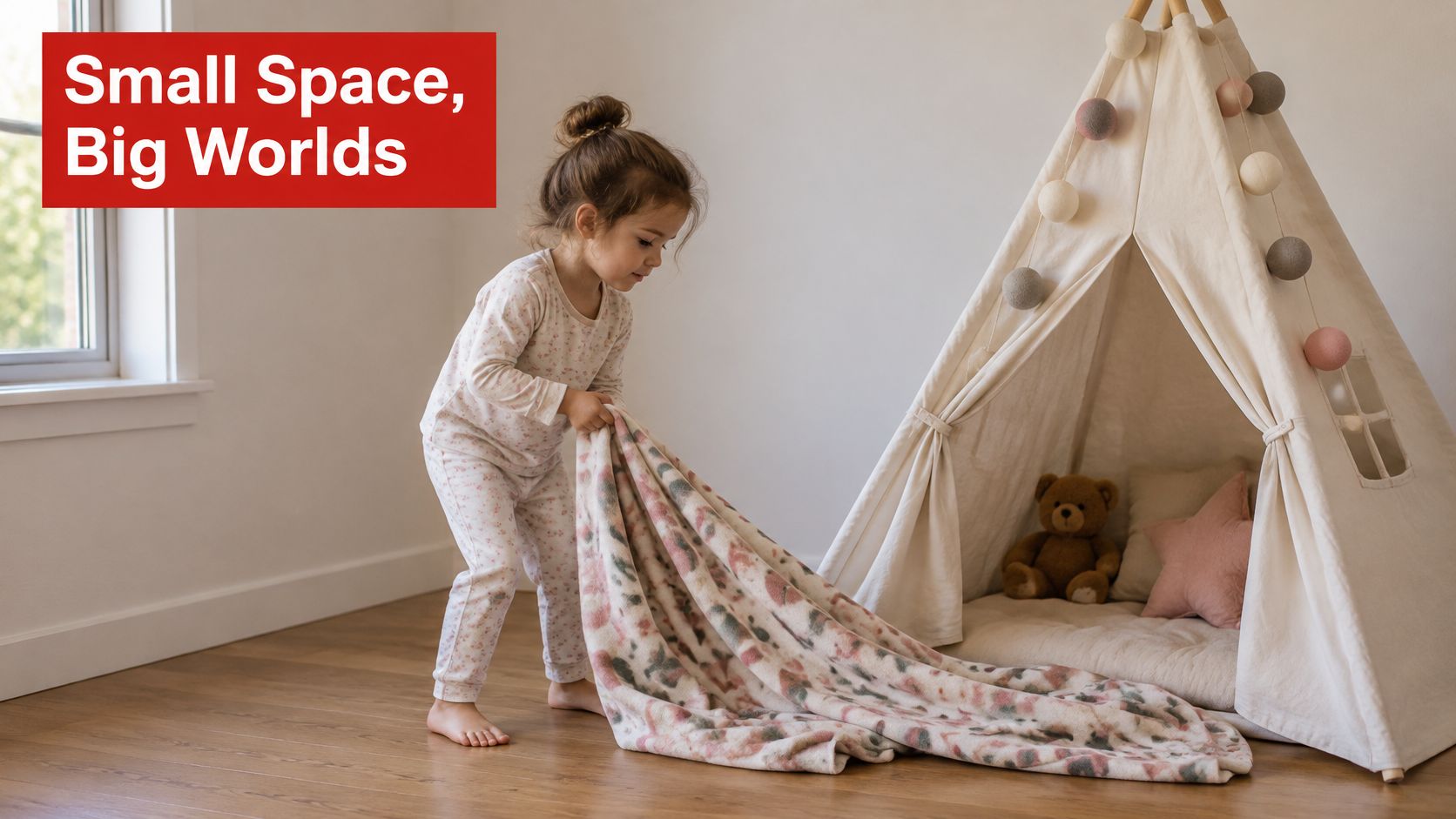
That flexibility is why the interior can become a home, classroom, or storytelling space without changing the structure. It also explains the appeal described in the benefits of pretend play for young children, though the object alone doesn't create the play.
Buy the boundary, not the promise. Your real decisions are size, materials and safety, then supervised use.
Sizing a Play Tent Tipi for Your Child and Room
Start with the table, then measure your child and your floor. Don't start with age printed on a box.
| Child age | Child standing height | Tipi height | Floor diameter | Clear floor needed |
|---|---|---|---|---|
| 1-2 years | New walker to early toddler height | Low cone for seated and crouching play | Compact footprint for one toddler and an adult at the entrance | Compact square with open clearance on every side |
| 3-4 years | Preschool standing height | Child can crouch through entrance and sit upright inside | Room for one child, books, and a few props | 2 m square |
| 5-7 years | Early primary standing height | Taller cone for kneeling, sitting cross-legged, and standing at center where design allows | Room for one older child or two smaller children seated | 2.5 m square |
| 8+ years or two children | Older child or siblings sharing | Tallest play size, still primarily seated play | Largest footprint for shared props and two occupants | 3 m square |
Why Height Beats Age
A child who can't enter comfortably loses interest fast. She has to crouch without pushing the frame over, turn around without dragging the walls, and sit without her head pressing fabric into the poles.
Measure standing height in socks against a wall. Then compare it with the manufacturer's stated tipi height and entrance height, not just the decorative peak where poles cross.
Floor diameter is the footprint once the poles spread. Clear floor is bigger. As an example, keep about 60 cm of open space beyond the footprint on every side so the fabric doesn't sit against a bed, radiator, bookcase, or wall.
Take a worked example. A 4-year-old in a small bedroom fits the 3-4 years row only if you can clear the matching square and still open the door. If that square pushes the tipi against heating or furniture, the room doesn't fit that tipi, however cute the listing looks.
A family with a 6-year-old and a younger sibling belongs in the two-child thinking, even if the younger child is small. Shared play needs elbow room, two sitting spots, and space for props that don't block the entrance.
Room Checks Before You Order
- Ceiling height: Confirm the crossed poles clear light fittings and sloped ceilings with room to spare.
- Doorway width: Check the folded bundle can move into the room and into storage without forcing poles to bend.
- Floor type: Carpet grips pole feet differently from hard floors, and hard floors may need a flat mat under the base.
- Adult sightline: Place the opening where an adult can see inside from the usual supervision spot.
- Storage corner: Pick where the folded tipi will live before you buy, using ideas from toy storage solutions for small spaces if floor space is tight.
If your child sits between rows, choose the larger size only when the room has the clear square and adults can still see and reach inside. Oversizing in a cramped room creates tipping, blocked exits, and fabric pushed toward heat.
Skip the bigger model if you have to wedge it in. A smaller tipi used in open space beats a large tipi trapped between furniture.
Materials and Frames Compared Side by Side
A tipi's fabric label matters less than how it is sewn, cleaned, and checked. Choose materials and a frame you can inspect, then match them to how often the tent will be set up and who will use it.
| Option | Strengths | Trade-offs | Best fit |
|---|---|---|---|
| Polyester or nylon ripstop | Light, quick to dry, easy to wash | Less breathable; check for a flame-resistance statement | Frequent setup and indoor use |
| Cotton canvas | Breathable, sturdy, natural feel | Heavier, slow to dry, may mildew if packed damp | Long-term home use with supervision |
| Mesh window panels | Improve airflow and adult visibility | Openings must not let little fingers through or catch | Toddler and preschool rooms |
| Fiberglass poles | Light and flexible | Can shed fibers when cracked or worn | Lightweight tents with regular inspection |
| Wood dowel poles | Sturdy and easy to inspect | Heavier; may splinter if the finish fails | A tipi kept in one indoor spot |
| Plastic snap-fit connectors | Quick to assemble and take down | May crack with repeated folding | Frequent folding or travel |
Fabric Trade-Offs in Plain Terms
Ripstop polyester or nylon is a practical choice if you often pack the tipi away. It is light, dries quickly after spot cleaning, and folds into a compact bundle. Airflow becomes a concern if the design has no mesh and children close every flap, so choose a model with ventilation you can see and inspect.
Cotton canvas feels sturdy and allows more airflow in a warm room. It is heavier and takes longer to dry. If you cannot air it out fully, skip canvas for a damp basement playroom. Packing damp fabric away invites mildew.
Check for a written flame-resistance statement that names a test. “Non-toxic” does not answer the flammability question or explain how printed areas, coatings, and seams behave. Treat vague material claims as a reason to ask the seller for specifics, not as proof that the tent suits indoor play.
Mesh supports both airflow and supervision. It lets an adult check hands, faces, and toys without opening the entrance each time. Run a finger over the panel and check its openings. They should not stretch wide, let small fingers push through, or snag on rough edges.
Frames You Can Actually Inspect
Fiberglass poles keep a tipi light and flex during setup. That flexibility does not make damaged poles safe. Skip a frame with cracks, splinters, or a fuzzy surface, and choose fiberglass only if you will inspect it regularly.
For a tipi that stays in one room, wood dowels are my pick. Cracks and rough spots are easy to see and feel, and a damaged pole is often easier to replace. Wood weighs more, so a tipi that tips can cause a harder impact. Check that the frame stands securely before letting children use it.
Plastic snap-fit connectors make setup straightforward for grandparents, classrooms, and families who travel. Folding puts repeated stress on the joints. Before each use, check for white stress marks and loose connections. If a connector clicks loosely or looks cracked, stop using the tipi until it is replaced.
Price Reality Check
Listings for budget tents and multi-packs vary, and camping or party products do not necessarily suit durable indoor play. The Walmart listing for a kids' Ozark Trail teepee tent and Amazon teepee tent listings are examples of listings to assess by intended use, not by price alone. A low-cost tent may work for occasional supervised play, but the listing does not establish that its fabric, frame, or finish is suited to daily use.
My recommendation is simple: for occasional supervised use, consider a budget tipi only if it passes your safety checks. For daily indoor play, choose reinforced seams, a stated flame-resistance test, stable feet, and poles you can inspect without tools. Safety features and room setup matter more than a low price or a camping-style look.
Safety Checks and Safe Setup Rules
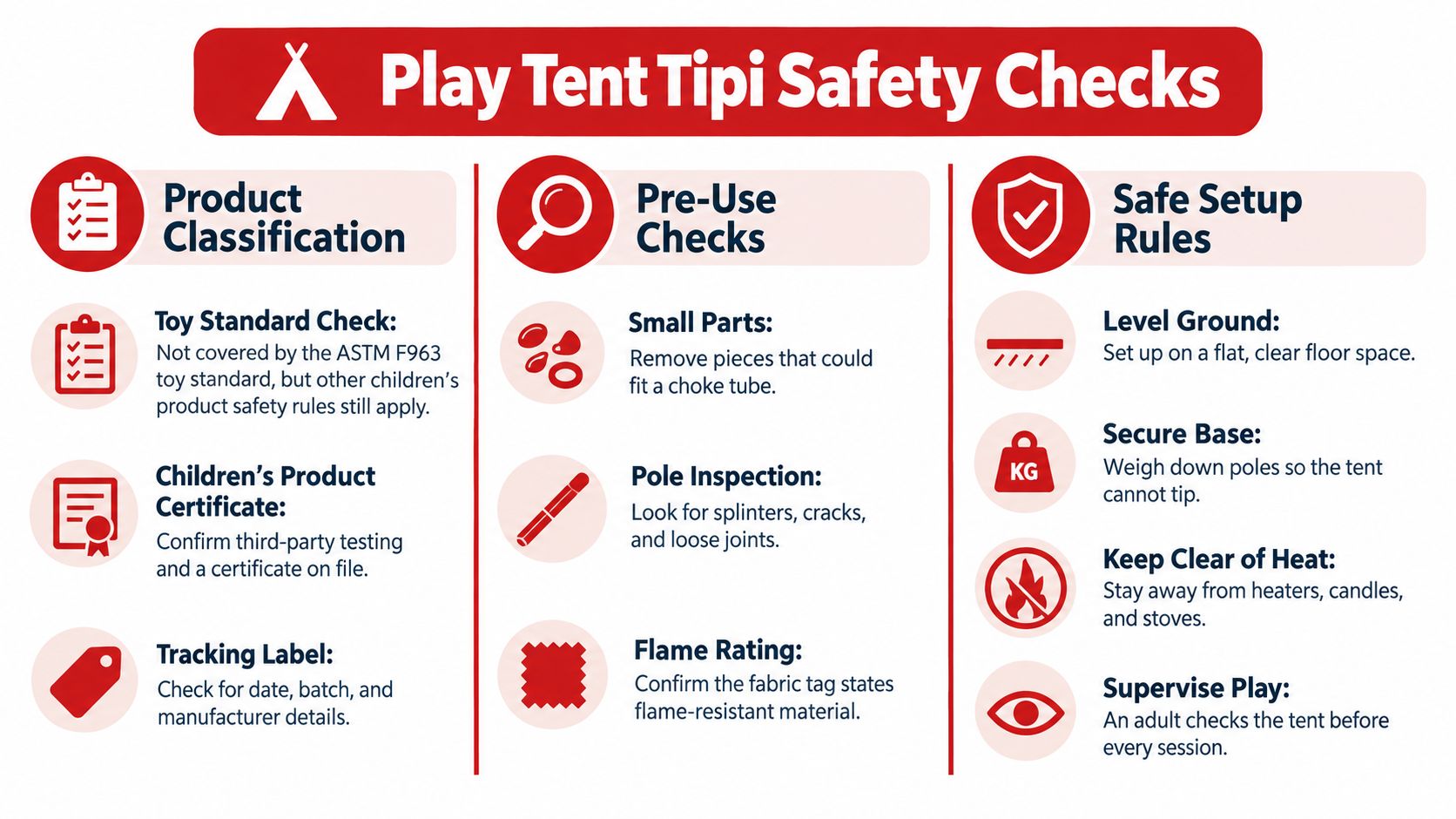
A play tipi is a supervised indoor space, not a toy that makes a room safe by itself. Check how the product is classified, inspect its parts, and choose a setup that leaves clear exits and keeps the child visible.
The CPSC explains that some sporting and camping equipment intended primarily for children 12 or under may fall outside the ASTM F963 toy standard, while other children's-product requirements can still apply. The classification depends on the product and how it is marketed, so don't treat age alone as a complete compliance check. Ask the seller what standards apply to this specific tipi and request supporting documentation. See the CPSC guidance on sporting and camping equipment.
Ask for the flammability test report, not just a “flame-resistant” label. The CPSC guidance names 16 CFR §1500.44, ASTM F963 Annex A5, and the voluntary CPAI-84 camping-tent protocol as possible routes, depending on intended use. Have the seller identify the applicable protocol in writing and provide the report for the fabric or finished product. If the seller cannot say what was tested, choose another tipi.
Use this play tent safety checklist infographic before play, then check your own model's instructions.
Flammability Without the Jargon
The CPSC ASTM F963 chart describes a flammable solid benchmark involving a material that ignites and sustains combustion at a rate greater than 2.5 mm/s along its major axis. Use that information as a reason to verify the relevant test, not as a substitute for checking which rule applies to the tipi. Skip fabric with loose fringe or paper-like trim, and keep every tipi away from candles, heaters, fireplaces, and cooking areas. In an enclosed space, heat and smoke can build quickly.
Watch a full setup before the first use. Then check that the instructions match the poles, seams, and ties on the product you bought.
Placement Rules That Prevent Most Problems
Health Canada's safety advice for specific toy types identifies trapping, suffocation, and strangulation risks associated with play tents. Set up the tipi with these rules in mind:
- Openings on multiple sides: Keep at least two ways for air and a child to move. Don't block openings with cushions.
- No long cords or loops: Remove ribbons, dangling ties, and light strings that a child could wrap around themselves or catch.
- Stable frame on flat ground: Set pole feet evenly, away from stairs, and test for rocking before play.
- Distance from heat: Keep fabric clear of radiators, stoves, fireplaces, and candles.
- Play only, not sleep: Don't use a play tipi as an overnight sleeping space.
The Fiberglass Recall Lesson
The CPSC's play tent recall listing shows why a damaged pole deserves immediate attention. Check the listing for the product and model you own. If your tipi is recalled, follow the notice's instructions and stop using it. Fiberglass damage can expose fibers that irritate skin or eyes, so don't let children handle suspect poles.
That does not make every fiberglass tipi defective. It does make inspection part of regular use.
Your Weekly Inspection Routine
Run your palm lightly along each pole. Stop using the tipi if you find splintering, fuzz, cracks, rough surfaces, or shedding. Check pole sleeves and connectors, where repeated friction can wear materials down.
After each takedown, inspect seams, stitched reinforcements, ties, and printed or coated fabric. If damage appears, stop using the tipi until you can confirm it remains safe. For broader guidance on checking children's products, read this toy safety guidance for children.
Practical rule: If the tipi sits beside a heater, under a dangling cord, or where you cannot see inside, the setup is not ready.
A cozy enclosure is not automatically safer or calmer. It reduces visibility and airflow, and camping-style language can make a play tent seem suitable for unsupervised sleeping. Judge the whole room: account for siblings, pets, nearby furniture, and whether the frame could collapse.
Play Value, Screen Time and Supervision by Age
A tipi is a play space, not a developmental treatment. Buy one for a child who enjoys pretend play, then set it up where you can supervise and where it will not replace active play.
In a study of elaborate pretend play, children used conventional toys and symbolic-play materials in different conditions. Their mean elaborate-pretend-play scores were 66.76 with conventional toys and 48.57 in the symbolic-play condition. The finding supports offering children concrete props, but it does not show that a tipi causes developmental gains.
Pretend play typically begins around 18 to 24 months. A review of research on pretend play found limited support for claims that pretend play is uniquely necessary for development, and no compelling evidence for some proposed problem-solving benefits. Guided play can help with particular learning outcomes, including early mathematics, shape knowledge, task switching, and spatial vocabulary.
A tipi gives children a defined place for play; an adult can add prompts, new words, and turn-taking while letting the child lead. Keep expectations realistic. The setting helps organize play, but the tent itself does not make a child smarter.
Screen-Time Substitution With Supervision
The American Academy of Pediatrics media guidance recommends limiting children ages 2 to 5 to no more than 1 hour per day of high-quality digital media. Offer the tipi as an activity when a child asks for a tablet. Keep the tent in a room where an adult can see and hear the child.
| Age | Screen-time guidance | Supervision for tipi play |
|---|---|---|
| Birth to 18 months | Avoid screen media except video chatting | Stay with the child; use the tipi only for supervised interaction |
| 18 to 24 months | If introducing media, choose high-quality content and watch it with the child | Stay with the child and keep play in view |
| 2 to 5 years | Limit high-quality media to 1 hour a day | Keep an adult in the room and the child visible |
| 6 years and older | Set consistent limits that protect sleep, physical activity, and other healthy behaviors | Set supervision and room rules to fit the child and space |
The ChildCare.gov guidance on learning through play supports learning through play; it does not provide the screen-time limits in this table. For ages 2 to 5, use the AAP recommendation above. For older children, set family rules around media rather than assuming a universal daily allowance. These practical ways to limit screen time can help make the switch to play part of a predictable routine.
Put a timer near the entrance if it helps your child stop and tidy up. When play ends, have the child leave the tipi and put away props, then check that the setup remains in good condition. Keep the space supervised rather than leaving it available as an unattended hiding place.
Play Ideas and Decorating for Each Age
Give each age one routine you can repeat. Repetition lets children extend a story instead of starting from zero every time.
Toddlers From 18 to 24 Months
Sit at the entrance where your child can see your face. Play peekaboo with the flap, then place two toy animals inside and name them slowly.
Read one board book together and let your child carry a soft animal in and out. You're building entry, exit, naming, and turn-taking, not a complicated plot.
Preschoolers Who Love Missions
Set a 20-minute camping mission. Your child packs a small backpack with a book, toy animals, a blanket, and drawing materials, crawls in, and tells you who's visiting the camp.
Add one simple task inside. Sort toys by color, count the animals entering, or arrange three picture cards in story order. Ask what happened first, then stop talking and let the child direct.
Early Primary Children
Use story sequencing with three cards, then draw a map of the journey on paper. Assign cooperative roles, such as guide, animal keeper, and person who keeps camp tidy.
Close with reflection. Ask, what would you change next time? A bear family moving to a mountain can run across three sessions, adding one prop and one new word each time. Ideas from fort building ideas for imaginative play can refresh the setting without buying new themed kits.
Let the child own the plot. Adults ask questions, supply one useful prop, and protect the ending time.
Decorating Rules
- Stickers only where fabric accepts them: Test one hidden spot so adhesive doesn't damage coating or leave residue near seams.
- No small parts for under-threes: Keep buttons, loose gems, and detachable decorations out of toddler sessions.
- Battery lights only with adult control: Use short, secured battery-operated lights with no trailing cords or loops.
- Nothing dangling within reach: Remove garlands, ribbons, and hanging ornaments children can pull down.
- No flame decorations: Never use candles, lanterns with real flame, incense, or sparklers in or near the tipi.
Decoration should never cover mesh, close a second opening, or hide pole damage. If a decoration makes inspection harder, it comes off.
Frequently Asked Questions About Play Tent Tipis
How Much Ventilation Is Enough
Use openings on at least two sides and keep mesh windows clear. Don't cover the tipi with a blanket or lid during play.
If the interior feels warm or stuffy, end the session and open every flap. Ventilation isn't fixed by a decorative top opening alone.
Can a Child Sleep in a Play Tent Tipi
No. Use it for supervised play, then move your child to a proper sleep space.
That rule applies even during a living-room campout. An adult staying nearby doesn't turn a play enclosure into a bed.
How Do You Fold and Store It
Dry fabric fully before packing. Store poles separately from fabric where the design allows, so rough pole ends don't abrade the walls.
Inspect each pole at every takedown. Storage is your easiest inspection moment because the frame is already in your hands.
How Do You Clean It
Spot clean fabric with mild soap and air-dry it completely. Wipe poles instead of soaking them, especially wood and connector joints.
Don't pack canvas while damp. Mildew is a storage problem you create in one rushed afternoon.
Is a Tipi a Learning Toy
No, not in the guaranteed-outcome sense sellers imply. It's a stable, object-rich space where guided pretend play can happen.
The setting supports the activity. Your prompts, props, supervision, and repetition decide whether that activity has learning value.
Confirm Your Pick Before You Buy
Run this one-line checklist against the exact model in your cart. If one item fails, don't rationalize it away with a discount.
- Measured child and size row: Height recorded and manufacturer dimensions checked.
- Flame-resistance statement: Named test in writing, not a vague safety slogan.
- Poles and recalls: Poles inspectable and model checked for current recalls.
- Cords and loops: Nothing long or dangling within a child's reach.
- Room placement: Flat, dry, clear square away from heat and stairs.
- Supervision plan: Adult role and session length chosen by age.
- No sleeping use: Every caregiver and gift recipient knows the rule.
Verdicts by Situation
Toddler at home. Buy a compact tipi with mesh windows and easy adult access. Keep sessions short and caregiver-led.
Preschooler at home. Use the 3-4 or 5-7 size row based on measured height and the room square you can clear. Run timer-based camping missions with books and toy animals ready inside.
Childcare setting. Choose the largest row that fits without blocking exits, keep a weekly inspection log, and name one staff member responsible for checks. Playz sells play tents alongside science kits and creative toys, which makes it one option to compare against other inspectable indoor models.
Gift buyer. Write the child's age band, no-sleep rule, and inspection reminder in the card. The parent may never read the product page, and the adult supervising daily use may not be you.
Measure the child tonight, tape the clear square on the floor, and reject any tipi that doesn't fit both. That's a better buying method than sorting by color, fringe, or a promise printed on the box.
Browse play tents, science kits, and creative toys built around active, screen-free play at Playz, then compare each tipi against your measured floor square and safety checklist. Pick the size you can supervise well, set it up away from heat, and plan your first 20-minute camping mission this week.