

In 65 of 67 countries and economies in the OECD's 2015 PISA analysis, boys treated science as a relative strength even when overall science scores were mixed. That pattern, reported in the OECD brief on girls and science careers, comes from 15-year-olds, not from eight-year-olds, and it does not prove that a toy changes a career path. It does show that subject identity is already taking shape well before high school.
STEM toys for 8 year olds work best when a child can use, test, and redesign them in more than one way. A box full of sensors is not automatically a better teacher than paper, tape, and a clear constraint. The useful question is whether the child still has to think.
Why Eight Is a Strong Age for Hands-On STEM Play
A U.S. study of 6- to 17-year-olds found that 49.1% had more than 2 hours of screen time a day, and 16.3% exceeded 4 hours. That age band is wide, so the figure describes a general gap, not your eight-year-old's exact day. A STEM toy is a way to trade some passive viewing for building and testing. It is not a promise of higher grades, and it should sit beside sleep, movement, reading, and time with other people. The case for hands-on learning is practice, not a score jump.
What changes around eight
Around eight, many children can follow a multi-step build, read a ruler or a timer, and hold two ideas in mind for a short test. They also bounce back from a first failure more often than they did a year earlier.
Say a tower falls. A seven-year-old may push the pieces away. An eight-year-old can measure the weak joint, change one support, and try again. That recovery is the skill you are buying.
Practical rule: A strong toy at this age invites a prediction, allows repeated tests, and ends with an explanation in the child's own words.
The checks below cover categories, design, safety, sample sessions, and how a kit fits a balanced week.
STEM Toy Categories at a Glance for Age Eight
Start with the row that matches a question your child already asks. Use the last column as a filter before you look at price or piece count.
| Category | Core Skill Practiced | Typical Age-8 Challenge | Check Before Buying |
|---|---|---|---|
| Coding (block-based or tangible) | Sequencing, loops, debugging | Program a character through a maze in 5 to 8 commands, then fix one wrong turn | Does it run offline and explain each command? |
| Engineering and building | Design cycle, load, stability, measurement | Build a bridge that holds a set load using a limited number of pieces | Are there at least two valid solutions and spare parts? |
| Chemistry and science kits | Variables, observation, controlled reactions | Test how water temperature changes dissolving speed over three trials | Are ingredients labeled and are adult-only steps marked? |
| Robotics | Sensors, motors, mechanical design | Tune a vehicle's turn angle by changing its code or gear setup | Are parts compatible and batteries easy to reach? |
| Electronics and circuits | Current, switches, series and parallel paths | Light an LED using two different circuit paths | Are wires insulated and connectors snap-type? |
One challenge per row
Coding: The child lays five to eight commands to move a character through a maze, then finds the one wrong turn. Offline play matters when you want the logic, not another app. A short guide to robotics kits for beginners helps if motors come later.
Engineering: A bridge must hold a small load with a capped number of pieces. Two different shapes that both work beat one picture on the box.
Chemistry: The child times how fast sugar dissolves in cold, room-temperature, and warm water across three trials. An adult handles any heat.
Robotics: The child changes motor code or a gear so a vehicle's turn angle gets closer to a taped line on the floor.
Circuits: Snap connectors and an LED lit two ways, series and parallel, are a calmer start than loose wire and a soldering iron.
A child who loves stacking may learn more from a general construction set than from a narrow kit. Curiosity keeps practice going longer than a new gadget does.
How to Spot a Kit That Teaches Real Thinking
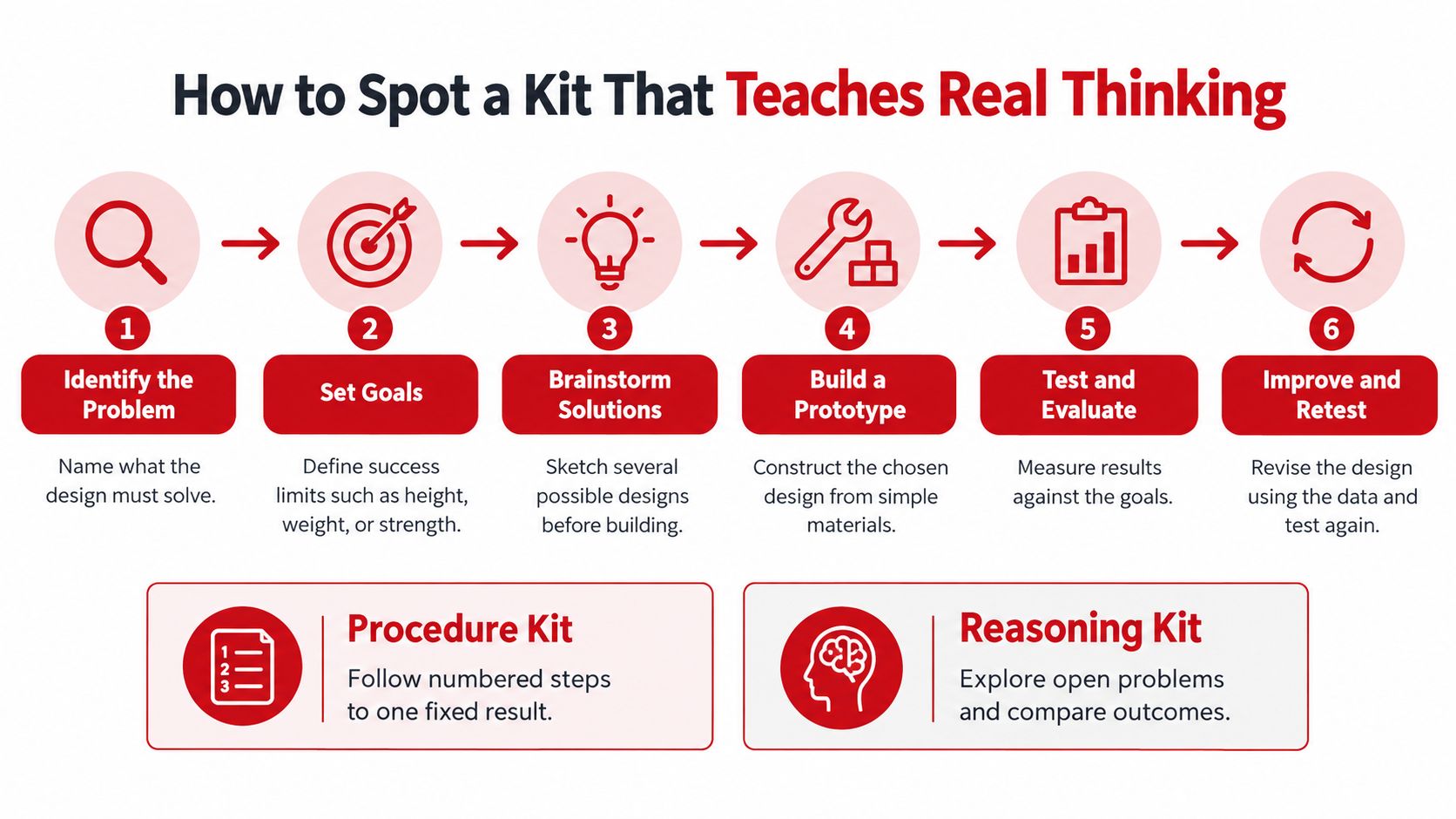
A procedure kit ends when the model matches the photo. A reasoning kit ends when the child can say what failed and what to change.
The National Academies describe engineering design as a repeatable cycle: identify a problem, define goals and constraints, generate and analyze solutions, build, test, evaluate, iterate, and communicate. The same report notes that elementary students significantly improved their understanding of light properties, including reflection, transmission, and absorption, after a design unit.
Constraints do the teaching. A load limit or a short parts list forces a trade-off. A test then shows the failure, and that failure becomes evidence for the next version.
| Design Feature | Strong Sign | Weak Sign |
|---|---|---|
| Open-ended goal | Several valid solutions to one challenge | One picture-by-picture build with one correct result |
| Replacement parts | Spare pieces for at least two redesigns | Exact parts only, with nothing to spare |
| Measurable result | Distance, height, load or time to compare trials | Success judged by whether the model looks right |
| Visible variables | Changing one input changes the outcome | Results fixed in advance by the design |
| Thinking prompts | Asks for predictions and recorded results | Only step-by-step instructions |
| Household materials | Works with cups, tape, string or paper | Needs a proprietary app for each step |
Open-ended goals and spare parts support brainstorming and a second build. A measurable result and a visible variable support the test stage. Prompts support the explanation. Household materials keep the challenge alive after the branded pieces run out.
An observational study of 60 preschool-aged children, discussed in The Conversation, found that everyday open-ended materials prompted longer play and more STEM-related behaviors than single-purpose toys. Those children were preschoolers, so this supports a principle, not an age-eight rule.
Could my child use this toy in a second way?
Electronic kits can pass if the child still predicts, changes one main variable, collects at least three observations, and explains the result. If the app does that thinking, the kit is entertainment with a STEM label.
Safety and Durability Checks Before You Buy
Age eight on the box is not a safety check. Read the standard, the battery door, and the chemistry notes before you pay.
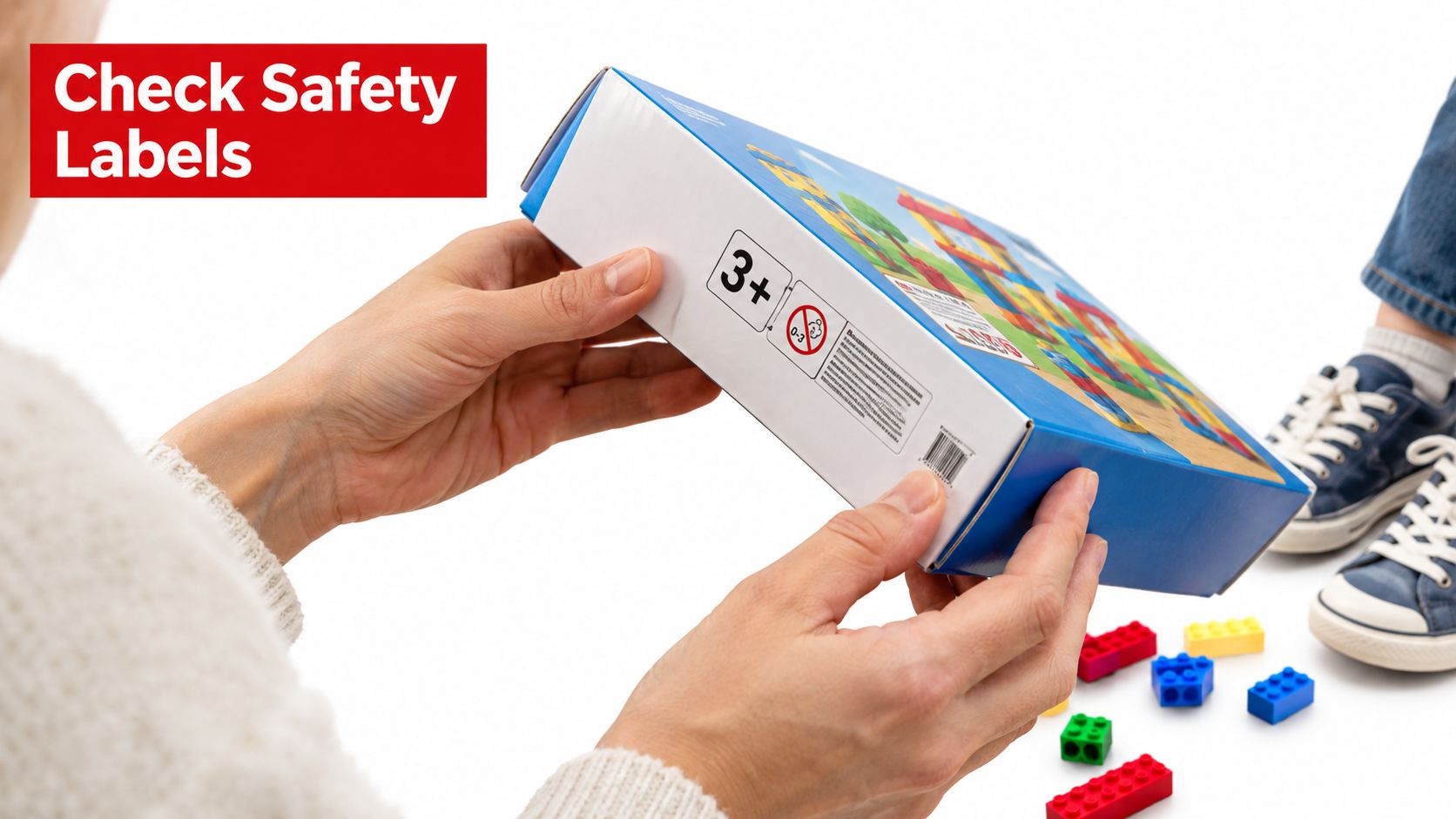
In the United States, toy packaging should state compliance with ASTM F963, the toy safety standard required under federal law. Products sold in Europe should show CE marking. A deeper look at toy safety for children is worth five minutes before a birthday order.
| Check | What to Look For | Red Flag |
|---|---|---|
| Certification | ASTM F963 named for U.S. toys, or CE marking for products sold in Europe | No safety standard named anywhere on the listing |
| Chemistry kits | Labeled ingredients, eye protection, adult-only steps marked | Unlabeled substances or no supervision guidance |
| Battery compartment | Screw-secured or child-resistant door | Snap-open door reachable by a child |
| Small parts | Choking warning and storage for pieces under 3 years | Tiny parts in a kit shared with a toddler |
| Build quality | Sturdy plastic or metal joints and gears | Thin gears or parts that bend under light pressure |
| Replacement parts | Spares listed and sold by the brand | No spare parts or support contact available |
Chemistry, batteries, and wear
Chemistry kits for this age should list every ingredient, include or recommend eye protection, and mark heating, acid, or base steps for an adult. Button-cell compartments should need a screwdriver or a child-resistant latch. A swallowed button cell can cause serious injury in a short time.
Small-parts warnings target children under three. An eight-year-old can handle gears. A toddler who shares the rug cannot. Store loose pieces in a lidded bin.
A robot whose motor gear strips after two weeks is a durability failure, even if the first build was fun. A brand that sells replacement gears is more likely to stay in the rotation. If the child uses a kit most days, check moving parts and battery doors once a month.
Sample Play Plans for Engineering, Coding and Chemistry
Object play lets children test materials with their hands. The American Academy of Pediatrics notes that this kind of play supports planning, language, mathematics, and emotional regulation. The U.S. Administration for Children and Families ties play to exploration, cause-and-effect reasoning, and critical thinking.
Each session below runs 45 to 60 minutes. Rotate four roles: builder, tester, recorder, and presenter. Ask "What changed?" and "What evidence supports that?" Do not hand over the fix.
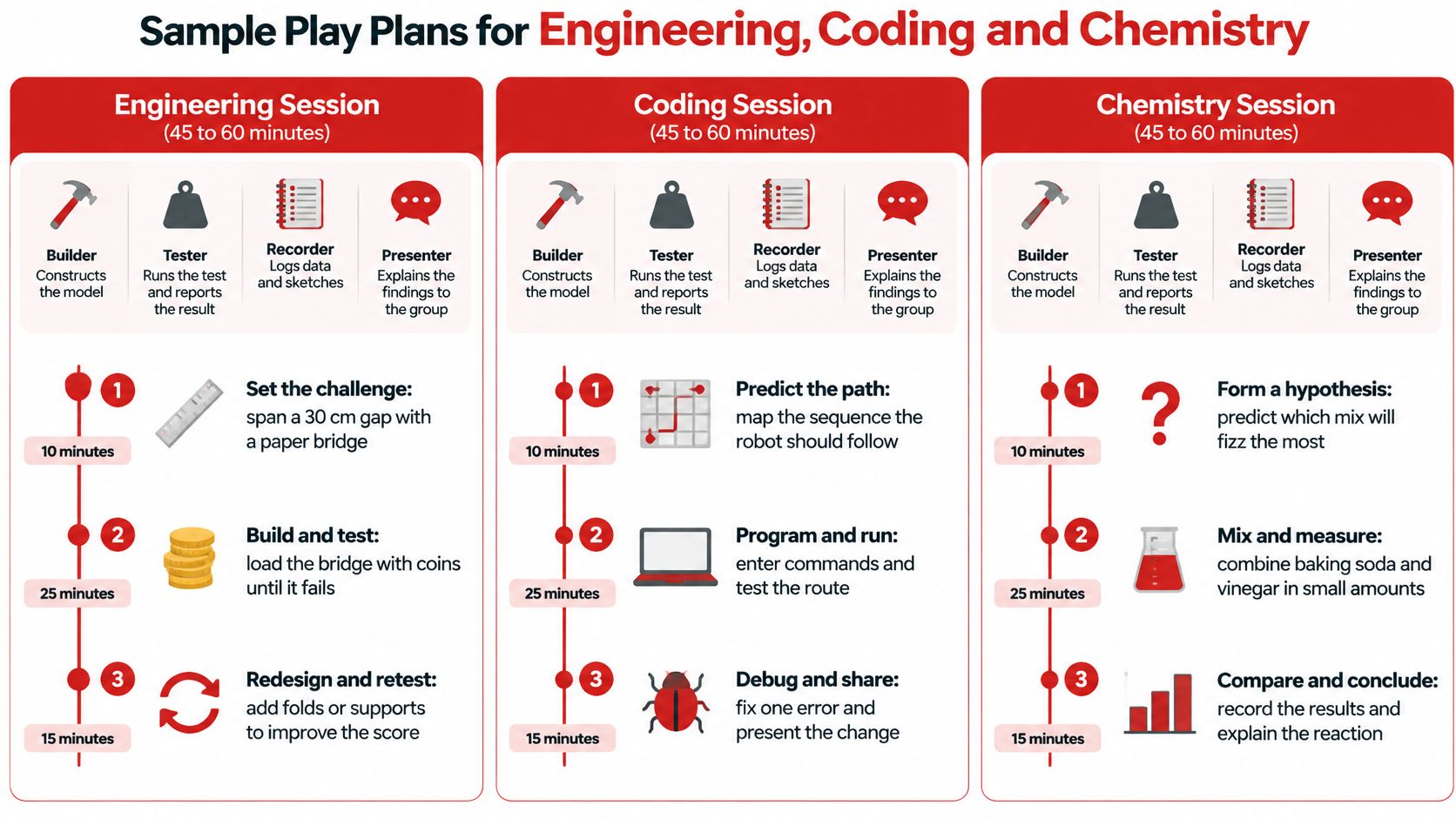
Engineering session
- Span a 30 cm gap with a paper bridge that holds a stack of coins.
- Ask which shape will hold the most, and have the child write the guess.
- Build two designs with only paper and tape.
- Add coins one at a time and record the load.
- Change one variable, such as fold depth.
- Explain the failure point in two sentences.
Step 2 matters because a written prediction turns a building game into a claim you can test. A flat sheet and a folded sheet make the variable obvious.
Coding and chemistry sessions
For coding, skip the screen. The child writes a 10-step route for a partner walking as the character, then finds and fixes one wrong command. That is the same debugging habit as a first coding lesson, without a login.
For chemistry, dissolve sugar in cold, room-temperature, and warm water. Time three trials and chart them. An adult handles any heating. One temperature change at a time keeps the comparison fair.
A four-week run can go engineering, coding, chemistry, then a combined project that reuses one kit's parts for a new challenge.
A short build-and-test demo helps if you want to see the pace before you host the first session.
Fitting STEM Play Into a Balanced Week
Pediatric experts at Children's Hospital Los Angeles emphasize 9 to 12 hours of sleep and more than one hour of physical activity each day for children ages 5 to 12, plus unstructured play. A kit that eats bedtime or replaces a bike ride is not educational, no matter how many science words are on the lid.
Current AAP screen-time guidance does not set one daily number for every school-aged child. Families are asked to judge whether media crowds out sleep, movement, or time together. Many households still use an older 2-hour cap on noneducational screen use as a reference point while they write their own plan. Ideas for how to limit screen time pair well with a building block on the calendar.
| Daily Benchmark | Recommended Level | How to Use It |
|---|---|---|
| Sleep | 9 to 12 hours a night | Protect bedtime before adding any STEM session |
| Physical activity | More than 1 hour a day | Schedule building after movement, not instead of it |
| Unstructured play | Daily, without adult direction | Keep one open block free for self-led play |
| Recreational screen time | No fixed number for school-aged children; earlier AAP guidance was 2 hours | Set limits with the child using a Family Media Plan |
| Screen-free times | Mealtimes and one technology-free evening | Pair with a building or experiment challenge |
A sample week
Try 30 minutes of building after homework on weekdays, a 60-minute family build on Saturday, and one technology-free evening. Use the AAP Family Media Plan so the child helps set those limits.
After a tower test, ask "What would you change?" before anyone reaches for a tablet. The toy should add movement and talk, not replace them. Boredom between sessions is useful. It is often when a child invents the next challenge.
Frequently Asked Questions About STEM Toys for 8 Year Olds
Is an electronic kit better than a building set?
The best choice is the one an eight-year-old can use in different ways. Everyday open-ended materials held children's attention longer and prompted more STEM behaviors in observational work than single-purpose toys. Apply that idea to electronic kits too: can your child change the design, test what happens, and try again?
Will this improve grades?
A review of guided-play research found advantages over direct instruction for some early mathematics outcomes and spatial vocabulary, with no difference for several other outcomes. A toy can offer practice with a specific skill, such as comparing shapes or following a sequence. It cannot promise a report-card result.
How much help should I give?
Ask what changed and what evidence supports the next try. If a bridge tilts, for example, ask which part moved before suggesting a fix. Let the child attempt a solution first. Giving the answer at the first wobble teaches waiting, not design.
What if my child loses interest after one kit?
A kit can still be useful when its pieces invite a new challenge. Rotate categories every few weeks and connect the next kit to a question your child asks. Keep one free-play block each week, so parts can be combined and tested without a worksheet.
Offer the same challenges to every child, guided by interest rather than the color of the box. Judge a toy by the ways a child can use, test, and redesign it, not by how much technology it contains.
Choose Your First STEM Toy This Week
Start with the child's question, then choose a kit that lets them test more than one answer. Match curiosity. Coding suits children who enjoy rules and puzzles; engineering, builders; chemistry, experimenters; and robotics, tinkerers curious about moving motors.
Check the design. Look for several possible solutions, spare parts, and a variable the child can change and observe. A simple test: can they alter one part and see what happens?
Check safety. Look for a named certification, a secure battery door, labeled chemicals where relevant, and a way to buy replacement parts.
For a first STEM toy, an open-ended building or science kit gives children room to try, adjust, and try again. A kit used for challenges over four weeks may offer more chances to redesign than an expensive box left unopened. Try one kit for two weeks before adding a subscription or another set.
Playz offers science kits, building models, and creative toys centered on hands-on play. Choose the category that fits the child's question, then check one option against the design and safety criteria this week. Visit Playz and choose a first challenge the child can test and redesign.