

It's 2 p.m. in a classroom and attention has drifted. Pencils tap, chairs tip, and the wiggles have taken over. A two-minute tape-line walk resets the room in a way no worksheet can, because children have to slow down, look ahead, and control every step.
That's the logic behind these balance activities for kids, arranged as a progression ladder from floor-based, zero-equipment games to wobble-board work. Each rung gives you a setup recipe, a way to make it easier, a way to make it harder, and the setting it suits best, so you can build a routine instead of hunting for one-off games.
Balance play also counts toward daily movement. The World Health Organization physical activity fact sheet recommends that children and adolescents aged 5 to 17 average at least 60 minutes of moderate-to-vigorous physical activity per day across the week. Short balance bouts won't replace running, climbing, or jumping, but they fit neatly alongside them.
If your child wants a more structured class after home practice, a parent's guide to kids' Jiu Jitsu is worth reading for another route into coordination and confidence. At home and school, start low, stay close, and only add height or wobble when the flat version looks easy.
1. Balance Beam Walk
Start here. Put a strip of painter's tape on the floor, about as long as a hallway rug, and ask children to walk it heel to toe with arms out like airplane wings. It looks too simple, but the narrow base forces constant ankle and core corrections.
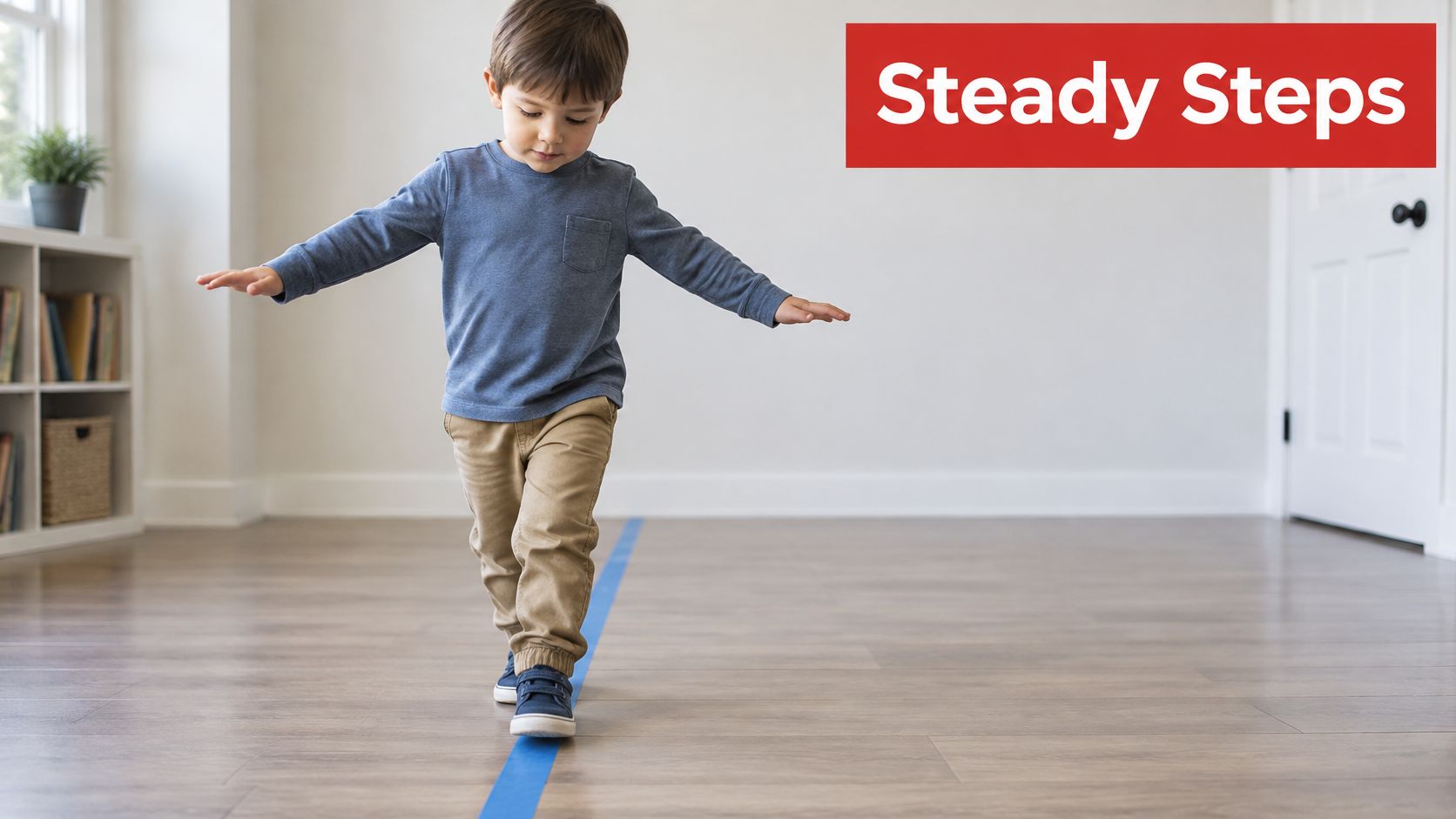
The federal Physical Activity Guidelines describe balance training as static or dynamic exercise designed to help a person resist forces that could cause a loss of balance, with examples including walking heel-to-toe and walking backward. A tape line lets you practice both without any fall height.
Setup and Progression
- Make it easier: Use two parallel tape lines as a wide path, and let a child hold your hand or trail fingertips along a wall.
- Standard version: Walk forward slowly, turn at the end, then walk back sideways with small shuffle steps.
- Make it harder: Carry a beanbag on the head, walk backward with an adult spotting, or say the alphabet while walking.
A typical preschool version works well. Children cross the carpet line carrying a beanbag, drop it in a basket, and sidestep back. The trade-off is queueing. With a big class, lay three lines or you'll spend more time managing the line than balancing on it.
Practical rule: If a child rushes, the task is too easy or too exciting. Slow the walk down before you narrow the line.
Best setting: Home, classroom, and childcare. It's quiet, cheap, and easy to peel up. Physical therapists also use beam-style walking for gait work, but at home, keep any real beam low, wide, and fully supervised with clutter cleared away.
2. Kids' Yoga Poses for Balance
Some children won't do a drill, but they'll happily become a tree. That's why yoga works. Tree, Airplane, and Flamingo all ask a child to stand on one leg, find a fixed spot to look at, and hold still while breathing.
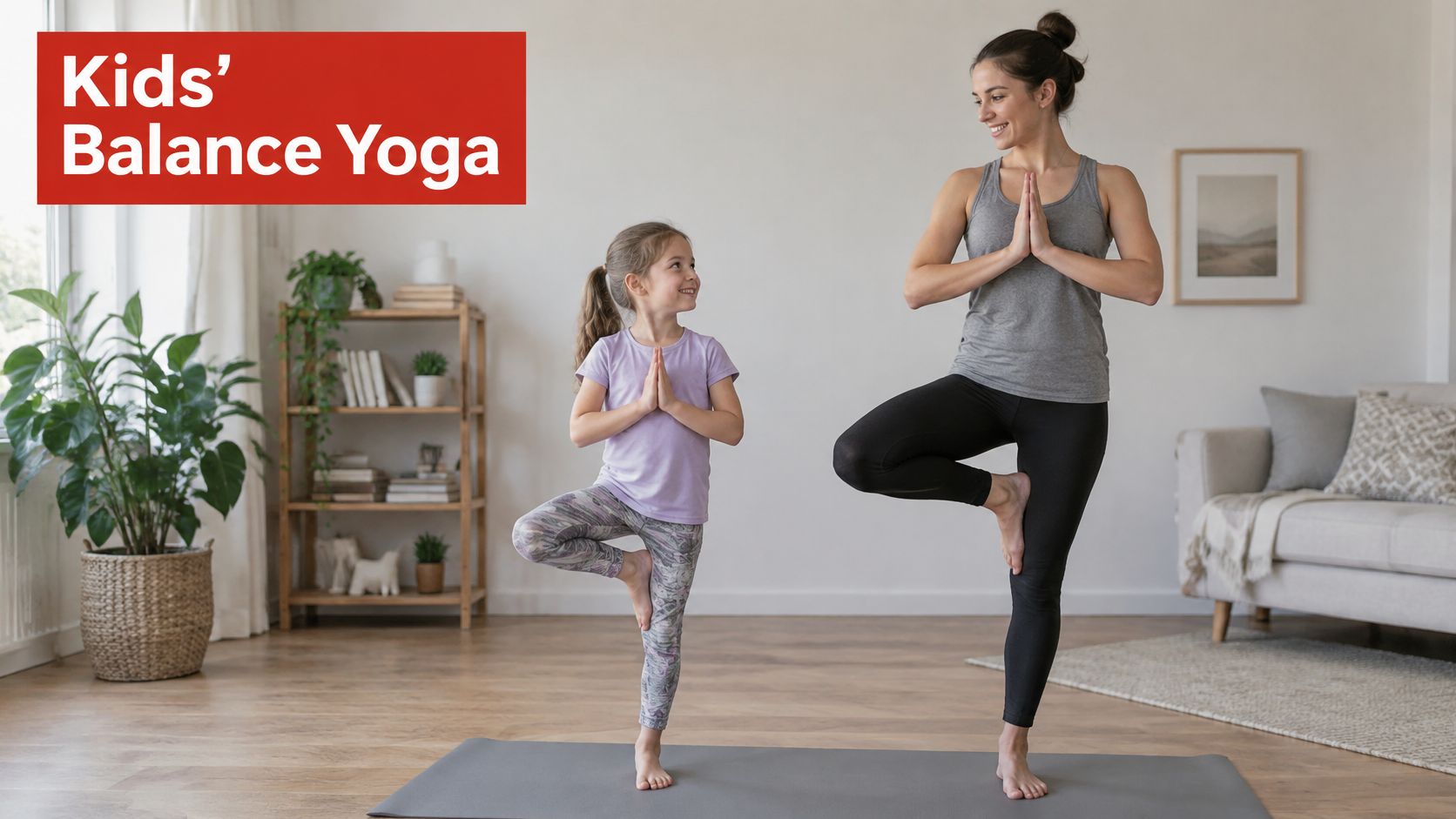
The CDC identifies standing on one foot as an example of an activity that improves balance in its physical activity framework graphic. You can measure it without turning it into a test. Count breaths, switch sides, and note whether the wobbles get smaller over a week.
Cosmic Kids Yoga, created by Jaime Amor, wraps poses in animated adventures, which helps children who lose interest in plain instruction. In class, a morning Tree Pose Challenge works the same way. Everyone grows roots, raises branches, and counts slowly together.
How to Run a Short Session
Start beside a wall or chair. Young children can hold on, then lift one hand, then both when they're ready. Aim for 5 to 10 breaths per pose, and celebrate effort over perfect stillness, because a wobbling tree is still doing the work.
- Make it easier: Keep the lifted foot low against the ankle and keep a chair within reach.
- Make it harder: Close the eyes only with close supervision, reach the arms overhead, or sway the branches gently in the wind.
For rainy days, pair this with other indoor gross motor activities for small spaces so calm poses alternate with bigger movement. The trade-off is energy level. Yoga settles a group, but it won't satisfy children who urgently need to run.
Best setting: Classroom mornings, home wind-down time, and childcare transitions. It needs floor space, not equipment.
3. Animal Walks Obstacle Course
Bear crawl to the cone. Crab walk to the hoop. Frog hop home. Animal walks shift weight across hands, feet, knees, and seat, so balance changes constantly instead of settling into one pose.
This video shows the basic movement shapes before you build them into a course:
Set up a living room jungle with pillows as habitats, or run an Animal Safari at camp between cones and hoops. Demonstrate first, because crab walk confuses almost everyone the first time. Children need to see hips lifted and fingers pointing behind them.
Gross motor variety matters at this age. A 2024 BMC Pediatrics study of 84 children aged 3 to 6 reported a mean balance-quality score of 81.01 out of 100 while examining activities linked to agility and balance. Don't chase a score at home. Use it as a reminder that balance sits inside broader movement, not apart from it.
Course Recipe
- Station 1: Bear crawl around two cushions, knees off the floor if possible.
- Station 2: Duck waddle under a pool noodle held low by an adult, staying in a squat.
- Station 3: Frog hop between floor markers, landing with both feet and pausing before the next hop.
Make it easier by shortening distances and putting soft mats under hands and knees. Make it harder by adding a direction change or asking children to carry a beanbag to the next habitat without dropping it.
The honest downside is fatigue. Bear crawls tire shoulders fast, so rotate animals each round and keep turns short. Best setting: Active recess, PE relays, and home play where furniture can move aside.
4. Classic Hopscotch
Chalk, a flat beanbag, and a grid of squares. Hopscotch has survived for generations because the rules teach themselves. Hop on one foot, land on two, turn, and come back without stepping on a line.
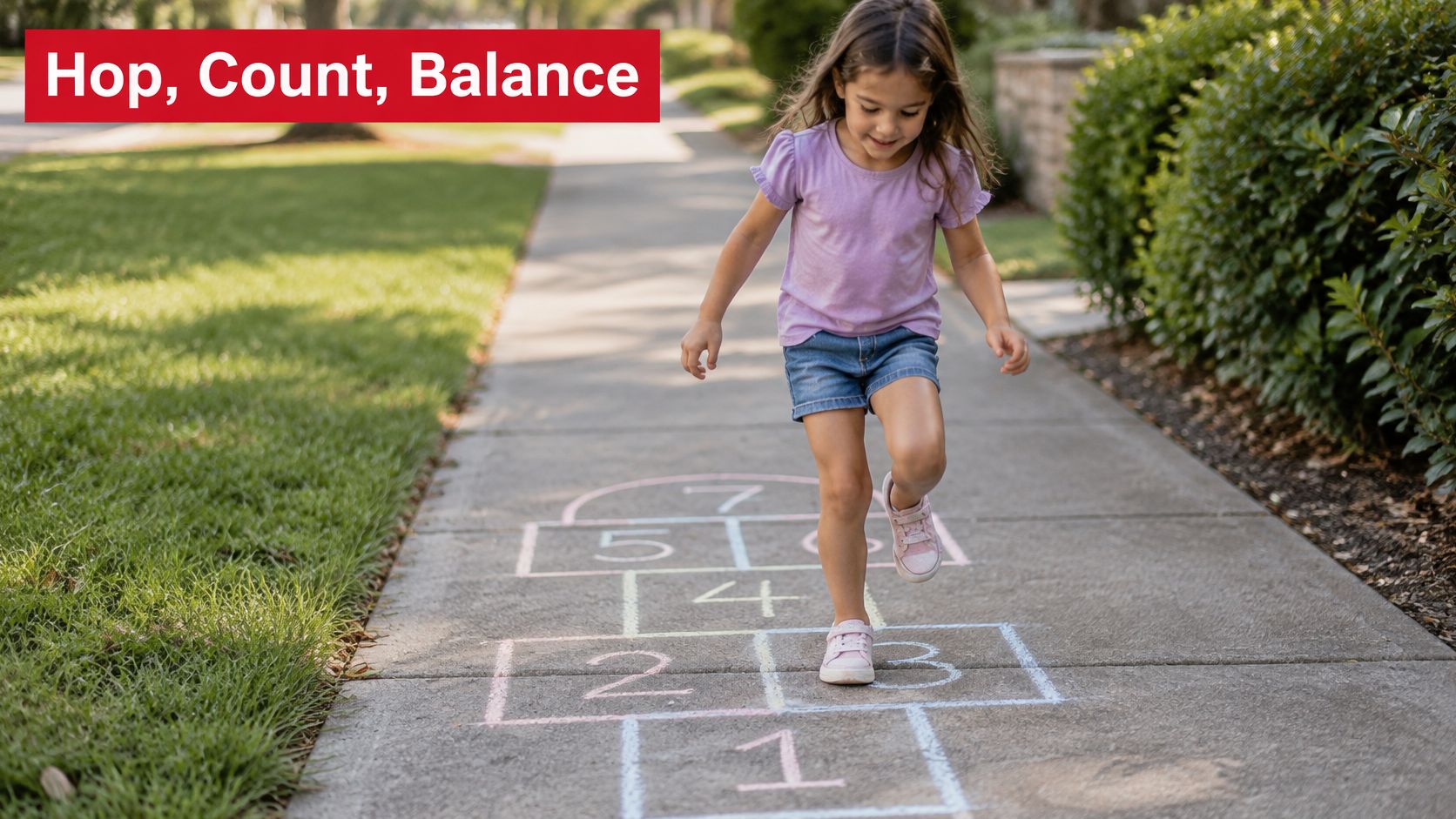
Age scaling matters here. The CDC developmental milestones list hopping on one foot as a movement milestone by age 5, and milestones are skills that at least 75% of children can do by a specified age. A three-year-old who two-foot jumps through the grid isn't failing. She's playing the version her body is ready for.
Draw 6 to 10 squares for younger children and number them clearly. Early-years teachers often use the grid to practice counting from 1 to 10, while schools paint permanent grids to encourage active recess. Giant versions at street festivals work for mixed ages because older children can hop farther patterns.
Easier and Harder Versions
- Make it easier: Allow two-foot jumps everywhere and skip the beanbag toss.
- Standard version: Toss the beanbag, hop the course, pick it up on the way back while balancing.
- Make it harder: Let children design their own pattern with diagonal squares or a spin at the top.
Play on grass or a softer surface when you can, especially for beginners who land heavily. Pair this with other games to play at a park and you've got a full outdoor session with almost no gear.
Best setting: Playground, sidewalk, and active recess. The trade-off is weather and hard ground, so keep an indoor tape version as backup.
5. Freeze Dance and Statue Challenge
Play music. Everyone dances. Stop the music and shout flamingo. Every child has to brake, find one foot, and hold still while giggling.
That stop is the balance work. Children must control momentum, tighten up, and recover without toppling into a neighbor. Because the rules take ten seconds to explain, kindergarten teachers use freeze games between lessons, birthday hosts run statue contests, and occupational therapy sessions use them to practice stopping safely.
You don't need formal drills to get value here. A 2025 meta-analysis in BMC Public Health found no significant difference between active play and skill-oriented physical education for balance or overall fundamental movement skills. Enjoyable, varied play that makes children stop, turn, and recover is defensible practice, not a lesser substitute.
Running It Without Chaos
Use a no-elimination format so nobody sits out for wobbling. Clear sharp corners first, spread children out, and pause at unpredictable moments to build attention. If you need instruments or shakers for the dance breaks, these music toys for toddlers give younger children something to hold, though hands-free is better for the freeze itself.
Call the pose before you restart the music, not during the scramble. Children balance better when they know what shape they're hunting for.
Make it easier with two-foot statues like star or tree with both feet down. Make it harder by calling one-leg poses, adding a slow count to five, or asking for statues on tiptoe.
Best setting: Classroom brain breaks and home parties. It's loud and joyful, so it doesn't suit a quiet wind-down. Pick your moment.
6. Wobble Board and Balance Board Play
A wobble board is the most demanding rung in this balance progression. Its tilting surface asks children to make small corrections through the ankles, knees, hips, and core. A child who manages a tape line easily may need to slow down and focus here. Treat board work as one tool in a varied routine: balance training in general has measurable effects, and a systematic review and meta-analysis of 22 trials reported effects on static and functional balance in children with developmental disorders.
Safe Starting Point
Choose a wide, low board and set it on carpet or a mat. Stay close enough to help if your child loses balance.
- First attempts: Stand with both feet on the board, hold a wall or an adult's hands, and try for 10 to 20 seconds.
- Next step: Shift weight slowly from side to side. Keep the board's edge from banging against the floor.
- Make it harder: Add a light ball toss or count backward while balancing.
- Make it easier: Sit on the board and rock gently, or kneel with hands down.
The trade-off is that a board takes more space and costs more than floor games, while needing close supervision. Home practice works best when an adult can stay nearby. A supervised school circuit can also suit board work, with turns kept orderly and the board placed on a stable surface.
For children interested in trying wheels later, read the first-board advice from Blitz Surf Shop. For indoor play ideas, browse gross motor toys for active play. A low, wide balance board is a more suitable starting point than a dramatic, highly tilting one.
7. Stepping Stone Obstacle Course
The floor is lava. You already know this game, but the balance value sits in the pause between steps. A child lands on a foam pad, steadies, plans the next foot placement, and shifts weight without touching down.
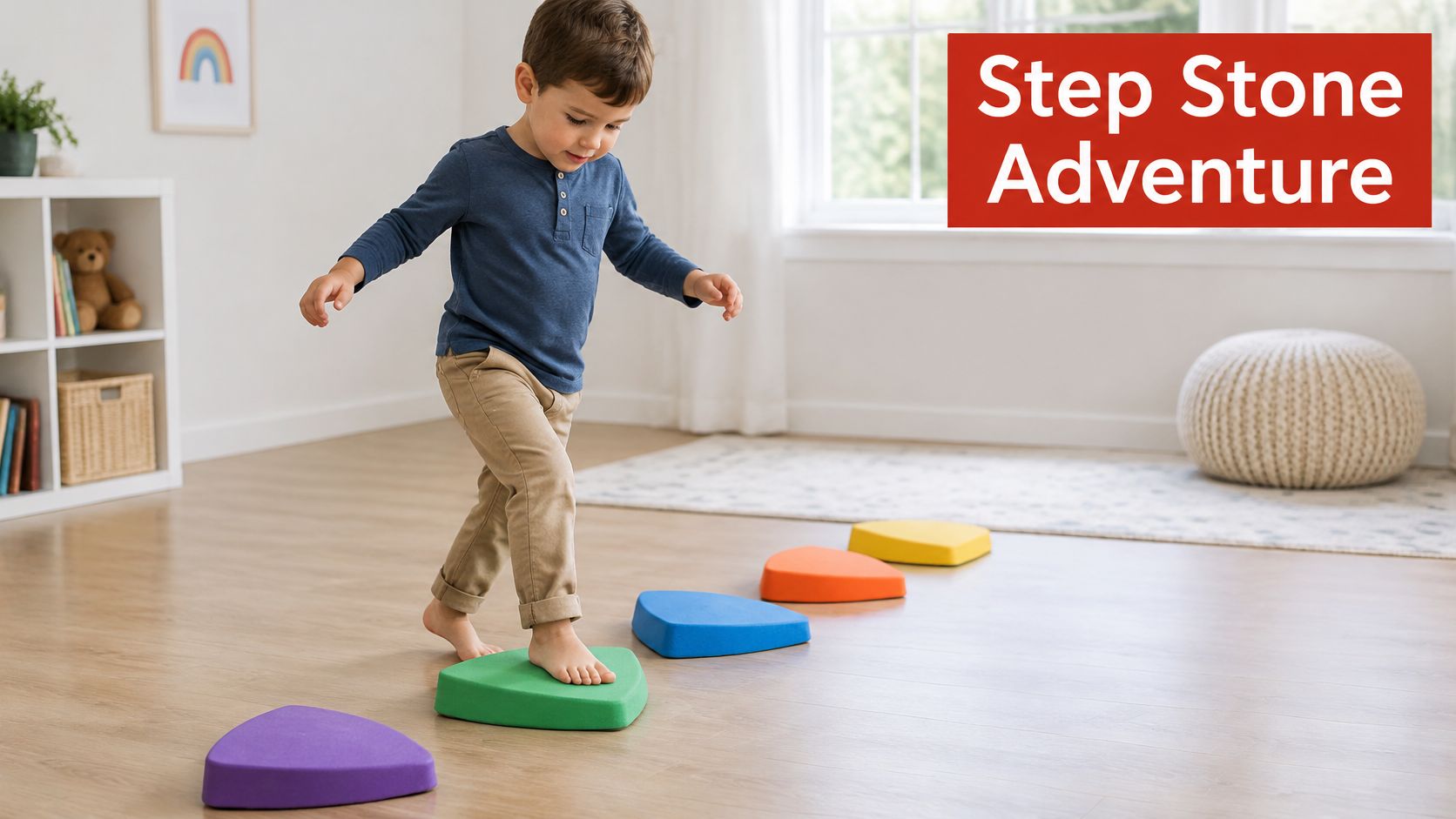
Use foam squares, floor tiles, or flat cushions. Tape them down or put non-slip mats underneath, because a sliding stone teaches fear, not balance. Start with three pads close together and build toward a full room crossing.
Short bouts like this suit younger children well. WHO guidance for young children recommends at least 180 minutes of varied physical activity daily for ages 1 to 4. A river crossing before breakfast, again after lunch, fits that spread-out pattern better than one long session.
Ways to Play It
Preschool teachers label colored squares with numbers, so children count while crossing the river. Occupational therapy clinics use the same setup for motor planning. At home, call a color sequence and let children step only on matching stones.
- Make it easier: Place stones in a straight line with small gaps and allow a handhold.
- Make it harder: Widen gaps, add a turn, or carry a small object across without dropping it.
Let children design the next course. They'll usually make it harder than you would, then negotiate it back to possible. For more layouts, these indoor obstacle course ideas combine stones with tunnels and tape lines.
Best setting: Living room, preschool, and rainy-day recess. It's endlessly rebuildable, which is its strength. The weakness is setup time, so keep pads in one basket.
8. Balance Challenges with Everyday Objects
Put a beanbag on your head and walk to the kitchen. Carry a ball on a spoon. Balance a paperback on your shoulders and follow the hallway path. Adding an object turns plain walking into a dual task, where attention splits and balance has to run in the background, just like real life.
Inclusive versions matter most in this category. A review of motor-skill interventions in the Journal of Intellectual Disability Research found that interventions improved balance in children and adolescents with intellectual disabilities, while noting the evidence base was small and methodologically limited. In practice, that means you should individualize. Wider paths, handholds, visual cues, partner help, and seated options let every child join without turning play into therapy or a contest.
Three Reliable Versions
- Spoon Race: Walk a clear path carrying a ball on a spoon, slowly at first, with a soft ball indoors.
- Book Walk: Balance a light book or beanbag on the head and follow a taped route around one chair.
- Balance Relay: Carry a plastic cup with a little water outside, pass it to a partner, and walk back. Expect spills and plan for them.
Make it easier by using a beanbag instead of a ball, since it doesn't roll away, and shortening the path. Make it harder by adding a gentle turn, a second object, or a counting task on the way.
What I recommend: Choose soft, lightweight objects and judge success by a slower, steadier walk, not by speed. Races undo the control you're trying to build.
Best setting: Home and classroom group play. It costs nothing and scales to any group size. The trade-off is dropped objects everywhere, so keep the path clear and the finish line obvious.
How the 8 Balance Activities Compare at a Glance
| Item | Equipment Needed | Best Setting | Main Skill Built | Difficulty |
|---|---|---|---|---|
| Balance Beam Walk | Tape, rope, plank, or low beam | Home, classroom, or childcare space | Balance and posture | Adjustable |
| Kids' Yoga Poses for Balance | Optional mat | Indoor group or home setting | Static balance and body awareness | Beginner-friendly |
| Animal Walks Obstacle Course | Open floor space; optional soft mats | Yard, gym, or living room | Coordination and core strength | Adjustable |
| Classic Hopscotch | Sidewalk chalk or floor tape; optional beanbag or stone | Playground or large indoor area | Single-leg balance and timing | Adjustable |
| Freeze Dance and Statue Challenge | Music and open space | Classroom, party, or indoor play area | Balance, listening, and self-control | Beginner-friendly |
| Wobble Board and Balance Board Play | Child-sized wobble or balance board; mat or carpet | Supervised home, therapy, or sports setting | Dynamic balance and ankle stability | Advanced |
| Stepping Stone Obstacle Course | Foam pads, cardboard shapes, tiles, or cushions | Home, classroom, or therapy space | Foot placement and spatial awareness | Adjustable |
| Balance Challenges with Everyday Objects | Beanbag, spoon, book, ball, or plastic cup | Home or classroom | Focus and coordination | Adjustable |
Start Small Tomorrow and Build a Balance Routine That Sticks
Pick one floor-based activity tomorrow. A tape-line walk before breakfast or a freeze dance round after school is enough to start. Run it at the same time each day, because routine does the heavy lifting when motivation dips.
Keep the dose small and repeated. For ages 3 to 5, the CDC physical activity guidelines recommend physical activity throughout the day rather than one fixed workout. Two short rounds while dinner cooks will beat one ambitious weekend session that everyone dreads by week two.
How to Know When to Move Up a Rung
Watch for observable signs, not a calendar. A child holds a pose longer, recovers from a wobble without grabbing furniture, or crosses varied surfaces without looking at her feet the whole way. When the group looks bored and steady, move up one step on the ladder.
- Stay on the rung: Children still need a handhold, rush to finish, or avoid the activity.
- Move up one rung: Children slow down on purpose, switch sides willingly, and ask for a harder version.
- Step back down: Falls increase, shoulders hunch with effort, or the game stops being fun.
Don't promise a timeline. One small study in Frontiers in Psychology randomly assigned 24 healthy children aged 3 to 6 to experimental and control groups for 12 weeks of gymnastics, which shows researchers think in weeks, not days. Your home routine should think the same way.
If a child misses movement skills you'd expect, loses a skill she once had, or you feel a persistent worry, talk to a healthcare professional instead of comparing her with siblings or classmates. Balance play is practice and observation. It isn't a diagnostic test, and it shouldn't feel like one to the child.
Build the week from the ladder. Floor lines and statues on busy days, stepping stones and animal walks when you have space, a board only when an adult can spot properly. Rotate settings too, since a skill that only works on your carpet isn't finished yet.
Share your favorite version with your class, your family group chat, or the teacher next door, and swap variations when one game goes stale. If you want ready-made active play gear to support the routine, Playz offers play tents, science kits, and creative toys you can fold into obstacle courses and movement corners. Keep it playful, keep it brief, and keep going, because kids learn best through play.
Visit Playz to explore play tents, science kits, and creative toys that turn balance practice into active, screen-light play at home or in the classroom. Pick one activity from this ladder, set it up tomorrow, and let your child wobble, recover, and try again.