

A STEM toy is a play-based product that lets children investigate, build, measure, test or program ideas from science, technology, engineering or mathematics through hands-on activity, not a toy that merely carries science words on its box.
Birthday season forces the question faster than any parenting book. You're in a shop aisle holding two boxes that both say STEM, both cost about the same, and a seven-year-old is already walking toward the door.
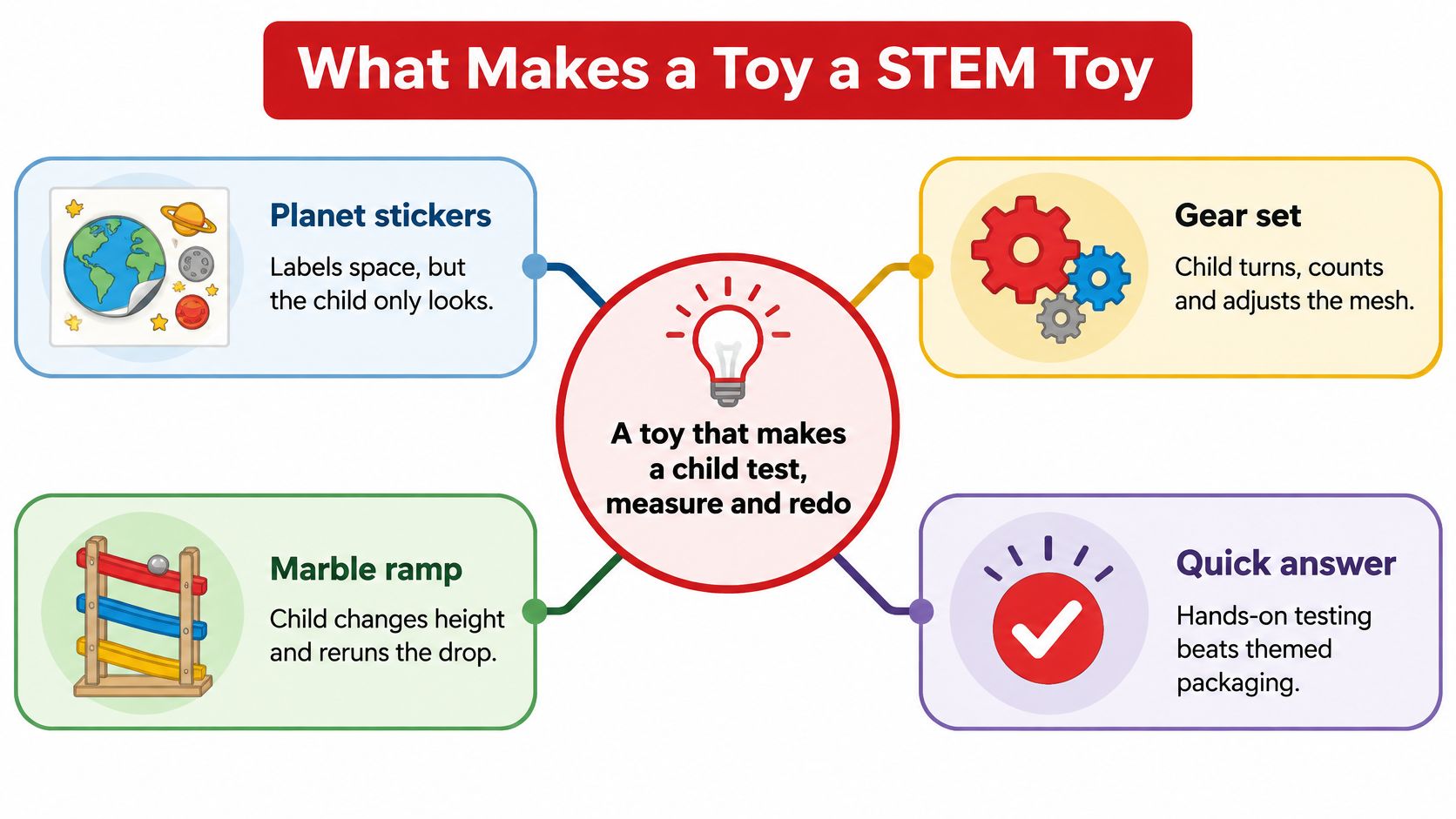
One box has planets on it. The other has gears. That's usually the whole difference, and the packaging won't tell you which is which. The category is big business, too: DataHorizzon Research estimated the global STEM toys market at USD 3.2 billion in 2024, and plenty of those boxes sell the vocabulary rather than the practice.
Here's the definition that settles most of these arguments, and a test you can run before you pay.
What Makes a Toy a STEM Toy
Line the two boxes up on the kitchen table and the difference appears within a minute. The planet puzzle asks a child to match shapes and read moon names out loud. The gear set asks her to line up teeth, turn a handle, count how many turns the small wheel makes for each turn of the big one, and rebuild the frame when the mesh slips.
Only the second demands STEM practice. The Association for Supervision and Curriculum Development describes STEM education as a range of strategies in which students apply concepts and skills from multiple disciplines to solve meaningful problems, rather than studying the four subjects as isolated categories. A construction set shows how that works in miniature: engineering design, mathematical measurement, material behaviour and technology all arrive in one task.
That's why a science word on a box proves so little. A STEM toy, in the useful sense, is a play-based tool that pushes a child to investigate, build, measure, calculate, program, test or redesign something. The same ASCD analysis notes that no single agreed definition of STEM exists across policy and education, so what separates a real one from a themed one is the learning experience, not the label.
A workable STEM toys definition comes down to verbs: investigate, measure, build, test, revise.
Investigate and Iterate, in Plain Words
Investigate means the child tries something to find out what happens before anyone tells her the answer. A four-year-old sending a marble down three ramps of different heights is investigating.
Iterate means she changes one thing and runs it again. Not starting from scratch, just adjusting the ramp height, the brace, the gear ratio, then checking whether the result moved.
Two words, one habit: the child owns the next move.
The Test You Can Run in a Shop
Pick up the box and ask one question. Can my child try something, see what happens and change the design?
If the box promises a finished model that matches the photo exactly, the answer is probably no. If it shows a build with a moving part, a scoring target, or three versions of the same structure, the answer is probably yes.
The shelf test: if the toy has one correct end state and the child can only follow steps to reach it, you're buying an instruction sheet with parts attached.
The Four Fields and the Toys That Fit Each
Where each letter shows up in play, and the question that tells you whether the toy really teaches that field:
| STEM field | What children practise | Example toy type | Test question |
|---|---|---|---|
| Science | Observation, prediction and controlled tests | Chemistry kit, crystal growing, volcano or slime experiment | Can the child change one ingredient and compare results? |
| Technology | Using tools and systems built on digital or mechanical logic | Circuit kit, simple machines, tablet-based coding app | Does the child connect a part to a visible effect? |
| Engineering | Designing, building and testing structures | Construction set, bridge challenge, marble run | Can the child change length or angle and see which design holds? |
| Mathematics | Measurement, counting, patterns and calculation | Gear-ratio set, scale-based building kit, pattern game | Does the child measure, count or calculate before deciding? |
| Computer science | Sequences, conditions and debugging | Binary bracelet kit, sorting-race coding kit, maze-programming robot | Can the child fix a sequence after the robot misses? |
Most good toys cover two or three rows at once. A marble run is engineering while it's being built and mathematics while the child times the drop, and the child who shortens the track to make the marble faster is running a controlled test without calling it one.
Where Parents Misread the Letters
Technology is the field parents misjudge most often. A tablet app that drills sums is a worksheet on a screen. A tablet app that makes a robot travel a set distance is technology practice, because the child's input produces a visible effect she can test and adjust.
U.S. federal law defines STEM education as instruction in science, technology, engineering and mathematics, explicitly including computer science, as set out in the statute. That definition underpins STEM programs at agencies including the National Science Foundation, the Department of Energy, NASA, NOAA, NIST and EPA, which makes it a solid baseline for explaining the acronym and for avoiding the common mistake of treating STEM as science alone. Programmable toys qualify, lab or no lab.
Strong kits usually let one field lead. A box claiming all four fields properly teaches one of them and decorates the rest, so pick the leading field first and treat the others as bonus.
If you're weighing how much art and design belong alongside this, our breakdown of STEM vs STEAM explains where the two approaches part ways.
Then match the row to the child. The dinosaur-obsessed kid starts in science, the builder starts in engineering, the pattern-spotter starts in mathematics, and shortlisting by row beats comparing claims on the back of a box.
The Active Learning Test Every Real STEM Toy Passes
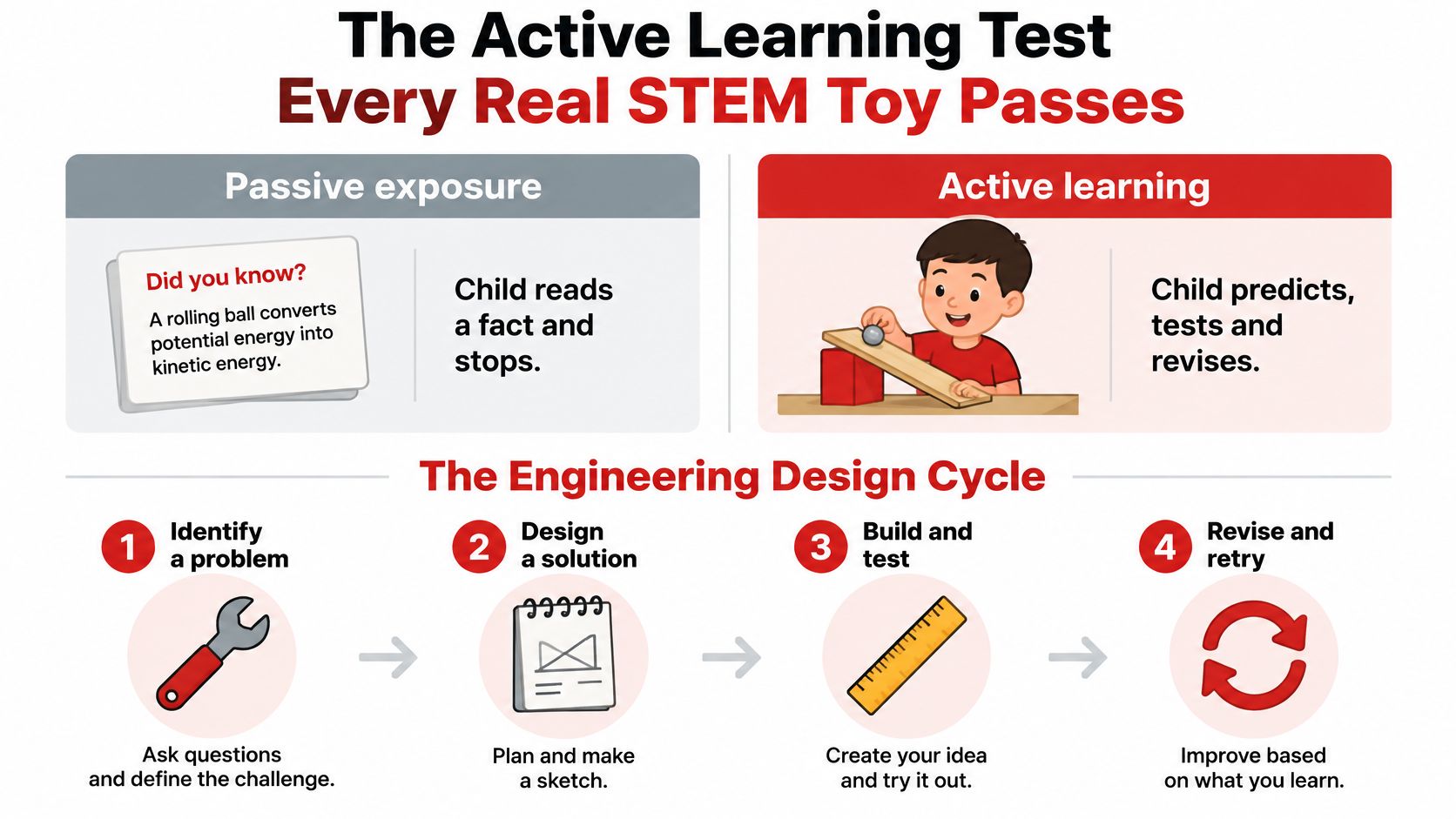
Passive exposure can look like learning from across the room. A fact card about volcanoes teaches a word, and the child is done. Active learning asks for a prediction before the reveal, so the child has something at stake in the result.
The technical distinction sits in one loop. A STEM toy worth the money supports an engineering-design cycle: identify a problem, generate ideas, build a prototype, test performance, improve the design. A systematic review of toy-based elementary engineering education reports that construction kits, mechanical toys and robotics platforms get used precisely because their materials and design constraints make engineering principles tangible, and the same review finds construction and building systems showing up most often for structural reasoning, mechanical principles, robotics and spatial thinking.
Early-childhood evidence points the same way. A systematic review of 29 studies published from 2014 to 2023 found that effective STEM activities build science-process skills and engineering thinking by having children apply scientific concepts inside design or construction tasks, not by listening to explanations first.
The Five Question Checklist
- Does the child get at least one deliberate change? Length, angle, weight, connection method, gear ratio or material. One adjustable variable is enough.
- Is there a visible or measurable result? The structure stands or sags, the mechanism moves, the distance on the tape changes.
- Are there two or more workable solutions? A toy with one legal answer is a puzzle, not a design task.
- Can the child fail and retry without an adult taking over? A collapse the child can inspect is worth more than a build an adult rescues.
- Does something prompt an explanation? Why did version two hold when version one didn't?
What the Checklist Looks Like in Play
Say a child makes a catapult from a cardboard tube, a rubber band and a wooden spoon. She sets the release angle at three positions, launches three times at each, marks each landing with masking tape, and picks the angle that throws furthest. That's a design variable, a measurement, a data set and an iteration in one afternoon, and the parts came out of a recycling bin.
Notice what the toy did and didn't do. It supplied the constraint and the feedback. The child supplied the question.
What moves a kit from following to testing: instead of demonstrating the build, ask your child which part she'd change if the ramp were twice as steep, then let the answer be wrong.
The label is weak evidence on its own. An adult asking what your child expects to happen turns a basic kit into real inquiry, while a child working through step cards alone may only practise following instructions. Facilitation and the structure of the activity often matter as much as the object.
Scoring Your Shortlist
Count the yes answers. Four or five means the toy supports genuine STEM design, and you can buy it knowing the play will outlast the first afternoon. Two or three means it needs an adult nearby to convert the steps into questions. One or none means you're paying for a theme.
If you want the classroom version of how much structure a child needs, our guide to active learning in education walks through the balance between guidance and open exploration.
What STEM Play Builds, With Pros and Cons
The label has a short history behind it: the National Science Foundation used the acronym SMET through the 1990s, adopted STEM in 2001 with Judith Ramaley credited with the word order, and an early NSF-supported teacher-education project carried the STEM name at the University of Massachusetts Amherst back in 1998, as NSF's own history records. Four school subjects became one integrated framework, and toy shelves followed the classrooms.
So what does the play build? Problem solving, when a child works out why the third floor collapsed. Critical thinking, when she compares two runs and asks why the second went further. Communication, when she explains the result to a sibling who wasn't watching. Collaboration, when two children split roles on one build. Persistence, when she returns to a failed design the next morning. Comfort with measurement, because the ruler stayed on the table.
Each of those is a skill, not a promise printed on cardboard.
What the Research Backs and What It Doesn't
Reviews of STEM toy research report benefits in problem-solving, critical thinking, communication, collaboration and domain knowledge, while noting that the studies cover very different toy types and teaching approaches. Read that carefully: the skills are well supported as goals, not as guarantees that come with the box. The same kit can produce measuring, predicting and revising in one household and quiet instruction-following in another. How the toy gets used decides which ones show up.
The Trade-offs, Plainly
- Screen-free play wins on attention. A hands-on kit holds a child's focus without a device competing for it.
- Repeatable challenges stretch one purchase. A build with adjustable variables gets revisited; a model gets built once.
- Skills transfer across subjects. The measuring and recording habit a child learns from a ramp shows up in the next science kit and the next maths lesson.
- Cost runs higher than for themed toys. Adjustable parts, real tools and printed guides cost more to make.
- Frustration arrives without support. A kit pitched above a child's fine-motor level produces tears, not inquiry.
- Single-build kits end up shelved. If there's nothing left to change, the toy is finished after one weekend.
Notice how the first three points mirror the last three. The strengths and the weaknesses come from the same design choices. Adjustable variables are what make a kit repeatable, and also what make it more expensive and harder for small hands. You are never choosing between a good toy and a bad one. You are choosing how much adjustability your child can use right now, at the price you are willing to pay for it.
Buyer rule: one kit that gets rebuilt five times beats five kits that get built once.
The wider case for physical play over demonstration is set out in our guide to the benefits of hands-on learning, and it applies here directly: a child who touches the variable remembers the lesson, while a child who watched the video remembers the video.
STEM Toys in Everyday Play Across Three Examples
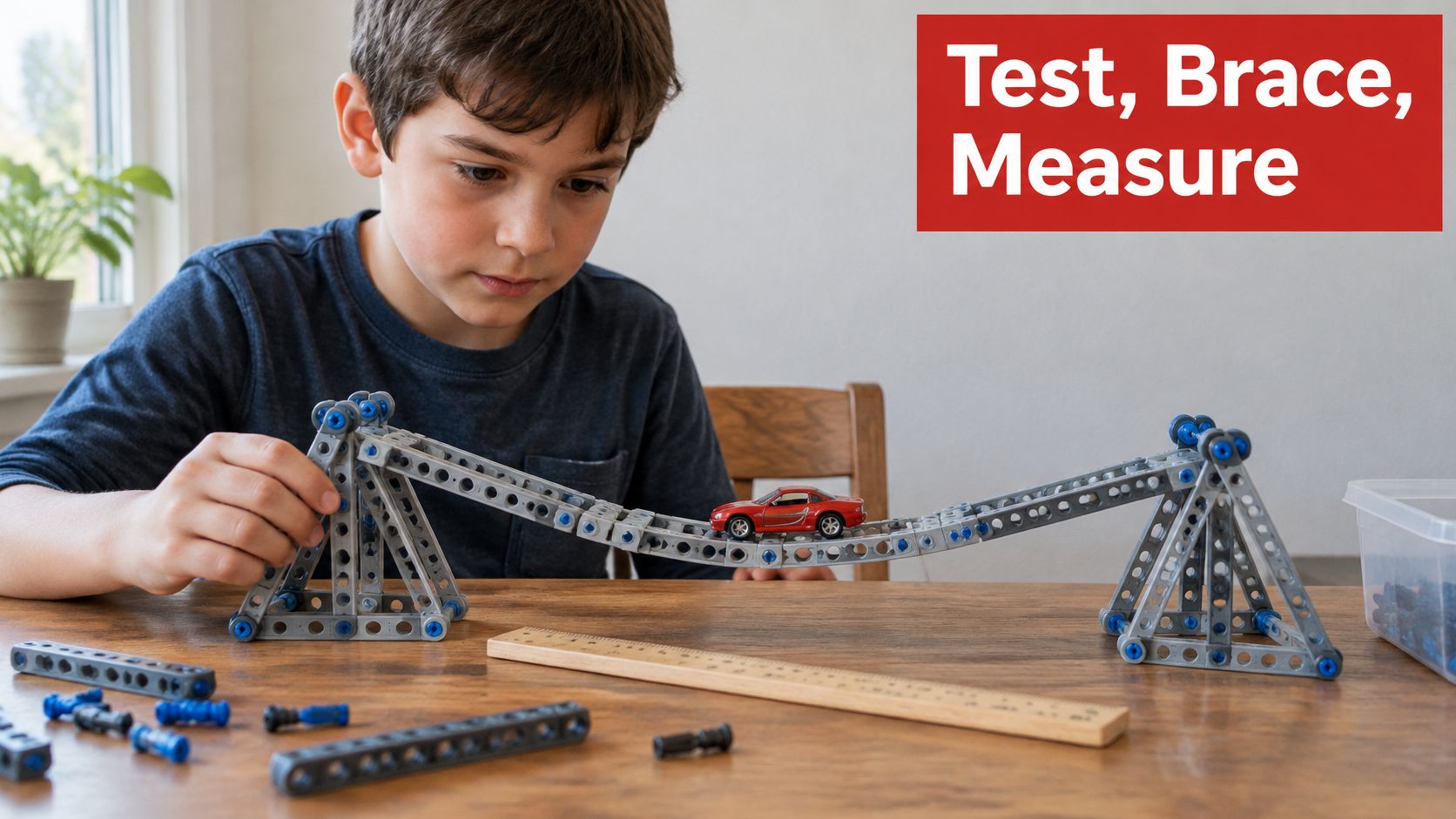
Say a nine-year-old builds a bridge from construction pieces, spanning two stacks of books. She drives a toy car across and the deck sags in the middle. She measures the dip against the table with a ruler, digs out a triangular brace, fits it under the centre, and measures again.
A Bridge That Sags
Field: engineering, with a dose of mathematics for the measurement and a design fix as the outcome. Activity: build, load, inspect the failure, brace, reload. Skill built: structural reasoning, the sense that a shape rather than extra material carries the load. The sign that learning happened isn't the final bridge, it's that she proposed the brace herself before anyone suggested it.
The failure point to watch for is copying. If she builds the picture on the box exactly and never loads it, the same pieces teach nothing about structure.
The predict, test and revise loop looks like this when a child is running it on her own:
A Prediction Tested
Field: science, specifically observation and control. The child guesses which liquid will change colour when the powder goes in, writes the guess down before the spoon moves, then records the result and compares the two.
The skill is prediction with a control, and the sign that it landed is the second run: she repeats the test with one ingredient swapped and watches whether her rule survives. A kit that produces the same fizz every time and never lets her change a variable is a magic trick with a lab coat on. Veronika, a Playz customer, described the Kaboom science kit this way: "We have tried the Kaboom science kit and it's unbelievable! So many different science experiments that keep the child busy for days!"
A Sorting Race Debugged
Field: computer science and technology, delivered as a sequence of moves. The child writes instructions for a sorting race or a maze robot, runs them, watches the robot miss the target, then reads her own sequence back to find the step that failed.
Skill built: sequencing and debugging. The sign learning happened is the child editing the sequence before calling for help, because finding the bad line is the whole skill.
Three examples, one pattern: the child decides what to try next. Not the guide, not the adult, and definitely not the box. Plenty more of these fit a kitchen table, and our collection of STEM activities for kids groups them by the materials you already own.
Frequently Asked Questions About STEM Toys
Is a Toy With Science on the Box a STEM Toy?
Not by itself. Run the test: does the child investigate, build, measure or program something through an active task? A planet puzzle introduces a topic. A gear set demands practice.
Does Coding Count as STEM?
Yes, and it isn't a loophole. Fixing a sequence after a robot misses is testing and revising, the same loop a bridge builder runs.
Are STEM Toys Only for Older Children?
No. Age labels are safety information as much as difficulty, and the bands shift sharply around the toddler years. Check the band against what your child does with small pieces.
Do I Need Expertise to Help My Child?
No. Ask what she thinks will happen, and what she'd change to get a different result. Open questions often matter more than the toy.
Are STEM Toys Only for Boys?
No. Research on STEM toy participation treats gender stereotypes and access for students with disabilities as an active strand of the field, which tells you inclusion isn't a side issue. Pick kits where children at different levels can hold real roles in one build.
Quick checklist before you buy: a STEM toy asks the child to test, change and explain; the label alone is weak evidence; check the age band, the active-learning setup and the adult support the kit will need.
Choose a STEM Toy That Teaches Something Real
The decision is simpler than the shelf suggests. Buy the kit where the child can change something, see a result and try again. Three checks, in this order.
Start with the age band and the small parts. The Consumer Product Safety Commission states that products intended for children younger than 3 must not contain small parts or release them after use-and-abuse testing, and toys intended for children aged 12 and under must undergo third-party testing and be covered by a Children's Product Certificate. Gears, magnets, beads, connectors and batteries matter most here, because they are both the activity and the hazard. Store loose pieces separately after play, and inspect the kit for broken components that could become new hazards.
Then run the five questions in the shop or on the product page. One adjustable variable. A visible result. More than one workable solution. Room to fail. A reason to explain. A marble run passes the first four before the box is even open, because a child can move one ramp, watch the ball, reroute it and knock the whole thing over trying. Four or five yes answers is your shortlist.
Finally, count the support your child will need. Fine-motor demands, reading level, how many children can play at once, the supervision time the kit really takes, and whether replacement parts exist for the pieces that always go missing. Educational does not mean inclusive, and a kit that suits one child can shut another out on hand strength alone. If your child's enthusiasm points toward one field, articles about subject choices from Edvdo help you see where that interest can lead in school.
Our educational STEM kits are sorted by age groups of 1-3 years, 3-8 years and 8+ years, and our science kits cover chemistry, biology and physics, so each listing can be held against the three checks instead of a marketing claim.
Playz builds science kits, construction sets and coding kits around the same loop this article describes, where a child predicts, builds, tests and adjusts rather than following a card to a single answer. Every Playz toy meets and exceeds all USA CPSC Toy Safety Guidelines, so the safety check is one you can tick off before you look at the fun part. Visit Playz to find a kit that gives your child something to change and a reason to try it again.