

Picture this: a child watches a documentary about volcanoes. An hour later, they've forgotten most of it. Now, imagine another child who builds a model volcano, mixes baking soda and vinegar, and watches it erupt across the kitchen counter. Which one do you think truly understands how a volcano works?
That’s active learning in a nutshell. It’s the messy, exciting, hands-on process of learning by doing instead of just listening. It puts kids in the driver's seat, empowering them to build their own understanding through projects, problem-solving, and teamwork.
What Is Active Learning in Education? A Hands-On Approach
Active learning flips the traditional classroom model on its head. Instead of students sitting quietly while a teacher lectures—passively absorbing information—they become active participants in their own education. It’s a dynamic, engaging process where kids are encouraged to roll up their sleeves and get involved.
This isn't just another educational buzzword; it's a fundamental shift in how we approach learning. It's built on one powerful idea: we understand things best when we experience them ourselves.
Active learning isn't a single technique but an umbrella term for many student-led methods, like project-based learning. As Tracy Gardner, a teaching professor at the Colorado School of Mines, puts it, "active learning beats passive learning when it comes to students understanding concepts and retaining information and skills." That's why you're seeing it pop up in schools everywhere.
The Core Pillars of Active Learning
So, what does active learning look like in practice? It boils down to three key ingredients that work together to create a space where curiosity can flourish and knowledge actually sticks.
- Hands-On Engagement: This is where kids physically interact with what they’re learning. Think building circuits with a science kit, piecing together a historical diorama, or mixing colors to paint a masterpiece.
- Problem-Solving: Instead of just memorizing facts, students are given real challenges that demand creative solutions. They have to think critically and figure things out for themselves.
- Collaboration: Working in pairs or small groups is essential. It teaches kids how to communicate their ideas, consider different viewpoints, and work as a team—skills they'll need for life.
These three pillars are deeply interconnected, creating a rich and memorable learning experience.
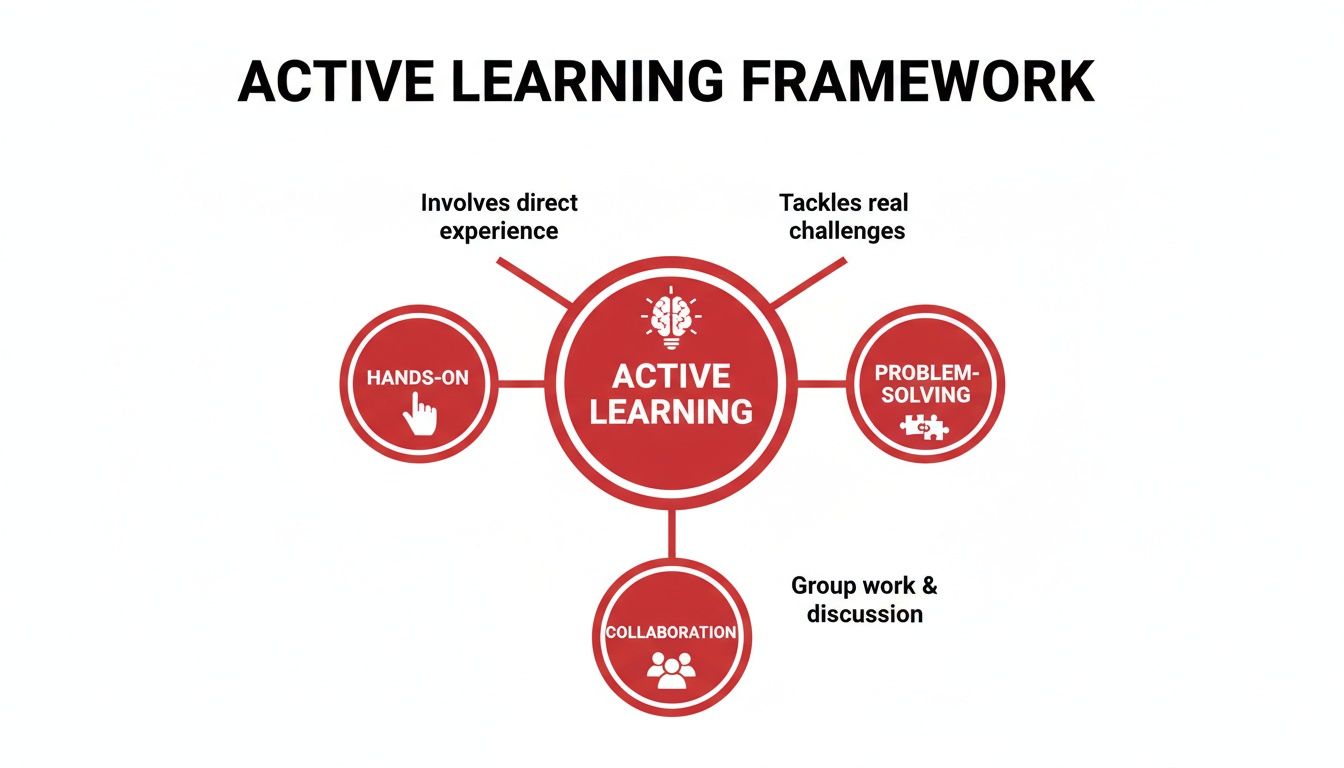
As you can see, it's about blending engaging methods to empower kids to construct their own knowledge. This idea shares roots with other child-led philosophies, like the Reggio Emilia approach, which views children as naturally curious and capable learners from the start.
Active Learning Versus Passive Learning: A Clear Comparison
The difference between active and passive learning is night and day. One requires real mental effort and engagement, while the other often leads to information going in one ear and out the other.
To give you a clearer picture, let's break down the key differences side-by-side.
Active Learning vs. Passive Learning At A Glance
| Characteristic | Active Learning (Learning by Doing) | Passive Learning (Learning by Observing) |
|---|---|---|
| Student's Role | Active participant, creator, problem-solver | Passive recipient of information |
| Learning Process | Hands-on, interactive, collaborative | Listening, watching, memorizing |
| Key Activities | Debates, projects, experiments, group work | Lectures, reading, watching videos |
| Information Retention | High; knowledge is constructed and applied | Low; information is often forgotten after exams |
| Focus | Developing critical skills and deep understanding | Transmitting facts and information |
This comparison highlights how active learning is designed for deeper, more meaningful engagement.
It all ties back to how our brains are wired to process and hold on to new information. If you're curious about the science behind why "doing" is so much more effective, you can learn more by checking out our guide on what is constructivist learning theory.
Key Takeaway: Active learning transforms education from a one-way street into a dynamic conversation. It’s the difference between zoning out during a lecture and raising your hand to ask a question that sparks a debate.
The Brain Science Behind Hands-On Learning
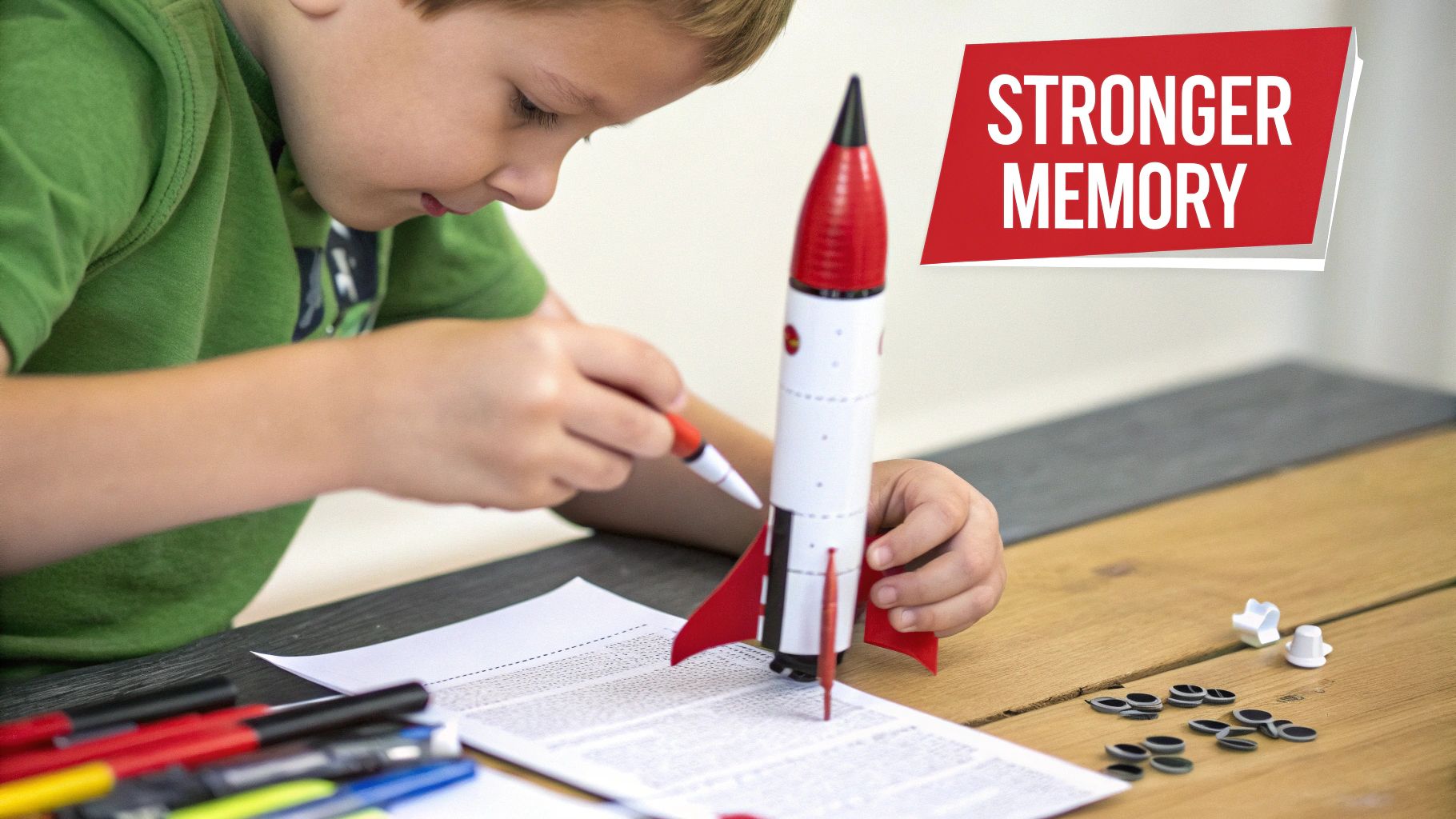
Have you ever noticed how a child can remember the details of a rocket they built for weeks, but the one they just read about in a textbook is forgotten by dinnertime? That’s no accident. It’s a perfect example of how our brains are actually wired to learn.
When a kid gets their hands on a project, their brain isn't just a sponge soaking up facts—it's an architect, actively building knowledge from the ground up.
This process is all about creating stronger, more intricate connections inside the brain. Think of learning as trying to create a path through a dense forest. Reading about the path is like looking at a map—helpful, but the trail itself is still faint and overgrown.
Actually walking that path—building the rocket, mixing the slime, solving the puzzle—is like clearing the way yourself. You're stomping down dirt, moving branches, and putting up signs. That physical effort creates a durable, well-defined neural pathway, making the information much easier to find and use later on.
Forging Stronger Neural Connections Through Multi-Sensory Input
When a child physically interacts with something they're learning, they fire up multiple senses at once. They see the colors fizzing in a chemistry experiment, feel the different textures of building blocks, and hear the satisfying click as a circuit connects.
This multi-sensory flood activates different areas of the brain simultaneously. This widespread brain activity strengthens the links between neurons, creating a rich, interconnected web of knowledge. It’s the difference between a single, fragile thread of memory and a sturdy rope woven from many different strands.
Key Takeaway: Hands-on learning is a mental workout. It forces the brain to problem-solve, apply ideas, and think critically, building a much deeper and more lasting understanding than just memorizing facts.
Take a child using a Playz science kit, for example. They aren't just learning about a single chemical reaction. They're actually figuring out:
- Cause and Effect: "When I pour this liquid into that one, it creates all these bubbles!"
- Hypothesis Testing: "I wonder what will happen if I add more of this powder? Will the bubbles get bigger?"
- Resilience: "Oops, that didn't work. Let me look at the instructions again and see what I missed."
This deep engagement is what makes learning stick. It turns abstract concepts into real, tangible experiences. The emotional connection—the thrill of a discovery or the pride in figuring it out—cements these memories even further.
From Concrete Actions to Abstract Thinking
One of the most powerful aspects of hands-on learning is how it builds a bridge from simple, physical actions to complex, abstract ideas. A child might start by just moving objects around, but that physical process is laying the groundwork for much bigger thinking down the road. It’s a natural step from doing to knowing.
Think about a simple activity like building a fort with a Playz play tent. On the surface, the child is just connecting poles and throwing fabric over them. But under the hood, their brain is firing on all cylinders:
- Developing Spatial Reasoning: They're instinctively learning how different shapes fit together in a 3D space.
- Practicing Problem-Solving: They hit roadblocks, like figuring out how to make the structure stable, and have to come up with solutions on the fly.
- Engaging in Sequential Planning: They learn, often through trial and error, that there's a logical order to the steps needed to reach their goal.
These skills, developed through something as simple as play, become the foundation for later success in subjects like math, engineering, and science. The kid who figures out balance and structure while building a fort is already better prepared to grasp geometry concepts later on.
To see just how wide-ranging the advantages are, you can read our full article on the benefits of hands-on learning. It really shows how much profound educational value is hidden in every act of play.
Building Essential Life Skills Through Active Play
Active learning is about so much more than memorizing facts; it’s a powerful engine for developing the core life skills kids need to navigate the world. When children get their hands on a project, they aren't just having fun. They’re running tiny experiments in resilience, collaboration, and creativity, building a foundation for success one block at a time.
This is where playtime transforms into a training ground for real-world abilities. By connecting these fun activities to tangible skills, we can see exactly how play shapes capable, well-rounded kids.
From Playtime to Problem-Solving
One of the biggest wins of active play is how it cultivates strong problem-solving skills. When a child tries to build a circuit with a science kit, they aren't just connecting wires. They’re diving headfirst into a cycle of trial, error, and discovery. Each failed attempt isn't a setback—it’s a valuable piece of data.
This hands-on experimentation teaches them to analyze a problem, form a hypothesis ("Maybe this piece goes here?"), and test their ideas in a safe, low-stakes environment. The drive to make a light bulb glow or a buzzer sound builds resilience, teaching a kid that sticking with it pays off.
Key Takeaway: Active learning turns a simple challenge, like completing a circuit, into a lesson in tenacity. The satisfaction of finally seeing it work is a powerful motivator that reinforces the value of sticking with a problem until it's solved.
Fostering Creativity and Innovation
Imaginative play is where creativity truly comes alive. When children use a Playz play tent, it’s rarely just a tent. One day it’s a spaceship exploring new galaxies, the next it’s a castle under siege, and after that, it's a vet clinic for stuffed animals.
This kind of open-ended play encourages kids to think outside the box and build entire worlds from scratch. There are no right or wrong answers, which frees them to explore different roles, stories, and solutions without fear. This is the very essence of innovative thinking—seeing new possibilities in ordinary things. For the youngest learners, having the right tools is key, and guides on choosing the best educational toys for 1-year-olds can help foster this early development.
The Art of Collaboration
Many active learning experiences are naturally social, creating the perfect environment for developing communication and teamwork skills. Picture a group of kids working together to build an epic fort or tackling a multi-step science experiment.
To succeed, they have to figure out a complex social puzzle:
- Negotiating Roles: "You be the architect, and I'll be the builder."
- Sharing Ideas: "What if we use this blanket for the roof?"
- Resolving Conflicts: "I wanted to put the door there!" "Okay, let's try your way first."
These interactions teach children how to explain their ideas, listen to others, and work toward a common goal. This cooperative spirit is a critical skill for school and for life. The immense value of play-based learning benefits stretches far beyond academics, shaping how kids interact with the world.
Simple Ways to Bring Active Learning Home
You don’t need a fancy classroom to ignite a passion for learning. Your home is already a fantastic learning lab, and with a few small tweaks, you can turn everyday moments into amazing educational opportunities. It’s all about letting your child explore, ask questions, and create on their own terms.
The best part? It doesn’t require expensive gear or a strict schedule. Bringing active learning home is about leaning into curiosity and turning regular playtime into a real adventure.
Turn Your Kitchen into a Science Lab
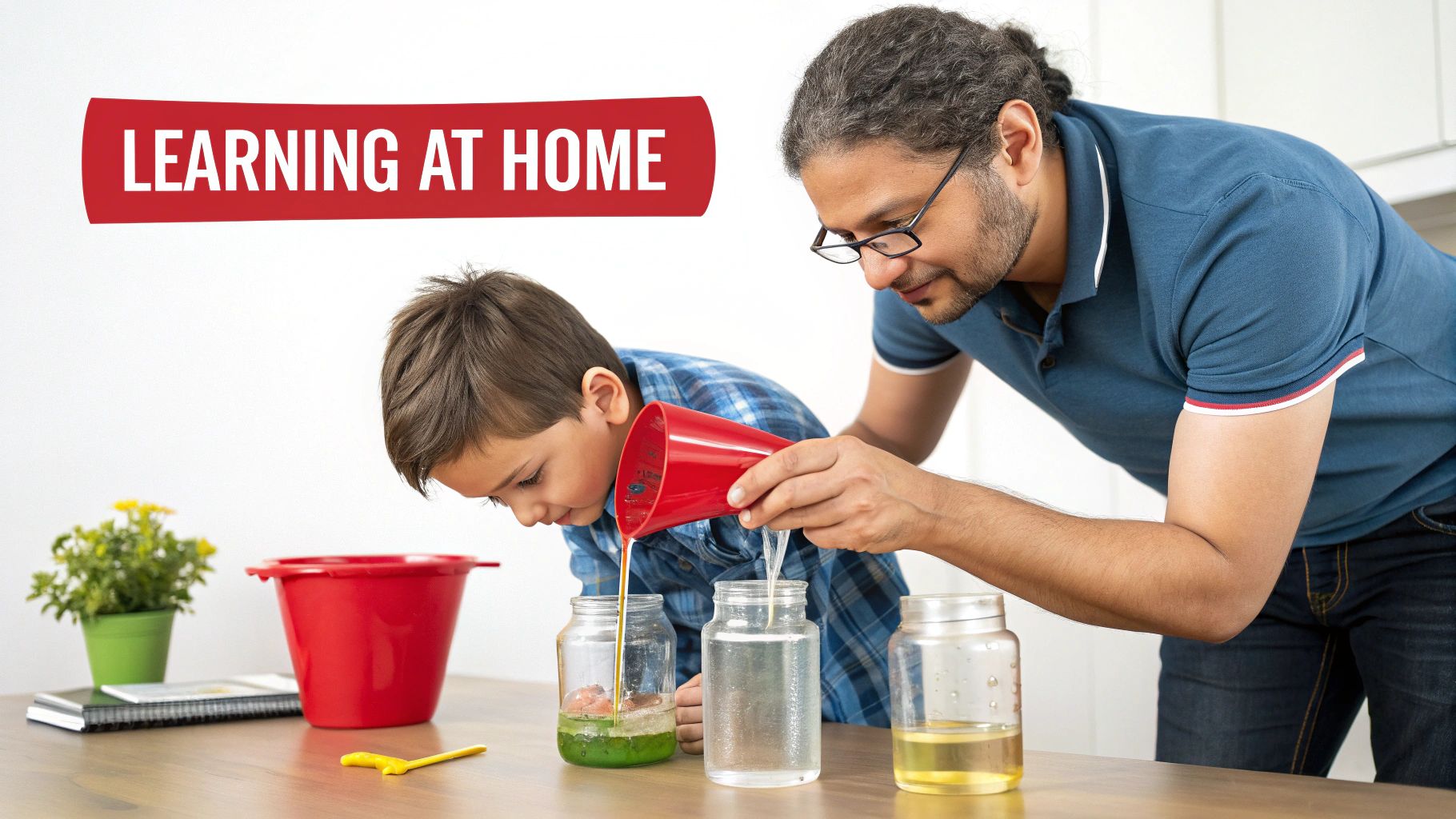
Your kitchen is a goldmine of hands-on learning just waiting to happen. Simple, everyday ingredients can become the building blocks for cool experiments that teach core science concepts in a fun, tangible way. This approach makes abstract ideas like chemical reactions feel real and exciting.
- Fizzing Volcanoes: A classic for a reason! Mix baking soda and vinegar in a bottle and watch the bubbly eruption. It’s a perfect (and safe) introduction to acids and bases.
- Homemade Slime: Combining glue, water, and a contact lens solution is a messy but memorable lesson in polymers.
- Sink or Float: Grab a few small items from around the house (a spoon, a cork, a toy car, an apple) and have your child guess which ones will sink or float in a bowl of water. This is a brilliant hands-on dive into density.
What They're Learning: These activities teach the scientific method in its purest, most playful form: form a hypothesis (what will happen?), observe the result, and draw conclusions.
Unleash Imagination with Open-Ended Play
Some of the best learning happens when kids are given the freedom to create their own worlds. Open-ended toys, like a simple play tent, are fantastic because they don’t come with a rulebook. One day the tent is a royal castle, and the next it’s a spaceship headed for Mars.
This kind of imaginative play is vital for developing creativity, storytelling, and problem-solving skills. It pushes kids to invent narratives and solve challenges that come up in their stories.
A play tent isn’t just a toy; it’s a blank canvas for the imagination. It becomes whatever a child needs it to be—a secret fort, a veterinarian's office for stuffed animals, or a cozy reading nook. This flexibility is what makes it such a valuable tool for active learning.
By encouraging this type of play, you’re helping your child build complex skills without them even realizing it. A child directing a "play" with their toys is practicing leadership, planning, and communication all at once.
Build More Than Just Models
Structured kits, like the ones from Playz that focus on building circuits or assembling models, offer another important kind of active learning. These activities guide kids through a process of following instructions, understanding how steps fit together, and seeing how individual parts create a functioning whole.
When a child successfully builds a circuit that lights up a bulb, the feeling of accomplishment is huge. They’ve just gotten a hands-on lesson in engineering and physics, and they learn that failure is just part of the process—if the circuit doesn’t work, they have to troubleshoot and try again.
For more great ideas, check out our guide filled with other hands-on learning activities you can easily do at home.
What They're Learning:
- Sequential Thinking: Understanding that steps must be done in a certain order.
- Resilience: Learning to stick with a problem and not give up when something doesn't work.
- Spatial Reasoning: Picturing 3D objects and figuring out how they fit together.
By working these simple, fun activities into your routine, you make learning a natural and joyful part of everyday life.
Practical Active Learning Strategies For Educators
For many of us in the classroom, the jump from knowing about active learning to actually doing it can feel big. But weaving these student-led strategies into your lessons is one of the best ways to change the energy in your room, get kids excited, and see those lightbulb moments happen more often.
The idea is simple: create a space where students are more than just listeners. They're doers, talkers, and discoverers. Think of these strategies as a toolkit—you pick the right tool for the lesson to make learning stick.
Here's a look at some of the most effective active learning techniques, along with simple ways you can bring them to life in your classroom.
Top Active Learning Strategies And Classroom Applications
| Strategy | Core Concept | Example Classroom Application |
|---|---|---|
| Project-Based Learning (PBL) | Students tackle a complex problem over time, applying knowledge from various subjects to find a solution. | A history class creates a mini-documentary about a local historical event, handling research, scriptwriting, and editing. |
| Gamification | Game-like elements (points, quests, competition) are used to boost motivation and engagement in lessons. | Use a tool like Kahoot! for a fun, competitive review session before an exam. The friendly rivalry helps everyone focus. |
| Think-Pair-Share | A simple, three-step process where students think individually, discuss with a partner, and then share with the class. | After a science lesson, ask, "What would happen if...?" Give students 60 seconds to think, a few minutes to chat with a partner, and then call on pairs to share. |
| Movement-Based Learning | Incorporating physical activity into lessons to help kinesthetic learners process and retain information. | Have students act out vocabulary words or use their bodies to form letters and numbers. |
| Peer Teaching | Students teach a concept they've mastered to a small group of their peers, reinforcing their own understanding. | After a math unit, have "expert" groups teach a specific problem-solving method to other groups who are still learning it. |
Let's break down a few of these in more detail.
Embrace Project-Based Learning (PBL)
Project-Based Learning (PBL) shifts the focus away from memorizing facts for a test. Instead, kids dig into a real-world problem over an extended period. For instance, instead of a lecture on ecosystems, a PBL approach would have students design and build their own self-sustaining terrarium.
This method is gold because it pushes students to research, collaborate, and pull knowledge from different subjects. They're not just learning facts; they're building critical thinking and project management skills that will stick with them long after the project is done.
Leverage The Power Of Gamification
Gamification means adding game-design elements to your lessons to make them more exciting. This doesn't mean turning every lesson into a video game! It's about using things like points, friendly competition, and storytelling to get students fired up.
Here are a couple of easy ways to try it:
- Learning Quests: Frame a unit as a "quest." Students complete different tasks (like homework or small projects) to "level up" and unlock the final challenge.
- Point Systems: Give out points for participating, helping a classmate, or turning in homework on time. These points can be cashed in for small rewards, like extra free-reading time.
Implement The Think-Pair-Share Model
One of the easiest and most powerful strategies out there is Think-Pair-Share. It’s a simple three-step method that gets every student involved, not just the ones who are quick to raise their hands.
- Think: Start by asking a thought-provoking question. Then, give everyone a minute to think about it silently.
- Pair: Students turn to a partner and discuss their ideas. This is a low-pressure way for them to practice articulating their thoughts.
- Share: Finally, call on a few pairs to share what they discussed with the whole class. This usually sparks a much richer group conversation.
Actionable Insight: This model is fantastic for breaking up a long lecture. It guarantees every student's brain is engaged and helps build their confidence in sharing ideas out loud.
These strategies are just the start. The magic happens when you find what works for your teaching style and your students. By bringing in techniques that get kids moving, talking, and creating, you build a classroom that feels more alive and rewarding for everyone.
If you’re looking for even more ideas that get kids out of their seats, our guide on kinesthetic teaching strategies is packed with hands-on approaches.
Common Questions About Active Learning
Making the shift to a more hands-on way of learning naturally brings up a few questions. Whether you're a parent or a teacher, it’s completely normal to wonder how this dynamic style fits into the real world of curriculum standards, different age groups, and unique little personalities.
This section provides clear, straightforward answers to demystify the process and help you feel confident bringing active learning to your kids or students.
How Can I Balance Active Learning with Required Curriculum Standards?
This is one of the biggest questions we hear. The great news is that active learning isn’t meant to replace your curriculum—it’s designed to bring it to life.
Think of it as the delivery method for the information you already need to teach. Instead of just lecturing about the butterfly life cycle, you could have students raise caterpillars in the classroom. They’ll still learn all the required vocabulary and stages, but the experience will make that knowledge stick in a way a textbook never could.
- Map activities to standards: Start with the learning standard you need to cover and then brainstorm a hands-on project that achieves it.
- Use projects as assessments: A well-designed project can reveal a student's true understanding far better than a multiple-choice test.
The key is to see active learning as a powerful tool to meet your goals, not another box to check.
What Is the Role of Technology in Active Learning?
When used thoughtfully, technology can be a fantastic partner for active learning. It’s not about replacing hands-on activities with screens, but about using digital tools to make the experience even richer.
For example, a student might use a tablet to research bridge designs before building their own with craft sticks. Or they could use a coding app to program a small robot to navigate a maze they've built. The tech becomes a tool for creation and exploration.
One of the most exciting frontiers is AI-enhanced active learning. Studies have found that students in these programs can score 54% higher on tests. Why? Because AI can spot knowledge gaps early, allowing for more targeted, hands-on activities to close them. It's a big reason why the AI education market is projected to hit $112.3 billion by 2034. You can learn more about the growing impact of AI in education here.
For parents looking to strike a healthy screen-time balance, purposeful play with physical toys like science kits can achieve similar goals by building the very same problem-solving skills.
How Do I Adapt Active Learning for Different Age Groups?
Active learning is incredibly flexible. The core principles of doing, creating, and exploring are universal—only the complexity of the activities changes as kids grow.
- For Toddlers (Ages 1-3): Focus on sensory and motor skills. Think stacking blocks, playing with water and sand, or sorting colorful objects. The learning here is all about cause-and-effect.
- For Preschoolers (Ages 3-5): This is the time for more imaginative and collaborative play. Building a fort with a play tent, diving into role-playing, or working on simple craft projects helps build crucial social skills.
- For Elementary Students (Ages 6-10): This is the sweet spot for structured kits and project-based learning. Building a simple circuit, conducting a kitchen science experiment, or designing a model city encourages systematic thinking.
- For Middle and High Schoolers (Ages 11+): Challenge them with more complex, long-term projects like designing a solution to a community problem, coding a simple app, or producing a short documentary. The focus shifts toward critical analysis and real-world application.
What If My Child Seems Resistant to Active Learning?
It happens! A child who is used to being told exactly what to do might hesitate when asked to take the lead. They might be afraid of getting the "wrong" answer or feel lost without step-by-step instructions.
If you run into resistance, the best approach is patience and gentle encouragement.
- Start Small: Introduce short, simple activities with a high chance of success to build confidence.
- Model Curiosity: Jump in and get involved yourself! Show them that it’s okay to experiment and make mistakes. Your enthusiasm is contagious.
- Offer Scaffolding: You don't have to leave them completely on their own. Provide some initial structure, but let them make the final choices. Instead of telling them what to do, try asking, "I wonder what would happen if we tried this?"
Often, this resistance is a temporary hurdle. Once a child experiences that "aha!" moment of figuring something out for themselves, they'll be much more eager to dive into the next challenge.
At Playz, we believe every child is a natural scientist, artist, and engineer, just waiting for the right tools to unlock their potential. Our science kits, play tents, and creative toys are designed to turn playtime into a powerful learning experience, making complex concepts fun, accessible, and unforgettable.
Ready to bring the magic of hands-on learning into your home? Explore our collection of award-winning toys and find the perfect adventure for your young learner today!