

The best science toys for 7 year olds do more than just entertain—they transform big, abstract ideas into something a child can actually hold, build, and explore. These aren't just playthings; they are foundational tools that build grit, critical thinking, and problem-solving skills they'll use for the rest of their lives.
The right toy can spark a genuine passion for discovery, turning an hour of potential screen time into an afternoon of unforgettable, hands-on learning.
Why Science Toys Are a Game Changer for 7 Year Olds
At seven, a child's brain is buzzing with curiosity. They are moving past simple make-believe and are eager to understand the "why" behind everything. This age is a golden window for introducing STEM concepts because their minds are making a huge developmental leap from abstract thought to logical reasoning.
It's the perfect moment to hand them a toy that challenges them to think, experiment, and figure things out. Getting them hooked on the thrill of scientific discovery now lays a foundation for a lifetime of curiosity and confidence.
From Abstract Ideas to Tangible Fun
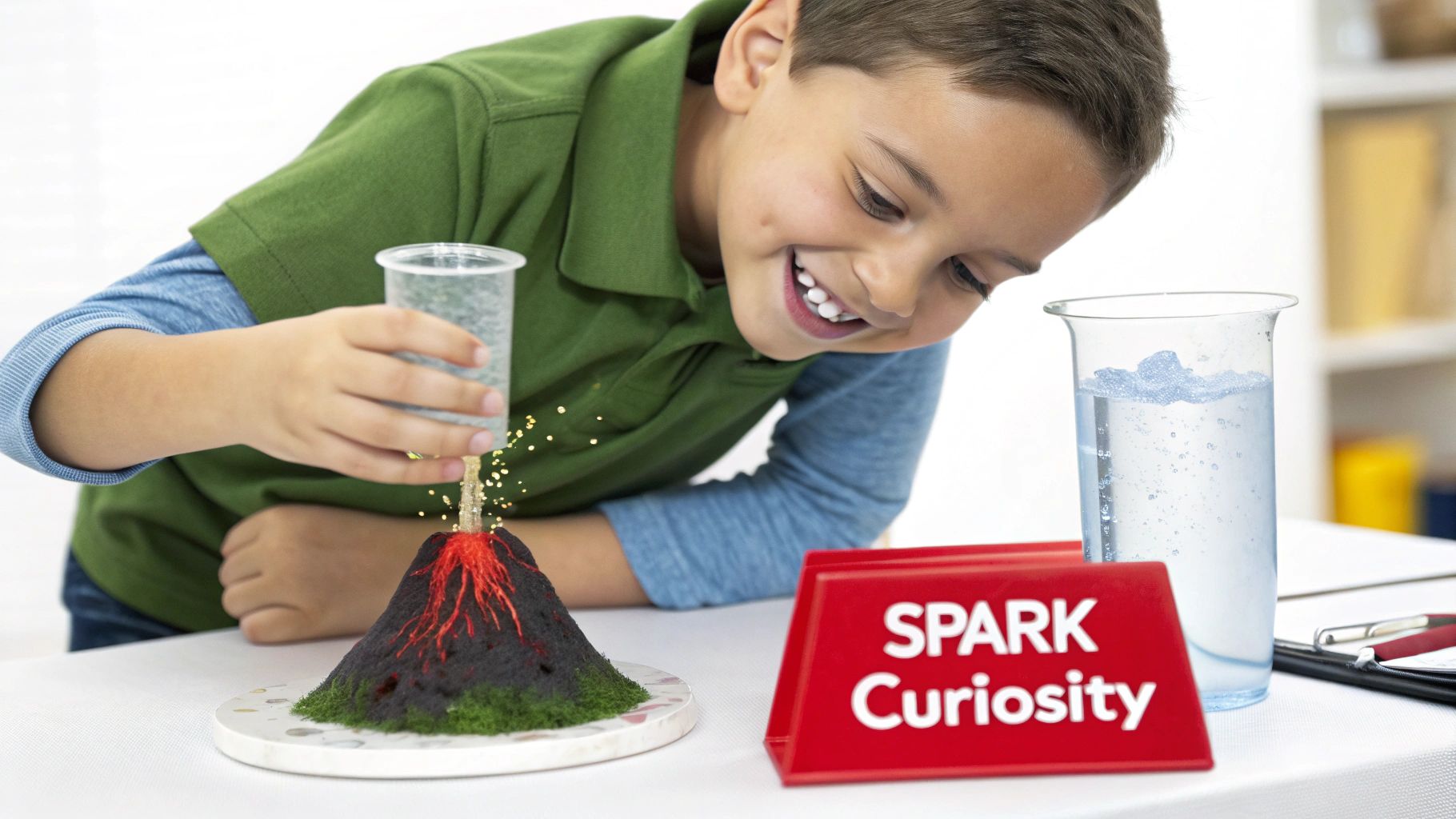
Think about explaining gravity. You can talk about apples and Isaac Newton all day, but letting a 7-year-old build their own marble run and feel the ball accelerate makes the concept click instantly. Science toys act as the bridge between confusing classroom theories and real, hands-on understanding.
They give kids a chance to wrestle with scientific principles directly, and that active participation is what makes learning stick. If you want to dive deeper into why this works so well, check out the amazing benefits of hands-on learning.
A science kit isn’t just a box of parts; it's a guided adventure. It gives a child permission to be curious, to make messes, and to feel the thrill of figuring something out on their own.
This kind of play flips the script, turning learning from a passive chore into an exciting, interactive quest.
Building Skills Beyond the Experiment
The real magic of science toys isn't just about memorizing facts. When an experiment fizzles out instead of bubbling over, a child learns resilience. When they have to tweak a wonky design to get it to work, they're building priceless problem-solving muscles. Simply following a multi-step instruction booklet helps them practice focus and attention to detail.
These are the core skills that set them up for success everywhere, from the classroom to the playground.
It’s no wonder parents are catching on. The global market for STEM toys hit USD 1.20 billion in 2024 and is expected to climb to USD 1.83 billion by 2030, according to industry reports. By picking the right science toys for your 7-year-old, you're not just buying a toy—you’re investing in their future.
How Science Toys Fuel a 7 Year Old's Development
Science toys provide a wealth of benefits that support a 7-year-old's growth in multiple areas. Here’s a quick look at how these toys fuel their development.
| Developmental Area | How Science Toys Help | Practical Example |
|---|---|---|
| Cognitive Skills | They challenge kids to think logically, follow steps, and connect cause with effect. | Building a simple circuit to power a small lightbulb or fan. |
| Problem-Solving | Experiments often require tweaking and troubleshooting, teaching kids not to give up. | Figuring out why a volcano experiment isn't fizzing and adjusting the ingredients. |
| Fine Motor Skills | Manipulating small parts, connecting wires, and assembling kits sharpens coordination. | Carefully placing gears in a mechanical toy or using tweezers in a crystal-growing kit. |
| Patience & Resilience | Waiting for results (like a plant to sprout) teaches patience, and failed attempts build grit. | Observing a butterfly habitat over several days or rebuilding a collapsed structure. |
These activities do more than just teach scientific principles; they build the foundational skills that help children thrive.
Matching Toys to Your Child's Natural Curiosity
Walking down the toy aisle can feel overwhelming. Every brightly colored box promises to boost your child's brainpower. But here's the secret: the best science toy isn't the most complicated one. It's the one that clicks with your child's unique personality and interests.
A toy that aligns with their passions becomes a genuine tool for discovery. The wrong one just gathers dust.
Your job is to become a "toy detective." Look past the flashy packaging and check for three key things: safety, durability, and—most importantly—how well it connects to what your kid already loves. Nailing these three points is how you turn a simple purchase into a real catalyst for learning and joy.
Actionable Tip: Prioritize Safety and Durability
Before getting to the fun stuff, let's cover the basics. A toy must be safe, period. For a 7-year-old, this means looking for kits made from non-toxic, high-quality materials. Reputable brands will be transparent about their safety certifications, like ASTM F963 in the U.S., which confirms the product has been rigorously tested.
Durability is just as critical. Nothing kills the excitement faster than a toy that breaks after one use. A flimsy kit doesn't teach science; it teaches frustration. Look for sturdy plastic parts and well-made components, and check reviews to see if other parents say the toy held up to enthusiastic, hands-on play. Science is all about trial and error, so the tools need to be tough enough for the journey.
Actionable Tip: Follow Their Fascination
The most successful science toys are the ones that tap into what your kid is already obsessed with. Pay attention to the questions they ask and the games they play—that's your roadmap. Is your child always digging for "fossils" in the backyard? Or are they constantly staring up at the night sky?
The best educational toy is one that doesn't feel like a lesson. It should feel like an extension of their own imaginative world, giving them the tools to explore questions they are already asking.
Match a toy to their current passion:
- For the Potion Mixer: A chemistry set that lets them create safe, fizzing, color-changing concoctions will feel like pure magic.
- For the Dinosaur Expert: A geology kit for digging up fossils or growing their own crystals is a direct line to their love of ancient Earth.
- For the Aspiring Astronaut: A model rocket they can actually launch or a cool solar system kit can send their curiosity into orbit.
- For the Builder: An electronics set or a simple machines kit will satisfy that deep need to see how things tick and put them together.
When you follow their lead, learning becomes a natural and exciting part of play. Educational toy market growth for the 3-8 age group is projected at a 7.7% CAGR through 2030, driven by toys that cleverly mix real STEM concepts with pure fun. To dive deeper into how hands-on activities work for different kids, check out our guide on what is tactile learning style.
Exploring the World of Science Kits
Once you know what to look for, the real fun begins—diving into the incredible variety of science toys available for 7-year-olds. The world of science kits is huge and exciting, with something to spark the imagination of every young explorer. Think of this as your idea catalog, broken down by scientific theme, to help you find the perfect match for your child’s curiosity.
From bubbling chemistry concoctions to mind-blowing earth science discoveries, each type of kit opens up a completely different corner of the scientific world. Picking the right one can turn a passing interest into a genuine passion.
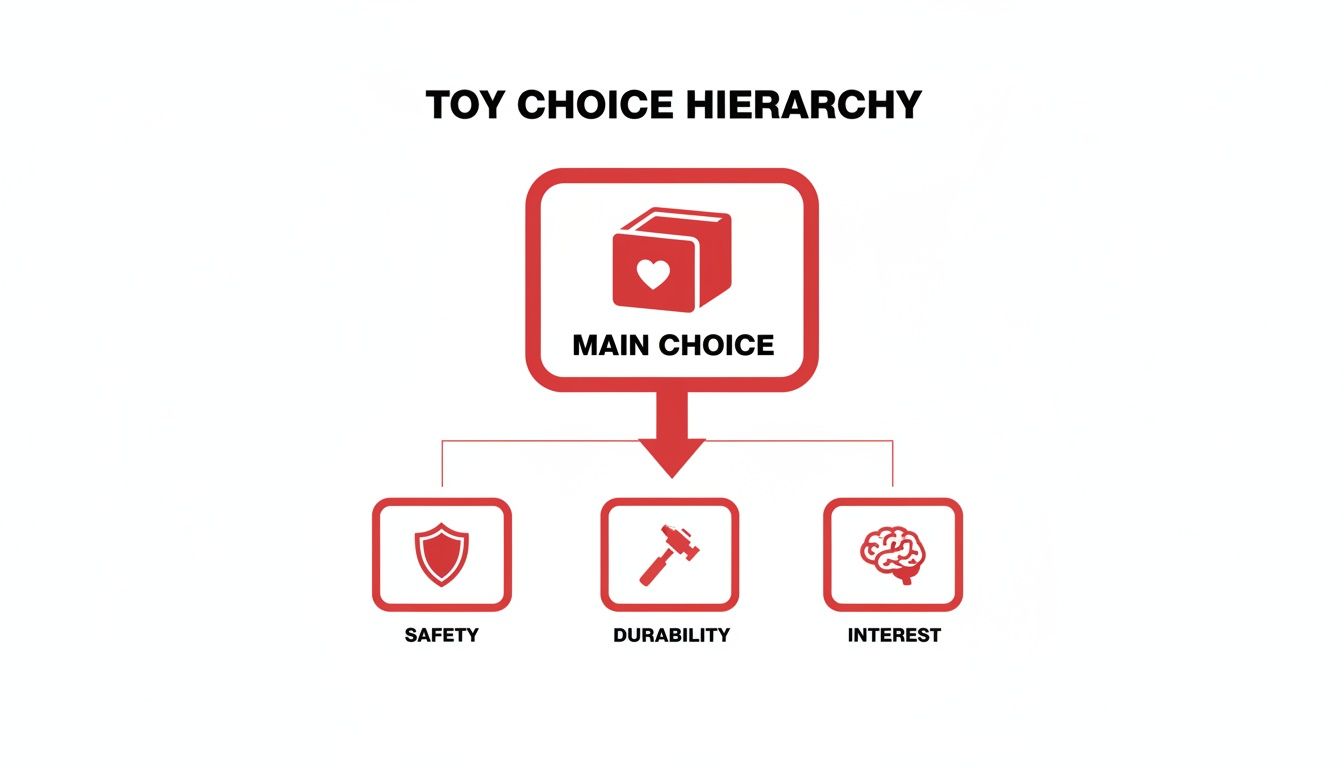
This simple chart gets right to the point: a fantastic toy choice is built on a solid foundation of safety, durability, and a real connection to what your child loves. Hitting that sweet spot means the toy won't just be educational, but it'll be a well-loved favorite that gets used again and again.
Chemistry and Physics Kits: For the Tinkerers and Mixers
Chemistry sets for this age are all about safe, hands-on reactions. They use common household ingredients like baking soda and vinegar to create awesome, fizzy results. Kids can mix up their own gooey slime, brew colorful bubbling "potions," or build that classic erupting volcano.
Physics kits, on the other hand, pull back the curtain on the invisible forces that make our world work. A 7-year-old can build simple machines with gears and levers, construct wild marble runs to see gravity in action, or experiment with basic circuits to make a light bulb glow. These kits are perfect for kids who love to build and figure out how things operate.
The science category dominates the global STEM toy market because topics like gravity and chemical reactions are fundamental to school curriculums. These hands-on kits are priceless for building both fine motor skills and the ability to grasp complex ideas.
Earth Science and Biology Toys: For the Natural Explorers
Does your kid love digging in the dirt or collecting cool-looking rocks? Earth science toys are made for them. Crystal-growing kits are a huge hit, letting kids watch stunning structures form over just a few days. Similarly, geology sets with real geodes to crack open or "fossils" to excavate bring the wonders of our planet right to your kitchen table.
For the budding naturalist, biology kits offer a closer look at the living world. Simple, kid-safe microscopes can turn everyday objects like a leaf or a strand of hair into a bizarre and fantastic new landscape. Other kits might involve growing a plant from a seed or observing the life cycle of butterflies, teaching patience and observation skills.
If you're looking for projects that keep the discovery going, you might want to explore different kinds of monthly science kits for kids.
A truly great science kit does more than just teach a concept; it gives a child a story to tell. They won't just learn about crystallization—they'll remember the day they grew their own sparkling amethyst-colored crystals.
Comparison: Matching Science Toy Types to Core STEM Skills
Use this comparison table to choose the right type of science toy based on the skills you want to foster in your child.
| Toy Type | Primary STEM Skill Developed | Example Kit Concept |
|---|---|---|
| Chemistry Set | Understanding Cause and Effect | Creating a color-changing mixture by adding a safe acid to a base. |
| Physics Kit | Problem-Solving and Engineering | Building a small catapult to see how adjusting the lever changes the launch distance. |
| Earth Science Toy | Observation and Patience | Watching and documenting the daily growth of a crystal formation. |
| Biology Kit | Scientific Inquiry and Observation | Using a microscope to compare the structures of different plant leaves. |
Ultimately, the best science toys for 7-year-olds are the ones that tap into their natural sense of wonder. They give kids the tools they need to finally start answering all of their own endless "whys."
How to Guide Learning Without Taking Over
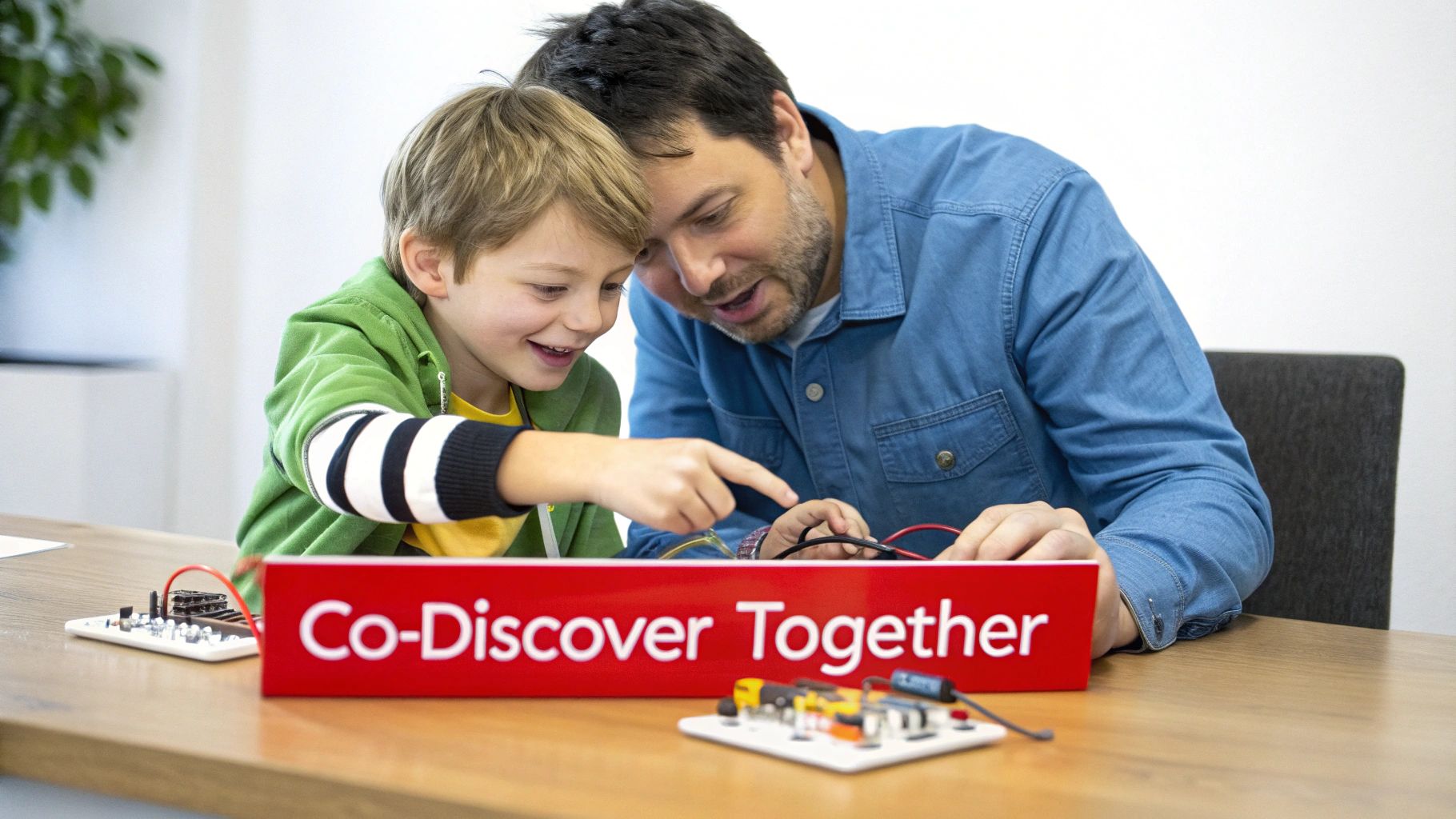
The best science toys for 7 year olds come with an instruction manual, but the real magic happens when you step back and let your child take the lead. Your role isn’t to be a teacher with a rigid lesson plan. Think of yourself as a curious co-discoverer, an enthusiastic lab assistant who’s just as excited to see what happens next.
This shared adventure transforms playtime into a powerful bonding experience. When you shift from instructor to partner, you give them the space to think, fail, and try again. This approach reinforces that learning isn't about getting the right answer on the first go—it's about the thrill of the process.
Actionable Tip: Create an Inviting "Lab Space"
You don’t need a dedicated room to spark scientific curiosity. A designated "lab space" can be as simple as a corner of the kitchen table or a plastic bin that holds all their experiment supplies. The key is making it accessible and completely mess-friendly.
Cover the area with a cheap plastic tablecloth or old newspapers. This small step sends a huge message: it’s okay to make a mess here. This frees your child from worrying about spills and lets them focus entirely on the experiment.
Actionable Tip: Spark Curiosity with Open-Ended Questions
Instead of telling your child what’s about to happen, nudge their critical thinking with gentle, open-ended questions. This technique, often called scaffolding, is a fantastic way to guide their learning without giving away the answers. You can learn more about this effective method by exploring what is scaffolding in child development in our detailed guide.
Try using questions that get them predicting and observing on their own:
- "What do you think will happen if we add this next?"
- "Why do you suppose it bubbled up like that?"
- "What could we change to get a different result?"
This questioning approach turns you from a source of answers into a sounding board for their own theories. It teaches them how to think like a scientist—by hypothesizing, observing, and drawing conclusions.
Actionable Tip: Frame "Failures" as Discoveries
Not every experiment will go as planned, and that’s a fantastic learning opportunity. When a volcano doesn't erupt or a circuit doesn’t light up, resist the urge to jump in and "fix" it. Instead, treat it like an exciting new puzzle to solve together.
Celebrate the unexpected outcome! Say things like, "Whoa, that's not what we expected! How interesting. What should we try differently?" This reframes "failure" as a natural and essential part of the scientific method, building resilience and serious problem-solving skills. Every "mistake" is just data for the next attempt.
Finally, connect their playtime discoveries back to the real world. If they grow a crystal, talk about how geodes form deep inside the Earth. If they build a simple circuit, point out how the lights in your house work on the very same principle. These small connections make science feel relevant and exciting.
Understanding the Mind of a 7-Year-Old Scientist
So, what exactly is going on in the busy brain of a 7-year-old? This age is an amazing sweet spot for science because they're making a massive cognitive leap. They're starting to move past the purely imaginative play of their younger years and into a world governed by logic and rules.
This shift is a game-changer. Suddenly, concepts like cause and effect aren't just fuzzy ideas; they're real, observable things they can test for themselves. A 7-year-old can finally follow a few steps in a row, think more systematically, and even start predicting what might happen next—the perfect recipe for a budding scientist.
Bridging Imagination and Logic
This is where well-designed science toys for 7 year olds truly shine. The best kits meet kids right where they are, offering the perfect balance between structure and creative freedom. They give enough guidance to prevent frustration but leave enough room for genuine, kid-led exploration.
A good science kit doesn't just hand over the answers. Instead, it creates a framework for discovery:
- Guided Exploration: Clear, simple instructions act as a safety net, helping them understand the process without stealing their sense of ownership.
- Tangible Results: The experiments are designed to produce visible—and often exciting—outcomes that make abstract scientific principles feel real and concrete.
- Creative Freedom: Many kits subtly encourage kids to ask "what if...?" They can tweak the variables, try things differently, and see how their changes affect the outcome.
This approach validates their growing ability to think logically while still giving their powerful imagination plenty of room to run wild.
A 7-year-old is no longer just mixing random "potions"; they're a chemist observing a chemical reaction. They aren't just stacking blocks; they're an engineer testing a structure's stability. The right toy gives them the words and the context to understand their own brilliant discoveries.
This transition from pretend play to purposeful experimenting is what builds a true, lasting sense of accomplishment. When a 7-year-old completes an experiment, they feel incredible pride because they followed a logical process to create a real result. That feeling is incredibly empowering—and it’s the spark that can ignite a lifelong love for science.
FAQs: Answering Parent's Top Questions About Science Toys
Choosing the perfect science toy for a 7-year-old can bring up a lot of questions. You want something fun, safe, effective, and that won’t end up forgotten under the bed. Here are answers to the most common concerns we hear from parents.
Are science kits actually safe for my 7-year-old?
Yes, absolutely—as long as you stick with a high-quality kit designed specifically for this age group. Reputable brands making science toys for 7 year olds use non-toxic materials and put their products through rigorous safety testing. Look for certifications like ASTM F963 on the box; it's a key sign that the toy meets strict safety standards. Good kits also come with clear instructions and safety rules. Of course, adult supervision is always recommended to ensure a safe and collaborative adventure.
My child gets frustrated easily. What if the toy is too hard?
This is a valid concern. The trick is to start with kits that deliver a quick, visible, and exciting payoff, like a bubbling volcano or a simple slime-making kit. The "wow" moment happens almost immediately, which is a massive confidence booster. Your role is to be their "lab assistant." Offer help with tricky steps, encourage them when they're stuck, and celebrate every discovery.
Actionable Tip: Frame mistakes as discoveries. Try asking, "That's an interesting result! What do you think would happen if we tried it a different way?" This simple shift helps build resilience and problem-solving skills.
How do I choose between a chemistry set and a physics kit?
Follow their lead. Pay attention to what they're already drawn to.
- For the creative mixer: If your kid loves making messes, mixing "potions," or seeing what happens when you combine things, a chemistry set is a great fit.
- For the natural builder: If they are always building towers, taking things apart, or creating ramps for toy cars, a physics or engineering kit will capture their imagination.
If you're still on the fence, a broader variety kit with a few different types of experiments is a great starting point. You can find more ideas in our guide to different STEM toys for kids.
What if I don't know anything about science myself?
Perfect! You don’t need to be a scientist. In fact, it can be even better if you aren't. The best science kits are designed for anyone to use and come with easy-to-follow guides that explain the science in simple, clear language. This is a golden opportunity to learn alongside your child. Your genuine curiosity and excitement are far more valuable than any textbook knowledge. When you explore and discover together, you're modeling a true love for learning—and that's contagious.
Ready to find the perfect kit to ignite your child’s curiosity? At Playz, we design our science kits to be safe, engaging, and packed with the "wow" factor that turns learning into an adventure they'll never forget.