

Kinesthetic teaching is all about using physical activity to help kids learn. Instead of just listening to a lecture or reading from a book, students get to learn by doing. This practical approach makes abstract concepts tangible and memorable through movement and hands-on interaction.
Why Movement Unlocks a Child's Learning Potential
Ever met a kid who just can't sit still? That boundless energy isn't always a sign of distraction—it's often a signal. For many children, the urge to move is directly wired into how they process the world around them.
Kinesthetic teaching strategies are designed to harness this natural impulse, turning restlessness into a powerful learning tool. The core idea is simple: learning by doing. When children physically engage with a concept, their brains forge stronger, more lasting connections than when they just passively take in information.
This is a huge step beyond traditional classroom methods. It's about experiencing lessons firsthand, not just memorizing facts from a textbook.
- Deeper Engagement: Physical activity grabs a child's attention and makes any topic more exciting.
- Improved Memory: The brain links learning to physical action, which helps information stick.
- Better Comprehension: Abstract ideas click when students can touch, build, or act them out.
Real-World Example: A study looking at multiplication lessons for students in grades 3-5 found a massive spike in engagement when movement was part of the lesson. Kids who were normally distracted became active participants, held onto the concepts longer, and even achieved better test scores.
Think of it like this: you can either look at the blueprint of a building or you can actually help construct it. The hands-on experience solidifies understanding in a way that just watching never could. By integrating physical action, we help kids build knowledge from the ground up.
These strategies aren't just for one "type" of learner, either. They benefit everyone by turning education into a full-body, multi-sensory experience. To get a better sense of how this works, you can read more about the benefits of hands-on learning.
The Brain Science Behind Learning Through Action
Ever wonder why a hands-on science experiment sticks in your head so much better than a dry textbook chapter? The answer is hiding in the way our brains are wired. When we physically get involved with the world around us, our brain isn’t just a passive sponge for information—it’s actively building knowledge by creating and reinforcing neural pathways.
Think of it like building a memory muscle. Every time a child manipulates an object, acts out a story, or tinkers with an experiment, they're essentially doing "reps" for their brain. This physical action helps shuttle abstract concepts from flimsy short-term memory into solid, long-term understanding.
This idea isn’t just a hunch; it’s a powerful educational approach that connects the body, the brain, and the simple joy of having fun.
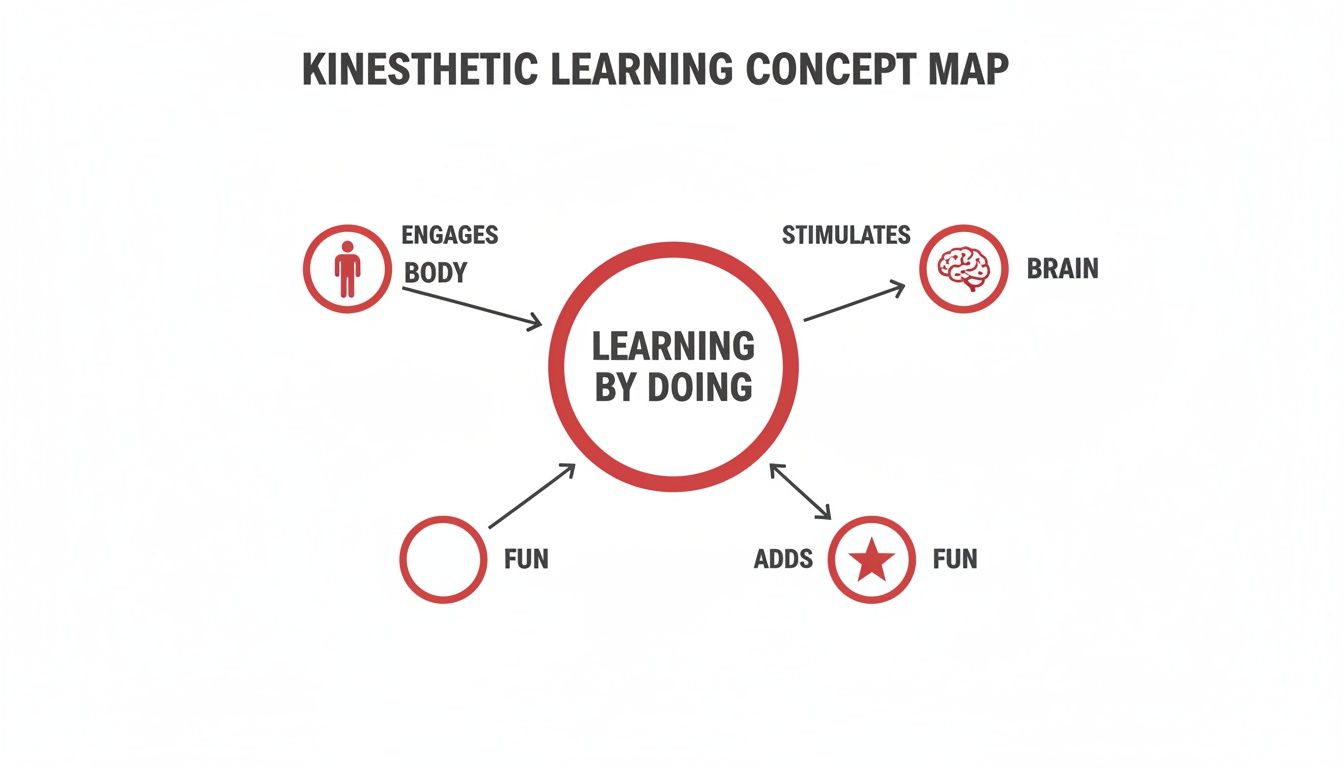
As you can see, learning by doing is a holistic process. It pulls in multiple senses and cognitive functions at the same time, which is what makes it so much more effective—and honestly, more enjoyable.
How Movement Cements Knowledge
The link between moving and thinking is incredibly deep. Physical activity gets more blood and oxygen flowing to the brain, which naturally boosts focus and cognitive function. Fields like applied kinesiology dive deep into this intricate relationship between body movement and brain performance.
But this isn't just about general brain health; it’s about how memories are actually encoded. When a student builds a model of a DNA strand with pipe cleaners, their brain forges a link between the tactile sensation, the physical act of building, and the scientific concept itself. This multi-sensory connection creates a much richer, more durable memory than just reading about it.
Not Just for a Select Few
While getting up and moving benefits all students, it’s an absolute game-changer for some. Neil Fleming’s foundational VARK model highlights different learning preferences, and it turns out that traditional classrooms often leave a key group behind. Shockingly, only 10-18% of students from kindergarten through college are identified as primarily kinesthetic learners, yet the "sit-and-listen" model is still the default.
By ignoring the need for action, we risk disengaging a huge chunk of students who learn best when they are on their feet. Integrating kinesthetic teaching strategies isn't just a niche approach; it’s a must-have for truly inclusive education.
This idea fits perfectly with constructivist principles, where learners actively build their own understanding through direct experience. If you're curious, you can learn more in our guide on what is constructivist learning theory and how it works.
At the end of the day, building with blocks or mixing ingredients for a volcano experiment aren't just "fun activities." They're powerful brain-building exercises that lock in learning in a way that passive listening never could.
Putting Kinesthetic Strategies into Practice
Knowing the "why" behind kinesthetic learning is one thing, but actually turning that theory into an organized, engaging classroom activity is the real goal. The good news? You don't need to throw out your entire curriculum. Just introducing small, deliberate movements can make a world of difference for engagement and memory.
The key is to start with lesson plans you already use and look for simple opportunities to get students out of their seats. When you turn passive tasks into active ones, you’re not just helping your kinesthetic learners—you're making the concepts stick for everyone.
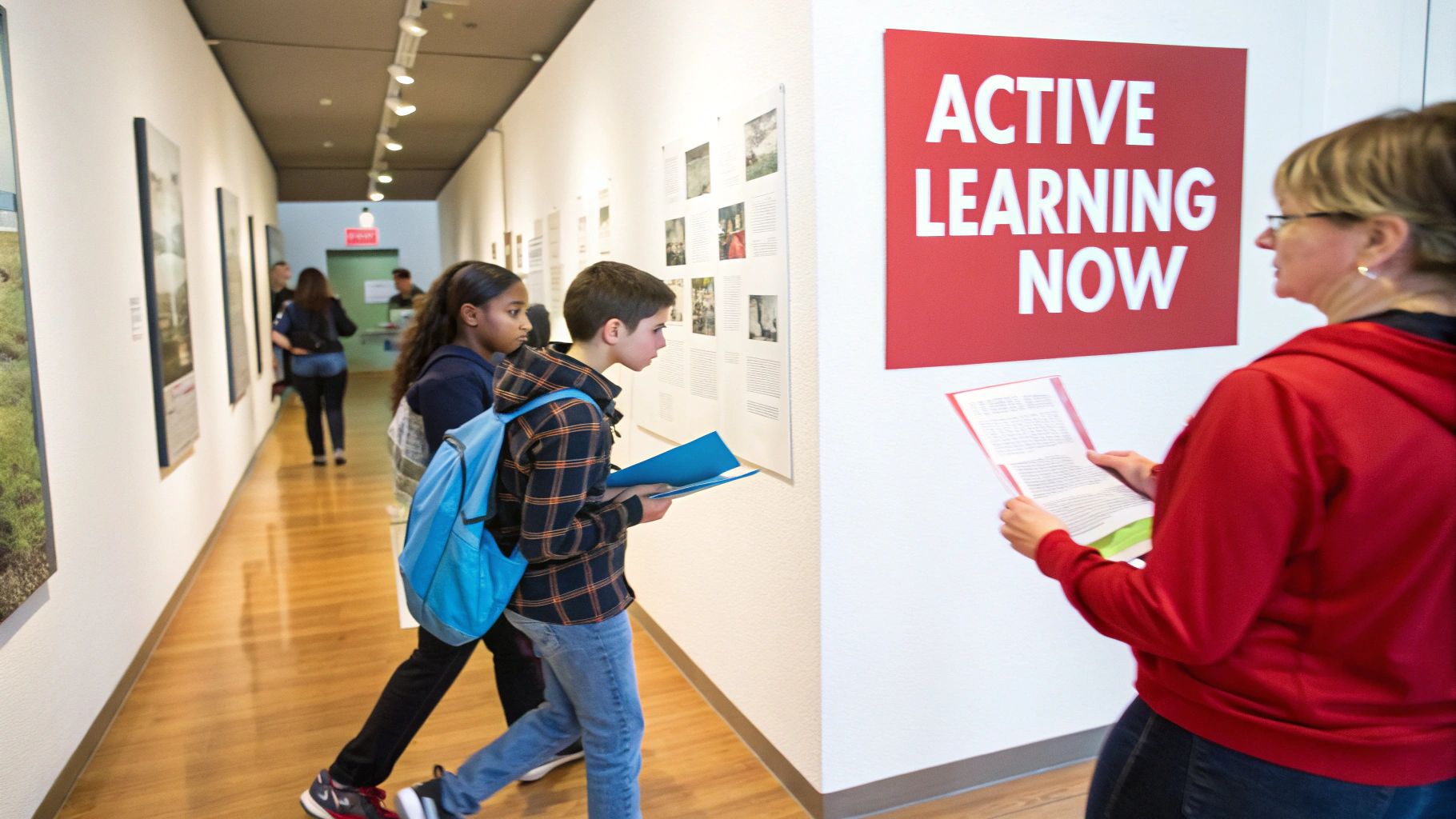
This shift isn't just a nice-to-have; it's a critical adjustment for modern classrooms. Landmark studies have pointed out a huge mismatch in education: while up to 50% of secondary students might learn best by doing, a staggering 70-80% of class time is still dominated by traditional lectures.
Even weaving in just a handful of kinesthetic-focused activities can dramatically boost student confidence and problem-solving skills.
Easy to Implement Kinesthetic Teaching Strategies
Ready to get started? Here are a few adaptable, actionable strategies that work across different subjects and grade levels. Each one is a simple way to transform a standard lesson into an interactive experience.
- Gallery Walks: Instead of a worksheet, post questions, images, or problems around the room on different "stations." Students move from one to the next, either alone or in small groups, to discuss, solve, or analyze. It’s a simple tweak that gets kids moving and collaborating.
- Role-Playing and Reenactments: Bring history or literature to life by letting students act it out. Have them reenact a scene from a novel or take on roles for a historical debate. It makes the material personal and much harder to forget.
- Human Graphs: This one is a classroom favorite. Use the floor as a giant, imaginary graph. Ask a question with a range of answers (like, "On a scale of 1 to 10, how much did you trust this character?") and have students physically stand on the spot that represents their answer. It’s a living bar chart!
The goal isn't chaos; it's purposeful movement. Every kinesthetic activity should have clear instructions and connect directly back to what you want students to learn. When managed well, an active classroom is an engaged classroom.
Transforming Traditional Lessons with Kinesthetic Activities
It's often easier to see the potential when you compare a static lesson with a dynamic one. Here’s a quick comparison of how you can swap out traditional methods for more hands-on alternatives across different subjects.
| Subject | Traditional Method | Kinesthetic Alternative |
|---|---|---|
| Math | Solving a worksheet of fraction problems at a desk. | Using measuring cups with water or sand to physically combine and compare fractions. |
| Language Arts | Writing vocabulary definitions from a list. | "Vocabulary Charades" where students act out the meaning of new words. |
| Science | Reading about the states of matter in a textbook. | Having students act as "molecules"—huddled tight for solid, moving around for liquid, and spreading out for gas. |
| Social Studies | Listening to a lecture about the branches of government. | Dividing the class into three groups (legislative, executive, judicial) to debate and "pass" a mock bill. |
The learning objective stays the same, but the experience of learning becomes much more memorable and effective.
Managing a Dynamic Classroom
One of the most common worries teachers have about active lessons is losing control of the classroom. But a little structure goes a long way. Before you start, lay out the ground rules, explain the goal, and show students what success looks like. Use a clear signal—like a chime or a simple hand clap—to bring everyone’s attention back when you need to.
Sometimes, even small tools can help students channel that restless energy. Something as simple as a wooden wobble board under a desk can help a fidgety student focus during quieter work periods.
Assessing what students learned during these activities also looks a bit different. Instead of a formal quiz, try observing. Listen to their conversations, ask guiding questions as they work, and use quick "exit tickets" where they jot down one key takeaway before leaving. This gives you a fantastic, real-time snapshot of their understanding.
Many of these hands-on approaches fit perfectly with other student-led methods, which you can learn more about in our guide to inquiry-based learning activities.
Bringing Active Learning Into Your Home
You don’t need a formal classroom setting to spark a lasting love of learning. Your home is already a fantastic laboratory for discovery. With just a few simple shifts in perspective, you can turn everyday moments into powerful, hands-on educational experiences.
The goal isn't to replicate school at the kitchen table. It’s about leaning into the natural curiosity that makes kids want to touch, build, and figure things out for themselves. When you create opportunities for them to physically engage with ideas, abstract concepts suddenly become tangible, screen time naturally decreases, and you'll see their problem-solving skills grow—all without needing complicated lesson plans.
Turn Your Home Into a Learning Playground
Integrating kinesthetic activities at home is all about seeing the learning potential in things you already do. It’s making small, intentional changes that invite your child to learn by doing.
- Kitchen Science: Baking is just chemistry in action. Let your child measure the flour (math), mix the batter (fine motor skills), and watch how heat transforms it all in the oven (a lesson in states of matter). Prompt them with questions like, "What do you think will happen when we add the baking soda?"
- Living Room Engineering: Building a fort with blankets and pillows is a classic for a reason. It's an intuitive lesson in physics, structural integrity, and spatial reasoning. Give them a little challenge: "Can you make the entrance taller?" or "How can we make the roof stronger?"
- Backyard Math Hunt: Why sit with a worksheet when you can go on an adventure? Hide numbered items around the yard and have your child find them in order. Or, create a scavenger hunt where they have to find "three round leaves" or "five smooth stones."
These simple activities layer learning with genuine fun, making it feel less like a chore and more like what it should be: play.
Low-Prep Kinesthetic Activities for Any Day
You don't need to spend hours prepping to create a meaningful hands-on experience. Here are a few ideas you can pull out on a moment's notice to get your child moving, thinking, and learning.
The most effective kinesthetic strategies often feel like games. When a child is physically and emotionally invested in an activity, their brain is primed to absorb and retain new information.
For instance, a simple walk around the block can become a full-blown sensory exploration. You can learn more about the power of engaging multiple senses in our guide on what is sensory play.
Here’s a quick comparison of how a simple shift can make learning active:
| Topic | Passive Approach | Active Kinesthetic Approach |
|---|---|---|
| Learning Letters | Using flashcards or an app. | Forming letters with modeling clay, writing them in sand, or finding objects around the house that start with that letter. |
| Understanding Weather | Watching a weather report on TV. | Making a simple rain gauge for the backyard, creating a "wind sock" from a plastic bag, or acting out different types of weather. |
| Practicing Counting | Completing a math worksheet. | Counting steps on the way to the car, sorting colored beads into groups, or lining up toy cars and counting them one by one. |
By using what you already have, you can transform your home into a dynamic environment where learning happens naturally through movement, curiosity, and play.
How Hands-On Play Supercharges STEM Skills
For many kids, subjects like physics and chemistry can feel like a foreign language. The concepts often seem abstract, floating in a textbook with no connection to the real world. This is exactly where kinesthetic teaching strategies save the day, turning those complex ideas into something kids can actually touch and feel.
Think of hands-on play as the bridge between abstract theory and real-world understanding. When a child builds a simple circuit with a battery and a lightbulb, the concept of electricity stops being just a diagram. It becomes a real, observable force they can control. They aren't just reading about electrical flow; they're making it happen.
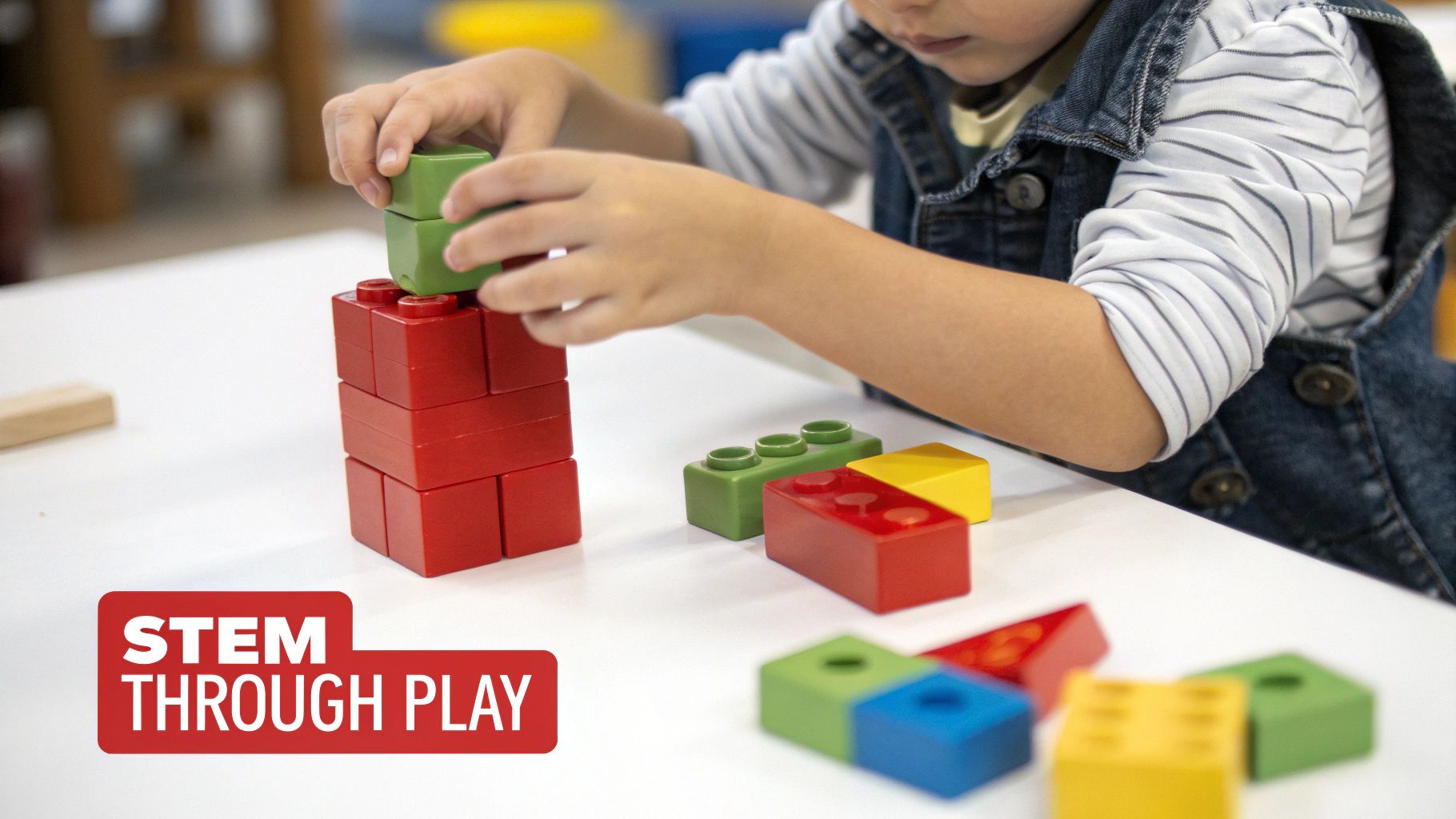
This kind of active engagement is far more powerful than just sitting and listening. In fact, research shows that learners can retain up to 75% of what they learn when they do a task, compared to just 10% from reading alone. By physically experimenting with materials, kids build a deeper, more intuitive grasp of how the world works.
Building Skills Beyond the Classroom
The magic of using kinesthetic strategies in STEM goes beyond just memorizing formulas. These activities are powerhouses for developing life skills that matter for future success, both in school and in a career.
When a child is trying to build a tower with blocks, they’re doing much more than just stacking shapes. They're diving headfirst into a process that builds foundational cognitive abilities.
- Problem-Solving: "Why does my tower keep falling over?" That question sparks an immediate, hands-on investigation into balance, weight distribution, and structural integrity.
- Spatial Reasoning: Kids learn to mentally rotate objects, see how pieces fit together, and understand the relationships between shapes in a 3D space.
- Creative Thinking: Hands-on play is all about experimentation. There’s no single "right" way to build a fort or design a marble run, which is fantastic for fostering innovation.
These are the very skills that form the foundation for careers in fields like engineering, architecture, and design.
By turning learning into a physical exploration, we do more than just teach STEM concepts; we cultivate a mindset of curiosity, resilience, and creative problem-solving. It shows children that challenges are puzzles to be solved, not problems to be feared.
From Playtime to Pathways
The link between hands-on play and future success in STEM is crystal clear. Getting kids involved in these kinds of activities helps demystify science and math, making them feel fun and approachable. A child who has a blast building a baking soda volcano is far more likely to walk into a high school chemistry class with confidence instead of dread.
This early foundation is what inspires the next generation of innovators. You can find more ways to build these skills with our guide to STEM activities for elementary students. By bringing kinesthetic learning into their lives, we aren't just teaching science—we're nurturing the future scientists, engineers, and big thinkers of tomorrow.
FAQs: Your Questions on Kinesthetic Learning Answered
Even after diving into the world of hands-on teaching, it’s normal to have questions. We’ve pulled together answers to the most common questions from parents and educators to help you feel confident bringing more movement into your home or classroom.
Is kinesthetic learning just for kids with ADHD?
This is a common myth, but the answer is a resounding no. While it's true that kinesthetic strategies are a fantastic outlet for kids with ADHD, offering a positive way to channel their energy, these methods benefit every child.
Think about it—we all learn better when more of our senses are involved. Adding movement to a lesson helps lock in memories, sharpens focus, and gets kids genuinely excited about what they're learning. It’s a universal tool, not a specialized fix.
How do I know if they're actually learning during hands-on activities?
Grading a hands-on activity isn't like marking a worksheet, and that's a good thing! It often gives you a much deeper insight into what a child truly understands. The key is to shift from looking for right-or-wrong answers to observing and communicating.
You can get a great read on their comprehension by:
- Asking "Why" and "How" Questions: Try prompts like, "Walk me through the steps you took here," or "What do you think would happen if you moved that piece?"
- Watching Their Process: Pay attention to how they solve a problem. Are they testing ideas? Working well with a partner? Can they explain the reason behind their choices?
- Doing a Quick "Show and Explain": Ask kids to present what they built or created. Their ability to talk about their work is a fantastic window into their understanding.
The goal isn't to test memorization, but to see their thinking in action.
What’s the best age to start with kinesthetic learning?
You can start from day one! In fact, you don't really "start" it at all—you just lean into what kids do naturally. Toddlers and preschoolers are the ultimate kinesthetic learners; it's how they figure out the entire world.
Every time a baby grabs for a rattle or a toddler figures out how to stack blocks, they're learning by doing. It's not a formal strategy you need to introduce. It's an instinct you can encourage and build on.
Simple things like sensory bins, finger painting, or building forts are all kinesthetic learning in its purest form. As kids get older, the activities just get a little more complex. It's never too early to support this innate learning style.
How can I use these strategies if I don’t have much space?
You don't need a huge classroom or a sprawling backyard to make this work. The magic is in the hands-on interaction, not necessarily big, sweeping movements. Plenty of powerful learning activities can happen right at a desk or on a small rug.
A child can use modeling clay to shape letters and numbers, sort colorful beads to practice patterns, or build a simple circuit on a tray. What matters is the physical manipulation of the learning tools, which can happen in just about any corner of a room.
Here at Playz, we're all about turning abstract concepts into tangible, unforgettable adventures. We believe that hands-on exploration is what unlocks a child's true potential. Our science kits are designed to do just that, making learning something they can touch, build, and experience.
Ready to bring more active, joyful learning into your world? Check out our collection of award-winning STEM toys at Playz and discover for yourself why #KidsLearnBestThruPlayz.