

Your two-year-old turns a stacking toy upside down, wears one cup as a hat, and drops the others into a laundry basket. You wonder whether the toy is being “used correctly,” especially after seeing a box promise engineering, problem-solving, and early math.
That play is already useful. At age two, children learn through repeating actions, testing limits, copying adults, and giving familiar objects new jobs. The question isn't whether your child is performing the activity as pictured. It's whether the toy is safe, easy to handle, and flexible enough to support the way a two-year-old explores.
Why STEM Toys for Two Year Olds Look Different Than You Think
A two-year-old rarely approaches a toy with the tidy sequence shown in a product photograph. A stacking ring becomes a bracelet. A shape sorter becomes a container for crackers. Blocks become towers, roads, food, or something to knock down immediately.
That doesn't mean the learning disappeared. The child is testing size, balance, force, fit, and what happens next. The useful distinction is between marketing language and developmental readiness. A box may use the word STEM for a toy that flashes, counts, or names shapes, but a toddler may gain more from a quiet object that can be grasped, moved, filled, emptied, and rebuilt.
A helpful overview of play-based learning benefits can give parents broader context, but your child's actions should remain the most important guide. Watch what your child repeats without being prompted. Does your child stack, pour, match, hide, connect, or carry objects from one place to another?
The toddler version of STEM
For two-year-olds, STEM play usually looks like:
- Building: placing one large block on another, then rebuilding after it falls.
- Sorting: putting similar objects together by color, shape, size, or type.
- Measuring informally: noticing that one cup holds more water than another.
- Testing cause and effect: pushing, dropping, rolling, pulling, and watching what changes.
- Communicating: naming actions, asking for help, or following a short sequence.
Research on early STEM education has an important limitation. A 2026 scoping review found that toddlers remain largely absent from formal play-based STEM studies, with very few studies including this age group (Nordic Journal of Comparative and International Education). That means parents should be cautious with sweeping claims about specialized toddler kits.
The strongest filter is simpler: choose materials that match what a two-year-old can manipulate and understand today. Blocks, chunky sorters, nesting cups, large balls, tubes, and supervised water play make sense because they meet children at the level of movement, repetition, and discovery.
The Milestones That Make STEM Play Click at Age Two
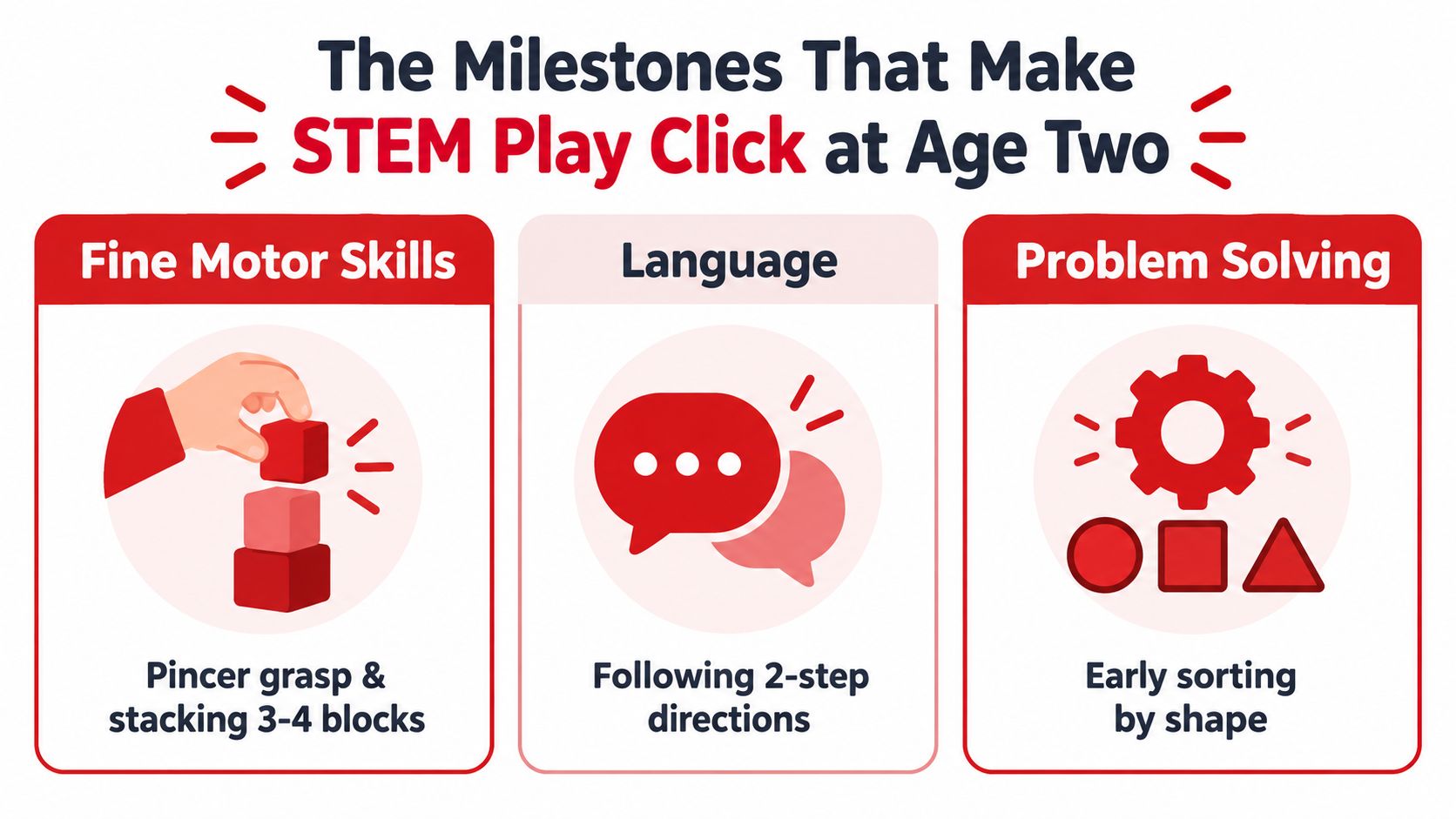
Around age two, children are gaining control over small objects, though their coordination still varies widely. Many can scribble, build a tower of three to four blocks, and turn pages in a cardboard book, according to health guidance for children from 18 months to 3 years.
Three abilities to notice
Fine-motor control helps a child grasp, release, stack, thread, pour, and place. A large connector or chunky block gives the hand a manageable challenge. Health guidance for this age also recommends activities such as building blocks, threading large beads or pasta, and using tweezers or tongs, because these actions involve grasping, releasing, and coordinating both hands.
Language and listening turn an action into a shared investigation. A child who can follow a simple two-part direction, such as “put the block in the box, then close the lid,” is ready for short building sequences. Your child may not follow the direction every time, especially when tired, but the ability to understand a sequence is more important than perfect compliance.
Early problem-solving often appears as trial and error. A toddler may try the wrong hole several times, rotate a piece, or change the position of a block after a tower falls. Sorting by one clear feature, such as putting all the red pieces together, is more realistic than expecting a complicated pattern.
Useful question: Can my child repeat the action independently, with a little help, without needing tiny pieces or a long explanation?
A 15-month-old may explore a cup by banging it, mouthing it, or carrying it. A 30-month-old may begin combining several pieces with a purpose, such as making a longer road or sorting objects into more than one group. A two-year-old sits between those stages, so the best toy offers one obvious action and room for the child to add complexity.
You can read more about childhood development milestones, but don't use milestones as a pass-or-fail test. Development follows a range. If your child isn't interested in stacking, the same skills may appear through pouring, pushing, carrying, fitting, or pretend repair.
How to Tell If a Toy Is Safe and Ready for a Two Year Old
At pickup, a parent may show you a toy marked “STEM” and “toddler,” expecting an easy yes. The label describes the marketing promise. Your child's hands, mouth, coordination, and attention determine whether the toy belongs in today's play space. Start with safety, then ask whether the toy offers an action a two-year-old can manage.
Run the box checklist
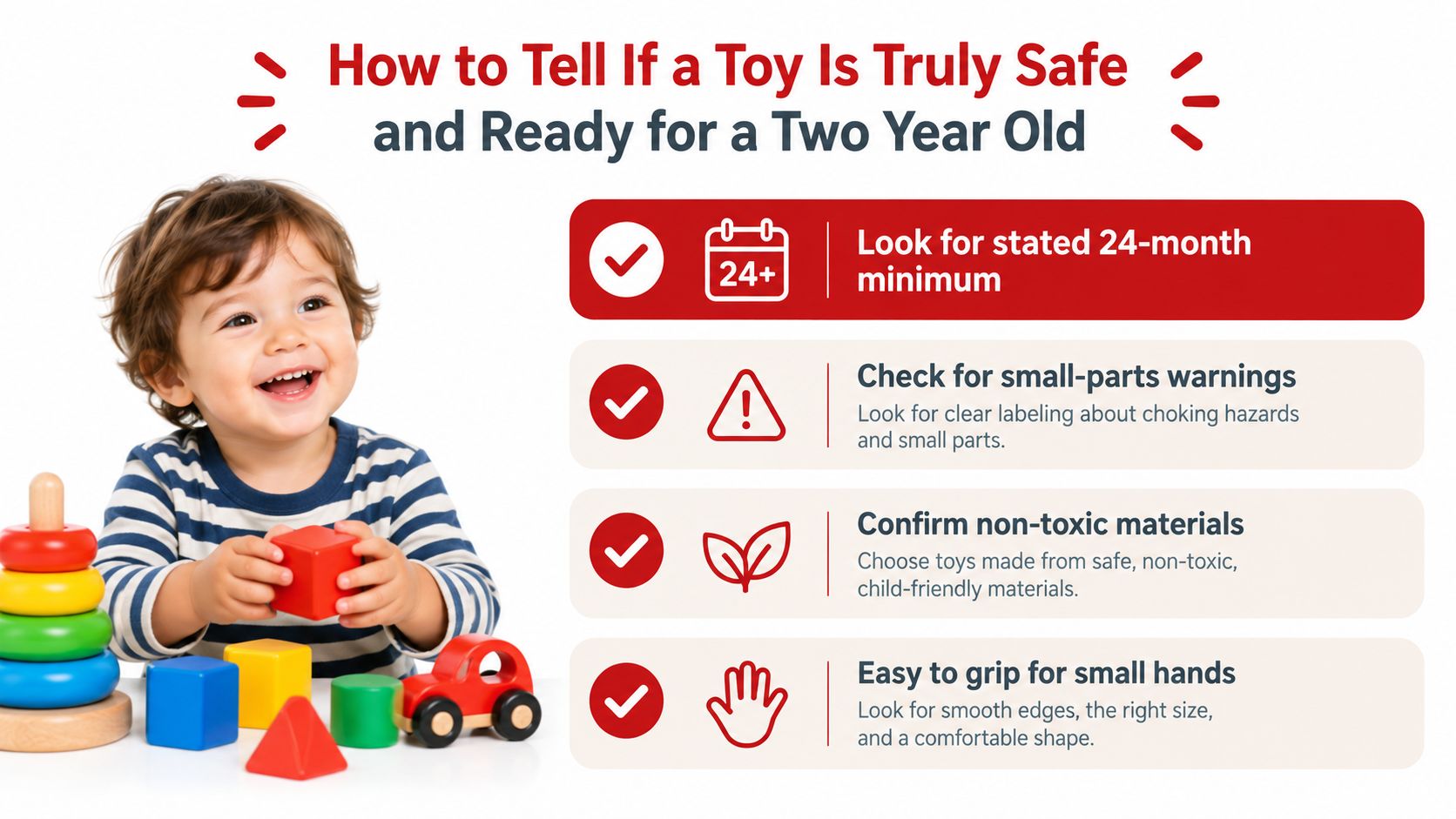
- Check the age range: Look for a stated minimum that includes 24 months. “Toddler” is not a precise safety category, so read the manufacturer's range.
- Read the small-parts warning: Under US consumer-safety rules, an object that fits completely inside the small-parts cylinder is a choking hazard for children under three. The CPSC defines that cylinder as 2.25 inches long by 1.25 inches wide (CPSC small-parts regulation).
- Look for material information: Choose products that identify their materials and explain care. A “non-toxic” label should make clear what the manufacturer means. This guide to non-toxic toys for babies offers another way to examine material claims.
- Inspect the shape: Choose rounded edges, secure connections, and smooth seams. Pieces should fit comfortably in small hands without requiring a hard squeeze.
- Check testing information: Toys intended or designed primarily for children 12 years of age or younger must be tested by a CPSC-accepted third-party laboratory and certified by the manufacturer or importer in a Children's Product Certificate (CPSC toy safety guidance).
Do a two-minute home test
Before handing over a new toy, pull each piece firmly, twist connectors, bend flexible parts, and drop the toy from a low height onto a hard floor. Inspect every component afterward, including parts attached to a larger piece. A toy that survives packaging and shelf display can still have a weak connector.
Use the size guidance as a practical filter. Toddler toys should be at least 1¼ inches, or 3 cm, in diameter, and 2¼ inches, or 6 cm, in length. Avoid balls 1.75 inches, or 4.4 cm, or smaller, because they can lodge above the windpipe (pediatric toy guidance). Supervise closely when play involves cords, flexible parts, water, or mouthing.
A safe toy also needs a manageable first move. If your child cannot grasp, connect, pour, or place the parts without a long demonstration, the “engineering” feature may be ahead of the child. Look for one clear action, then room to repeat it and change the result.
Do Two Year Olds Really Need a STEM Toy at All
A specialized STEM label isn't a developmental requirement. A two-year-old's core work is often to repeat, stack, drop, sort, carry, and notice what changes. Cardboard tubes, metal bowls, wooden blocks, and plastic cups can support those same habits without a branded kit.
Consider a hypothetical comparison. A $40 engineering kit might offer chunky pieces that connect in a few ways. A set of cardboard tubes and wooden blocks can also invite sequencing, cause-and-effect testing, and rebuilding, provided the materials are safe and supervised. The kit earns its place when it offers stronger construction, easier cleanup, a useful storage system, or pieces that match your child's current interest.
What matters more than the label
The word STEM doesn't create learning by itself. Your child still needs to handle the object, decide what to try, and notice the result. When you say, “That block fell when you put the big one on top,” you add vocabulary and attention to the physical experience.
Open-ended materials also make it easier to adjust the challenge. Start with two cups to pour between, then add a funnel. Begin with a short tower, then invite your child to build one “as tall as your hand.” The child remains in control, while you introduce language and a small next step.
The best purchase is often the one your child can use in several ways, safely, without waiting for an adult to demonstrate every move.
Buy when the toy is durable, oversized, washable, and flexible. Borrow when you're unsure whether the interest will last. Improvise when your child is focused on a clear theme, such as pouring, fixing, collecting, or rolling. A toy that supports repeated handling may be more valuable than one with a longer feature list.
Play Scenes That Turn Any Toy Into a STEM Activity
At two, STEM play usually looks like a child testing an idea with ordinary objects. Put safe materials within reach, watch the choice your child makes, and add one sentence that helps them notice the result. These scenes build on our guide to learning activities for toddlers at home, adapted for a two-year-old's short attention span. They also show how play supports child development when adults join without taking control.
Blocks on the rug
Place large wooden blocks on a clear rug. Your child may stack them, knock them down, change the order, and try again. Each attempt gives them a simple test of balance, gravity, size, and cause and effect.
Ask, “What could make your tower stay up?” Then wait. A falling tower is useful information, so resist rebuilding it for your child. Use blocks with stable shapes and no detachable small pieces. This scene supports fine motor control, spatial reasoning, and cause-and-effect thinking.
Water at the sink
Set out a shallow basin or use the sink with cups, a large funnel, and a ladle. Filling, emptying, and transferring water require controlled wrist movements, while different containers invite early comparisons. Stay within arm's reach, and empty the water as soon as play ends.
A towel under the station protects the floor and makes small spills manageable. You might ask, “Which cup holds more?” Your child may answer by pouring rather than speaking. That action still explores fine motor control, early measurement, and volume.
Sorting into a bowl
Offer large, safe objects such as oversized toy pieces or washable socks. Ask your child to place items in bowls according to one feature, perhaps color or shape. “Can you find all the blue ones?” gives the activity a starting point without requiring a correct performance.
Your child may invent a different rule. Follow it, then name what you see: “You put the soft things together.” Avoid loose pom-poms, bottle caps, and other small objects unless direct supervision and their size make the choking risk acceptable. The play builds classification, early math, and language.
A cardboard ramp
Lean a baking sheet securely against a low, stable surface, then roll large toy cars or balls down it. Change one feature at a time, such as the ramp's height or the object used, so your child can connect the change with the result.
Ask, “Which one reached the bottom first?” Keep the ramp away from stairs and use only large, intact objects. Your child is exploring slope, speed, prediction, and cause and effect through repeated trials.
A kitchen science moment
At the counter, mix flour and water, watch ice melt in a bowl, or test which large household objects float. Your child might point, repeat a prediction, or just watch. Respond to the moment: “You thought it would sink, and it stayed on top.” Keep ingredients and tools away from mouths, allergies, heat, and sharp edges. The goal is observation, prediction, sensory exploration, and vocabulary, not a tidy or technically precise result.
STEM Toy Categories Worth Buying for a Two Year Old
Choose a category based on what your child already enjoys. A child who carries everything may love a construction basket. A child who pours may stay with nesting cups longer than a shape board. A child who pretends to repair the sofa may learn more from a chunky toy screwdriver than from a counting game.
| Category | Example Toys | Core Skill | Buying Check |
|---|---|---|---|
| Building and construction | Wooden unit blocks, large magnetic tiles | Geometry, spatial reasoning, construction | Choose oversized pieces with secure connections and manageable weight |
| Stacking and sorting | Nesting cups, large rings, chunky shape sorters | Sequencing, precision, early problem-solving | Check that pieces are easy to grip and too large to create a choking risk |
| Cause and effect | Ball runs, hammer benches, pop-up pegs | Prediction, timing, hand-eye coordination | Look for stable bases, enclosed paths, and strong joints |
| Matching and early math | Large counters, bowls, tongs, matching boards | Classification, one-to-one handling, language | Favor washable parts and avoid loose pieces that are too small |
| Pretend-play tools | Toy screwdriver set, kitchen kit, doctor bag | Vocabulary, sequencing, social role-play | Check rounded edges, simple mechanisms, and durable handles |
Match the category to the moment
For a builder: Unit blocks and large magnetic tiles support repeated arranging, balancing, and redesigning. They fit a child who already stacks objects or likes making roads and houses.
For a sorter: Nesting and shape-sorting sets offer a clear action without requiring a single perfect solution. Begin with a few large pieces, then add complexity only when your child remains engaged.
For a tester: Ball runs and hammer benches make an action visible. Your child pushes, taps, or drops something and immediately sees a response.
For a collector: Bowls, tongs, and large counters turn gathering into classification. Use them for “all the round ones” or “one in each cup,” while checking every piece for size and durability.
For a role-player: A toy screwdriver, kitchen kit, or doctor bag adds STEM through pretend work. Your child practices sequences such as open, place, close, and explain, while you supply words like “tight,” “empty,” “full,” and “under.”
A useful selection guide for learning toys for toddlers can help you compare options, but the final choice should reflect your child's hands, interests, and supervision needs.
Common Mistakes Parents Make When Buying STEM Toys for Two Year Olds
At the store, a box may promise coding, engineering, or early science. Your two-year-old may be ready for stacking, sorting, filling, dumping, and repeating one action many times. The gap between the marketing claim and the child's actual milestone is where buying mistakes begin.
Mistake one is chasing the label
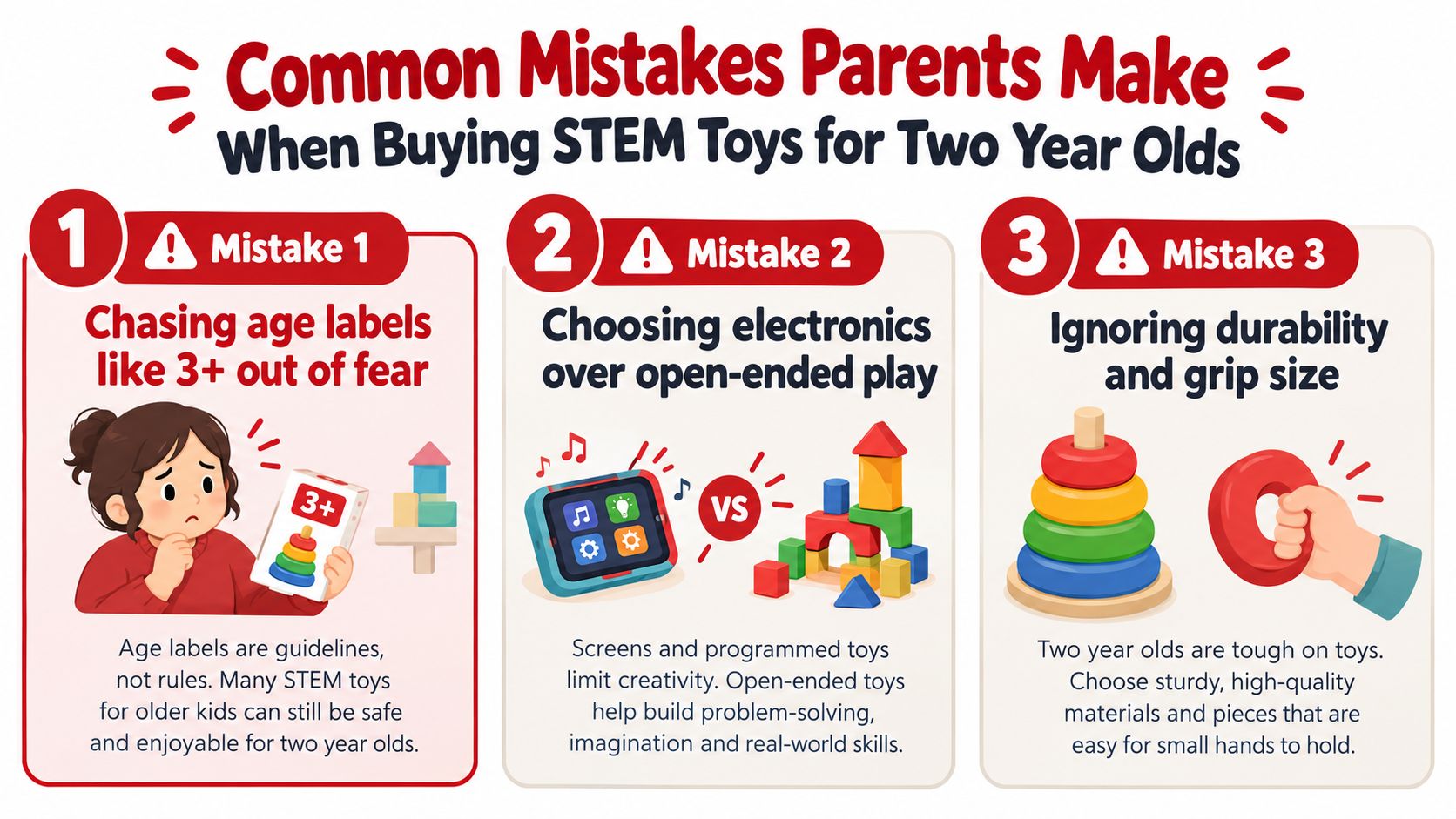
A “3+” label does not mean a younger child cannot enjoy construction or sorting. Buying a toy marked for an older child because it appears more educational creates the opposite problem. Look at grip size, stability, and the number of actions your child must sequence. The box age is one clue, not the whole readiness test.
A toy requiring tiny movements or several instructions may cause frustration even when your child understands the underlying idea. Choose the version that matches what your child can physically do today.
Mistake two is choosing too many pieces
A kit with five to ten chunky pieces may support more independent play than a box filled with fiddly parts and instruction cards. The exact count matters less than whether your child can see a possible action, hold each piece securely, and try again after a failed attempt.
Put extra components away and offer only the pieces that fit the current play scene. Fewer choices can make the next action easier to find.
Mistake three is equating buttons with learning
Flashing lights and electronic sounds can attract attention, yet they do not automatically create problem-solving. Compare a button that repeats one response with a ball run where your child chooses a starting point and watches the result.
Open-ended wooden, silicone, or sturdy plastic designs often leave more of the thinking with the child. The toy supplies the materials. Your child supplies the experiment.
Mistake four is skipping the physical check
A toddler label does not replace inspection. Use the small-parts test described earlier, pull gently on attachments, examine seams, and watch how your child handles the toy during the first session. CPSC guidance treats strings longer than 7 inches on toys for children under three as a strangulation risk and warns that any object fitting inside a toilet paper roll tube is a choking hazard.
Check the toy again after regular use, because cracks, loosened parts, and stretched cords can change its safety profile.
A toy that lets the child do the thinking will usually outlast a toy that performs the whole demonstration.
A Simple This Week Plan and Quick Answers for Parents
Use what you already have. The point of this rotation is not to create four perfect activities. It's to give your child repeated chances to notice balance, volume, classification, and cause and effect.
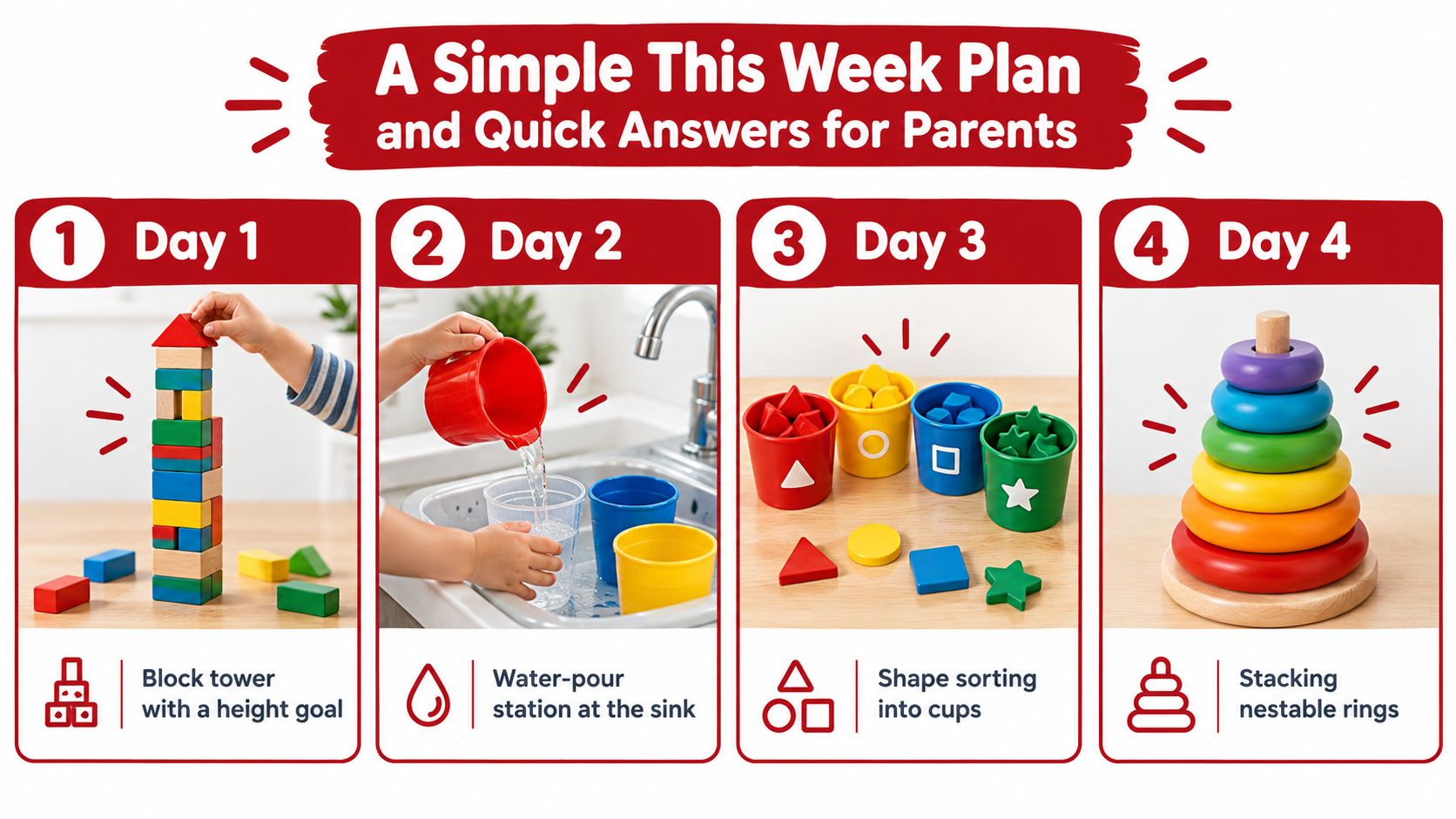
Four low-prep days
Day one, build a block tower with a height goal. Say, “Can we make it as tall as your hand?” Skill focus: balance, spatial awareness, and rebuilding.
Day two, set up a water-pour station at the sink. Say, “What happens when the cup is full?” Skill focus: volume, wrist control, and cause and effect.
Day three, sort kitchen utensils by size and color. Say, “Which ones are long, and which ones are short?” Skill focus: classification, comparison, and vocabulary.
Day four, make a ramp race with a cardboard tube. Say, “Which object will roll farther?” Skill focus: prediction, movement, and cause and effect.
Keep each activity short enough that your child can stop while still interested. Supervise water, food ingredients, household objects, and any toy parts throughout.
If you want a visual version of the rotation, place the activity list on the refrigerator and invite your child to choose the next scene. The adult's job is to prepare a safe setup and add language, not to insist on a finished product.
Two questions parents ask
When should I retire a STEM toy my child has mastered? Put it in a bin for two weeks rather than throwing it away. When you reintroduce it, add one new rule, such as building beside a line, sorting by a different feature, or using the pieces in pretend play.
Do screen-based STEM apps belong in the mix? Occasional co-viewing can be part of family life, but hands-on play should remain primary for this age. Guidance for early childhood media use recommends avoiding screen time for children under two except video chat and limiting routine screen time for children from two to five (Children and Screens early-childhood guide).
Choose one small play invitation this week, stay nearby, and follow your child's curiosity before adding another toy.
Playz offers toys for children in the 2 to 4 years range, including building, stacking, shape-sorting, and creative play options that can fit the milestone filter in this guide. Visit Playz to explore age-relevant choices, then select the materials that match your child's current interests and give them room to build, test, and play.