


Most buying guides sort STEM toys by age and call it a day. That advice is convenient, but it often leads parents toward kits a child finishes once and ignores forever. The better question is harder and more useful: Will this toy keep creating new problems to solve as the child becomes more capable?
The top rated STEM toys aren't necessarily the most expensive, most electronic, or most heavily branded. They offer open-ended construction, hands-on experimentation, social play, and a clear path from simple challenges to harder ones. A magnetic building set that becomes a bridge, a city, or a marble machine can outperform a flashy kit with better packaging but only one scripted result.
Use this guide to judge replay value, developmental fit, cost per play, learning depth, and safety. The recommendations focus on toys that earn their place in a home, classroom, or childcare setting.
Why Most STEM Labels Are Misleading
A STEM sticker doesn't guarantee STEM learning. Manufacturers can market a toy as STEM without meeting a formal minimum educational standard, so the label tells you far less than the toy's actual design. Independent guidance on how STEM toys teach math and science recommends judging products by observable features such as active, meaningful, open-ended, and socially engaging play.
That distinction matters. A child who follows a fixed sequence, presses a button, and watches a result may have an entertaining experience, but the toy gives limited control over the learning. A stronger design lets the child change variables, make predictions, encounter failure, and try again.
The features that matter most
Look past the box art and inspect the play pattern.
- Open-ended construction: Can children build more than one final object?
- Visible cause and effect: Does changing a wire, angle, material, or sequence alter the result?
- Iteration: Can a child improve a design rather than only complete it?
- Multiple difficulty levels: Does the toy grow with the child?
- Social use: Can siblings, classmates, or adults solve problems together?
- Transferable skills: Does play support reasoning that applies beyond the kit?
A single-script chemistry activity can introduce a concept, but a reusable circuit board or modular construction system creates more opportunities for independent investigation. The best products don't remove every obstacle. They provide enough structure to get started and enough flexibility to let children take ownership.
Practical rule: If the instructions disappear and the toy has nothing left to offer, it isn't a strong long-term STEM purchase.
For more ideas focused on purposeful, hands-on play, explore STEM toys for kids, then apply the same test to every product you consider. A top rating should describe the child's experience, not the marketing department's vocabulary.
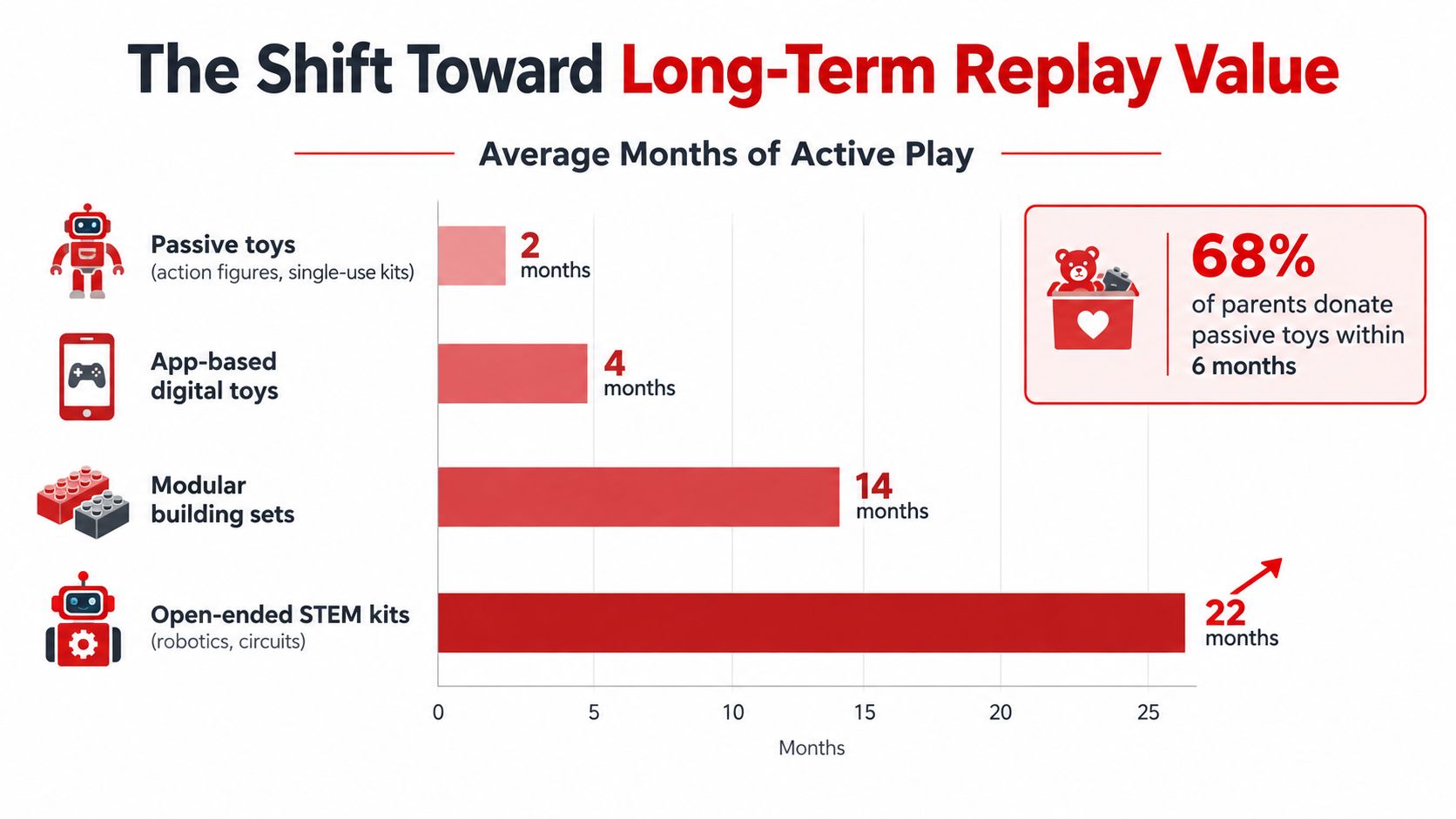
The Shift Toward Long-Term Replay Value
Parents are moving away from toys that deliver one impressive reveal and toward systems children can revisit, modify, and combine. That change is visible in the wider educational-toy market. One educational-toy market forecast projects growth from USD 72.08 billion in 2025 to USD 118.08 billion by 2031, while forecasting STEM toys to expand at a 9.92% CAGR through 2031. The same research places STEM toys at 35% of the global educational-toys market in 2025, making them the largest product segment in that market.
Those figures don't mean every STEM purchase will be worthwhile. They show that families and educators are assigning more value to toys that combine play with coding, engineering, experimentation, and problem-solving. Product design now matters more than a generic claim that a toy is educational.
Why modular toys stay useful
Building sets remain a major part of the category. A STEM toy market analysis reports that building sets held 34.6% of 2025 revenue, while robotics kits are forecast to grow at an 11.1% CAGR. The practical lesson is clear: building remains the reliable foundation, but robotics and coding are adding deeper progression.
A strong modular toy supports several stages of play:
- The child copies a simple model.
- The child changes the model and notices what happens.
- The child designs without a model.
- The child explains, tests, and improves the design.
- The child combines the toy with another system.
Magnetic tiles, circuit systems, marble runs, and robotics platforms all benefit from this structure. They can begin as guided activities and later become independent design tools. That makes them better purchases than kits that produce a single robot, volcano, or decorative object and then stop.
For a closer look at reusable experiments and hands-on building, compare the options in educational STEM kits. The right kit isn't the one with the longest parts list. It's the one that gives children a reason to return tomorrow.
Matching Toys to Developmental Milestones
Age labels are useful, but they're only a starting point. Children can begin exploring STEM ideas in preschool, while common guidance separates products into ranges such as 3 to 7 years and 8 years and up to better match counting, basic engineering, and programming with developmental ability, as explained in expert STEM toy age guidance.
Choose the cognitive task first, then choose the product. A preschooler who struggles with fine-motor control needs a different entry point from an older child who can plan a multi-step build and debug code.
STEM Toy Categories by Developmental Stage
| Age Range | Primary Toy Category | Core Skills Targeted | Playz-Aligned Activity |
|---|---|---|---|
| 3 to 5 years | Magnetic tiles, large building pieces, counting manipulatives, simple observation tools | Pattern recognition, counting, spatial reasoning, vocabulary, fine-motor control | Build a shelter or animal habitat, then sort, count, and compare the pieces |
| 5 to 7 years | Beginner science kits, gear systems, construction sets, screen-free sequencing toys | Prediction, measurement, cause and effect, basic engineering, following and changing sequences | Test which structure stands longest, or create a picture-based experiment sequence |
| 7 to 9 years | Marble runs, circuits, logic games, guided robotics | Planning, debugging, variables, balance, systems thinking | Design a route, identify where the system fails, and modify one part at a time |
| 8 to 12 years | Modular robotics, advanced electronics, microscopes, physics builds | Computational thinking, data collection, technical communication, design iteration | Build a working model, record observations, and explain why the design works |
| Teens | Programmable robotics, advanced lab equipment, engineering platforms | Abstract reasoning, coding, experimental design, independent research | Set a design goal, document failed attempts, and present a working solution |
For younger children, large and flexible materials beat complexity. Magnetic tiles, construction pieces, counting cubes, and nature tools support spatial reasoning and observation without requiring reading or an app. A creative play tent can become a weather station, veterinary clinic, animal habitat, or engineering headquarters when an adult adds a problem to solve.
Children in the middle years can handle more structure, but don't confuse instructions with learning. A beginner chemistry kit is useful when children predict what will happen and discuss the result. It becomes a demonstration if an adult performs every step while the child watches.
Select for the next challenge, not the current label
For older children, choose a platform with a genuine ceiling. A modular robotics system, circuit board, or marble run should allow increasingly difficult challenges. A child might begin by copying a design, then alter the mechanism, troubleshoot a failure, and eventually create a device for a self-defined purpose.
Parents comparing enrichment options may also find it useful to ask whether Quantum LEEP Academy is right for your child's learning style, especially if the child enjoys science but needs a more structured environment. A toy and a program serve different purposes, so don't use one to compensate for the absence of the other.
Before buying, observe what the child already does naturally. A child who builds ramps from cardboard may need a physics challenge, not a coding robot. A child who sorts objects and invents rules may get more from a logic game or circuit system than from a large construction set. Developmental fit means meeting current abilities while leaving room for the next useful struggle. The childhood development milestones guide can help frame that choice without reducing every child to an age bracket.
Calculating the True Cost Per Play
The cheapest toy isn't always the best value, and the most expensive robotics kit isn't automatically a better investment. High cost remains a restraint in the STEM toy market, while screen-based entertainment competes for children's attention, according to market coverage of affordability and access.
Evaluate the toy's cost per meaningful play session, not its shelf price. You don't need complicated accounting. You need an honest estimate of how often the toy will create active, satisfying work.
Use this four-part value test
Start with repeatability. Can the child use the materials for new builds or experiments after completing the instructions? A box that supports multiple configurations has a stronger value case than a kit designed around one finished object.
Count the users. A durable construction set shared by siblings, classmates, or a childcare group may deliver more value than a fragile individual kit. Check whether the parts can be sorted, cleaned, replaced, and stored without losing the entire system.
Look at adult involvement. Some toys need constant setup or explanation. That's not necessarily a flaw, but it changes the actual cost. A classroom product that a teacher can prepare quickly and reuse deserves more credit than one that consumes substantial adult time for a short activity.
Price the learning, not the promise. Identify the skills the toy targets. A circuit kit that supports switching, conductivity, and troubleshooting offers more depth than a product that merely lights up when assembled correctly.
Budget rule: Buy one reusable system before buying several novelty kits. Add extensions only after the child has exhausted the original possibilities.
A toy rotation system can also improve value. Put away part of a building set, bring it back with a new challenge, and combine it with household materials such as cardboard, paper, string, or recycled containers. The toy rotation system approach keeps familiar materials feeling fresh without requiring constant purchases.
For educators, record which activities produce independent work, collaboration, and repeated use. That simple record reveals whether a premium kit earns classroom space. For families, the best purchase is often the one that remains available for years and changes with the child's questions.
How Hands-On Play Builds Real Skills
Physical play gives children feedback they can see, feel, and discuss. A bridge collapses, a marble misses its target, a gear turns the wrong direction, or a circuit fails to close. Those outcomes make abstract ideas concrete and give children a reason to revise their thinking.
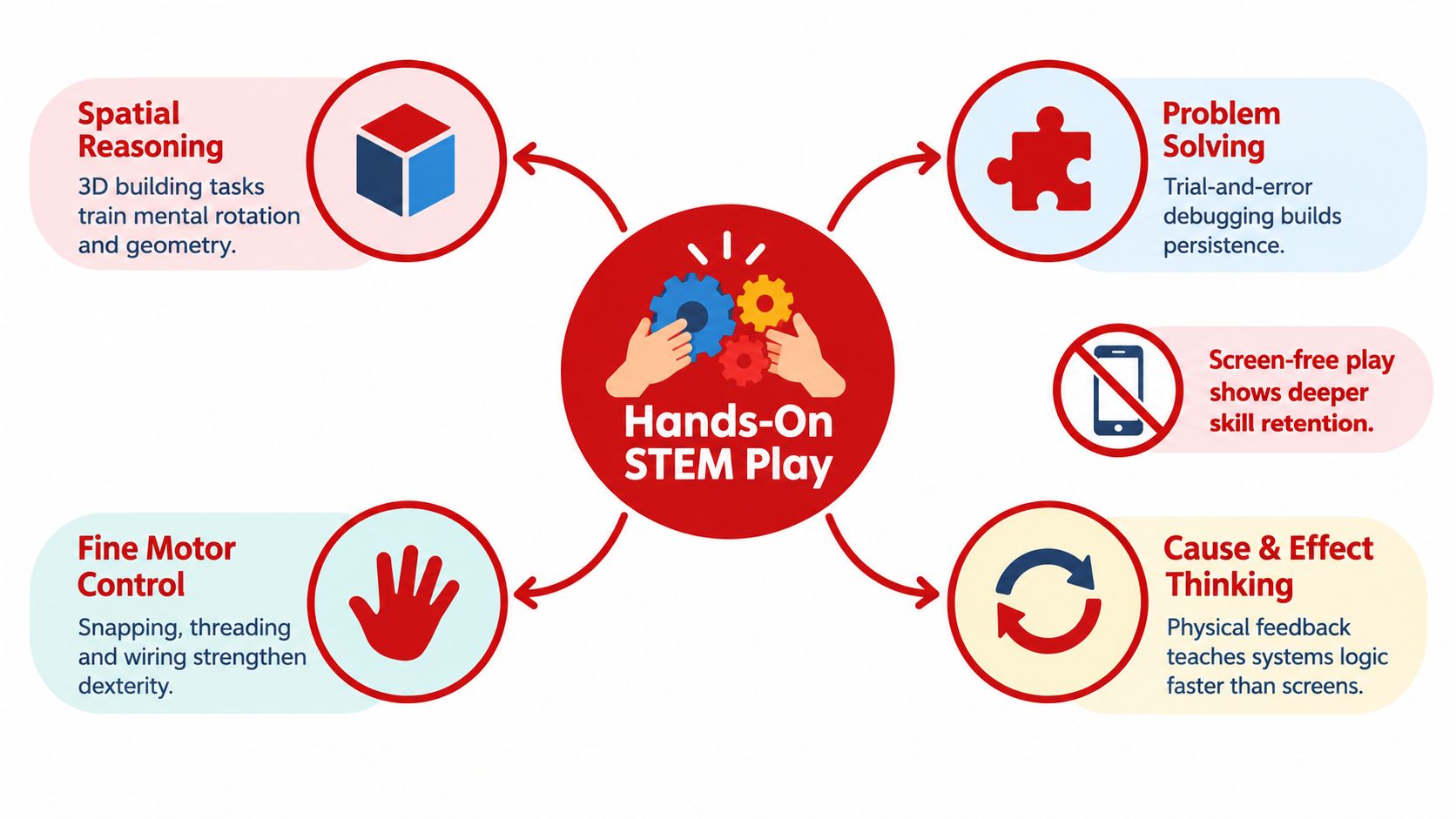
A 2026 systematic review in Frontiers in Education synthesized 131 studies on traditional and digital toys and found that STEM-oriented toys can support problem-solving, collaboration, communication, and computational thinking. The strongest effects typically came from toys that encouraged teamwork and hands-on experimentation, according to the systematic review of traditional and digital toys.
Match the toy to the skill
Different toys specialize. Don't expect one product to develop every STEM ability equally.
- Spatial reasoning: Magnetic tiles, geometric construction sets, and marble runs require children to visualize orientation, balance, and three-dimensional form.
- Problem-solving: Logic mazes and robotics challenges make children plan, test, identify errors, and revise.
- Computational thinking: Sequencing toys and programmable robots teach children to break a goal into ordered instructions.
- Communication: Group builds force children to explain designs, negotiate roles, and defend choices.
- Fine-motor control: Snapping, threading, connecting, and wiring strengthen the physical control needed for later technical work.
The review also illustrates why broad claims about STEM toys need care. In one reviewed study table, Bee-bot scored 35 in science and 28 in technology, while Coko-robot scored 30 in technology and 14 in mathematics, showing that different toys can specialize in different skill domains rather than producing uniform gains across science, technology, engineering, and mathematics.
A child using a robot alone may learn sequencing. Two children designing a maze together also practice communication and perspective-taking. An adult can deepen the experience with questions such as, “What changed when you moved that support?” or “How could you test that without rebuilding everything?”
For educators who want a practical explanation of discovery-based learning, learning by doing with LearnStream offers useful context. The central principle is straightforward: children retain more from making predictions and acting on them than from passively receiving an answer.
Use the benefits of hands-on learning as a practical filter. If a toy keeps the child physically and mentally involved, creates visible consequences, and rewards another attempt, it has the foundation of meaningful STEM play.
Navigating Safety Standards and Certifications
Safety isn't a footnote. A clever activity loses its value if the parts create avoidable hazards or the seller can't explain where the product came from.
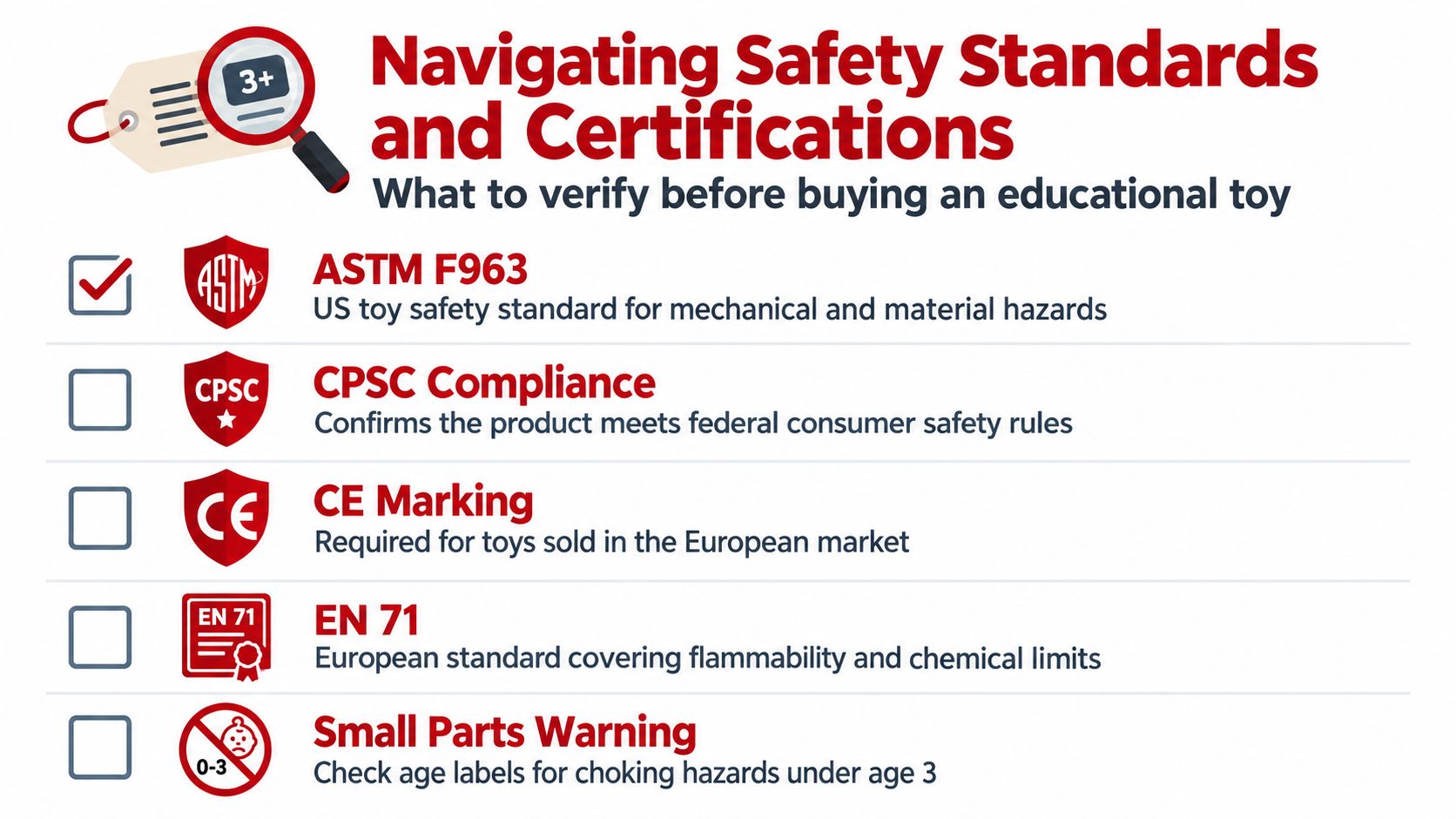
Requirements vary by market. In the United States, relevant rules include ASTM F963 and CPSIA, which address choking hazards, sharp edges, and limits on lead and phthalates. In the European Union, toys must comply with the Toy Safety Directive 2009/48/EC and standards such as EN71, while CE marking indicates conformity, as detailed in this STEM toy safety testing guidance.
Check before you buy
- Read the age guidance: Treat small-parts warnings seriously, especially for children under age 3.
- Verify the market requirements: Look for the applicable safety information for the country where the toy will be used.
- Inspect the seller: Prefer an established retailer or manufacturer with clear contact details, instructions, and product identification.
- Check the materials: Avoid products with strong chemical odors, loose components, sharp unfinished edges, or unclear material disclosures.
- Review the contents: Make sure replacement parts, batteries, protective equipment, and adult-supervision requirements are clearly stated.
- Separate play zones: Keep chemistry activities, magnets, tools, and small components away from younger children who aren't the intended users.
A certification mark shouldn't end your evaluation. Check that the mark belongs to the actual product and not merely to a generic listing image. Be especially cautious with third-party marketplaces that combine several sellers under one product page.
For classrooms, inspect every kit before distribution and maintain a parts inventory. Teachers should also establish rules for goggles, tools, liquids, magnets, and cleanup. The safest top rated STEM toys are the ones adults can supervise confidently because the instructions, hazards, and intended age are easy to understand.
Building a Screen-Free Learning Environment
Screen-free STEM play works best when it feels like a real activity, not disguised homework. Put materials where children can reach them, keep instructions short, and offer a question instead of a lecture. “Can you make it stronger?” creates more ownership than “Build this exactly.”
A useful home setup needs three things:
- A visible work surface: Children need room to spread out pieces, compare options, and leave an unfinished design in place.
- A small supply of flexible materials: Cardboard, paper, tape, string, cups, craft sticks, and building pieces turn one toy into many challenges.
- A place to document ideas: A notebook, sketchpad, or photo record lets children explain what they tried and what failed.
Don't rush to solve problems. If a structure falls, ask what part moved first. If a circuit doesn't work, have the child trace the path. If a robot misses its target, change one instruction or one physical condition at a time. That habit builds persistence without turning play into a test.
Playz offers science kits, STEM kits, and creative play products, including activities connected with chemistry, biology, physics, and electronics. Its catalog can fit a screen-free environment when adults use the materials as starting points for repeated experiments rather than one-time demonstrations.
The strongest buying decision is simple. Choose a toy that invites construction, supports multiple attempts, matches the child's current abilities, and leaves room for a harder challenge. Skip products that depend on novelty, require an app for every meaningful interaction, or offer no satisfying use after the instructions end.
Explore Playz for hands-on science kits, STEM activities, and creative play products that can support purposeful, screen-free learning at home or in the classroom. Choose one flexible kit, set up a place to experiment, and give your child a problem worth solving.