


At its core, the Montessori method of teaching is a child-centered educational approach built on self-directed activity, hands-on learning, and collaborative play. Instead of a teacher dictating lessons to a whole class, children are encouraged to explore their own interests in a thoughtfully prepared environment. This method naturally cultivates independence, confidence, and a genuine love for learning that can last a lifetime.
What Is the Montessori Method of Teaching, Really?
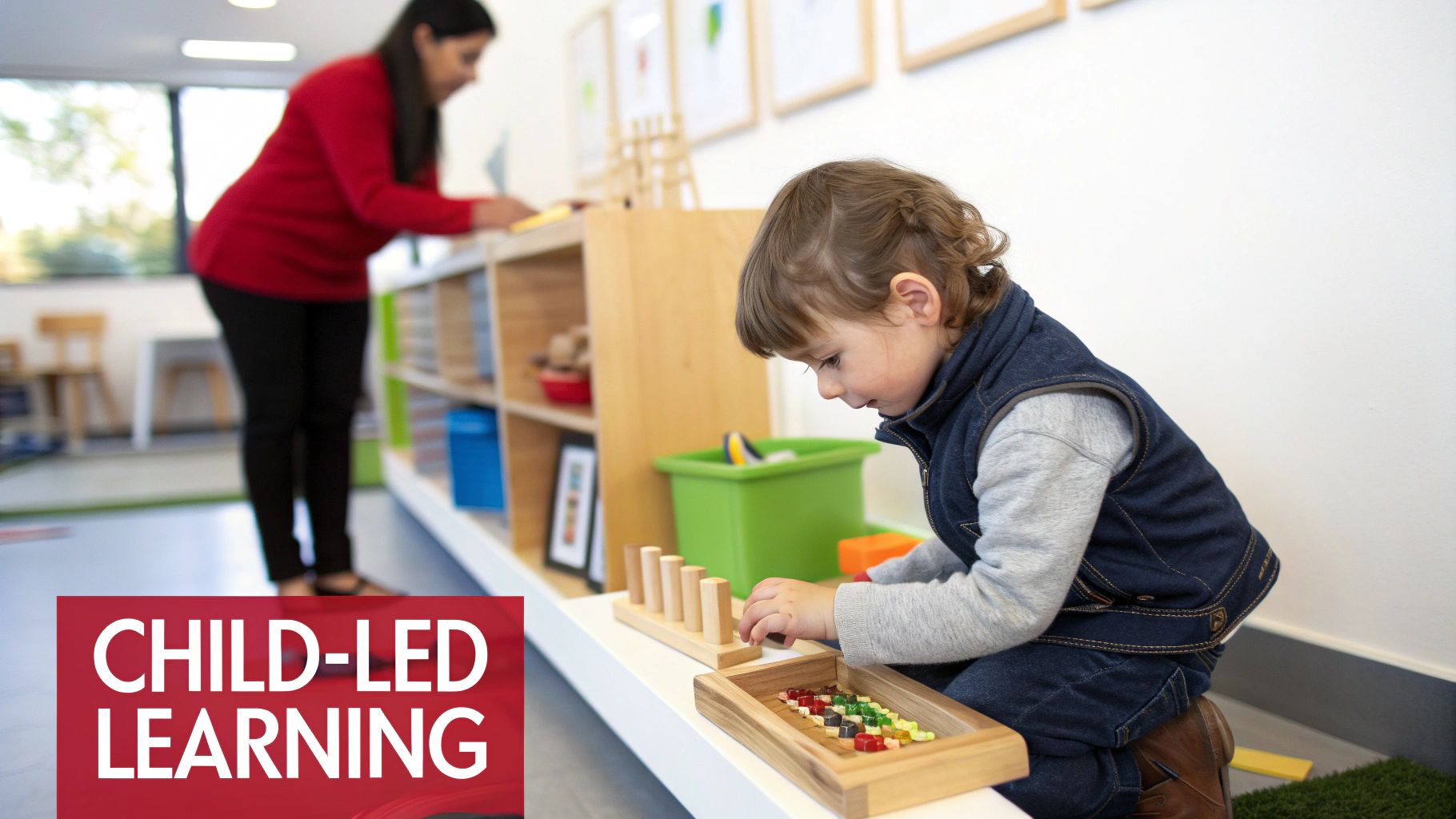
Think of a Montessori educator as a skilled gardener. You don't force a plant to grow; you provide the perfect soil, water, and sunlight, then trust it to flourish. That’s the heart of the Montessori philosophy. Developed by Dr. Maria Montessori over a century ago, this child-led approach is built on a deep trust in a child's natural ability to learn and discover the world on their own terms.
The goal is to build a strong foundation where children become motivated, self-sufficient learners ready to take on the world. By creating a safe, engaging, and nurturing environment, a Montessori classroom helps children develop real confidence in their own abilities.
How Does It Champion Child-Led Discovery?
The Montessori Method is deeply rooted in child-led discovery, aligning perfectly with modern constructivist learning principles. This philosophy centers on the idea that learners actively build their own knowledge rather than passively receiving information. If you want to go deeper, we break this down in our guide on what is constructivist learning theory.
This freedom to choose is a cornerstone of the method. For example, a child might spend an entire morning engrossed in building with geometric blocks, not because a teacher assigned it, but because they are intrinsically motivated to understand spatial relationships. This autonomy leads to deeper engagement and longer periods of concentration.
The greatest sign of success for a teacher... is to be able to say, 'The children are now working as if I did not exist.' - Dr. Maria Montessori
This famous quote captures the ultimate goal: to foster such profound independence that children are driven entirely by their own curiosity. The teacher acts not as a director, but as a guide who observes and gently connects the child to meaningful activities.
Key Differences from Traditional Classrooms
To truly grasp what makes this method unique, it helps to compare it with a typical school setting. While both aim to educate children, their approaches are fundamentally different.
Take a look at this quick comparison to see the main distinctions.
Montessori vs. Traditional Classroom at a Glance
| Aspect | Montessori Method | Traditional Method |
|---|---|---|
| Learning Pace | Child-led and individualized | Teacher-led and group-paced |
| Classroom Setup | Open, multi-age groups | Same-age groups, desk rows |
| Teacher's Role | Guide or facilitator | Instructor or lecturer |
| Materials | Hands-on, self-correcting tools | Textbooks and worksheets |
| Focus | Process of discovery | Memorization of facts |
| Assessment | Observation and portfolios | Standardized tests and grades |
These differences reflect a massive shift in perspective. Montessori education views the child as a capable, curious individual ready to absorb knowledge simply by interacting with a carefully prepared world.
The Story Behind Montessori Education
To fully appreciate the Montessori method, you have to understand its origin story. This isn't a fleeting educational trend; it's a philosophy backed by over a century of scientific observation and a profound respect for a child's natural abilities. The entire movement began in the early 1900s in Rome with a trailblazing physician whose work would completely reshape our understanding of education.
This approach wasn't developed in a university lab. It was forged in the trenches through careful, direct observation of how children actually learn. It’s a story of science, compassion, and the then-radical idea that children are perfectly capable of guiding their own development.
Who Was the Pioneer Behind the Method?
The hero of this story is Dr. Maria Montessori, one of Italy's first female physicians. While working at a psychiatric clinic, she became fascinated by children who had been written off as "uneducable." She hypothesized that their struggles weren't due to inability, but rather a lack of the right kind of environmental stimulation.
Following this hunch, she designed hands-on learning materials based on her observations. Her methods were so effective that these same children began passing public school exams—a result seen as nothing short of a miracle at the time. This initial success sparked a critical question in her mind: if her methods could work so well for children with significant learning barriers, what could they do for all children?
The First "Children's House"
That question led to a groundbreaking opportunity. In 1907, Dr. Montessori opened her very first classroom, the Casa dei Bambini or "Children's House," in a low-income Rome neighborhood. She filled this "prepared environment" with the self-correcting, hands-on materials she had developed.
Instead of lecturing from the front of the room, she stepped back and observed. She saw children, given freedom within clear boundaries, become incredibly focused, self-disciplined, and genuinely joyful in their work. With minimal adult interference, they were teaching themselves to read, write, and solve complex problems.
"The child is both a hope and a promise for mankind." - Dr. Maria Montessori
This was the lightbulb moment: children possess an innate, powerful drive to learn. The Children's House wasn't just a school; it was a living laboratory that proved kids could take the lead in their own education if provided with the right tools and a supportive space.
From a Small School to a Global Movement
From that single classroom, the Montessori method exploded into a worldwide movement. The success of the Casa dei Bambini attracted educators from across the globe, who traveled to witness this revolutionary approach firsthand. Today, Montessori is the most common alternative education model in the world.
The 2022 Global Montessori Census estimated 15,763 Montessori schools in at least 154 countries, with about 9% being government-funded. That's incredible growth from one small school in Rome, demonstrating the timeless, universal appeal of an educational method built on observation and respect for the child. You can dig into more statistics about its global reach in the Journal of Montessori Research.
Exploring the Five Core Montessori Principles
To understand what makes the Montessori method so effective, you have to look at its foundation. It’s built on five core principles that work in harmony to create a powerful framework for child-led learning. These aren't just abstract ideas; they're practical concepts you can see in action in any Montessori classroom.
Each principle flows seamlessly into the next, reinforcing a philosophy centered on trust, observation, and empowerment. By unpacking these pillars, you can see how they create a space—whether at school or at home—that nurtures a child's natural drive to learn and grow.
Principle 1: Respect for the Child
Everything in the Montessori philosophy begins with a profound Respect for the Child. This is more than just being polite; it’s about recognizing children as complete, capable individuals from birth who deserve the same dignity as adults. It means trusting their ability to make choices, solve problems, and learn at their own pace.
Real-World Example: In a Montessori classroom, you would never interrupt a child who is deep in concentration. An educator might observe a child struggling to fit a puzzle piece, but instead of jumping in to "fix" it, they allow the child the space and time to figure it out for themselves, thereby building resilience and self-confidence.
Principle 2: The Absorbent Mind
Dr. Montessori observed that children from birth to age six possess what she called The Absorbent Mind. Like a sponge, young children effortlessly soak up everything from their environment—language, social cues, cultural norms—without conscious effort. They learn just by being present and interacting with the world.
Real-World Example: A toddler learning their first language doesn't need formal grammar lessons; they absorb it by listening to conversations around them. This is why creating a rich, positive, and stimulating environment is so critical for feeding their naturally absorbent minds.
The child has a different relation to his environment from ours... the child absorbs it. The things he sees are not just remembered; they form part of his soul. - Dr. Maria Montessori
Principle 3: Sensitive Periods
Flowing directly from the absorbent mind are Sensitive Periods. These are temporary windows of time when a child is intensely driven to master a specific skill. During a sensitive period for order, a toddler might become upset if their toys aren't in their usual spot. Recognizing and supporting these periods is crucial.
A trained Montessori guide watches each child to spot these windows and offers materials that match their current developmental urge.
Here are a few common sensitive periods:
- Order: A deep need for consistency and routine, often seen between ages 1 and 3.
- Language: An intense period for soaking up vocabulary and grammar, peaking between birth and age 6.
- Movement: A drive to master coordination, balance, and motor control.
- Small Objects: A fascination with tiny details that helps build hand-eye coordination and concentration.
This infographic shows how Dr. Montessori's groundbreaking work in Rome's "Children's House" back in 1907 led to these foundational principles.
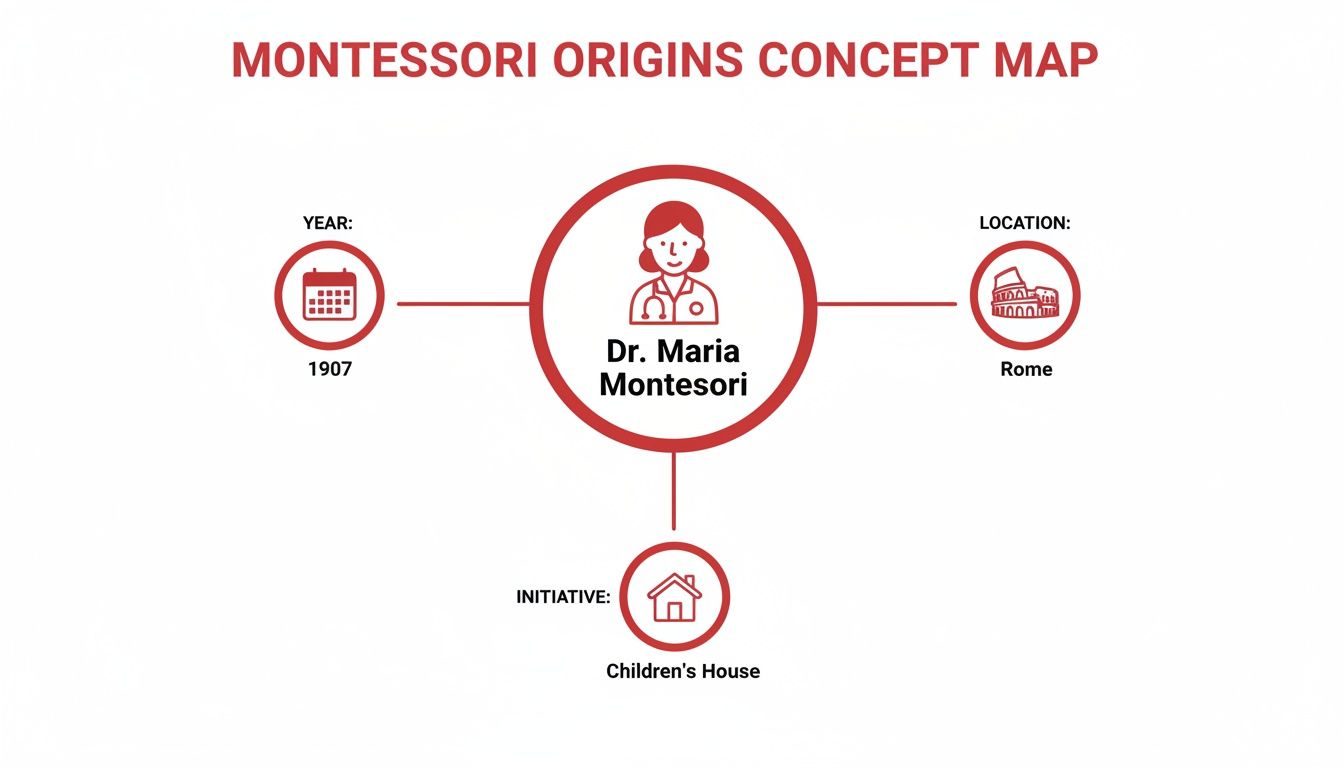
This visual captures how a single, innovative classroom became the birthplace of a global educational philosophy.
Principle 4: The Prepared Environment
Since children learn so much from their surroundings, the fourth principle is The Prepared Environment. This means the classroom (or home) is intentionally designed to meet the developmental needs of the children using it. Everything is child-sized, accessible, and organized to encourage independence.
Materials are laid out on low shelves in a logical order, from simplest to most complex. The space is calm, beautiful, and uncluttered to help children focus. A simple way to do this at home is to create a small kitchen station with a low stool and accessible snacks, empowering your child to get their own water without asking for help.
Principle 5: Auto-Education (Self-Education)
Finally, all these principles culminate in Auto-Education, or self-education. This is the core belief that children are capable of teaching themselves. When given a respectful guide, a prepared environment, and the freedom to follow their sensitive periods, children will naturally engage in the work that meets their developmental needs.
Many Montessori materials have a built-in "control of error," meaning a child can check their own work without needing an adult to correct them. Think of a puzzle where each piece only fits in one specific spot. This allows for self-discovery and builds real, intrinsic motivation—a core part of the Montessori approach. To see how this connects with other hands-on philosophies, you can read our article on what is discovery-based learning. Ultimately, true learning comes from within, driven by the child’s own curiosity.
A Look Inside a Montessori Learning Environment
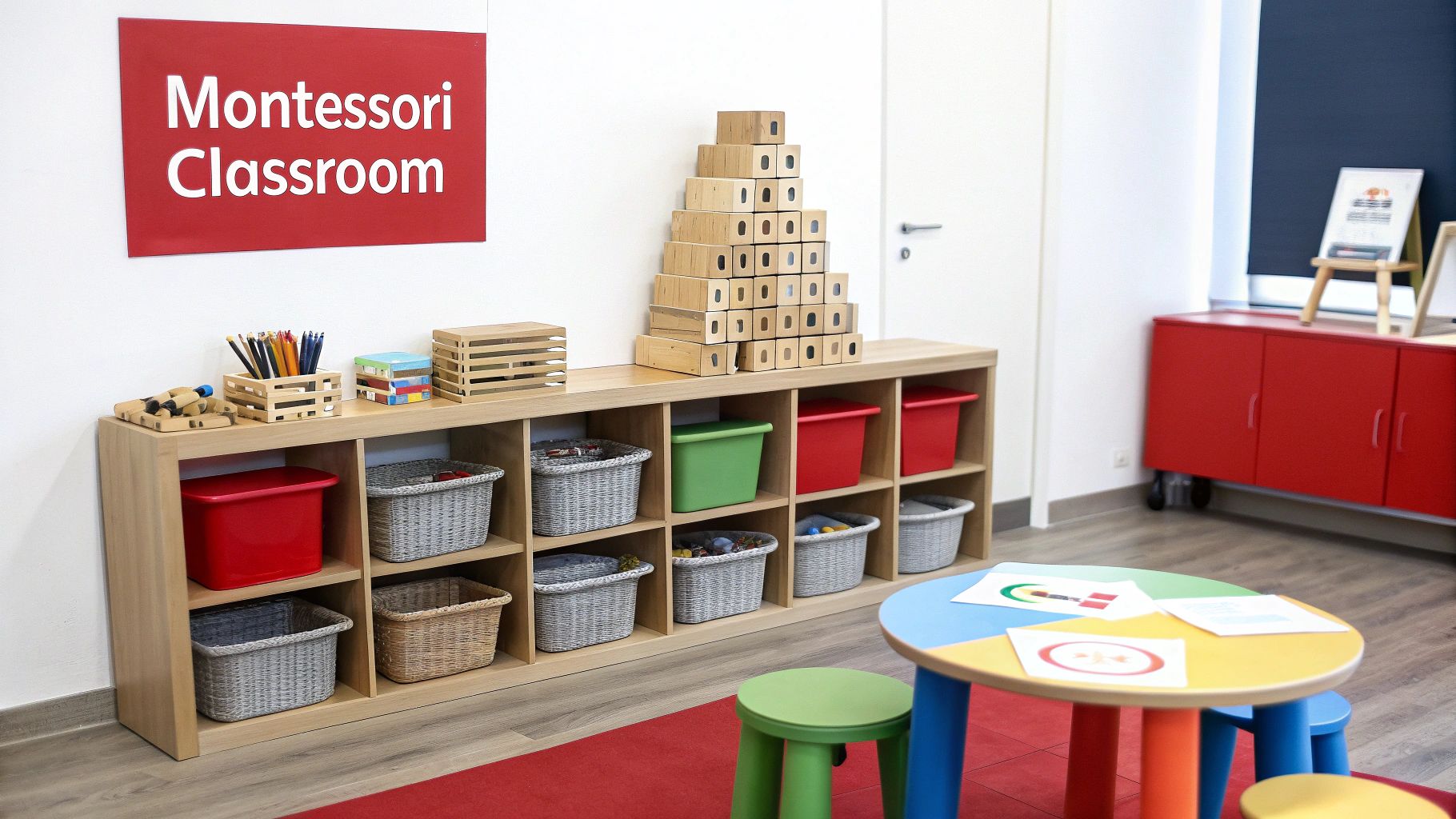
Stepping into a Montessori environment for the first time can be a surprise if you're used to traditional classrooms. Gone are the rows of desks facing a teacher. Instead, you'll find a calm, open space where children of different ages work independently or in small, focused groups.
Everything you see is there for a reason. The shelves are low, the tables are small, and the chairs are child-sized. This isn't just about aesthetics; it’s about empowering kids to take charge of their own learning. The room itself is a teacher, guiding them and giving them a sense of ownership from the moment they walk in.
The Five Key Learning Areas in a Montessori Classroom
A true Montessori classroom is thoughtfully organized into five distinct areas, each targeting a different aspect of a child's development. This setup allows kids to naturally gravitate toward activities that pique their interest at that moment, ensuring a well-rounded and holistic experience.
Here’s a quick tour of what you’d typically find:
- Practical Life: This is often the heart of the classroom for young children. They engage in real-world activities like pouring water without spilling, buttoning a shirt, or washing a small table. These tasks build fine motor skills, focus, and a sense of order.
- Sensorial: This area is dedicated to refining the five senses. It's filled with iconic materials like the Pink Tower (for discriminating size) and various texture tablets (for developing the sense of touch). These tools help children classify and make sense of the world in a concrete, hands-on way.
- Mathematics: Montessori math materials are brilliant for making abstract concepts tangible. Instead of memorizing formulas, children use colorful beads, rods, and cards to physically handle numbers, learning addition, subtraction, and even multiplication by seeing and feeling what the numbers represent.
- Language: Learning to read and write begins with sounds. Children trace Sandpaper Letters to connect a letter's shape with its phonetic sound, then use a Moveable Alphabet to build words long before they are comfortable with a pencil. It makes literacy feel like a natural, intuitive discovery.
- Cultural Studies: This is where children explore the wider world. They work with puzzle maps to learn about continents, study the life cycles of plants, and are introduced to art and music. This area sparks an early curiosity and appreciation for our diverse world.
"The environment must be rich in motives which lend interest to activity and invite the child to conduct his own experiences." - Dr. Maria Montessori
This quote perfectly captures the philosophy. Every material on the shelf is a deliberate invitation for a child to explore, learn, and discover something new on their own.
What are the Iconic Materials and Their Purpose?
The Montessori method is famous for its unique learning tools. These aren't just toys; they are scientifically designed materials that isolate one specific concept, so a child can focus on mastering it without distraction.
Crucially, each material has a built-in "control of error," which lets children identify and correct their own mistakes without an adult stepping in.
- The Pink Tower: A set of ten pink cubes of varying sizes. The task is to stack them from largest to smallest. If a child makes a mistake, the tower will look wobbly, providing a visual cue to rethink their approach. This builds resilience and problem-solving skills.
- Sandpaper Letters: Cards with letters traced in rough sandpaper. As a child feels the shape of the letter with their fingers while saying its sound, they build a powerful multi-sensory connection in their brain—a critical step toward learning to read.
Bringing the Montessori Environment Home
You don't need a formal classroom to bring these wonderful principles into your home. The philosophy is about creating a safe, accessible, and empowering space where your child can explore independently. Even small changes can have a big impact.
If you’re looking for ideas, our guide on preschool classroom setup ideas offers practical tips you can easily adapt for your home.
A great starting point is creating a "yes" space where your child is free to touch and interact with their surroundings. Put their toys and books on low, open shelves so they can choose their own activities. The goal is simply to encourage self-directed, hands-on exploration in everyday life.
The Lifelong Benefits of a Montessori Education
Parents and educators often ask the big question: "Does it work?" The answer is a resounding yes. The benefits of a Montessori education extend far beyond good grades—they shape how a child thinks, acts, and connects with the world for years to come. The goal isn’t just to teach facts but to help grow capable, curious, and well-adjusted human beings.
This approach leads to real, tangible outcomes. Instead of just memorizing dates and formulas, students develop a deep, genuine understanding of concepts because they discover them on their own terms. This is how you spark a love for learning that lasts a lifetime.
Cultivating Strong Executive Functions
One of the most significant advantages is the development of strong executive function skills. These are the crucial mental processes that allow us to plan, focus, remember instructions, and multitask. Think of them as the brain's air traffic control system.
In a Montessori environment, children constantly practice these skills. When they choose their own work, they learn to plan and manage their time. When they concentrate on a task without interruption, they build focus and self-control. This hands-on method builds the mental muscles needed for organization and seeing a task through to completion—skills that are powerful predictors of success in school and life.
A child’s work is to create the person she will become. An adult works to perfect the environment, but a child works to perfect herself. - Dr. Maria Montessori
The Research-Backed Advantages
Compelling evidence supports the Montessori method. It’s not just a nice philosophy; it’s a practice with proven results in academic performance and personal growth.
A comprehensive meta-analysis of 32 high-quality studies found that Montessori education has a strong positive effect on children. The research showed that Montessori students not only performed better academically—especially in language and math—but also demonstrated more advanced executive functions, such as flexible thinking and self-regulation. This data connects the day-to-day activities in a Montessori classroom to the lasting skills children develop.
Enhanced Social and Emotional Skills
Montessori classrooms typically group children of different ages together, creating a unique social dynamic. Older students naturally become mentors, reinforcing their own understanding as they teach younger peers. This fosters a genuine sense of community, empathy, and cooperation.
Instead of competing for the best grade, children learn to collaborate and respect one another's space and projects. This environment helps them develop advanced social skills, such as:
- Conflict Resolution: They learn to work through disagreements respectfully without constant adult intervention.
- Empathy and Community: They understand and appreciate the needs and capabilities of others.
- Intrinsic Motivation: They find satisfaction in their own progress, not just in external rewards.
These are the exact skills needed to build healthy relationships and work effectively in teams later in life. The focus on hands-on activities also strengthens these benefits, as kids physically engage with ideas, making what they learn much more memorable. If you want to dive deeper into this, you might like our article on the benefits of hands-on learning.
Simple Ways to Apply Montessori Principles at Home
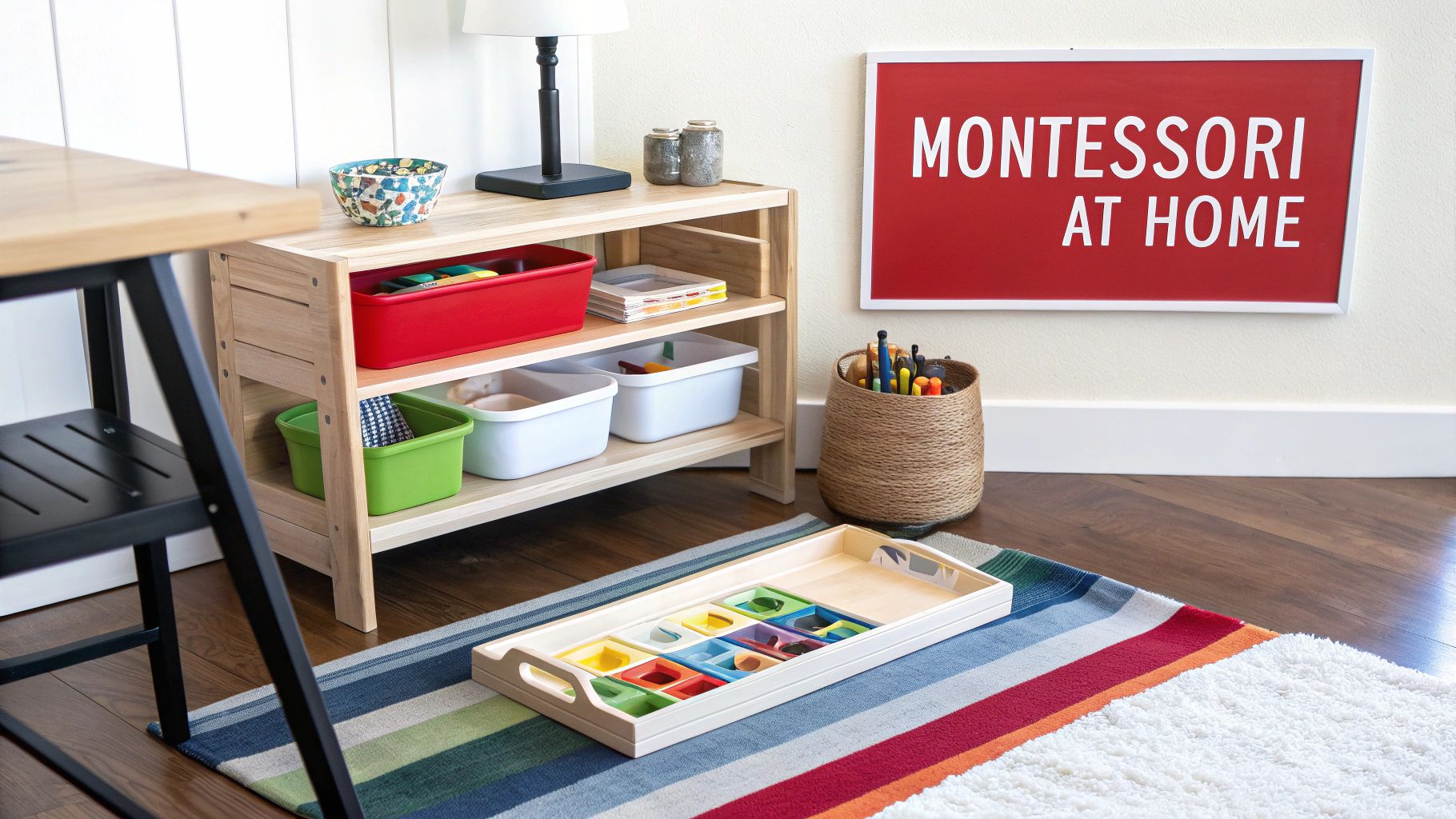
You don’t need an official classroom to bring the magic of Montessori into your home. The philosophy is less about buying specific equipment and more about shifting your mindset. It’s about creating a home environment that nurtures independence, sparks curiosity, and is built on mutual respect.
By making a few simple, intentional changes, you can transform your home into a space that supports your child's natural development and fosters a genuine love of learning.
Create a Prepared Environment at Home
The cornerstone of Montessori at home is the “prepared environment.” This simply means setting up your child’s space to be accessible, orderly, and empowering. The goal is to arrange things so they can do things for themselves without always needing to ask for help.
Get down on your hands and knees and see the world from their perspective. Can they reach their favorite books? Is there a low stool in the kitchen so they can help wash vegetables or get a cup of water?
Even small adjustments can make a world of difference:
- Low, Open Shelves: Ditch the overflowing toy box. Instead, place a handful of toys on low shelves where your child can see their options and make a choice. Rotate the toys every week or so to keep things interesting.
- Child-Sized Tools: Provide a small broom, a tiny pitcher, or a little dustpan. When kids have tools that fit their hands, they are more likely to want to help with daily tasks.
- Defined Activity Spaces: Use a small rug or a tray to define a workspace. This gives a clear visual cue that says, "This is your area to focus," which helps build concentration.
A child’s work is to create the person she will become. An adult works to perfect the environment, but a child works to perfect herself. - Dr. Maria Montessori
Foster Practical Life Skills Daily
A huge part of the Montessori method is involving children in the rhythm of daily life. These "Practical Life" activities are not chores; they are real, meaningful tasks that build confidence, fine-tune coordination, and give children a sense of responsibility.
Look for small opportunities to involve your child in what you’re already doing. It teaches them valuable skills and makes them feel like a contributing member of the family.
Here are a few easy ways to start:
- In the Kitchen: Let them tear lettuce for a salad, stir batter, or spread jam on toast. These simple food prep tasks are empowering.
- Getting Dressed: Set up a low drawer with a few weather-appropriate outfits. This gives them control over what they wear while you still provide guidance.
- Caring for the Home: Invite them to water plants with a small watering can, wipe up a spill with their own cloth, or help sort laundry.
Follow Your Child's Lead
If you adopt only one principle, make it this one: "follow the child." This means paying close attention to what they are naturally drawn to and providing activities that feed that interest. If they are obsessed with pouring, set up a bin with water, cups, and funnels. If they are in a sorting phase, give them a bowl of mixed pasta shapes to organize.
This approach validates your child's interests and respects their unique developmental timeline. It's no surprise that as more parents invest in child-led education, the demand for supportive learning tools is growing. The global Montessori Education market is projected to hit $26.7 billion by 2033, with the toy segment valued at around $1.2 billion in 2024. You can discover more insights about this growing market to see how it reflects a major shift in educational values.
Common Questions About the Montessori Method
When parents first explore the Montessori method, a few key questions almost always arise. Getting clear answers can help you decide if this philosophy is the right fit for your family and bust some common myths.
Is Montessori only for preschoolers?
No. While Montessori is famous for its success in early childhood, the educational approach extends all the way through high school. The principles adapt as children mature, with older students taking on more complex, collaborative, and self-directed projects.
Does the Montessori method work for all learning styles?
Because Montessori is centered on individual pacing and choice, it works beautifully for a wide range of learning styles and personalities. However, a child who thrives in a highly structured, teacher-led classroom might need an adjustment period to adapt to the freedom and independence it offers. The focus is always on meeting the individual child where they are.
Can I mix Montessori principles with other parenting approaches?
Absolutely! You don't have to adopt an "all-or-nothing" approach. Integrating core Montessori concepts—like fostering independence, creating a prepared environment, or following your child's lead—can complement any parenting style. It’s about using what works best for your family. This flexibility is a common thread in other child-led philosophies too, which you can see by exploring our guide on the Reggio Emilia approach.
If you're curious how this stacks up against other modern teaching strategies, you can find some interesting parallels in the world of gamification in education.
At Playz, we believe that hands-on exploration is the key to unlocking a child's potential. Our science kits and creative toys are designed to support the principles of self-directed discovery and make learning an exciting adventure. Bring the joy of learning home by exploring our collection at https://www.playzusa.com.