

In a world of constant connectivity, nurturing your preschooler's social and emotional skills is more important than ever. Strong social-emotional intelligence, which includes skills like sharing, listening, and understanding feelings, forms the essential foundation for a happy, confident, and successful life. These abilities aren't just "nice to have"; they are critical for forming friendships, succeeding in school, and navigating life's challenges.
But how do you teach such complex concepts to a three or four-year-old? The answer is simple and joyful: through play. Purposeful play provides a safe and engaging "social laboratory" where children can practice communication, navigate peer interactions, and build empathy without pressure. To truly understand how play serves as the key to social development, delve deeper into the immense benefits of open-ended play for young children.
This guide moves beyond generic advice to offer a comprehensive collection of fun, practical, and screen-free social skills activities for preschoolers. We have organized these activities into eight distinct categories, from cooperative games to conflict resolution practice. Each entry includes a clear purpose, material lists, and step-by-step instructions. You will also find adaptations for different needs and expert tips to help you transform everyday moments into powerful learning opportunities. Get ready to watch your child connect, cooperate, and blossom into a socially savvy superstar.
1. Cooperative Play Games and Activities
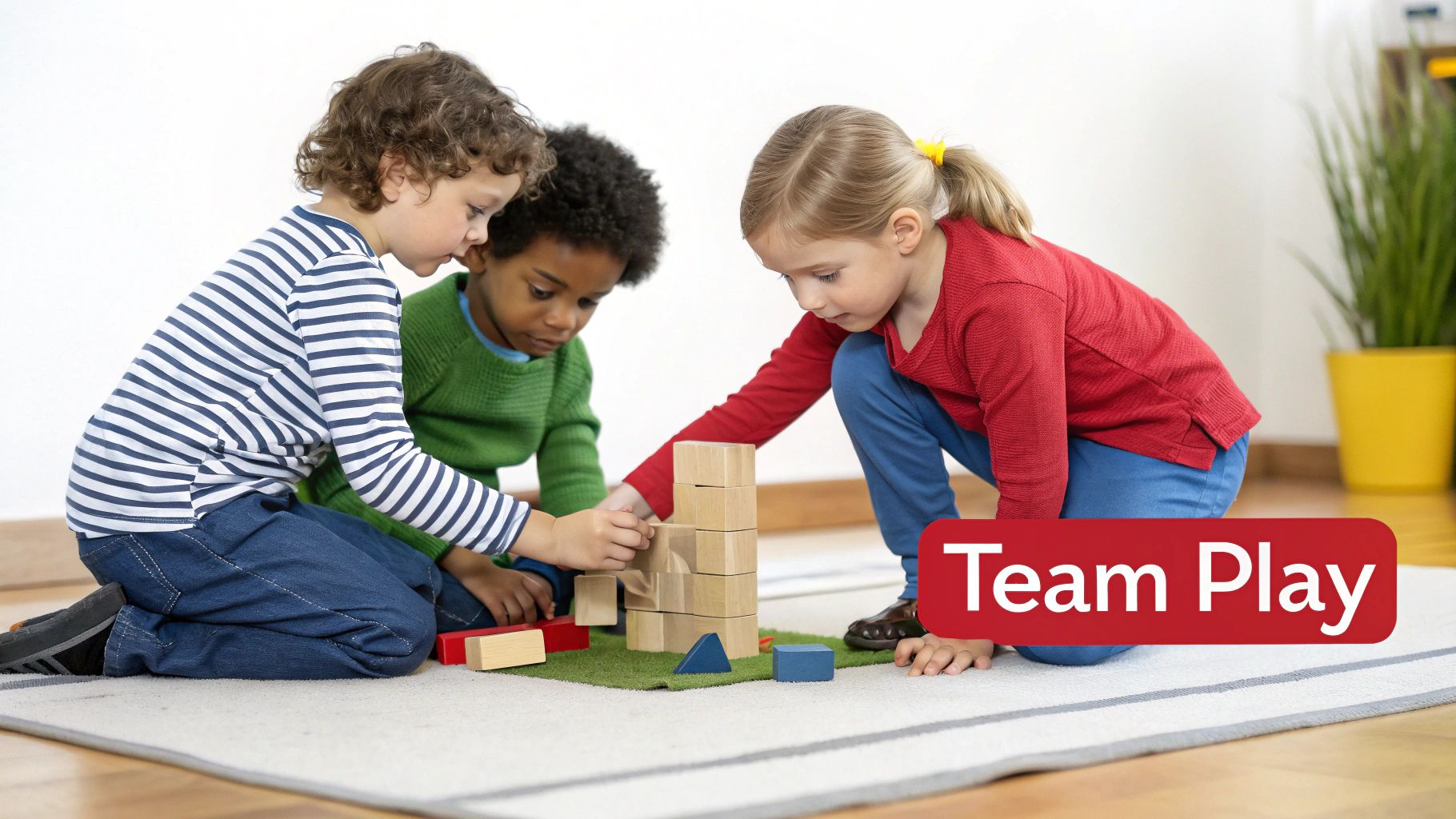
Cooperative play is a game-changer for preschool social development. Unlike competitive games that create winners and losers, cooperative activities require children to work together towards a shared objective. This foundational approach shifts the focus from individual achievement to group success, making it one of the most effective social skills activities for preschoolers to build empathy, communication, and teamwork. The core idea is that everyone contributes, and the group succeeds as one unit.
Why It Works
Cooperative play directly targets essential social skills by creating a low-stakes environment where collaboration is necessary for fun. When children build a fort together, they must listen to each other's ideas, negotiate roles ("You hold this wall while I get another pillow!"), and share resources. These interactions are powerful lessons in perspective-taking and problem-solving.
Actionable Insights: Examples of Cooperative Activities
- Group Fort Building: Using blankets, pillows, or a play tent kit, children work together to design and construct a shared space. Success depends entirely on their ability to communicate and coordinate their actions.
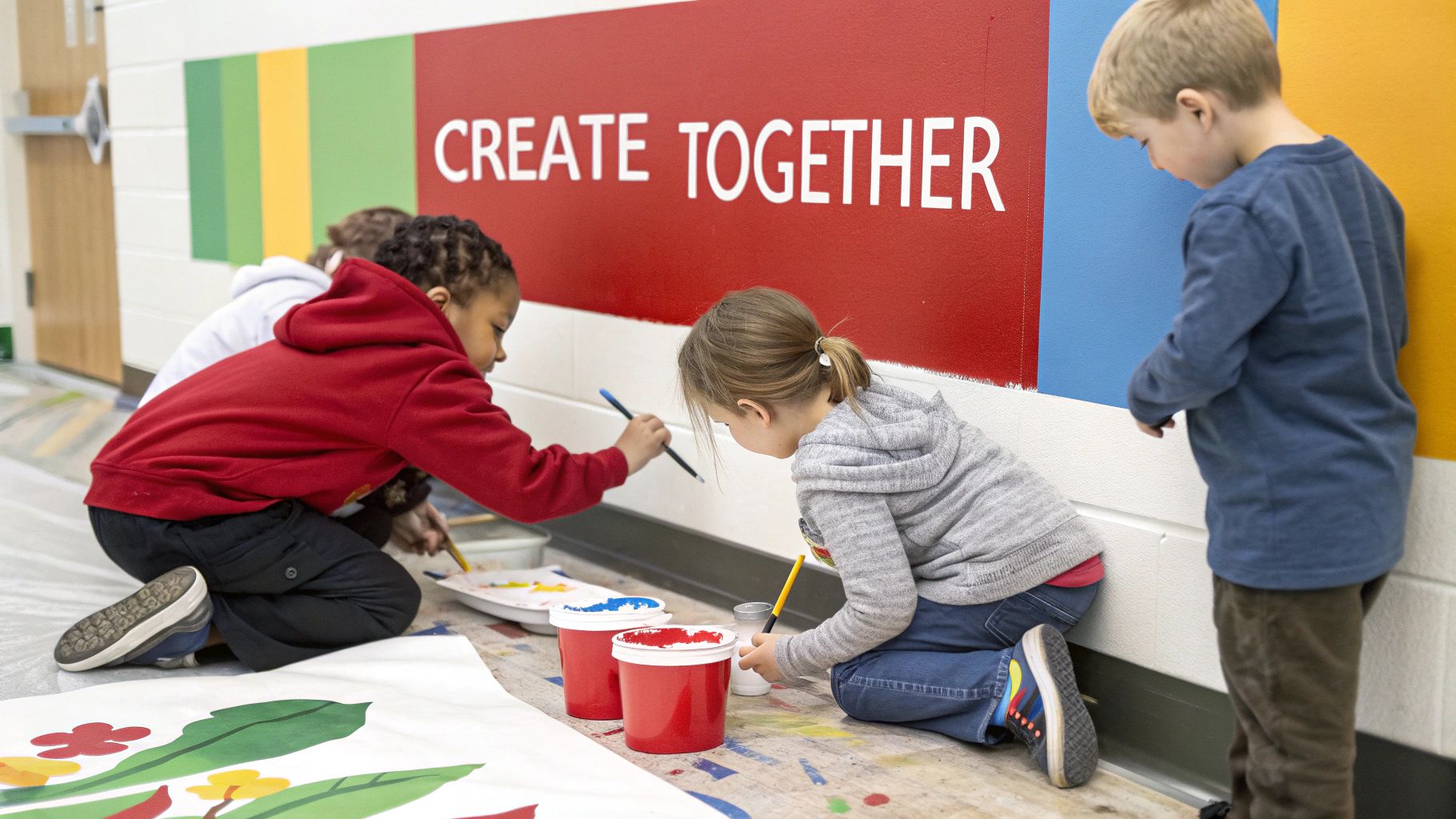
- Collaborative Art Mural: Tape a large sheet of paper to a wall or floor and provide various art supplies. The goal is for everyone to contribute to a single, large-scale masterpiece, blending their individual creativity into a cohesive whole.
- "Pass the Drawing" Storytelling: One child starts a drawing, then passes it to the next, who adds to it. This continues until the picture is complete, encouraging children to build upon each other's ideas visually.
Tips for Success
To get the most out of these activities, it's important to set the stage for collaboration. Start with small groups of two or three children to prevent anyone from feeling overwhelmed. Clearly state the goal: "Our mission is to build the biggest tower together!" Explicitly praise collaborative behaviors, such as sharing a block or complimenting a friend's idea. The powerful connection between unstructured play and developmental growth is well-documented; you can explore the benefits of play-based learning to understand more.
2. Role-Playing and Dramatic Play Scenarios
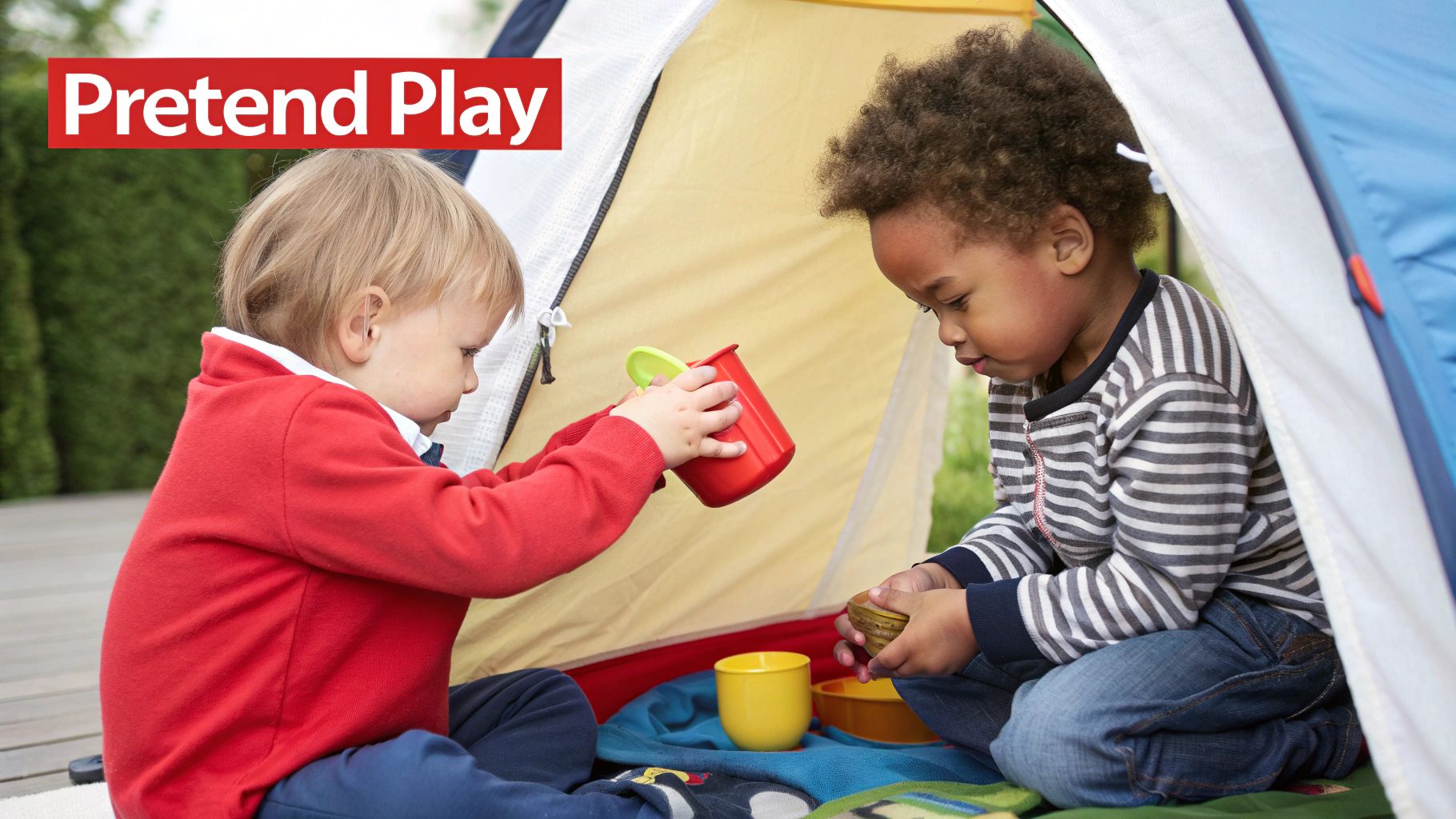
Role-playing invites preschoolers to step into someone else's shoes, whether it's a doctor, a chef, or a parent. This form of dramatic play is a powerful tool for developing empathy, communication skills, and an understanding of social norms. By acting out different scenarios, children safely explore complex emotions and practice real-world interactions. It’s one of the most natural and effective social skills activities for preschoolers because it transforms learning into an imaginative adventure.
Why It Works
Dramatic play is essentially a social-emotional laboratory. When children pretend to be a server in a restaurant, they must practice taking orders (listening), communicating specials (speaking clearly), and handling a "customer's" request (problem-solving and negotiation). This process helps them grasp different perspectives, understand cause and effect in social situations, and build the confidence needed to navigate their own social world.
Actionable Insights: Examples of Dramatic Play Scenarios
- Pretend Restaurant: Set up a small table with toy food and menus. Children can take turns being the chef, server, and customer, practicing conversational turn-taking, manners, and patience.
- Doctor's Office: Using a simple doctor's kit, one child can be the patient while another is the doctor. This scenario helps children process feelings about visiting the doctor and develops nurturing and caring behaviors.
- Grocery Store Checkout: Create a store with empty food boxes and a toy cash register. This activity encourages children to practice greeting others, asking for help, and understanding the concept of exchanging goods.
Tips for Success
To foster rich dramatic play, provide a designated area and simple props that spark imagination, like a play tent or a box of costumes. Gently guide the play by modeling social language ("May I please have an apple?") or asking open-ended questions like, "What happened next at the vet's office?" Rotating roles is crucial, as it allows every child to experience different perspectives. You can discover more about the developmental impact of imaginative play by exploring the benefits of pretend play and how it shapes young minds.
3. Emotion Recognition and Expression Activities
Understanding emotions is the bedrock of social interaction. Activities focused on emotion recognition and expression teach preschoolers to identify feelings in themselves and others, name them, and begin to understand how to respond appropriately. This emotional literacy is a critical component of empathy and effective communication, making it one of the most fundamental social skills activities for preschoolers. The goal is to build a child's "feelings vocabulary" and give them tools to navigate their complex inner world.
Why It Works
Before a child can manage their emotions, they must first be able to recognize them. These activities provide a safe and playful context to explore feelings like happiness, sadness, anger, and surprise. By labeling emotions and connecting them to facial expressions and situations, children learn that feelings are normal and manageable. This knowledge reduces frustration and helps them communicate their needs verbally instead of through challenging behaviors, paving the way for healthier peer relationships.
Actionable Insights: Examples of Emotion Activities
- Emotion Matching Cards: Use or create cards with different facial expressions. Children can play a memory game, matching the pairs of "happy" faces or "sad" faces, reinforcing visual cues for each emotion.
- Feelings Chart Check-In: Create a chart with faces showing various emotions. At different points in the day, like morning arrival, ask children to point to the face that shows how they are feeling and briefly talk about it.
- Mirror, Mirror: Sit with a child in front of a mirror and take turns making different emotional faces. Say, "Show me your surprised face!" or "Let's make an angry face," and discuss how the face changes with each feeling.
- Storybook Feelings: While reading, pause to ask questions about the characters. "How do you think the wolf is feeling right now? Look at his face. Why do you think he feels that way?"
Tips for Success
Set a foundation of emotional acceptance where all feelings are valid, even if certain behaviors are not. Model emotional expression by naming your own feelings in a simple way: "I am feeling frustrated because I can't find my keys." Use consistent and simple language for emotions, and incorporate songs or movement to make learning more dynamic. Praising a child for naming their feelings ("Thank you for telling me you feel sad") reinforces their efforts and builds their emotional confidence.
4. Turn-Taking and Sharing Games
Patience, sharing, and waiting for one's turn are sophisticated concepts for a preschooler, yet they are absolutely essential for successful peer relationships. Turn-taking and sharing games provide a structured, fun environment to practice these critical skills. These activities teach children that their desires are important, but so are the desires of others, laying the groundwork for impulse control, fairness, and empathy. The goal is to make waiting and sharing a predictable and positive part of play.
Why It Works
These games transform the abstract concepts of "waiting" and "sharing" into concrete actions with clear rules and immediate, positive reinforcement. When a child successfully waits for their turn in a simple board game, they are rewarded by getting their turn next. This direct cause-and-effect loop helps them understand that patience has a payoff. Learning to manage the minor frustration of waiting in a game is one of the most practical social skills activities for preschoolers for building resilience and emotional regulation.
Actionable Insights: Examples of Turn-Taking Activities
- Simple Board or Dice Games: Games like "Chutes and Ladders" or simple color-matching games provide a clear, one-at-a-time structure. The physical act of passing the dice or spinner reinforces the turn-based sequence.
- Timed Sand or Water Table Play: Use a visual sand timer to manage turns with highly desired toys. When the timer runs out, the child passes the toy to a friend, teaching them that sharing allows everyone a chance to enjoy the resource.
- Group Snack Preparation: Assigning sequential tasks like "First, you can pour the crackers, then it's your turn to spread the cheese" helps children practice waiting in a real-world context with a tasty reward.
Tips for Success
To make turn-taking a positive experience, start small and provide plenty of support. Begin with games for just two players to minimize wait times. Use a visual timer so children can see exactly how long they need to wait. Explicitly praise good waiting with specific language, like, "I love how patiently you are waiting for your turn!" For children who struggle, offer a small fidget toy or a quiet activity to do while they wait. Keeping the games short, around 5-10 minutes, will ensure they remain fun and engaging without taxing a preschooler's attention span.
5. Friendship Skills and Social Stories
Social stories are a powerful tool for teaching preschoolers the unwritten rules of social interaction. These are short, simple narratives that describe a specific social situation, explaining what might happen and suggesting appropriate ways to respond. By breaking down complex social cues into a clear, story-based format, this approach helps children navigate common challenges like making friends, sharing, and handling disagreements, making it one of the most targeted social skills activities for preschoolers. This technique transforms abstract social concepts into concrete, understandable steps.
Why It Works
Developed by Carol Gray, social stories work by providing a script for social success. They are especially effective for children who are visual learners or who feel anxious in new situations. By repeatedly reading a story about how to join a group, a child can mentally rehearse the steps before trying them in real life. This preparation builds confidence and reduces the anxiety of the unknown, giving them the tools to manage their emotions and interact positively.
Actionable Insights: Examples of Social Stories
- Joining Group Play: A story titled "How I Can Ask to Play" might show a character observing a game, walking over, and saying, "That looks fun! Can I play with you?" It would also show what to do if the answer is "not right now."
- Managing Disappointment: A narrative called "It's Okay to Feel Upset" could describe a situation where a child doesn't get their first choice of toy and shows them taking a deep breath or finding another fun activity to do.
- Conflict Resolution: A story about "When Friends Disagree" can model how to use words like "I feel sad when you take my block" and suggest solutions like taking turns or finding a new game to play together.
Tips for Success
To maximize the impact of social stories, personalize them as much as possible using photos or drawings of your child and their actual play environments. Read the stories proactively, before a child enters a situation they find challenging, like a birthday party or the first day of school. Keep the stories positive and reassuring, focusing on the desired behavior. Reinforcing these concepts is a key part of developing emotional intelligence; you can explore more emotional intelligence activities for kids to complement this strategy.
6. Group Art and Creative Projects
Collaborative art offers a fantastic, non-verbal avenue for preschoolers to practice essential social skills. Group projects, such as making a collage or building a sculpture, require children to communicate ideas, share materials, and negotiate space. These creative endeavors shift the focus from an individual final product to a shared, collective experience, making them one of the most effective social skills activities for preschoolers for fostering teamwork and mutual respect.
Why It Works
Art projects naturally create a platform for social interaction and problem-solving. When children work on a mural together, they must decide on colors, figure out who paints which section, and appreciate the contributions of their peers. This process teaches them to value different perspectives and compromise to achieve a common goal. It provides a safe outlet for self-expression while simultaneously building connection with others.
Actionable Insights: Examples of Creative Projects
- Collaborative Collage: Provide a large piece of poster board and a variety of materials like magazines, fabric scraps, colored paper, and glue. The group's goal is to work together to fill the board, making decisions on placement and theme.
- Playdough Community: Give each child a different color of playdough and encourage them to build a shared "town" or "garden." One child might make a tree while another makes a house, and they must work together to connect their creations into a single scene.
- Joint Construction Projects: Using recycled materials like cardboard boxes, tubes, and plastic bottles, children can build a large-scale robot, castle, or vehicle. This requires significant planning, role delegation, and cooperation.
Tips for Success
Set the stage for a positive and collaborative creative session. Begin by stating the goal clearly: "Let's all work together to make one big, beautiful picture!" Ensure there are plenty of materials to go around to minimize disputes over resources. For children new to collaboration, start with parallel projects where they work alongside each other before moving to a truly joint endeavor. Most importantly, celebrate the process and display the finished group masterpiece to give the children a sense of shared accomplishment. You can find more ideas for art and craft for preschoolers to inspire your next group activity.
7. Circle Time and Group Discussion Activities
Circle time is a cherished routine in early childhood settings that creates a powerful sense of community and belonging. These structured group gatherings involve children sitting together to sing, share, listen, and learn. By establishing a predictable and inclusive forum, circle time offers each child a chance to be seen and heard, making it one of the most effective social skills activities for preschoolers for developing active listening, turn-taking, and confident self-expression.
Why It Works
This activity directly teaches the rhythm of conversation and group dynamics. When children gather in a circle, everyone is visible and on an equal footing, which encourages participation. The format requires them to practice patience while waiting for their turn to speak, listen attentively to their peers, and formulate their own thoughts to share with the group. These guided interactions build a foundation for respectful communication and empathy as children learn to value the contributions of others.
Actionable Insights: Examples of Circle Time Activities
- Morning Meeting "Check-In": Each child shares their name and an emotion they are feeling, often using a visual feelings chart. This normalizes discussing emotions and helps children recognize feelings in themselves and others.
- "Show and Tell" Sharing Circle: Children bring an object from home and practice describing it to the group, answering questions from their friends. This builds public speaking confidence and descriptive language skills.
- Collaborative Storytelling: One child starts a story with a single sentence, and each child in the circle adds the next sentence. This fosters creativity, listening skills, and the ability to build on peers' ideas.
- Songs and Finger Plays: Interactive songs like "The Wheels on the Bus" or "Five Little Monkeys" with hand motions engage children physically while they practice following directions and coordinating actions as a group.
Tips for Success
To maximize the benefits of circle time, keep it brief and engaging, ideally 10 to 15 minutes for preschoolers. Use visual aids like puppets, story cards, or a "talking stick" to help maintain focus and signify whose turn it is to speak. Establish a consistent opening and closing routine, such as a special song, to signal the start and end of the activity. Most importantly, create a safe and supportive atmosphere by allowing children to participate at their comfort level and explicitly praising attentive listening and respectful sharing.
8. Conflict Resolution and Problem-Solving Practice
Conflicts are an inevitable and healthy part of social interaction, even for preschoolers. Instead of simply intervening, teaching children how to navigate disagreements independently is a powerful skill. Structured conflict resolution and problem-solving activities provide preschoolers with a concrete framework for handling disputes, turning moments of friction into valuable learning opportunities. These social skills activities for preschoolers empower them to understand others' perspectives, communicate their needs, and work toward a mutually agreeable solution.
Why It Works
This approach works by demystifying conflict and equipping children with a simple, step-by-step process. When a child learns they have tools to solve a problem, like sharing a toy, they feel more competent and secure in their social interactions. Guiding them through the process helps them build a mental script for future disagreements, fostering independence, empathy, and resilience. They learn that problems are solvable and that their voice can be heard respectfully.
Actionable Insights: Examples of Problem-Solving Activities
- Puppet Role-Play: Use puppets to act out common conflicts, like two puppets wanting the same toy car. Pause the scene and ask the children, "What do you think the puppets can do?" This allows them to brainstorm solutions in a low-pressure, playful context.
- The Peace Table: Designate a small, quiet area as a "Peace Table" or "Calm-Down Corner." When a disagreement arises, two children can go to the table, with adult support, to talk through their feelings and find a solution together.
- Guided Problem-Solving Conversations: When a conflict occurs, act as a neutral facilitator. Start by stating the problem objectively: "I see two friends who both want the red crayon." Then, guide them to express their feelings using "I" statements and brainstorm solutions.
Tips for Success
To effectively teach problem-solving, it's crucial to remain neutral and supportive. Your role is not to be a judge but a guide. Ask open-ended questions like, "What's another way we could handle this?" and validate all feelings expressed ("It's okay to feel upset"). Start with very simple, concrete conflicts and celebrate enthusiastically when children manage to solve a problem on their own. Helping children practice these skills consistently builds a strong foundation for their future interactions, and you can explore more ways to develop problem-solving skills to support their growth.
Comparison of 8 Preschool Social Skills Activities
| Activity | 🔄 Implementation Complexity | ⚡ Resource Requirements & Efficiency | 📊 Expected Outcomes | Ideal Use Cases | ⭐ Key Advantages & 💡 Tips |
|---|---|---|---|---|---|
| Cooperative Play Games and Activities | Low–Medium: needs adult facilitation for fairness | Low: minimal equipment; highly adaptable | Strong teamwork, communication, shared problem-solving | Small groups, free play, mixed-ability settings | ⭐ Builds collaboration & inclusivity. 💡 Start in pairs/small groups; provide enough materials. |
| Role-Playing & Dramatic Play Scenarios | Low–Medium: simple setup but needs space/rotation management | Medium: props/costumes or play tents improve immersion | Improved empathy, language, perspective-taking | Pretend-play areas, thematic units, transitions | ⭐ Highly engaging and motivating. 💡 Rotate roles, model interactions; use a designated space. |
| Emotion Recognition & Expression Activities | Medium: requires consistent modeling and repetition | Low–Medium: cards, books, mirrors; integrates into routine | Greater emotional literacy, self-regulation, empathy | Transitions, circle time, small-group lessons | ⭐ Supports emotional resilience. 💡 Use mirrors, consistent language, and story-based examples. |
| Turn-Taking & Sharing Games | Low: rules are simple but need supervision | Low: simple games, visual timers/indicators; very repeatable | Improved impulse control, patience, sense of fairness | Small-group centers, snack time, short game sessions | ⭐ Teaches waiting & fairness reliably. 💡 Use visual timers, keep rounds short (5–10 min). |
| Friendship Skills & Social Stories | Medium: preparation and repeated review required | Low (time investment): photos/illustrations; customizable | Better preparation for social situations, reduced anxiety | Anxious children, visual learners, pre-teaching social scripts | ⭐ Effective for targeted, individualized teaching. 💡 Use real photos and read before triggering situations. |
| Group Art & Creative Projects | Low–Medium: needs setup and cleanup management | Medium–High: variety of materials and space; can be messy | Fine motor development, non-verbal expression, cooperative negotiation | Art sessions, community projects, mixed-ability groups | ⭐ Non-threatening collaboration and creativity. 💡 Use washable supplies, set cleanup expectations, photograph work. |
| Circle Time & Group Discussion Activities | Medium: requires skilled facilitation to keep engagement | Low: routine-based with occasional visual supports | Improved language, listening, sense of community | Morning meetings, sharing circles, emotion check-ins | ⭐ Builds routine and voice for each child. 💡 Keep to 10–15 min, use songs and visuals. |
| Conflict Resolution & Problem-Solving Practice | High: needs patient, skilled adult mediation and practice | Medium: dedicated adult time and simple frameworks | Better dispute handling, independence, respectful communication | When conflicts arise, SEL lessons, small-group coaching | ⭐ Teaches lifelong negotiation skills. 💡 Keep steps simple, role-play, remain neutral when mediating. |
Your Next Step: Making Social Skills a Daily Adventure
Navigating the world of preschool friendships and interactions can be as complex as it is exciting. The comprehensive list of social skills activities for preschoolers we've explored isn't just a collection of games; it's a toolbox for building a strong foundation for your child's future. From cooperative building projects to navigating imaginary conflicts in dramatic play, each activity serves a critical purpose in developing empathy, communication, and self-regulation.
The journey of fostering these essential life skills is one of patience, consistency, and playful intention. By weaving these screen-free activities into your daily routines, you transform ordinary moments into powerful learning opportunities. You are not just teaching a child to share a crayon or take turns on the slide; you are equipping them with the tools to build meaningful relationships, solve problems creatively, and understand the rich tapestry of human emotions.
Key Takeaways for Lasting Impact
As you move forward, keep these core principles in mind to maximize the benefits of these social learning experiences:
- Consistency is Crucial: Social skills are like muscles; they grow stronger with regular practice. A few minutes of a turn-taking game or a quick role-playing scenario each day can have a more significant impact than a single, long session once a week. Make social learning a natural and expected part of playtime.
- Model the Behavior You Want to See: Children are keen observers. They learn more from watching you than from listening to your instructions. Demonstrate patience, active listening, and empathy in your own interactions. When you say "please" and "thank you" or calmly resolve a disagreement, you are providing a powerful, real-life lesson.
- Celebrate the Small Wins: Notice and praise the effort, not just the outcome. Acknowledge when your child offers a toy to a friend, uses their words to express frustration, or successfully waits for their turn. This positive feedback builds confidence and reinforces the desired behaviors. Understanding effective positive reinforcement techniques can be incredibly helpful here, as the principles apply far beyond potty training to encourage all kinds of positive development.
Turning Activities into Life Lessons
Remember that the goal of these social skills activities for preschoolers is not perfection. There will be squabbles over toys, moments of frustration, and times when sharing feels impossible. These moments are not failures; they are invaluable teaching opportunities. Use them to guide your child through conflict resolution, help them label their big feelings, and brainstorm better solutions for next time.
Your role as a parent or educator is that of a "social coach." You are there to provide the framework, offer support, and gently guide them toward pro-social behaviors. By creating a safe and encouraging environment where they can practice, make mistakes, and try again, you empower them to become confident, kind, and socially adept individuals. Every shared block, every puppet show, and every group art project is a stepping stone toward a lifetime of healthy and happy connections.
Ready to supercharge your cooperative play sessions? The imaginative play tents and hands-on science kits from Playz are specifically designed to encourage teamwork, communication, and shared discovery. Explore our collection at Playz and discover how #KidsLearnBestThruPlayz.