

At its heart, open ended play is play without rules, instructions, or a predetermined outcome. It’s child-led, totally flexible, and brimming with limitless possibilities.
Think of it like the difference between a blank canvas and a paint-by-numbers kit. One invites pure creation from the imagination, while the other guides you to a single, correct result. Open-ended play hands your child the blank canvas and trusts them to create something amazing.
What Is Open Ended Play? A Practical Definition
Open ended play is a powerful, pressure-free way for kids to learn and grow. Instead of following a strict set of rules to get something "right," they get to explore, experiment, and follow their own curiosity. This freedom is crucial for building confidence and resilience from an early age.
A real-world example: A cardboard box can become a spaceship, a castle, or a race car. A pile of blocks can be a tower, a bridge, or an entire city. The magic isn't in the toy itself, but in how a child decides to use it.
"In open-ended play, children decide what to play, how to use materials, how play evolves, and how long play lasts. There are no set instructions, no 'right way,' and no predetermined outcome."
This style of play sets the stage for a lifetime of creative problem-solving and innovation. It empowers children to see themselves as capable creators and thinkers, not just as followers of instructions.
The Core Principles Of Open Ended Play
This simple concept comes down to a few key ingredients that make the magic happen:
- Child-Led Exploration: The child is in the driver's seat, making all the calls about where their play is headed.
- No Predetermined Goal: There's no specific "finished product" to achieve, which completely removes any fear of failure.
- Focus on Process, Not Product: The real value is in the doing—the experimenting, imagining, and discovering—not in what gets made at the end.
- Unlimited Possibilities: The materials and scenarios can be used in countless ways, guided only by what a child can dream up.
The flowchart below gives a great visual of how this works. A simple, unstructured starting point leads to boundless imagination.
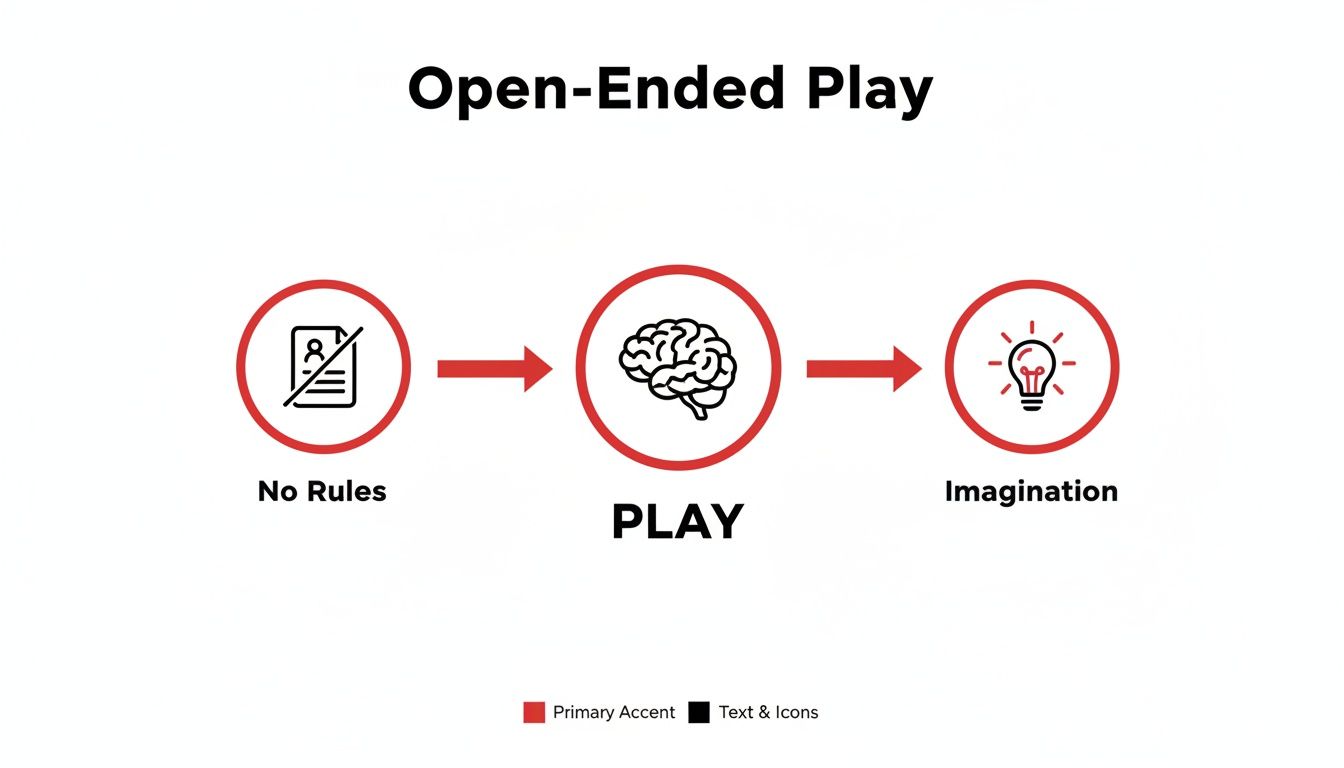
When the rules are stripped away, the brain is free to light up with creative and imaginative thinking.
Open Ended Play vs Closed Ended Play: A Quick Comparison
To really grasp what makes play "open-ended," it helps to see it side-by-side with its opposite: closed-ended play. Both have their place, but they serve very different purposes in a child's development.
This quick table breaks down the main differences with practical examples.
| Characteristic | Open Ended Play (e.g., Building Blocks, Art Supplies) | Closed Ended Play (e.g., Puzzles, Board Games) |
|---|---|---|
| Goal | No specific goal; process-focused | A clear, defined outcome or solution |
| Rules | No rules or instructions | Follows a specific set of steps or rules |
| Outcome | Limitless possibilities and creations | Usually a single "correct" way to finish |
| Skills Used | Creativity, problem-solving, imagination | Following directions, logic, memory |
| Child's Role | Creator, leader, decision-maker | Follower, problem-solver within a structure |
As you can see, open-ended activities are all about exploration, while closed-ended ones are about completion. For a deeper dive into sparking this kind of free-form fun, check out these ideas on Creative Play for Toddlers: Sparking Imagination and Learning.
By embracing these simple principles, you can support your child's natural drive to learn. Discover more about the research behind this powerful approach in our guide to the many play-based learning benefits.
The Science Behind Unstructured Play: Why It Works
Why are child development experts so passionate about open-ended play? It all comes down to the incredible way it physically shapes a child's brain. When kids engage in unstructured play, they're not just goofing around—they are actively building and reinforcing the neural pathways they'll need for complex, higher-level thinking later in life.
Think of this kind of play as a workout for the brain's "executive functions." This is the command center in our prefrontal cortex responsible for planning, focusing, and juggling multiple tasks. Every time a child has to figure out what to build with a pile of blocks or invents a backstory for a make-believe character, they're flexing these critical cognitive muscles.
Building Social and Emotional Skills Through Play
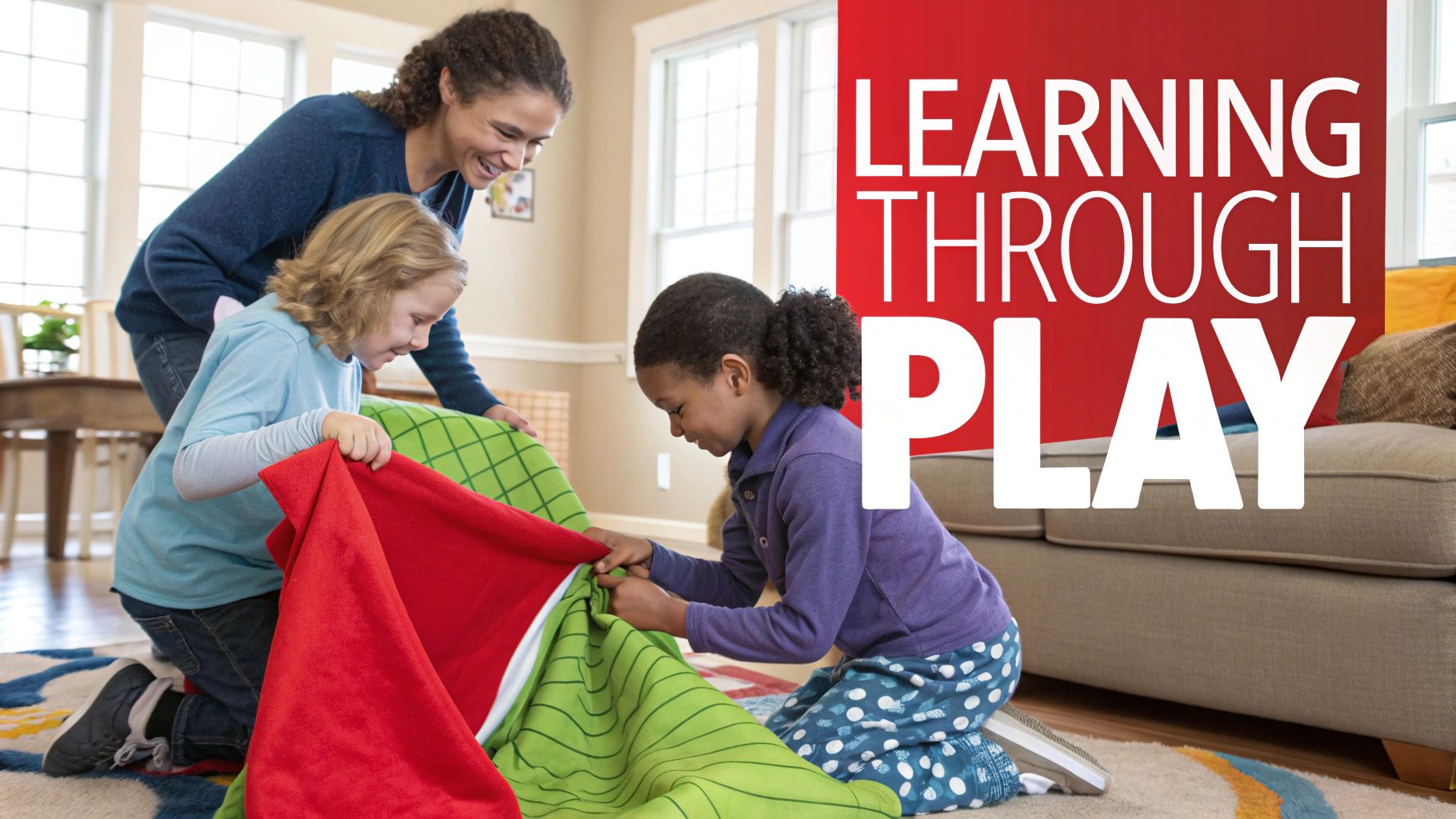
Beyond the brain-building benefits, open-ended play is a powerful social laboratory. When a group of kids decides to build a fort, they're doing much more than stacking cushions. They're learning to negotiate roles ("You be the guard!"), communicate their vision, and work together toward a shared goal—all in a low-stakes, fun environment.
There's no adult script to follow. They have to navigate disagreements and figure out compromises on their own. This hands-on process builds crucial social skills like empathy, teamwork, and emotional regulation. It's how they learn to see things from a friend's perspective and manage their own feelings when things don't go their way. This is a core part of what’s known as the constructivist learning theory, which you can read more about in our guide to constructivist learning theory.
From Simple Blocks To Future STEM Success
The link between unstructured play and future academic success is surprisingly strong, especially in STEM (Science, Technology, Engineering, and Math) fields. The hands-on, trial-and-error nature of open-ended play develops fine motor skills and spatial reasoning—the very abilities a child needs to grasp complex scientific concepts down the road.
Actionable Insight: A landmark study tracking preschoolers found that those who engaged in complex block play scored 45% higher on math readiness tests by the time they reached kindergarten.
This connection isn't a fluke. A 2001 study found that preschoolers who regularly played with blocks in complex ways showed significantly better mathematical performance throughout elementary school. You can discover more insights about these findings on open-ended play and learning on eatsleepdoodle.com.
Real-World Scenarios and Skills Development
It's easy to see these scientific principles in action during everyday playtime. The benefits aren't just abstract concepts; they are tangible skills being built, moment by moment.
- Engineering and Physics: When kids figure out how to balance blocks to build a tall tower without it toppling over, they are getting a hands-on lesson in gravity, stability, and structural integrity.
- Project Management: A group of kids creating an elaborate "restaurant" with play food has to decide on a menu, assign roles (who's the chef? the waiter?), and manage the entire flow of their pretend business.
- Creative Storytelling: A child using a few animal figurines to act out a whole saga is developing narrative skills, character development, and plot structure—the absolute foundations of literacy.
Each scenario shows how open-ended play seamlessly blends deep learning into an activity that, to a child, feels like pure fun.
How To Choose The Right Open Ended Toys
Walking the line between theory and your child's playroom can feel like a big leap, but identifying truly open-ended toys is easier than it looks. The secret is versatility. The best toys don't have a pre-written script; they can be used in countless ways, with a child's imagination as the only instruction manual.
Think about the difference between a flashy electronic toy and a simple set of wooden blocks. The electronic toy might say five specific phrases, and that's it—it dictates the play. Those blocks, however? They can be a castle, a spaceship, a fence for toy animals, or a bridge over a pretend river. Their purpose is brand new every time.
Key Takeaway: You want toys that are tools for imagination, not gadgets that try to replace it.
The Five Different Things Test: A Practical Guide
Here’s a simple trick I use when shopping for my own kids, which I call the "Five Different Things Test." Before you buy a toy, pause and ask, "Can my child use this to be at least five different things?" If you can rattle off five ideas easily, you've probably found a winner.
Let's put it into practice:
- Play Silks: Can they be a superhero cape? Yep. A river for toy boats? For sure. The roof of a tiny tent? Absolutely. A blanket for a baby doll? Of course. A ghost costume for Halloween? Easy. (Passes)
- Art Supplies: Can they be used for drawing, painting, making a collage, sculpting, and stamping? Yes. (Passes)
- A Character Action Figure: Can it be that one specific character? Yes. Can it be a totally different character? Not really. The play is largely stuck in that character's world. (Fails)
This quick mental checklist is a great way to filter out the one-trick ponies and zero in on the toys that will grow with your child's ever-expanding imagination.
The goal is to find toys that are 90% child and 10% toy. The child should be doing the heavy lifting—the thinking, creating, and directing—while the toy acts as a simple, passive prop for their brilliant ideas.
Beyond The Toy Store: Household Treasures for Play
The most powerful tools for imaginative play often aren't in a toy store at all. Everyday items hiding in plain sight around your house are fantastic for sparking creativity. This is great news because it proves you don't need to spend a fortune to give your child rich play experiences. When you're picking out playthings, especially for little ones, it’s key to find the best learning toys for 1-year-old toddlers, which are often wonderfully simple.
Here are a few household items that are champions of open-ended play:
- Cardboard Boxes: The undisputed king. A box is never just a box—it’s a house, a car, a robot costume, a secret tunnel, or a rocket ship to the moon.
- Blankets and Cushions: Perfect for building epic forts, creating cozy nests for reading, or becoming a magical, lumpy landscape for adventures.
- Kitchen Utensils: A whisk, some bowls, and a few measuring cups make for a world-class mud kitchen or a station for mixing magical potions.
By embracing versatility and using what you already have, you can easily fill your home with things that ignite endless creativity. For more ideas on what to buy, check out our guide to the best imaginative play toys.
Open Ended Play Ideas For Every Age
Knowing the "why" behind open-ended play is one thing, but bringing it to life is where the real fun starts. Here are practical, age-appropriate activities you can try right away. The best part is how they naturally scale with your child's development.
Toddlers (1-3 Years): Building Foundational Skills
For toddlers, the world is one giant sensory playground. Their play is all about touching, feeling, and figuring out how things work. Your goal is to offer safe, basic materials that spark curiosity without being overwhelming.
- Sensory Bins: Grab a shallow container and fill it with water, dry pasta, or sand. Toss in scoops and cups. The simple act of pouring and measuring is a fantastic workout for their fine motor skills.
- Simple Stacking: You can’t go wrong with classic wooden blocks or even a pile of soft cushions. Stacking them up—and, of course, knocking them down—is a toddler's first hilarious lesson in cause and effect.
- Cozy Fort Building: Drape a few blankets over some chairs, and you’ve just created a magical hideaway. This simple setup ignites their imagination and gives them a comforting, kid-sized space.
Preschoolers (3-5 Years): Expanding Imagination
Preschoolers are champions of make-believe. Their play gets more complex, filled with characters, stories, and elaborate scenarios. Now’s the time to provide materials that can keep up with their incredible imaginations.
Actionable Insight: The most basic materials often lead to the most creative play. In fact, research shows that open-ended toys can spark 40% more pretend play sessions than their closed-ended counterparts. Learn more about how this enhances imagination and critical STEM skills.
- Loose Parts Potions: Go on a nature walk and collect acorns, pebbles, and leaves. Add water and a few bowls, and watch them mix their very own magical "potions." It’s a great way to foster creativity and connect with the outdoors.
- Process-Focused Art: Ditch the craft kits with a specific outcome. Instead, lay out paper, paint, glue, and recycled goodies like cardboard tubes. The point isn't the final product, it’s the joy in the process of creating.
- Small World Play: Combine animal figurines, blocks, and colorful play silks to build miniature landscapes. One minute it's a zoo, the next it's a farm or an enchanted forest. This is a powerhouse for developing storytelling and problem-solving skills.
School-Aged Children (6+ Years): Encouraging Deeper Thinking
Once kids hit school age, their thinking becomes more abstract and strategic. Open-ended play evolves right along with them, encouraging bigger projects that involve designing, inventing, and complex experimenting.
For more ways to keep the learning going, check out our guide to fantastic play-based learning activities that grow with your child.
- Invent a Board Game: Hand them a blank piece of poster board, dice, and markers. Let them create the rules, design the path, and invent the entire game from scratch. It’s a brilliant way to flex their logic and creativity.
- Recycled Material Engineering: Challenge them to build the tallest tower or the strongest bridge using only stuff from the recycling bin. Boxes, bottles, and tape become tools for a hands-on introduction to engineering principles.
- Self-Directed Science: Use a simple science kit as a jumping-off point. After they finish the main experiment, encourage them to ask "What if...?" and test their own ideas. This is how you foster a genuine scientific mindset.
How To Foster A Creative Play Environment
Your job as a parent isn’t to be the director of your child’s playtime. Think of yourself more as a set designer—the architect of a space where their creativity can take off. When you thoughtfully set the stage, you empower them to explore, invent, and discover on their own terms.
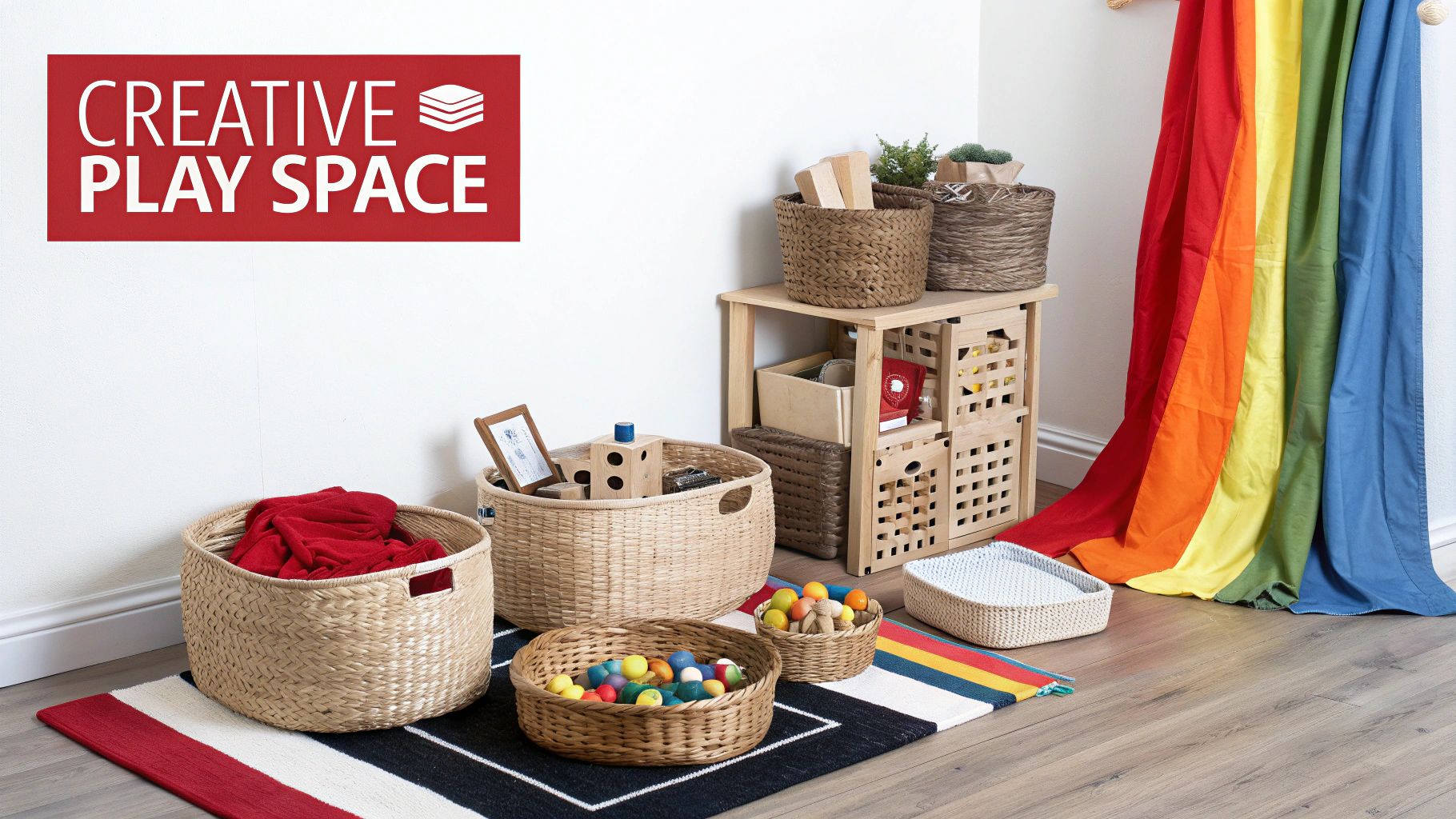
What you're aiming for is a 'yes space': an area where your child feels safe to explore without constantly hearing "no" or "don't touch that." When the environment is child-proofed and the right materials are within reach, kids can follow their natural impulses freely, building confidence and independence.
Set The Stage For Discovery
A simple but powerful technique is called strewing. It just means you strategically place interesting objects in your child’s path to spark their curiosity without saying a word.
Think of it as leaving a trail of creative breadcrumbs. A magnifying glass placed next to a pinecone, or a basket of colorful ribbons left on the floor, can invite investigation in a way that direct instructions can't match.
Accessible organization is another game-changer. Try storing toys in open, low baskets instead of giant, lidded boxes. When kids can see and reach their playthings, they’re far more likely to start playing on their own. For more on this, check out our practical tips on how to organize a toy room to boost creativity.
Your Role As A Play Facilitator: Step Back and Observe
Perhaps the most important piece of the puzzle is understanding your role: to observe more than you direct.
The art of facilitating is not in giving answers, but in asking better questions. Valuing the process of your child's exploration over the final product is one of the most powerful things you can do for their development.
So, instead of a limiting question like, "Are you building a car?" try one that opens up their imagination: "I wonder what will happen if you add this piece?" or "Tell me about what you're making." This small shift validates their creative process and encourages deeper thinking.
Research shows that when children play with open-ended materials like blocks, they tend to communicate and collaborate 30% more fluidly. Other studies have found a 25% gain in problem-solving flexibility compared to play with more restrictive toys. By creating an inviting space and asking thoughtful questions, you become a partner in their discovery, not a director of it.
Your Questions About Open-Ended Play, Answered
Stepping into the world of unstructured play can feel strange at first, and it's normal to wonder if you're "doing it right." Let's tackle some of the most common questions that pop up for parents.
How do I know my child is learning without rules?
It’s easy to think learning only happens with structure—like worksheets or guided lessons. But open-ended play is where some of the deepest, most authentic learning takes root. When a child builds a wobbly tower of blocks, they aren’t just stacking. They’re running a real-time physics experiment on balance, gravity, and structural integrity. Learning isn’t just memorizing facts; it’s building the mental muscle to think critically and solve problems. Open-ended play is the ultimate training ground for those skills.
How do I balance open-ended play with structured activities?
It's not an "either/or" situation. Structured activities like sports, music lessons, or even board games are fantastic for teaching specific skills and the importance of following rules. The key is a healthy mix. Think of your child’s schedule like a balanced diet: they need the structured "nutrients" from formal activities and the "free-range" nourishment that only open-ended play can provide.
Actionable Insight: A good rule of thumb is to ensure there are dedicated, unscheduled blocks of time each day where your child is free to simply be and play without any agenda. This isn't empty time; it’s essential processing time for their growing minds.
What if my child says they are bored?
That dreaded phrase, "I'm bored," can feel like a failure. But it's actually an incredible opportunity! Boredom is often the quiet space just before a creative spark ignites. Instead of immediately jumping in with a solution or a screen, try gently encouraging them to solve their own boredom. You could ask, "That's an interesting feeling. What do you think you could create right now?" Resisting the urge to fill that space for them gives their imagination the runway it needs to take off.
Do I need to buy expensive toys for open-ended play?
Absolutely not. In fact, some of the most powerful tools for open-ended play are things you probably already have. Cardboard boxes, blankets for fort-building, sticks from the yard, and old kitchen utensils are the unsung heroes of imaginative play. The true value of a toy isn't in its price tag, but in how many different things it can become in the hands of a child.
At Playz, we believe the best learning is powered by fun and curiosity. Our science kits and creative toys are designed to be the perfect launchpad for your child's next big idea, turning playtime into a thrilling adventure of discovery.
Ready to ignite your child's passion for learning? Explore our collection of award-winning STEM kits and see how we make science unforgettable at https://www.playzusa.com.