

Imagine a classroom buzzing with curiosity, where students are not just passive listeners but active explorers, creators, and problem-solvers. This isn't a distant dream; it's the reality of a student-centered learning environment. Traditional 'sit-and-get' instruction, where a teacher lectures from the front, is giving way to dynamic approaches that place the child at the heart of their own educational journey. This fundamental shift empowers learners, fosters a genuine love for discovery, and develops critical 21st-century skills like collaboration, critical thinking, and creativity.
By moving away from rote memorization and towards active participation, we create more authentic and lasting learning experiences. Student-centered learning is not about relinquishing structure; it's about redesigning it to build on a child's natural inquisitiveness. When students have a voice and choice in what and how they learn, their engagement and ownership skyrocket. They become invested partners in their education, better equipped to tackle complex challenges and adapt to new situations.
This comprehensive guide dives directly into 10 powerful student centered learning activities that you can implement immediately to spark engagement and create more meaningful educational outcomes. From hands-on experiments to collaborative projects and inquiry-based challenges, these strategies are designed to be practical, adaptable, and, most importantly, transformative for both educators and young learners. We will explore a variety of methods suitable for different age groups and learning goals, providing actionable steps and tips to bring these concepts to life in your home or classroom.
1. Hands-On Experiential Learning
Hands-on experiential learning moves education beyond textbooks, placing students directly in control of their learning through physical interaction. This approach is one of the most effective student-centered learning activities because it empowers children to construct knowledge by doing, touching, and exploring. Rooted in the educational philosophies of pioneers like Maria Montessori, it transforms abstract concepts into tangible, memorable experiences.
Instead of just reading about a volcanic eruption, a student creates one with baking soda and vinegar. This direct engagement solidifies understanding, improves retention, and caters to kinesthetic learners who thrive on active participation.
How It Works
This method leverages the brain's natural inclination to learn from direct experience. When a child builds a circuit, mixes solutions in a chemistry kit, or plants a seed, they are not just following instructions; they are problem-solving, observing cause and effect, and making critical neural connections. For a deeper dive into the theory behind this powerful method, you can explore the core principles of experiential learning and how it facilitates authentic understanding.
Implementation Tips
To successfully integrate hands-on activities, focus on preparation and guidance.
- Set the Stage: Prepare all materials in advance and organize them into accessible stations. This minimizes downtime and keeps students focused on the task.
- Guide, Don't Dictate: Provide clear, visually-supported instructions but allow room for exploration. Encourage students to predict what will happen before they start an experiment.
- Document the Process: Ask students to document their findings through drawings, photos, or a simple journal. This reinforces their observations and helps them reflect on what they learned.
By making learning a physical and sensory activity, you foster curiosity and build a foundational love for discovery. To discover more about the specific advantages this approach offers, you can explore the cognitive and developmental benefits of hands-on learning.
2. Project-Based Learning (PBL)
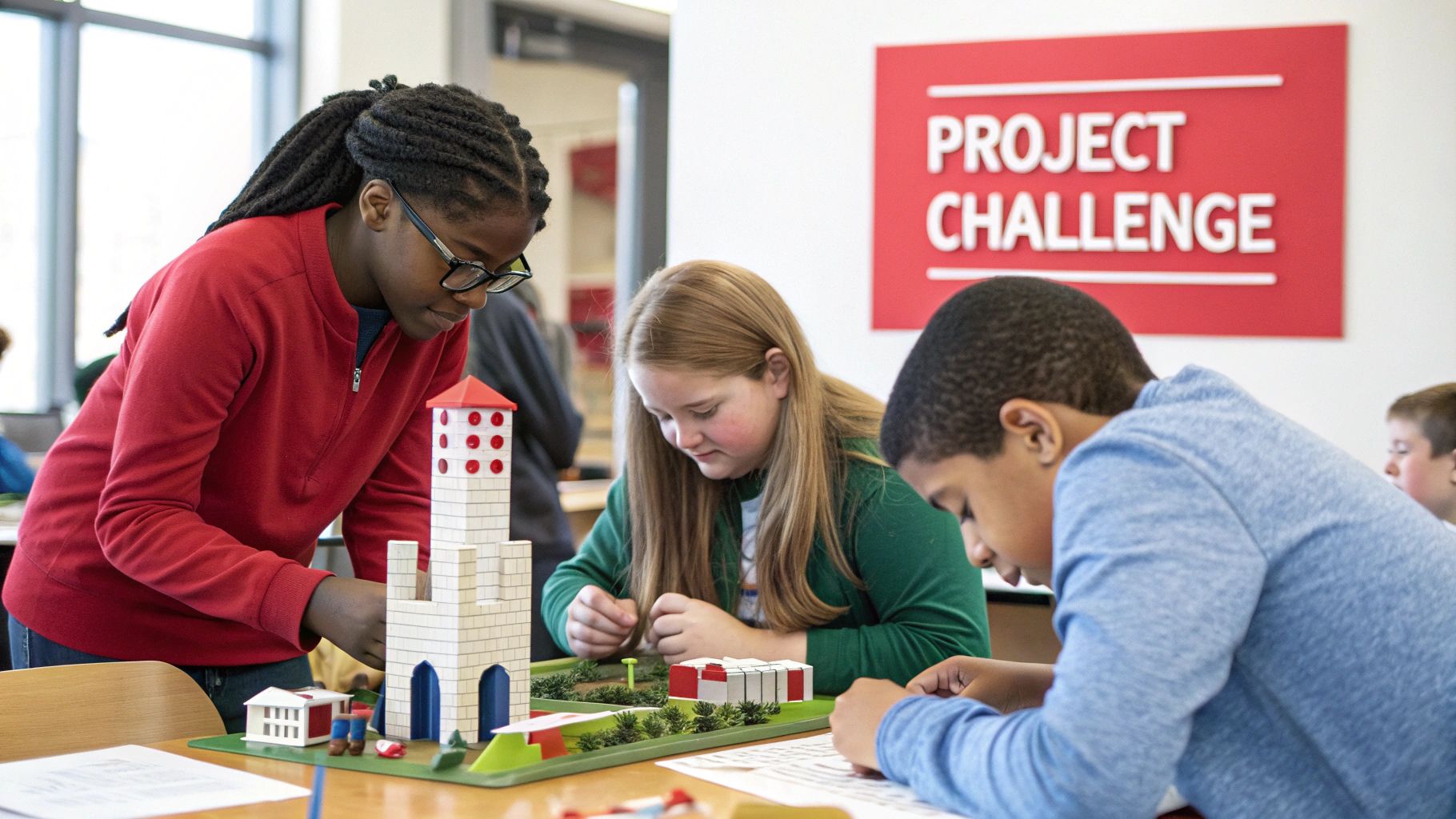
Project-Based Learning (PBL) shifts the educational focus from rote memorization to engaging with complex, real-world challenges. This dynamic instructional approach is one of the most powerful student-centered learning activities because it allows students to gain knowledge and skills by working for an extended period to investigate and respond to an authentic, engaging, and complex question, problem, or challenge. This method, built on the foundations laid by John Dewey, empowers students to take ownership of their education.
For instance, instead of just reading about ecosystems, students might design and build a self-sustaining terrarium or create a documentary about local wildlife. This deep, prolonged engagement helps students develop critical thinking, collaboration, and problem-solving skills as they see a project through from conception to completion.
How It Works
PBL is driven by a central, open-ended question that sparks genuine curiosity. Students work collaboratively over an extended period, researching, designing, and creating a tangible product or presentation for a real audience. When students engineer a solution to a local environmental issue or design and market a new product, they are not just learning facts; they are applying knowledge from multiple subjects like science, math, and language arts in a meaningful context. This interdisciplinary process creates a rich, holistic learning experience.
Implementation Tips
Successful PBL requires careful planning to guide students without stifling their creativity.
- Start with a Driving Question: Craft a compelling, open-ended question that frames the project and sparks student interest. It should be challenging enough to require deep inquiry.
- Establish Checkpoints: Build in multiple milestones for students to receive feedback from peers and instructors. This allows for iteration and prevents them from going too far off track.
- Provide Resources: Create a curated library of resources, including articles, expert contacts, and research guides, to support student investigation.
- Foster Collaboration: Structure tasks to require teamwork and create opportunities for students to give and receive constructive peer feedback throughout the process.
By grounding learning in authentic challenges, you empower students to become active creators of knowledge. To get started with this transformative approach, you can find a wealth of ideas in these project-based learning lesson plans.
3. Cooperative Learning and Small Group Work
Cooperative learning organizes students into small groups where they work together toward a shared objective. This method is one of the most powerful student-centered learning activities because it shifts the focus from individual competition to collective success. Pioneered by educators like David and Roger Johnson, it emphasizes positive interdependence, where each member's contribution is essential for the group's achievement.
Instead of a student working alone on a science worksheet, a small group might collaboratively assemble and troubleshoot a science experiment, with each member having a specific role. This direct peer-to-peer interaction builds communication, problem-solving, and teamwork skills while reinforcing academic content.
How It Works
This approach leverages social interaction as a catalyst for deeper learning. When students teach and explain concepts to one another, they solidify their own understanding and identify gaps in their knowledge. The structure ensures every student is an active participant. To further cultivate a supportive learning environment and enhance these collaboration skills, educators can explore resources like books about social emotional learning to build a strong classroom foundation.
Implementation Tips
To successfully implement cooperative learning, structure and clear expectations are key.
- Assign Specific Roles: Give each student a job like "Reader," "Recorder," "Materials Manager," or "Presenter." This ensures individual accountability and prevents one student from dominating the group.
- Teach and Model Skills: Explicitly teach collaborative skills such as active listening, respectful disagreement, and giving constructive feedback. Model these behaviors before asking students to practice them.
- Provide Clear Instructions: Give groups clear, written instructions and a defined final product. Use timers to help keep them focused and on task for each part of the activity.
By making learning a team-based endeavor, you nurture vital social skills alongside academic knowledge. For more ideas on fostering collaboration from an early age, you can find inspiration in these cooperative play activities for preschoolers.
4. Inquiry-Based Learning
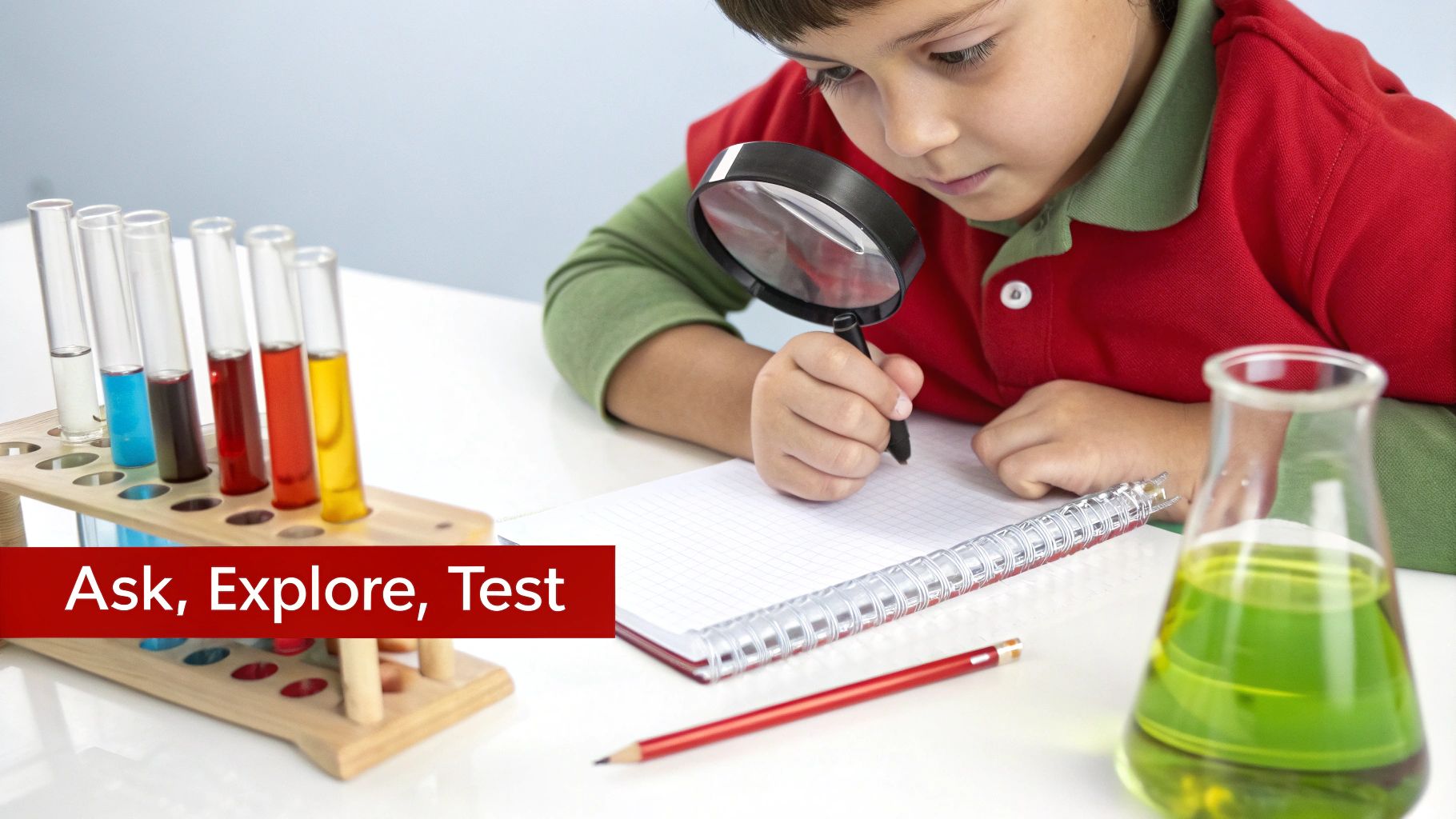
Inquiry-based learning transforms students into active investigators, empowering them to ask questions, conduct research, and construct their own understanding. This powerful approach is one of the most effective student-centered learning activities because it shifts the focus from receiving information to discovering it. Instead of being told facts, students are guided through a process of exploration, observation, and reflection, placing their natural curiosity at the heart of their education.
This method honors a child's innate desire to know "why" and "how." For instance, rather than just learning the parts of a plant, students might investigate what a plant needs to grow by designing their own experiments. This direct, self-led investigation builds critical thinking, problem-solving, and scientific reasoning skills that are valuable across every subject.
How It Works
Grounded in the constructivist theories of thinkers like Jean Piaget and John Dewey, this method operates on the principle that learning is an active process of creating meaning from experience. When a student asks a question like, "Why do some things float and others sink?" they initiate a cycle of investigation. They form a hypothesis, test it with different objects, observe the results, and draw conclusions, constructing durable knowledge along the way.
The teacher's role becomes that of a facilitator, guiding students with probing questions rather than providing direct answers. This nurtures intellectual independence and teaches children how to learn, a skill that will serve them for a lifetime. To see how this approach can be applied in practice, you can find a variety of engaging inquiry-based learning activities designed to spark curiosity.
Implementation Tips
To successfully foster an inquiry-driven environment, focus on creating opportunities for authentic exploration and thoughtful questioning.
- Spark Curiosity: Begin with a "discrepant event" or a compelling phenomenon that defies easy explanation. This could be a surprising science demonstration or an open-ended question that ignites interest.
- Guide with Questions: Use open-ended questions like "What do you notice?" or "What do you think will happen if...?" to guide student thinking without directing it toward a single correct answer.
- Embrace Productive Failure: Create a safe space where "wrong" answers are seen as valuable steps in the learning process. Encourage students to test ideas, even if they don't work out as expected.
- Document the Journey: Have students record their questions, observations, and conclusions in journals, photos, or videos. This reinforces the scientific process and makes their learning visible.
5. Differentiated Instruction
Differentiated instruction is a proactive teaching philosophy that tailors learning to meet the unique needs of every student. This approach moves away from a one-size-fits-all model, recognizing that learners vary in readiness, interests, and learning styles. It stands out as one of the most powerful student-centered learning activities because it ensures that every child is appropriately challenged and supported, creating an equitable path to understanding.
Instead of all students completing the same worksheet, one group might be building a basic circuit, another might be designing a more complex one, while a third group creates a presentation on how circuits work. This tailored engagement ensures students are neither bored nor overwhelmed, maximizing their potential for growth.
How It Works
This method empowers teachers to modify the content (what students learn), the process (how they learn it), and the product (how they demonstrate their learning). By using pre-assessments to gauge student readiness, educators can strategically design activities that target specific learning goals for different groups. For example, a Playz science kit exploring chemistry could be used for various challenges, from simple mixture observation to complex reaction analysis, all within the same classroom.
Implementation Tips
To effectively implement differentiated instruction, focus on flexibility and clear expectations.
- Assess and Group: Use quick pre-assessments or observations to understand student readiness. Create flexible groups that change based on the topic and student progress, not on fixed ability levels.
- Offer Meaningful Choices: Provide options for how students can learn about a topic or demonstrate their knowledge. For instance, they could choose between writing a report, creating a diagram, or building a model.
- Create Tiered Activities: Design activities that focus on the same core concept but vary in complexity. This ensures all students are working toward the same learning objective but at a level that is challenging yet achievable for them.
6. Discovery Learning and Free Play
Discovery learning and free play champion unstructured exploration, allowing students to learn through organic experimentation and direct interaction with materials. This is one of the most powerful student-centered learning activities because it trusts that children are natural scientists, capable of constructing their own understanding without predetermined outcomes or strict teacher guidance. Popularized by educational thinkers like Maria Montessori and Jean Piaget, this approach fuels intrinsic motivation and creativity.
Instead of following a step-by-step guide to build a specific model, a child is given a set of building materials and the freedom to create whatever they imagine. This self-directed process develops critical thinking, independence, and resilience as they test ideas, make mistakes, and discover solutions on their own terms.
How It Works
This method operates on the principle that learning is most meaningful when it is driven by personal curiosity. When children engage in free play, whether it's building a fort with blocks, exploring the properties of water in a sensory bin, or creating stories in a play tent, they are actively constructing knowledge. They aren't just memorizing facts; they are developing theories, testing hypotheses, and integrating new information into their existing worldview. The educator’s role shifts from instructor to facilitator, creating a rich environment and observing the learning as it unfolds.
Implementation Tips
To effectively facilitate discovery learning, focus on creating an inviting environment and trusting the process.
- Set the Stage: Prepare a rich, varied learning environment with a diverse range of open-ended materials. Think blocks, art supplies, natural items, and loose parts that can be used in multiple ways.
- Guide, Don't Dictate: Observe children's play rather than directing it. Ask open-ended questions like "What do you think will happen if...?" to extend their thinking without providing answers.
- Document the Process: Use photos, videos, or brief notes to document the learning you observe. This values the process over the final product and provides insight into a child's thinking. For more on how this enriches development, you can explore the cognitive and social benefits of play-based learning.
By providing time and space for uninterrupted play, you empower students to become confident, self-reliant learners who are driven by their own curiosity.
7. Peer Teaching and Collaborative Learning Networks
Peer teaching and collaborative learning networks shift the instructional focus from the teacher to the students themselves. This approach places learners in the role of both student and instructor, leveraging the idea that explaining a concept to others is one of the most effective ways to master it. This is a powerful form of student-centered learning because it builds confidence, communication skills, and a deeper sense of community.
The concept is rooted in the work of educational psychologists like Lev Vygotsky, who emphasized learning as a social process. When a student explains how to build a simple motor to a peer, they must organize their thoughts, simplify complex ideas, and anticipate questions, which solidifies their own understanding far more than passive listening would.
How It Works
This method taps into the social nature of learning and the unique ability of peers to communicate on the same wavelength. When students teach one another, they often use analogies and language that are more relatable and accessible than a teacher's formal explanation. This process reinforces knowledge for the student-teacher and provides a comfortable, low-stakes learning environment for the student-learner, fostering a culture of mutual support.
For example, in a cooperative learning structure, each member of a small group might become an "expert" on one part of a science experiment, responsible for teaching it to the rest of their team. This interdependence ensures every student is actively engaged and accountable for their part of the learning journey.
Implementation Tips
To cultivate a successful peer teaching environment, structure and guidance are essential.
- Train the Tutors: Before pairing students, provide mini-lessons on how to explain concepts clearly, ask guiding questions instead of giving answers, and offer positive, constructive feedback.
- Structure the Roles: Define clear roles and expectations. For instance, one student might be the "Explainer" while the other is the "Questioner" for a set period before they switch.
- Pair Strategically: Consider both academic and social dynamics when pairing students. Pairing a more advanced learner with one who is struggling can be effective, but so can pairing students with similar abilities to problem-solve together.
- Monitor and Guide: Circulate the room to listen in on conversations. This allows you to correct any misconceptions and provide support to peer teachers who may be struggling to explain a concept.
8. Maker Education and STEAM Learning
Maker education and STEAM learning fuse creativity with technical skill, transforming students from passive consumers into active creators. This approach emphasizes hands-on building, prototyping, and interdisciplinary problem-solving, making it one of the most dynamic student-centered learning activities available. By blending Science, Technology, Engineering, Arts, and Mathematics, it encourages students to design and build tangible solutions to real-world challenges.
Instead of just learning about engineering principles, a student designs and builds a small-scale bridge, testing its strength and iterating on the design. This process values failure as a learning opportunity, fostering resilience, innovation, and critical thinking.
How It Works
This method is built on the idea that learning is deepest when it is connected to making something meaningful. When students create inventions from recycled materials, design wearable technology, or build a working model, they are engaging in a cyclical process of ideation, creation, testing, and refinement. This active engagement mirrors the work of real-world innovators and engineers, making learning authentic and relevant. The integration of "Arts" into STEM is crucial, as it champions creativity, aesthetics, and human-centered design in technical projects.
Implementation Tips
To foster a successful maker environment, focus on empowering students with creative freedom and the right resources.
- Present Open-Ended Challenges: Instead of giving step-by-step instructions, pose a problem or a challenge. For example, "Design a device that can help water a plant automatically" encourages more creativity than "Build this pre-designed watering device."
- Normalize and Celebrate Failure: Frame mistakes and failed prototypes as essential steps in the design process. Create a "first attempt in learning" (FAIL) wall to showcase iterations and celebrate the learning that comes from what doesn't work.
- Encourage Documentation: Ask students to document their journey through sketches, photos, videos, or a maker journal. This reinforces reflection and helps them track their progress and thought processes.
By creating a culture of making, you empower students to see themselves as inventors and problem-solvers, building both confidence and practical skills for the future.
9. Outdoor and Nature-Based Learning
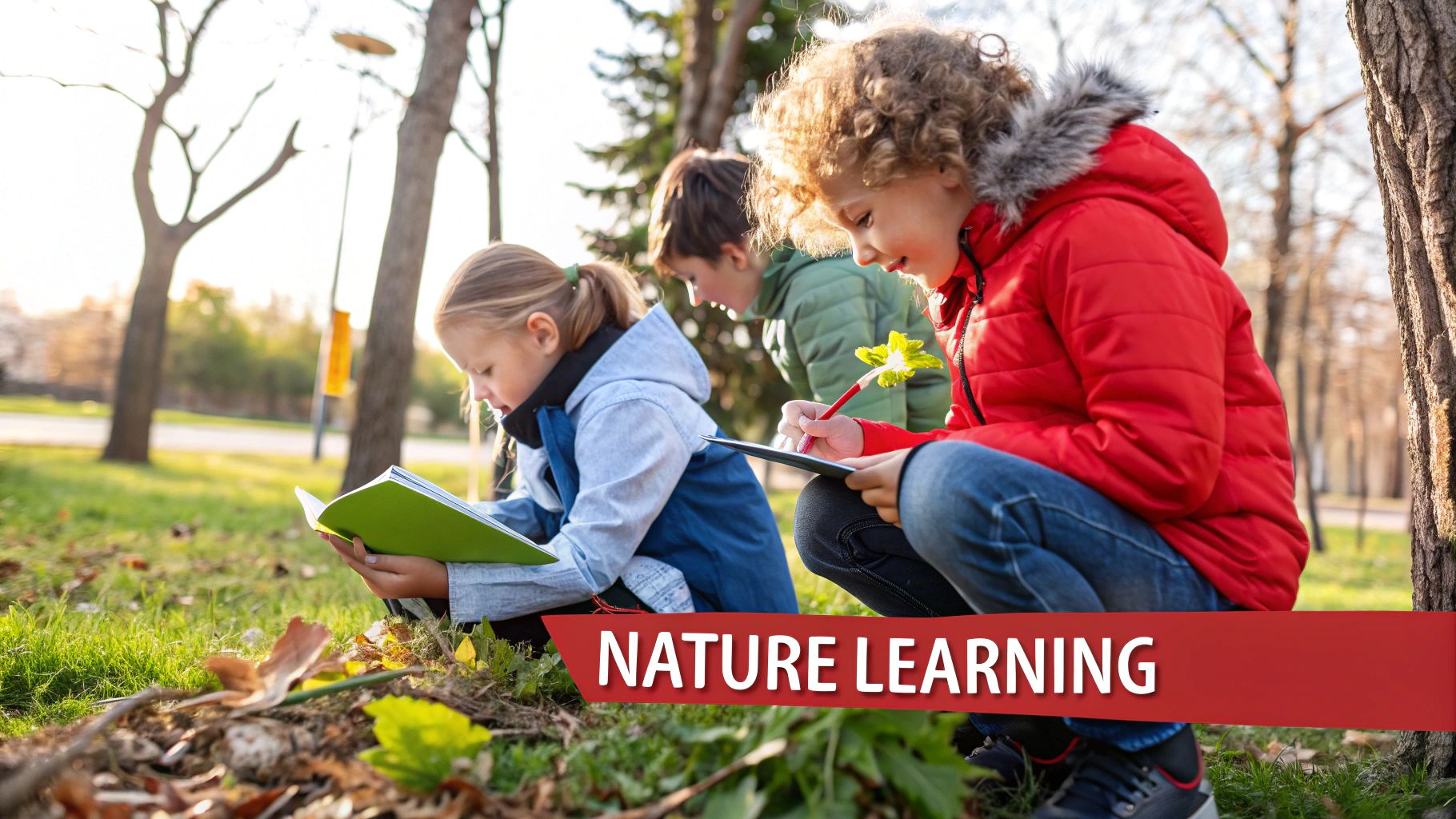
Outdoor and nature-based learning moves the classroom outside, using the natural environment as a dynamic and engaging teacher. This approach is a powerful example of student-centered learning activities because it allows children to learn through direct, sensory-rich experiences. Inspired by the Forest Schools movement and the work of environmental advocates like Richard Louv, it transforms the world into a living laboratory.
Instead of looking at pictures of insects, a student can gently catch a ladybug and observe it up close. This direct interaction with the natural world promotes physical activity, reduces stress, and builds a deep, personal connection to scientific concepts and the environment.
How It Works
This method leverages a child's innate curiosity about the world around them. When a student examines the rings on a tree stump, sorts rocks by texture, or sketches a flower, they are engaging in authentic scientific inquiry. They are observing patterns, making comparisons, and asking questions driven by their own discoveries. This hands-on exploration in a natural setting supports holistic development, addressing cognitive, physical, and emotional learning all at once. For a more detailed look into how outdoor education boosts development, consider exploring the foundational principles of nature-based learning.
Implementation Tips
To effectively bring learning outdoors, focus on creating structure within a flexible, exploratory framework.
- Start Small: Begin with short, regular visits to a nearby park or even just the schoolyard. Gradually increase the duration and complexity of outdoor activities as students become more comfortable.
- Encourage Careful Observation: Equip students with tools like magnifying glasses, binoculars, or journals. Prompt them to document their findings by sketching what they see, writing down questions, or collecting natural items (when appropriate).
- Use Natural Materials: Integrate leaves, sticks, rocks, and mud into learning. These can be used for counting, creating art, building structures, or conducting simple science experiments, making learning tangible and resource-free.
By taking education beyond the four walls of a classroom, you tap into a rich source of wonder and discovery, fostering resilient, curious, and environmentally-aware learners.
10. Reflective Practice and Metacognition Development
Reflective practice and metacognition development shift the focus from what students learn to how they learn, empowering them to become architects of their own understanding. This approach is one of the most powerful student-centered learning activities because it teaches children to think about their thinking. By analyzing their learning processes, students gain control over their education, building skills for lifelong, independent learning.
Instead of just completing a project and moving on, a student pauses to ask, "What part of building this model was the hardest, and what strategy helped me solve it?" This structured self-awareness, popularized by thinkers like John Dewey, transforms learning from a passive reception of information into an active, conscious process.
How It Works
This method cultivates metacognition, which is the awareness and understanding of one's own thought processes. When students journal about a failed experiment, discuss group dynamics after a collaborative task, or use a rubric to assess their own work, they are actively monitoring their comprehension, evaluating their strategies, and adjusting their approach. This internal feedback loop is crucial for developing resilience and a growth mindset.
Implementation Tips
To successfully integrate reflection, you must make it a consistent and valued part of the learning routine.
- Model the Behavior: Think aloud as you solve problems to show students what metacognition looks like. Say things like, "I'm not sure how to start this, so first I will try to break it down into smaller steps."
- Use Sentence Starters: Provide prompts to guide reflection, especially for younger learners. Use phrases like, "I was surprised when...", "I figured it out by...", and "Next time, I will try..." to structure their thoughts.
- Create a Safe Space: Emphasize that reflection is not about judgment but about understanding. Celebrate the process of overcoming challenges and treat mistakes as valuable data for learning.
By embedding reflective moments into daily activities, you help students build the essential skill of self-directed learning, turning them into more confident and capable thinkers.
10 Student-Centered Learning Activities Comparison
| Approach | 🔄 Implementation (complexity) | ⚡ Resources (requirements) | ⭐ Expected outcomes (quality) | 📊 Ideal use cases | 💡 Key advantages (insight) |
|---|---|---|---|---|---|
| Hands‑On Experiential Learning | Moderate — prep, supervision, safety | Moderate–High — materials, space, teacher training | ⭐⭐⭐⭐ — strong engagement & retention | Early childhood, science labs, makerspaces | Concrete understanding; multi‑sensory learning |
| Project‑Based Learning (PBL) | High — long-term planning & assessment design | High — materials, tech, community partners | ⭐⭐⭐⭐ — deep learning; transferable skills | Interdisciplinary units, capstone projects, community challenges | Real‑world relevance; collaboration & problem solving |
| Cooperative Learning & Small Groups | Moderate — group structures & management | Low–Moderate — common materials, facilitation | ⭐⭐⭐⭐ — improved social skills & achievement | Mixed‑ability classes, lab work, centers | Peer support; communication and teamwork practice |
| Inquiry‑Based Learning | High — guided facilitation & teacher expertise | High — materials, time, research resources | ⭐⭐⭐⭐ — strong scientific reasoning; curiosity | Science investigations, research projects, gifted learners | Fosters inquiry, independence, hypothesis testing |
| Differentiated Instruction | High — ongoing assessment & planning | Moderate–High — varied materials, flexible grouping | ⭐⭐⭐⭐ — increased growth across levels | Inclusive classrooms, diverse readiness groups | Meets individual needs; maintains appropriate challenge |
| Discovery Learning & Free Play | Low–Moderate — prepare environment; observe | Moderate — rich, open‑ended materials & space | ⭐⭐⭐ — high creativity & autonomy; variable content | Early childhood, unstructured play periods, exploratory centers | Encourages imagination, intrinsic motivation |
| Peer Teaching & Collaborative Networks | Moderate — training & role structure | Low — peer time, basic materials | ⭐⭐⭐⭐ — deeper understanding via teaching | Tutoring, mixed‑age programs, review sessions | Reinforces learning; builds leadership and communication |
| Maker Education & STEAM | High — tool safety, workspace, curriculum | High — diverse tools, consumables, safety gear | ⭐⭐⭐⭐ — strong design thinking & technical skills | Makerspaces, STEM clubs, design challenges | Integrates creativity with STEM; iterative problem solving |
| Outdoor & Nature‑Based Learning | Moderate — risk management & logistics | Moderate — outdoor gear, site access | ⭐⭐⭐⭐ — wellbeing, engagement, authentic science | Fieldwork, ecology lessons, movement‑based learning | Physical & mental health benefits; context for ecological learning |
| Reflective Practice & Metacognition | Moderate — routines, prompts, modeling | Low — journals, prompts, time allocation | ⭐⭐⭐⭐ — improved self‑regulation & transfer | Post‑project reflection, study skills, formative assessment | Builds metacognition, planning, and learning efficiency |
Ready to Spark Curiosity and Empower Your Learners?
Transitioning your learning environment from a traditional, top-down model to one that is truly student-centered is a transformative process. It's a journey that redefines the roles of both educator and learner, shifting from passive reception to active, engaged discovery. The student centered learning activities we've explored—from Project-Based Learning to Maker Education—are not just isolated lesson plans; they are building blocks for a more dynamic and empowering educational philosophy. By embracing these strategies, you are not simply teaching subjects; you are cultivating essential lifelong skills like critical thinking, collaboration, creativity, and resilience.
The core takeaway is that a student-centered approach is less about having all the answers and more about asking the right questions. It’s about creating an environment where curiosity is the compass and students are the explorers, charting their own paths to understanding. This shift requires a willingness to step back, facilitate rather than dictate, and trust in a child's innate drive to learn.
Key Takeaways and Your Next Steps
As you begin to integrate these ideas, remember the fundamental principles that unite them:
- Ownership Breeds Engagement: When students have a voice and choice in their learning, their investment skyrockets. Activities like PBL and inquiry-based learning put them in the driver's seat.
- Collaboration is a Superpower: Peer teaching and small group work build crucial social-emotional skills like communication, empathy, and teamwork, which are vital for success in all aspects of life.
- Learning is an Action Verb: True understanding is forged through doing. Hands-on experiential learning, STEAM challenges, and outdoor exploration move concepts from the abstract to the tangible, solidifying knowledge in a way passive listening never can.
Your immediate next step doesn't have to be a complete overhaul. Start small. Choose one or two student centered learning activities that resonate with you and your learners. Perhaps you can introduce a "Wonder Wall" to spark inquiry-based questions or dedicate a corner of your space as a mini-maker station. The goal is incremental, consistent change.
The Long-Term Impact of Student-Centered Learning
Embracing this educational philosophy extends far beyond improved test scores. You are nurturing individuals who are confident in their ability to tackle complex problems. You are raising a generation of innovators who are not afraid to experiment, fail, and try again. By providing opportunities for differentiated instruction and reflective practice, you teach children that learning is a personal journey, not a one-size-fits-all race.
The value lies in empowering learners to become architects of their own knowledge. They learn how to learn—a skill that will serve them long after they have forgotten specific formulas or dates. This is the ultimate goal: to foster a durable, authentic love for learning that lasts a lifetime. As you continue on this path, you'll witness a profound shift in your learning environment, transforming it into a vibrant hub of curiosity, collaboration, and discovery.
Ready to equip your young explorers with the tools they need for hands-on discovery? The science kits, building sets, and creative play spaces from Playz are specifically designed to support the very student centered learning activities discussed here, turning abstract concepts into exciting, tangible experiments. Explore the full collection at Playz and find the perfect kit to ignite your child's passion for learning today.