


A kids camo tent is a supervised pretend-play shelter for indoors or a calm, dry, shaded yard, not a weatherproof camping or sleeping tent. Choose it for the play space it creates, not because camouflage makes it suitable for the wilderness.
The familiar advice to buy an indoor/outdoor tent and let children camp anywhere skips the most important question: what does outdoor mean? A backyard hideout beside your chair is a different proposition from a tent left on a windy patio. Camouflage is a story theme, not a weather rating.
Where a Kids Camo Tent Is Safe to Use
Indoor floor play is the best default. A lightweight fabric shelter over flexible poles can make a useful mission headquarters, but it needs a clear footprint, an accessible opening, and a caregiver who can intervene.
Start with the setting rather than the packaging. An indoor/outdoor description doesn't establish waterproofing, sun protection, or suitability for sleeping.
Kids camo tent use matrix
| Use case | Conditions | Verdict | Main risk |
|---|---|---|---|
| Indoor floor play | Adult nearby, clear floor, open door or mesh | Best default | Tripping on poles or clutter |
| Shaded calm yard | Dry, little wind, caregiver in sight, short session | Acceptable with supervision | Heat, tipping, wandering off |
| Direct sun | Hot patio, beach, or unshaded lawn | Stop | Overheating and fabric fade |
| Wind or rain | Gusts, wet ground, or storms | Do not use | Collapse, soaking, slippery poles |
| Near flame or heater | Candles, heaters, grills, campfires, smoking | Never | Rapid ignition or melting fabric |
| Overnight or nap inside | Any setting, zipped closed | Never | Poor airflow and delayed exit |
| Unsupervised toddler | Adult out of sight | Never | Entrapment and tip-over |
For living-room or classroom play, move the tent away from furniture corners, door swings, and busy walking routes. Place its entrance where you can see the child without constantly leaning around a wall. Mesh helps visibility, but it doesn't replace supervision.
A shaded yard can work when the ground is level and dry and the structure stays steady without improvised weights. Stay within reach for toddlers, and keep older children within sight. End the session if the interior feels stuffy, the child seems uncomfortable, or the panels start pulling against the frame.
Outdoor access without camping claims
In a nationally representative University of Michigan poll of 710 parents of children ages 1–5, 62% said their child went outside almost every day, 29% several times per week, and 9% once a week or less. Those different routines help explain the appeal of a play shelter that can move between a room and a suitable yard, without turning it into camping equipment.
For more placement considerations, use this guide to kids' outdoor play tents alongside the product's instructions. If mosquitoes make a shaded session uncomfortable, Misaj's guide to gentle repellents offers a starting point for reviewing sensitive-skin options. Check the chosen repellent's age directions, and don't treat an open play tent as insect protection.
Practical rule: If that weather would flatten a playhouse, bring the child and the tent inside.
How Camo Fabric Handles Sun Wind and Rain
The convenience of a kids camo tent comes from its light construction. Thin cloth and flexible framing make it easy to move and pack, but they don't provide the structural margin you'd expect from camping equipment.
Look at the fabric, openings, and frame rather than judging outdoor suitability from the pattern.
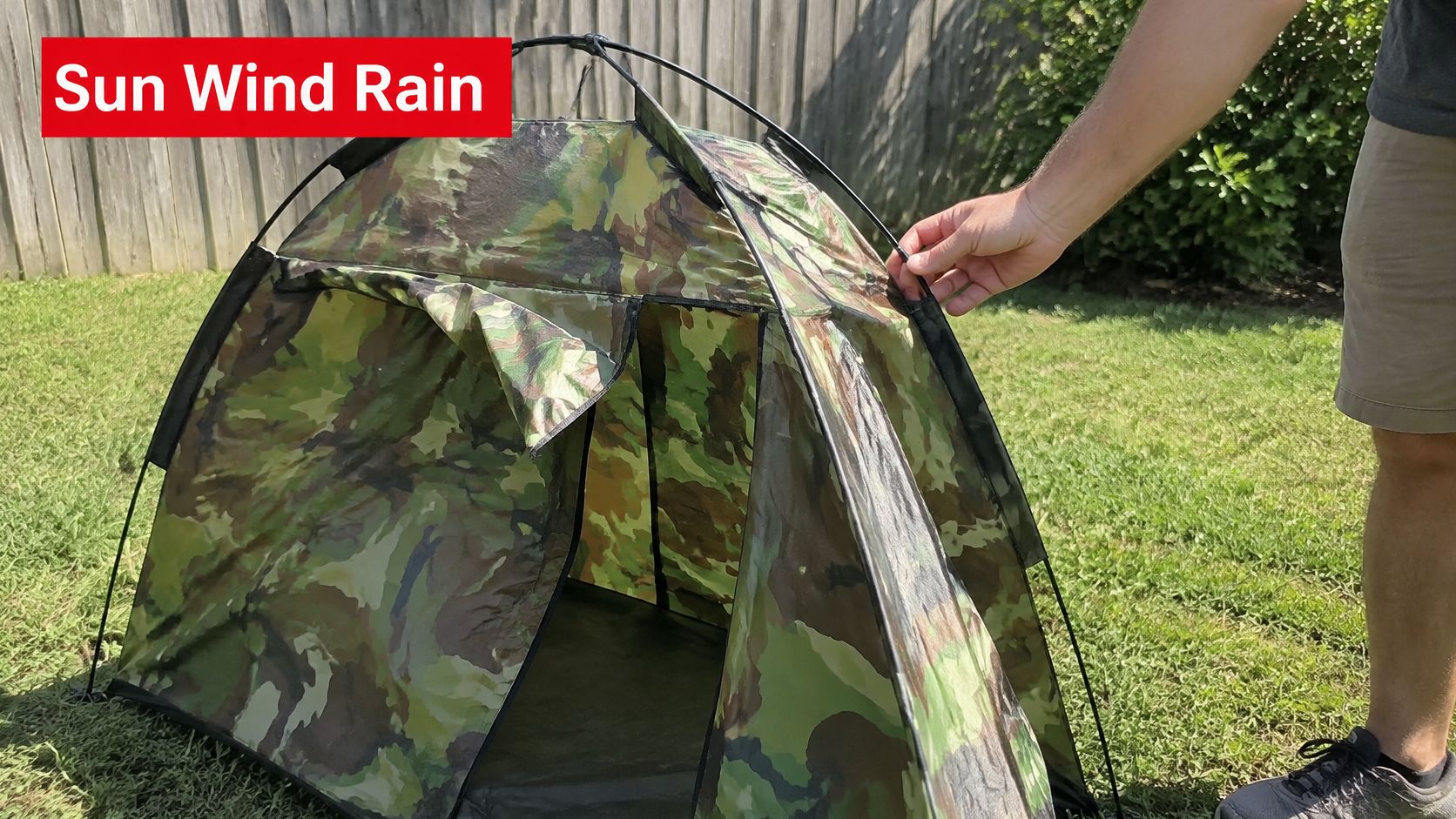
What stresses lightweight construction
Sun affects comfort before it affects appearance. Dark camouflage can feel hotter than a pale playhouse in comparable exposure, while prolonged sunlight can fade printing. Don't assume a fabric roof provides rated ultraviolet protection unless the manufacturer documents it.
Water resistance also needs careful interpretation. Cloth might shed a brief sprinkle while water enters through needle holes, door openings, or the floor. Untreated polyester isn't a substitute for a waterproof tent system with protected seams and an appropriate groundsheet.
Wind pushes against broad side panels like a sail. A flexible frame may bend rather than hold its shape, especially when a child leans on the opposite wall. Adding heavy objects to the corners can introduce new hazards without making the structure weatherworthy.
Repeated folding creates another stress: tight bends at the same pole locations and pulling around stitched corners. When a frame no longer opens evenly, inspect it rather than forcing it flat.
A buyer's construction check
- Wipeable floor: Look for an interior you can clean without soaking the whole structure.
- Doors that stay open: Check that the fastening holds the entrance back without dangling loops.
- Capped pole ends: Inspect every accessible end and connection.
- Reinforced door corners: These areas take repeated pulling during crawl-through games.
- Secure decorations: Avoid loose patches or trim a toddler could chew off.
- Suitable carry case: The folded frame should fit without crushing or sharply kinking its wires.
For a visual look at handling and setup, this video can supplement, not replace, the instructions supplied with your particular tent.
Use only the anchoring method the manufacturer specifies. Don't stake a toy tent into a storm, add improvised cords across walking routes, or leave it standing overnight.
The useful trade-off is portability over weather resistance. When the sky doesn't cooperate, the expedition can move to a rug without losing its story.
Safety Checks Before the First Mission
A toy label doesn't mean the cloth is flameproof. Treat a kids camo tent as a children's product that needs a deliberate fire plan, an unobstructed exit, and an inspection after assembly.
The U.S. Consumer Product Safety Commission's camping-equipment guidance explains that camping-style equipment primarily intended for children 12 or younger is excluded from ASTM F963, although other mandatory children's-product requirements still apply; it identifies 16 CFR §1500.44, ASTM F963 Annex A5, and voluntary CPAI-84 as relevant flammability-testing routes. Product classification matters, so a vague safety badge isn't enough to explain which requirements apply.
Lightweight synthetic fabric can ignite or melt rapidly, and enclosing walls can slow a child's exit. The practical response is to remove ignition sources, not to rely on reassuring wording on a hangtag.
Assemble inspect and clear the exit
- Read the age grade. Match the product to the child's age and abilities, and follow the stated supervision requirements. A child who can crawl into a shelter may still need help getting out.
- Inspect the complete structure. Look for sharp pole tips, broken wires, displaced caps, loose zipper pulls, and patches that detach when handled. Don't repair a damaged frame with an exposed wrap of tape and return it to play.
- Remove heat and flame. Keep candles, heaters, cooking gear, smoking, and campfires out of the play area. Plan an exit to a safe place, but don't use that plan as permission to play near heat.
- Hold the doorway open. Arrange the entrance so air can move and the child can see you. Keep the route outside free of baskets, shoes, and trailing fabric.
- Clear small objects. Check under blankets and around the floor edge for beads, coins, detached toy parts, or anything a younger child might swallow.
- Stop when the structure changes. End play if the tent tips, a pole cap comes off, or a child tries to zip themselves inside alone.
Keep this visual reminder near the storage area if several adults supervise play.
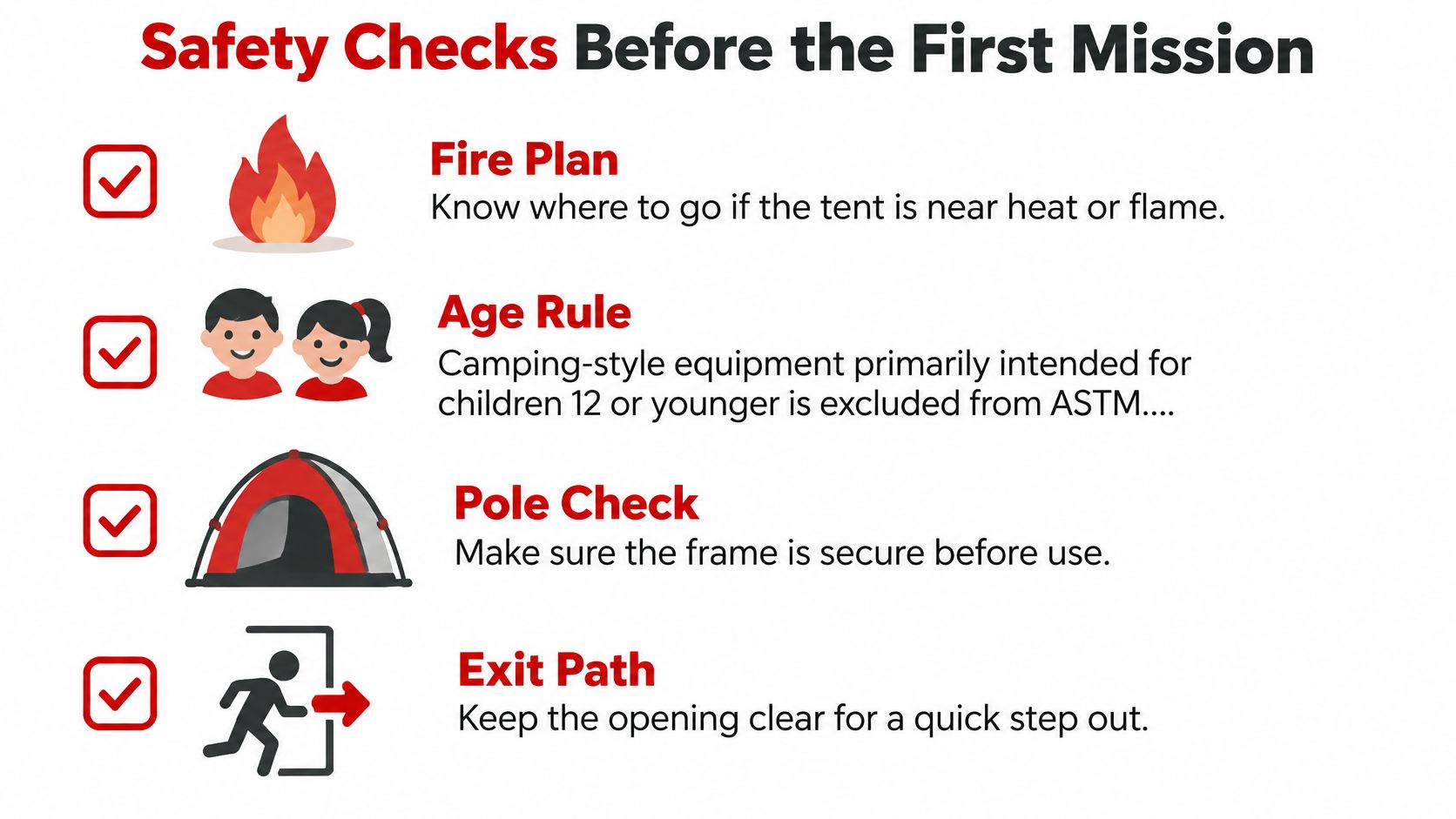
Check the product not just its label
According to CPSC's toy-safety guidance, children's toys manufactured or imported on or after April 20, 2024, must be tested and certified to ASTM F963-23 where that standard applies. That doesn't erase the classification distinction for camping-style equipment or the need to inspect an assembled product.
Use this broader toy-safety guide for children when checking accessories added to the game. Before every session, make a quick scan: frame secure, fabric intact, heat absent, floor clear, entrance open, caregiver ready.
Camo Prints Sizes and Easy Pack Away
Choose the print your child likes, then choose the footprint your home can accommodate. A convincing woodland hideout is a poor purchase if its entrance opens straight into the only walkway.
Camo print comparison for play tents
| Best for | Tradeoff | |
|---|---|---|
| Woodland green-brown | Forest missions and hiding stains | Dark tones can feel closed in within a small room |
| Desert tan | Expedition play and open floors | Shows dirt more readily |
| Bright accent camo | Small apartments and easy sight lines | Less realistic for the story |
Realistic dark prints can disguise everyday marks and help establish the adventure theme. Higher-contrast fabric can make the doorway easier to pick out, but your view through the opening matters more than the exterior color.
Measure the floor before ordering. Mark the proposed footprint with removable tape, then check whether a child can enter while someone else walks past. For a larger sibling playhouse, check ceiling clearance and make sure the frame won't brush pendant lights or nearby furnishings.
A tunnel or ball pit isn't automatically an upgrade. Extra sections mean more occupied floor, more surfaces to clean, and more fabric to dry after outdoor use.
Packing habits that protect the frame
- Empty the interior. Remove toys and shake out crumbs before folding.
- Dry it fully. Spread damp fabric out before bagging it. Trapped moisture encourages musty storage and can damage materials over time.
- Follow the frame's folding path. Use the supplied sequence rather than twisting wires into a knot. Stop if the frame resists unexpectedly.
- Use the carry case. Keep manufacturer-supplied small parts contained with the set, away from children who might mouth them.
- Store it away from heat and sunlight. Choose a dry shelf rather than a floor beside a heater or a sunny window.
A tent that packs away without a wrestling match is more useful than a larger set you avoid opening.
Give the carry case a permanent home using a simple kids' toy organization system. Keep the folding instructions with it so another caregiver doesn't have to guess.
As a practical shopping guide, active crawl-play shelters often suit children roughly ages 3 to 8, but that's not a universal product age grade. Younger children need an adult actively involved in the game, and gift buyers should confirm floor space, ceiling clearance, and storage before choosing the biggest box.
Adventure Games That Replace a Screen
The World Health Organization's under-five guidelines recommend at least 180 minutes of physical activity across the day for ages 1–2, and at least 180 minutes for ages 3–4, including 60 minutes of moderate- to vigorous-intensity activity; sedentary screen time should not exceed one hour for two-year-olds and children ages 3–4, with less being better. A tent can provide a reason to move between activities, but it doesn't replace outdoor exercise or make quiet sitting count as vigorous play.
A systematic review of 34 studies indexed by ERIC found a modest positive association between pretend play and social competence. Separately, the Australian Institute of Family Studies describes a longitudinal study of 1,426 Australian children in which stronger pretend-play ability at ages 2–3 was associated with fewer later internalizing problems, including anxiety and withdrawal, and externalizing problems, including aggression.
Neither finding establishes that buying a tent improves development. Both concern pretend play broadly, not camouflage products. The useful contribution is a defined stage for children to assign roles, negotiate a story, and take turns.
Camo tent adventure games by age
These are suggested starting ages for the activities, not product safety ratings. Adjust the tasks to the child and follow the tent's age grade.
| Game | Ages | Movement | Setup |
|---|---|---|---|
| Supply Run | 3–5 | Crawl and carry | Socks or blocks and a basket by the door |
| Rescue Radio | 4–8 | Role play and turn-taking | Two roles, adult within sight |
| Camo Map | 5–8 | Walk and count steps | Paper, crayon, pillow landmark |
| Quiet Night Watch | 3–6 | Low-energy storytelling | Open door, flashlight, no sleeping inside |
Supply Run and Rescue Radio
Supply Run starts with a nearly empty tent. Put rolled socks inside and a basket beyond the doorway, then tell your child the expedition needs its supplies delivered. They crawl in, collect a bundle, crawl out, and carry it to camp.
Keep the route clear and use socks instead of hard blocks when children are likely to hurry. With siblings, let one child organize supplies while another carries them, then swap jobs. The moving happens between the shelter and the basket, not through jumping onto the roof.
For Rescue Radio, an adult announces that a stuffed animal needs help beside a cushion. One child becomes the lookout and describes its position; another becomes the medic and carries a soft cloth to the patient.
Encourage useful exchanges: ask the lookout what the medic needs to know, then let the children solve the problem. Keep rescues at floor level. In a suitable shaded yard, a nearby tree or garden chair can become the landmark while everyone remains within adult sight.
Keep these activity ideas handy when the usual hideout game runs out of direction.
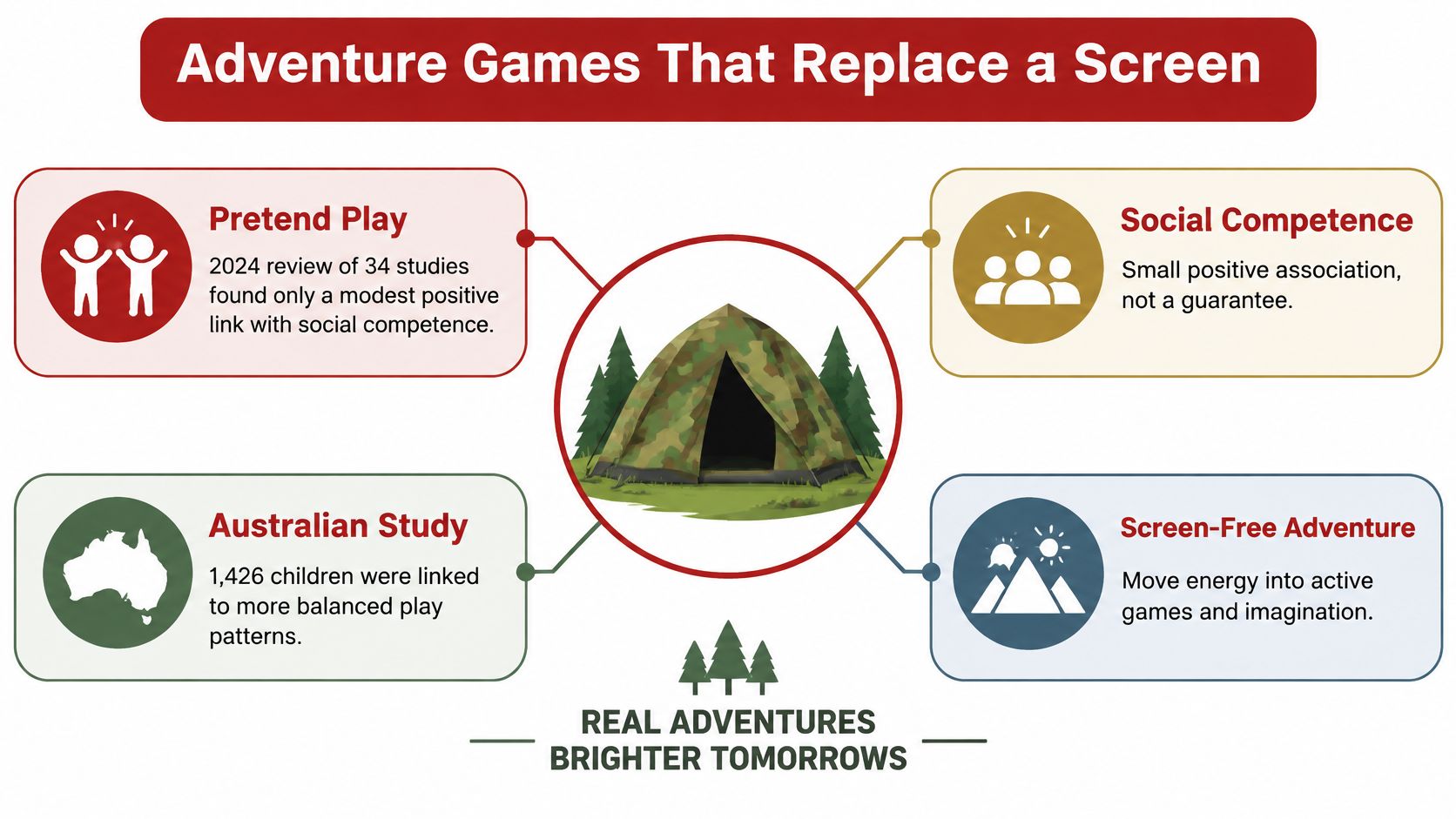
Camo Map and Quiet Night Watch
For Camo Map, draw the room as a trail with the tent as base camp and a pillow as the mountain. Walk the route together, count footsteps, and let your child add familiar landmarks. Keep crayons outside the shelter unless you're happy to supervise drawing inside it.
The point isn't cartographic accuracy. A child might decide the sofa is a forest and move the trail around it. For outdoor inspiration, adapt these nature scavenger hunt ideas into a search for visible colors or shapes rather than collecting unknown plants.
Quiet Night Watch changes the pace. Sit beside the open entrance with a child-safe flashlight and tell a story about animals settling down for the evening. Let your child choose what the imaginary explorer hears next.
End the adventure at the doorway, then move to the child's normal bed. A bedtime story in a play tent isn't a sleepover.
Make the next screen-free activity obvious before the screen goes off: socks ready, basket placed, mission chosen. An invitation to deliver supplies is easier for a child to act on than a general instruction to go and play.
Start the Mission With the Right Play Tent
Choose the setting first and the set second. A compact living-room base is often more practical than a sprawling arrangement that needs furniture moved every time. For yard play, decide where the caregiver will sit and where the entrance will face before considering accessories.
Match the set to the measured space
Our Playz tents come as single tents, sets, and bundles, including a Rainbow Tent and tunnels. The 5pc Rainbow Tent pops open in seconds, and its hut, cube cave, and ball house fold flat into the included carry case; it uses 190T soft polyester fabric and thick steel wiring. We describe it as baby approved and exceeding all USA toy safety guidelines, but parents should still check the product's age grade, intended use, and assembled condition before play.
That rainbow option also makes a useful comparison when shopping for a kids camo tent. If the main attraction is crawling between spaces and inventing missions, the layout may matter more than whether the walls resemble a forest.
- Choose a single shelter when you need an easy-to-see base that leaves the room usable.
- Consider connected pieces when you have a dedicated footprint and a realistic place to dry and store them.
- Skip the larger bundle if its entrance would obstruct a walkway or make supervision awkward.
For educators, a simple role invitation can matter more than extra equipment. This guide to the benefits of pretend play offers context for making the shelter part of an activity rather than another object in the room.
Start small before adding more
Families who want a more permanent outdoor project can also explore PADL's family-friendly backyard project for kids. That's a separate building decision, not a reason to expect a fabric pop-up shelter to behave like a fixed playhouse.
For the first session, clear the floor, leave the entrance open, and try ten minutes of Supply Run with screens off. Treat that as a manageable trial, not a developmental target. Watch whether your child enjoys the shelter, whether the route works, and whether packing it away fits your routine.
Playz offers play tents, tunnels, and connected sets for supervised imaginative play, whether your child's story begins at a forest camp or a living-room rescue station. Visit Playz with your floor measurements and storage space in mind, then choose the footprint you can use comfortably rather than the busiest bundle.