


The corner you had picked for a tent is smaller than it looked on the floor plan. A boy who used to crawl in and stay there now sits up, brings a friend, and knocks a pole with his shoulder. A teepee for boys works when the size, fabric, and layout match how he plays, not when the print looks like a jet or a camouflage fort. Themes can come later, as removable extras. Start with the room, the frame, and a space he can keep changing.
Teepee Sizes and Ages at a Glance
| Age range | Typical height | Base diameter | Minimum floor space |
|---|---|---|---|
| Toddlers 1-3 | 3-4 ft | 3-4 ft | 5 x 5 ft to 6 x 6 ft |
| Ages 3-5 | 4-5 ft | 4-5 ft | 6 x 6 ft to 7 x 7 ft |
| Ages 5-8 | 5-6 ft | 5-6 ft | 7 x 7 ft to 8 x 8 ft |
| Ages 8-12 | 6-7 ft | 6-7 ft | 8 x 8 ft to 9 x 9 ft |
| Ages 12 and up or shared use | 7 ft or more | 7 ft or more | 9 x 9 ft or more |
Typical height and base diameter describe the tent itself. Minimum floor space is the clear patch once you add 12 inches of clearance on every side, away from walls, furniture, radiators, and fans. Floor space equals base diameter plus 2 feet. These bands are typical product ranges, so confirm the listing's stated dimensions before you order.
A 4-foot teepee suits a toddler who mostly crawls and sits. By about age six it feels tight, especially with a sibling. A 6-foot model carries a boy through the early school years and still leaves a shoulder's width for a friend. Taller fabric also means he can kneel without the walls pressing his back.
Say the listing shows a 4-foot base. Clearance adds a foot on each side, so you need a 6-by-6 ft corner. A 5-by-5 ft nook is already too small, even if the folded bag looks compact in the photo.
Measure in three steps
- Measure the room. Mark the longest clear rectangle with a tape, not a guess from the doorway.
- Subtract clearance. Take 12 inches off each side for radiators, bed frames, and fan bases.
- Pick the largest band that fits. Match that floor patch to his current age, not the age printed on a box he will outgrow in a season. A tent he can share beats a cute one he abandons. If you are also watching how play changes with age, the notes on childhood development milestones help you judge when a size band is about to feel small.
Fabrics and Frames Compared for Durability
Fabric and frame decide how long the tent lasts and how it feels against a child's skin. Weight, wash routine, and whether it lives indoors or goes in a car all matter more than a printed theme.
| Fabric | Weight and feel | Durability | Care |
|---|---|---|---|
| Cotton canvas | Heavy, breathable, natural look | Strong; can mildew if stored damp | Spot clean; air dry fully |
| Polyester | Light, holds color well | Resists stretching and fading | Gentle machine wash; air dry |
| Ripstop nylon | Very light, packs small | Tear-resistant at the weave | Wipe clean; avoid harsh detergents |
| Cotton-polyester blend | Middle weight | Balanced strength and breathability | Gentle wash; dries faster than canvas |
Cotton canvas breathes and looks like cloth, not plastic. It also holds moisture. Rolled up damp, it mildews. I would keep canvas for a dry bedroom, not a damp basement.
Polyester stays light, holds dye, and dries fast after a juice spill. It can feel warmer and less airy than canvas, so leave the door tied open during long play.
Ripstop nylon packs into a small bag and resists a tear that starts at a snag. It is the travel and backyard choice. Wipe it. Harsh detergent breaks the coating down.
A cotton-polyester blend sits between those extremes: stronger than thin nylon, quicker to dry than heavy canvas. It is a fair everyday indoor fabric if you wash often.
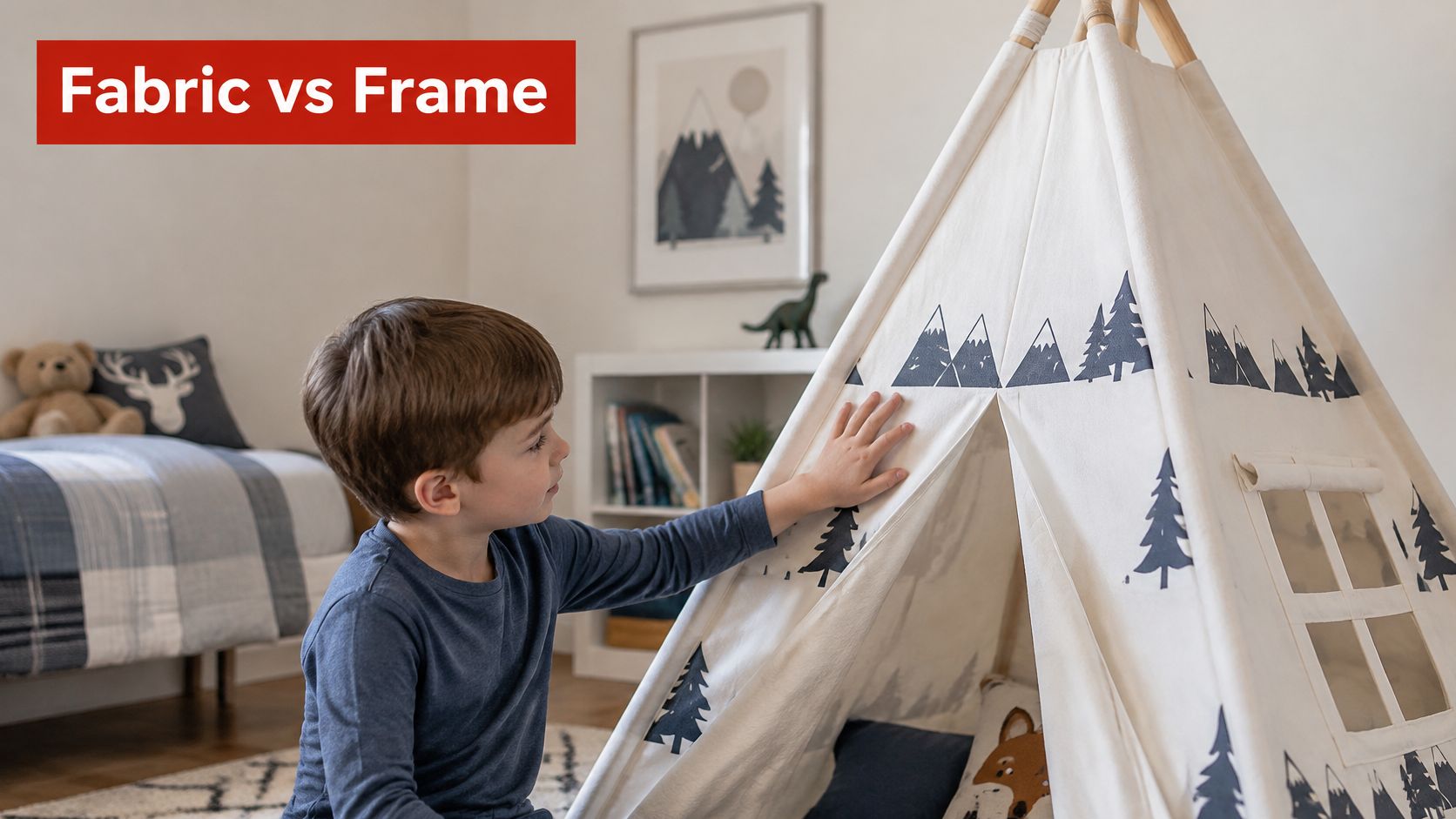
Frames that stay up when he leans
Wooden dowels look solid and cost more. They barely flex, so a bad joint cracks instead of bending. Fiberglass poles are lighter and spring back, which helps outdoors, but cheap ones splinter at the tip. Plastic poles are the lightest and cheapest. They also creep out of sockets when a child hangs on one side.
The frame should stand without folding when he leans. That is not a style preference. U.S. Consumer Product Safety Commission analysis.pdf) estimated an average of more than 3,200 emergency-department-treated tent-related injuries a year from 2010 through 2015, about nine injuries a day. That count covers tents generally, not teepees, so treat it as a safety signal, not a teepee injury rate. Stable assembly, capped ends, and a spot away from stairs and heaters are the practical response.
Decision rule: canvas for dry indoor use, polyester when you wash often, ripstop for travel or outdoor use.
How to Set Up and Maintain Your Teepee
Keep the center open, put the doorway on a clear path, and park soft props in one corner. A full interior turns the tent into a storage bin. An empty middle lets him sit, turn, and change the game. ChildCare.gov describes unstructured play as children choosing the activity and exploring ideas through imagination, tied to problem-solving, memory, curiosity, and cause-and-effect learning. A review indexed by ERIC does not yet justify strong claims that pretend play uniquely produces executive-function or social gains. The tent supplies space. It does not guarantee a developmental result.
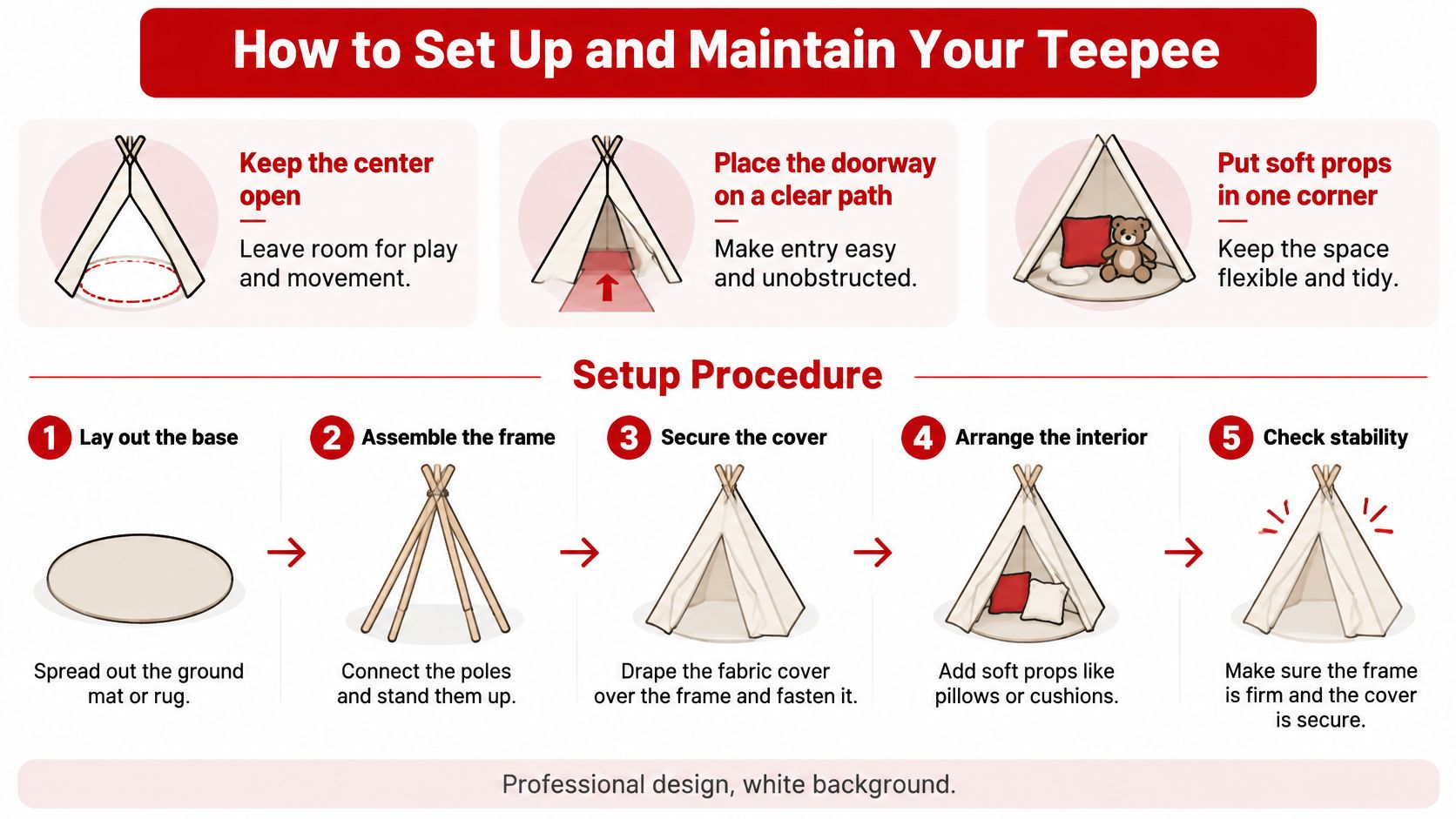
Setup in six moves
- Clear a level area and lay out every pole and piece before you start.
- Insert each pole into its sleeve or joint, starting with the longest.
- Raise the frame and space the poles so the base stays round.
- Fit the cover from the top and line the door up with the main path.
- Tighten each tie until the fabric is taut, not stretched thin.
- Stake or weight the base outdoors, then push one side gently and watch for shift.
If a joint pops on that push, reseat it before anyone climbs in. A cover that twists at the door is a layout problem, not a child problem. The same sequence, with photos of common snags, sits in these play tent instructions.
A short setup walk-through helps the first time the poles look identical.
| Task | How often | Method |
|---|---|---|
| Shake out and vacuum floor | Weekly | Use a soft brush attachment on the floor area |
| Check poles and joints | Monthly | Tighten ties, replace cracked pole ends |
| Spot clean marks | As needed | Mild soap and cold water on a cloth |
| Full wash | Every 2-3 months or after spills | Follow the care label |
| Dry completely | After every wash | Air dry away from heat |
| Store | Between uses | Dry, folded loosely, away from damp areas |
Full drying matters because damp canvas stored rolled tight is a common route to mildew. A teepee kept dry, tightened, and cleaned on this rhythm can last many seasons of daily play. Skip the monthly pole check and a hairline crack becomes a collapse during a lean.
Safety Checks for Indoor and Outdoor Play
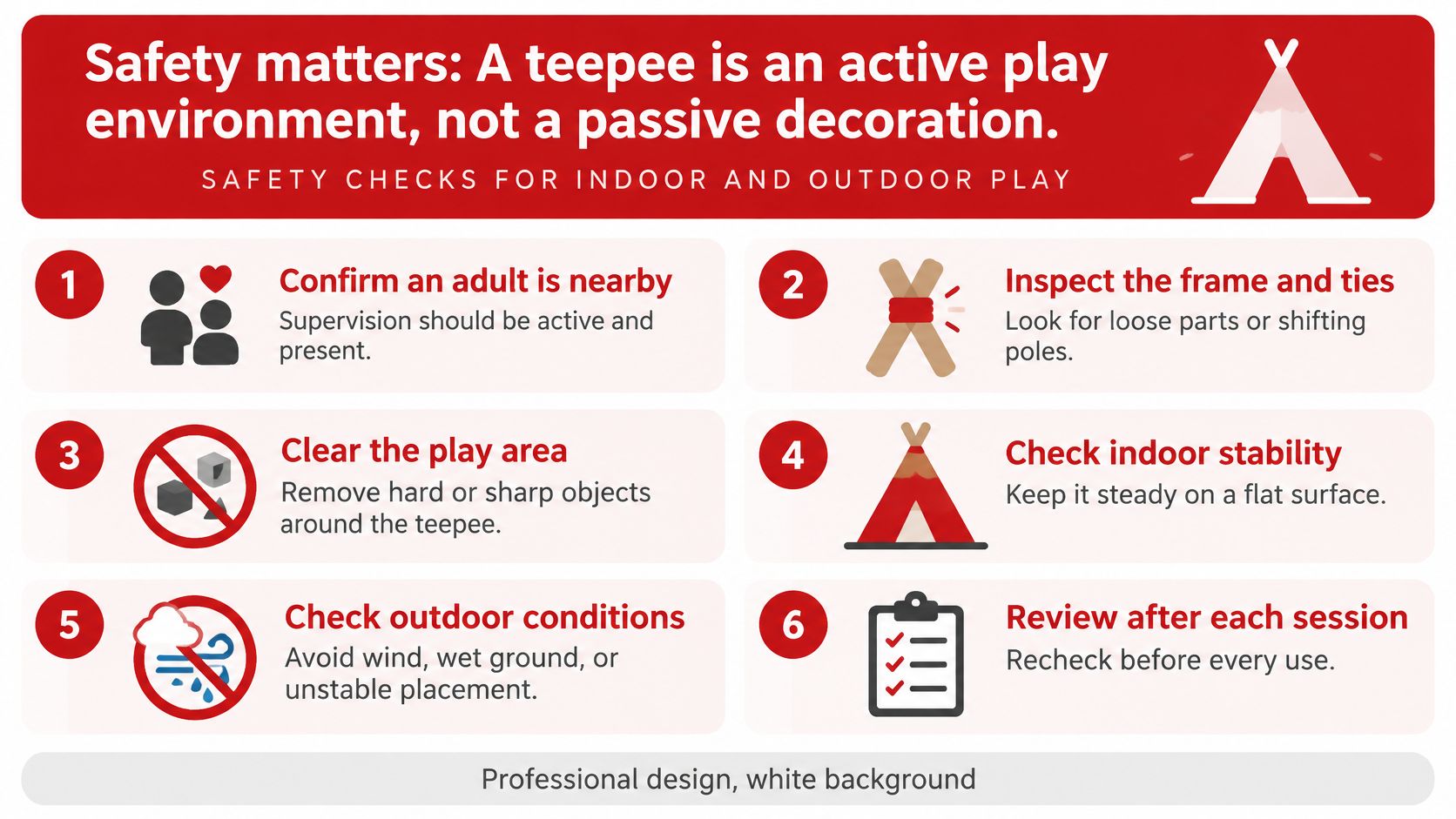
The serious hazard is usually mundane: a cord, a heater, or a blocked doorway you stop noticing after the tent has sat in the same corner for a week. A teepee is an active play space, so treat every session as a fresh check, especially when the tent moves rooms or goes outside.
- Put an adult within reach of the entrance. A tangle or a bumped head needs a response in seconds, not a shout from another floor.
- Check poles and ends. Seat every pole fully, lock the joints, and keep caps or smooth ends in place so a fall does not land on a raw tip.
- Inspect ties and cords. No loop should fit around a neck or wrist. Cut leftover packaging string instead of tucking it inside.
- Clear ignition and impact hazards. Keep candles, heaters, stoves, fireplaces, outlets, chargers, stairs, and hard furniture edges out of the play zone.
- Leave the entrance unobstructed. A bed, bin, or swinging door that blocks the opening traps a child who is trying to leave.
- Check light and a solo exit. A boy should be able to see the door and reach it without help, even when the fabric shifts.
- Anchor outdoors and lower the tent in strong wind. A light frame catches wind like a sail, and stakes or weights only help when the ground accepts them.
What a flame label actually means
The U.S. Consumer Product Safety Commission states that camping or sporting equipment primarily intended for children 12 and under is excluded from the toy standard ASTM F963-17, yet it must not present a substantial risk from extreme flammability. Flame performance can be shown through 16 CFR §1500.44, ASTM F963-17 Annex A5, or the voluntary CPAI-84 tentage protocol. Ask the seller which test the fabric passed. "Indoor" does not remove ignition, collapse, or entrapment risk. Repeat the checklist after every move, including a shift from bedroom to living room.
If you are weighing a larger backyard structure instead of a teepee, a playhouse guide for Albany homeowners from Tip Top Furniture & Mattresses is a useful contrast on footprint and supervision. For day-to-day toy hazards, start with toy safety for children.
Themes That Suit Any Boy
A common assumption is that a boy's teepee must look like a jet, a superhero base, or a camouflage fort. A 2025 preschool study found that children commonly linked boys' play with cars, trains, character-based activities, and more physical activity, and the researchers noted these views may reflect socially learned expectations rather than innate preferences. Broader play options support cognitive, social, and emotional development. A locked-in print does the opposite once the character fades.
I would start with a neutral base: natural canvas, sage, sand, or navy. Add removable decals, a flag, or bunting. When the interest shifts, you change the trim, not the tent. That is cheaper than replacing a licensed print he has outgrown.
Three looks you can swap
Reading den. A small lantern (battery, not flame) and a book basket. Prompt: "This corner is quiet. Pick one book and read two pages out loud."
Expedition base. A paper map and binoculars. Prompt: "Mark three places you will visit before lunch, and pack a list."
Science station. A magnifier and a notebook. Prompt: "Find five textures on the fabric and draw them."
More room-scale builds sit in these fort building ideas.
The tipi was developed and used by many Plains nations. The National Park Service identifies more than 30 Plains tribes, including the Lakota, Cheyenne, Arapaho, Crow, and Pawnee. Skip sacred symbols, headdress motifs, and costume imagery. Echo the shape. Do not copy a ceremonial look.
Would this teepee still be useful if his favorite character changed next year? If the answer is no, the theme is doing too much work.
Play Ideas That Build Real Skills
A six-year-old and his sister spend an afternoon inside a plain tent. They plan a campsite, write three rules, tell a story about a lost map, and argue, briefly, over who cooks. Nobody hands them a script, and the tablet stays in another room.
What the teepee gives them is an open space they can rewrite. ChildCare.gov explains that imaginative play encourages children to explore, think creatively, solve problems, understand cause and effect, and build memory. The same guidance links that play with sharing ideas, compromise, following rules, managing frustration, and building confidence. Screen time is not a replacement for playtime, so the tent is a practical spot for screen-free storytelling.
Four skills you can start today
Planning and sequencing. He writes a pretend expedition list: water, map, snack, flashlight. Order matters, and he notices when the flashlight is last.
Language and storytelling. They take turns narrating one shared adventure, one sentence each. You stay quiet unless they ask for a word.
Social negotiation. One child is the guide, one is the cook. They switch after ten minutes so nobody owns the role.
Problem-solving. A bridge of cushions connects this tent to a second one. If it collapses, they rebuild with fewer cushions, not a new toy.
Pair the inside time with movement. WHO guidance says children and adolescents ages 5–17 should average at least 60 minutes of moderate-to-vigorous physical activity a day across the week. A scavenger hunt between story sessions, or a crawl route out and back, turns the tent into a base camp rather than a chair. The tent does not supply that hour by itself.
For a quieter corner outside the tent, the Guynn Furniture & Mattress reading nook guide shows how a lamp, a basket, and a clear floor patch keep reading from competing with the rest of the room. If you want the skill side in more depth, see the benefits of pretend play.
Try one new prompt each day for a week. Note which one he starts without you suggesting it. That choice tells you more than the theme on the fabric.
Teepee for Boys FAQs
Is a teepee safe for a toddler? Yes, when the size matches the toddler band, an adult is nearby, and cords, heaters, and outlets stay well away. Use the session checklist every time, not only on the day it arrives.
Can a teepee be used outdoors? Yes, if the base is anchored, the frame is checked, and the tent comes down in strong wind. Ripstop handles weather-exposed use better than heavy canvas.
Does a boy's teepee need boy-themed decoration? No. A neutral base with removable decals or bunting covers the interests he grows through. A fixed character print is optional, and it dates fastest.
How long does a teepee last? With full drying, monthly pole and tie checks, and dry storage, a canvas or polyester teepee can last many seasons of daily play. Damp storage shortens that more than rough play does.
What age is a teepee right for? Most families use one from about age one through the early teens. Buy the size band that matches his current age and the clear floor, not the age on the box alone.
Choose Your Teepee Before You Buy
You already have the three answers that matter. The size band fits his age and the room after clearance. The fabric matches indoor washing, dry display, or travel. The base color can change when his interests change. Decoration is the last layer, not the first.
| Option | Key details | Listed price |
|---|---|---|
| Play tent bundles | 4-piece, 5-piece and 7-piece versions | 4pc Red Berry $54.94; 7pc Titan $74.94 on sale |
| 5pc Rainbow Tent | Ages 3-8 and up; 21-inch tunnel opening | $99.94 in the Rainbow Playtime Combo (regular $149.99) |
| Titan Playtime Combo | Indoor/outdoor set with 200 ball pit balls | $129.94 on sale (regular $199.99) |
Our play tent bundles come in 4-piece, 5-piece, and 7-piece versions. The 5pc Rainbow Tent suits kids ages 3-8 and up, and its tunnels use a 21-inch opening. The Titan Playtime Combo is an indoor/outdoor pop-up set with a 7pc tent, tunnel, and ball pit plus 200 ball pit balls, listed at $129.94 on sale (regular $199.99). Prices change. The same checks apply to any brand, so confirm listed dimensions and flame-resistance testing before you pay.
Measure the room, pick your size band, and compare the tent sets against that floor patch before the theme on the box makes the decision for you.
Playz builds play tents and open-ended sets that give children a place to imagine, move, and learn without a screen. If you are choosing a teepee for boys around size, fabric, and flexible play, start with a set that matches the room you measured. Visit Playz to compare current tent bundles and pick the one that fits.