

A preschooler pours water from one cup to another, stacks blocks until the tower wobbles, invents a story about a stuffed animal, or sorts leaves collected from the yard. To an adult, these moments can look ordinary. To a child, they're opportunities to test ideas, practice language, coordinate movement, manage feelings, and solve problems.
This roundup brings together 10 play based learning activities for preschoolers across sensory, motor, language, STEM, creative, and social-emotional development. Each activity includes a repeatable card with an objective, low-cost materials, practical steps, variations, optional Playz tie-ins, and observable learning outcomes.
You don't need expensive equipment or a formal lesson plan. Start with household materials, follow the child's interest, and observe what changes. A child who once grabbed every material may begin sorting them. A child who avoided group play may start offering a role to a friend. Those small behaviors are useful evidence, even when nobody fills out a worksheet.
If your preschooler needs a reset after a busy morning, try these ideas to reset attention with playful activities. Playz can also provide optional play tents, science kits, and creative toys, but everyday objects should remain the starting point.
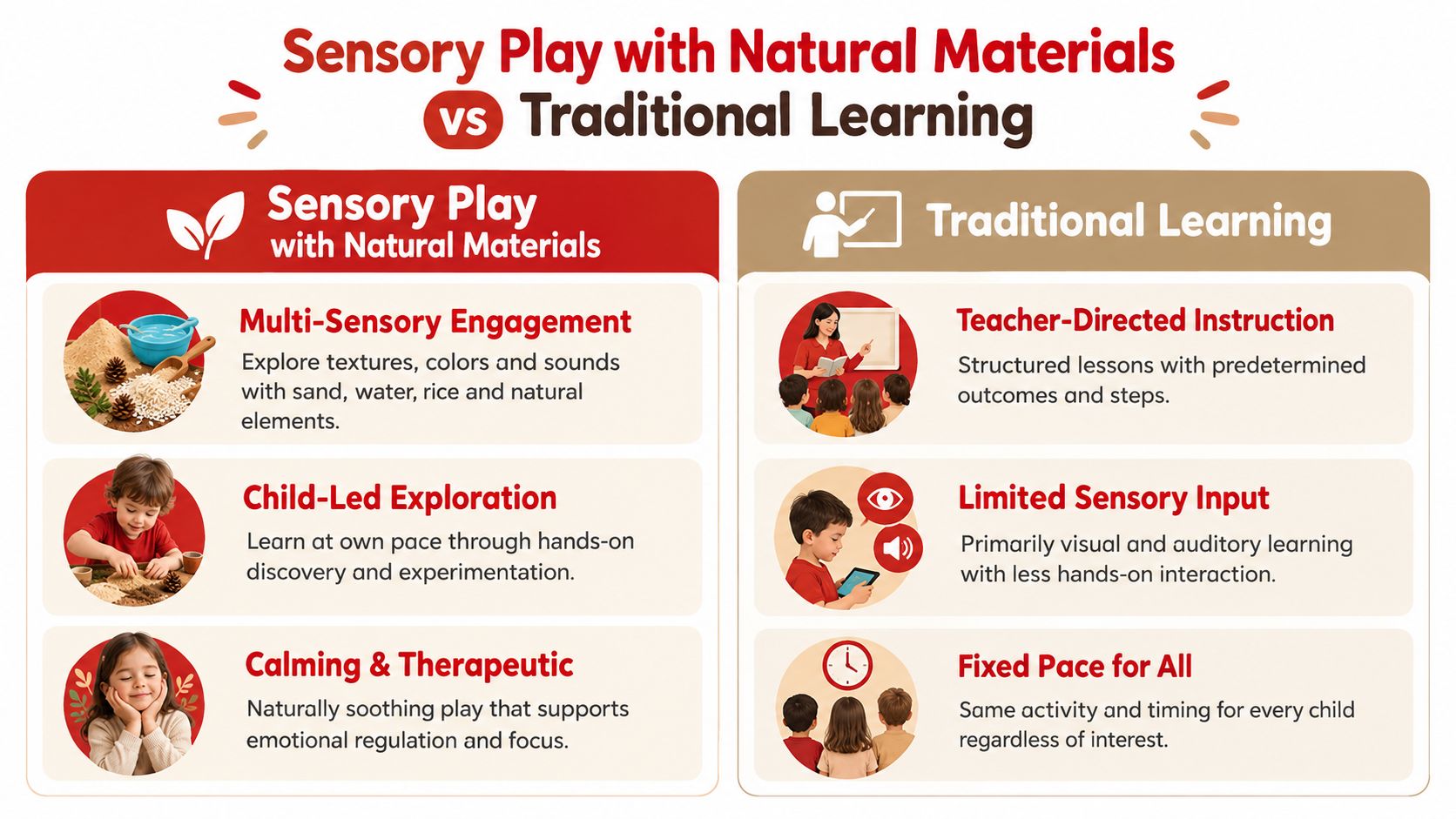
1. Sensory Play with Natural Materials
A shallow bin filled with leaves, smooth stones, twigs, or dried beans gives children a reason to touch, compare, scoop, hide, and discover. Add cups, sieves, tongs, and small containers so the child can change the materials rather than handle them.
Sensory play supports tactile awareness and fine motor practice while helping children notice cause and effect. When a preschooler pours beans through a funnel, feels the difference between a rough twig and a smooth stone, or predicts which objects will sink in water, the activity connects physical experience with early thinking.
Activity card
- Objective: Build descriptive language, hand strength, coordination, sorting, and early reasoning.
- Materials: A shallow tray, sand or dried beans, leaves, stones, twigs, scoops, cups, funnels, and large hidden objects.
- Steps: Invite the child to explore freely. Then offer one prompt, such as “Can you find two things that feel the same?” or “What happens when you pour this?”
- Variations: Create a nature discovery box, add a water station, or hide objects for a search game. Rotate materials when the setup begins to feel familiar.
- Optional Playz tie-in: A sensory-focused toy can add tools or themed props, but it should extend exploration rather than dictate one correct result.
- Observable outcomes: The child sorts by texture or color, uses words such as smooth or heavy, transfers materials with increasing control, and explains a simple prediction.
Practical rule: Use wide containers, set clear boundaries for where materials belong, and supervise closely around small items.
For more ideas about this approach, explore what sensory play means for preschoolers. Photograph a discovery or write down the child's words. Documentation helps you notice learning without turning the experience into a test.
2. Imaginative Dramatic Play and Role-Playing
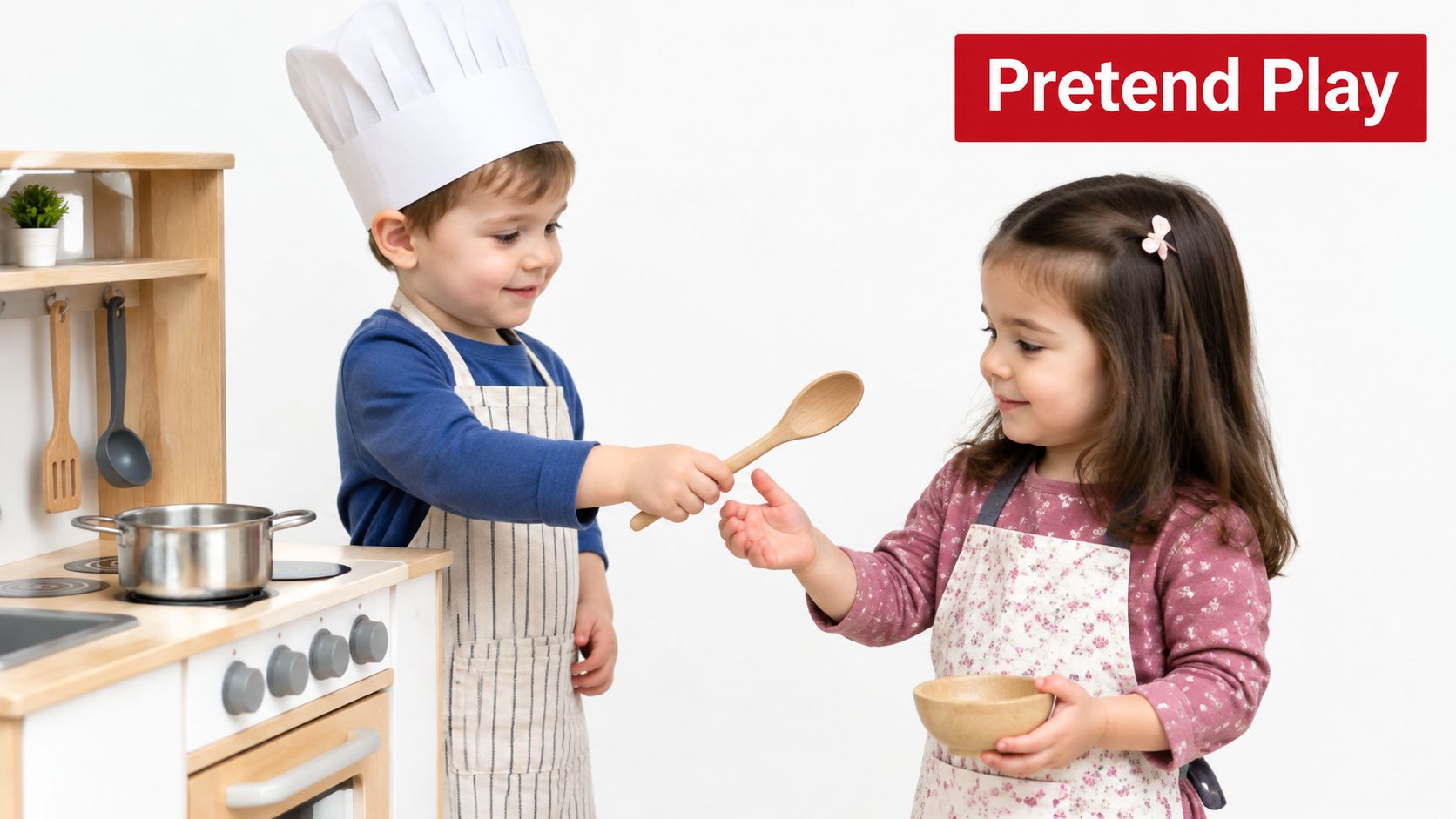
“Welcome to my restaurant,” a child announces while placing a pretend sandwich on a plate. One child becomes the customer, another records an appointment, and the group builds a shared situation from simple props. Dramatic play works like a rehearsal space for everyday communication: children try out language, sequence events, negotiate roles, and consider another person's needs.
A few objects can suggest many settings. A toy stethoscope, bandages, an appointment book, and stuffed animals can start a clinic. Scarves, cardboard boxes, clipboards, fabric pieces, cups, bags, and household containers can become a kitchen, repair shop, family home, or rescue station. Leave room for children to decide what each object means.
Use this activity card as a flexible guide rather than a script:
- Objective: Strengthen oral language, empathy, flexible thinking, and cooperative problem-solving.
- Materials: Pretend food, cups, bags, dress-up clothes, paper, pencils, toy tools, and household containers.
- Steps: Place a small group of props in one area and name a possible setting. Let children choose the characters, problem, and ending. Join for a short time by accepting a role, then follow their direction.
- Variations: Introduce a delivery problem, missing ingredient, sick stuffed animal, or customer who needs help. Children can also play alone while developing a story at their own pace.
- Optional Playz tie-in: A play tent can serve as a clinic, restaurant, campsite, or shop. It offers a defined space without deciding what the story must be.
- Observable outcomes: The child stays in a role, uses dialogue, responds to another person's idea, changes the plan, or explains what happens next.
Avoid correcting the story or assigning one fixed purpose to a prop. A cardboard tube might become a telescope, microphone, or thermometer. That shift shows flexible thinking.
For more ideas, explore how imaginative play supports preschoolers. Solo pretend play also gives quieter children time to develop a narrative before joining a group.
3. Building and Construction Play
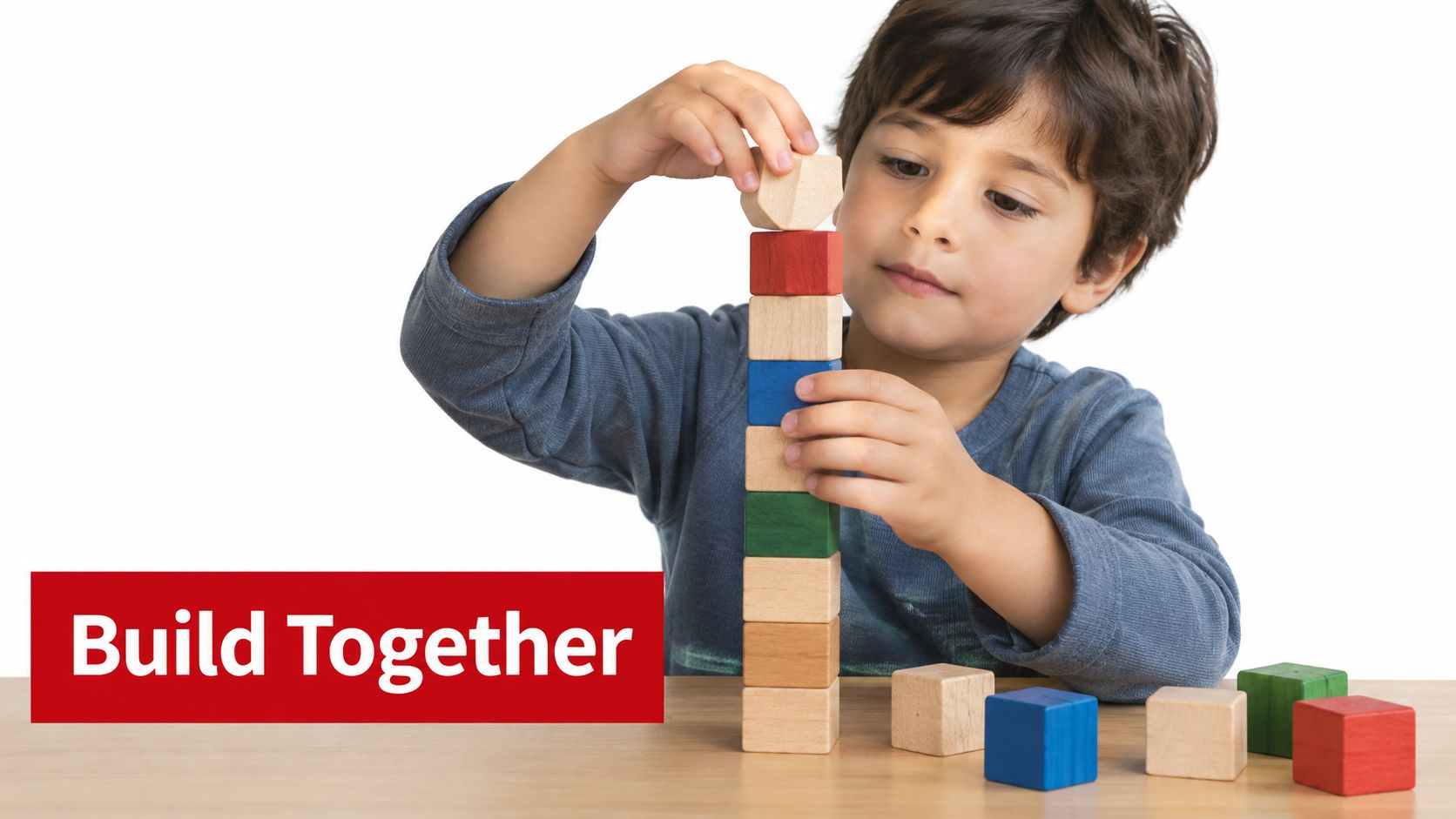
A bridge falls between two cushions. The child studies the gap, changes the base, and tries again. Construction play works like a small design workshop: each adjustment gives children a reason to explore balance, weight, shape, space, and stability.
Set out wooden blocks, cardboard boxes, magnetic tiles, recycled containers, toy vehicles, paper, masking tape, and safe natural materials such as logs or branches outdoors. Leave the building goal open, then offer one question at a time. “How could you make the bottom steadier?” invites reasoning without taking over.
Use this activity card as a flexible starting point:
- Objective: Develop spatial reasoning, fine motor control, early engineering thinking, and mathematical language.
- Materials: Blocks, magnetic tiles, cardboard, tubes, toy vehicles, paper, and masking tape.
- Steps: Let the child choose a plan. Observe first, then ask how pieces might connect, balance, or support one another.
- Variations: Build a bridge across two cushions, make a roadway, design a shelter for a toy animal, or compare different bases for a tower.
- Optional Playz tie-in: A construction set can provide connectors or pieces for repeated building and rebuilding.
- Observable outcomes: The child compares sizes, names shapes, adjusts a design after it falls, uses spatial words, or works with another child toward a shared structure.
Photograph the structure before dismantling it. Later, ask, “What changed between your first bridge and this one?” This helps children see rebuilding as part of design rather than evidence of failure.
Explore constructive play ideas for preschoolers to add variety to a block area while keeping children's choices central.
4. Art and Creative Expression Activities
A child covers paper with blue and orange paint, then calls the picture a storm, a party, or a color experiment. Leave room for that meaning instead of showing a model to copy. Open-ended art supports fine motor control, decision-making, and communication through marks, shapes, textures, and movement.
Paper, paint, playdough, and chalk each offer a different kind of practice. Playdough strengthens squeezing, rolling, pinching, and shaping. Collage work gives children choices about placement and texture. Drawing or painting can also provide a safe way to represent experiences that are difficult to explain directly.
Use this flexible activity card, adjusting the invitation to suit the child:
- Objective: Develop fine motor control, creative decision-making, emotional expression, and descriptive language.
- Materials: Washable, non-toxic preschool-rated paint, paper, crayons, playdough, glue, chalk, leaves, and fabric scraps.
- Steps: Put materials within reach. Offer an invitation such as, “Make something that could live in a garden,” then allow the child to choose the idea, tools, and process.
- Variations: Mix primary colors, sculpt imaginary food, create a nature collage, or make large chalk marks outdoors.
- Optional Playz tie-in: Creative toys can add tools or surfaces while keeping the process open-ended.
- Observable outcomes: The child selects materials, controls hand movements, explains a choice, persists through difficulty, or represents an idea with marks and shapes.
Display the work at the child's eye level. Ask, “Tell me about this part,” rather than guessing what the picture shows. This keeps the child's interpretation at the center and turns conversation into language practice.
For more art and craft ideas for preschoolers, offer one prompt at a time. Keep cleanup predictable, with a place for each material, so children can explore freely and help care for the workspace.
5. Outdoor Nature Exploration and Play
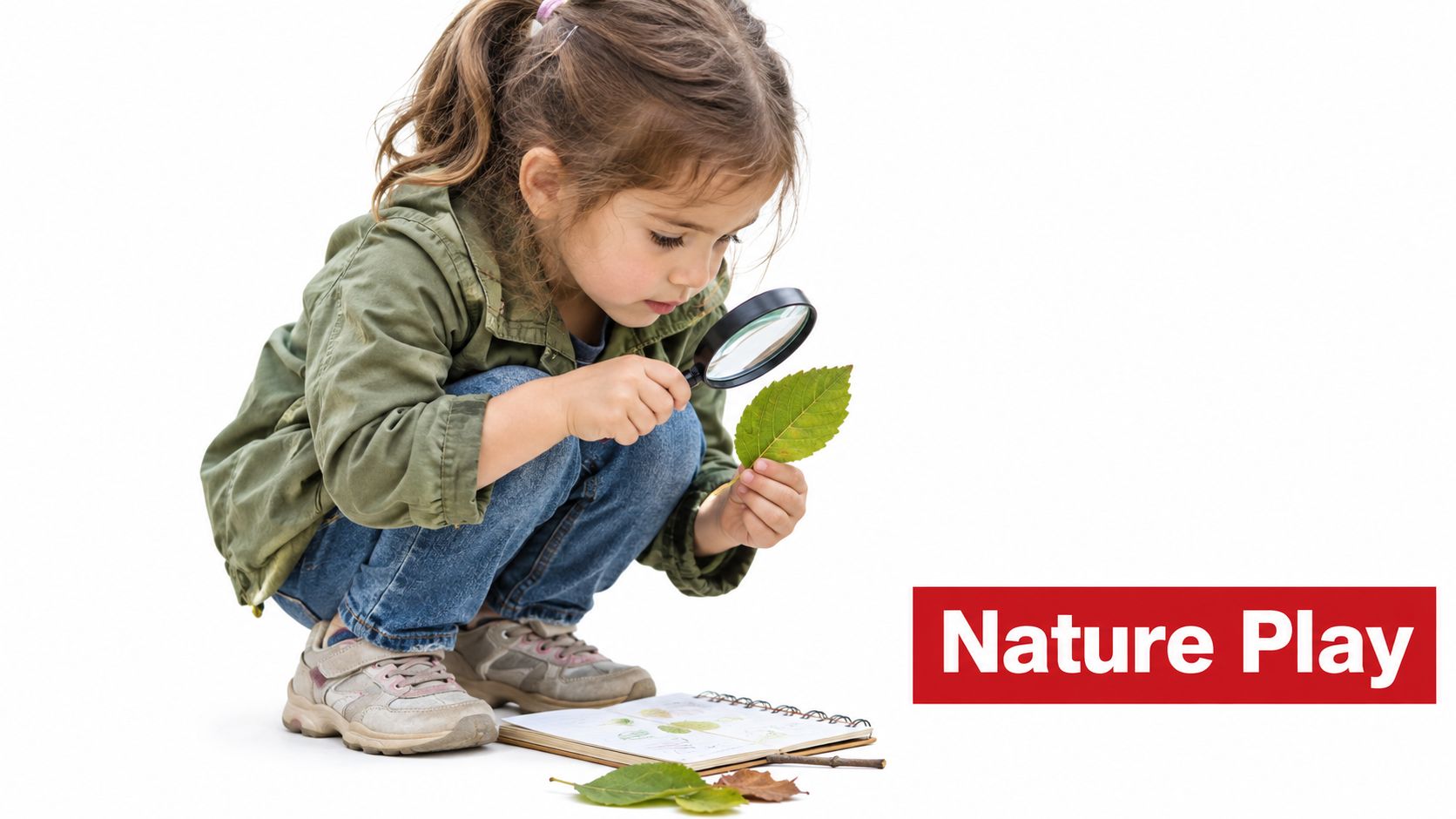
A small patch of grass can become a research site. With a magnifying glass, children may spot an insect's legs, a leaf's veins, wet soil, or a stone that feels warmer than another. The adult slows the moment, offers a careful question, and lets the child decide what deserves closer attention.
Outdoor play also develops large-muscle control through running, climbing, balancing, carrying, and digging. A mud kitchen made with dirt, water, bowls, sticks, and old spoons combines pretend cooking with sensory discovery. Leave room for investigation rather than aiming for a finished product.
Use this activity card as a flexible guide:
- Objective: Strengthen observation, gross motor coordination, curiosity, environmental care, and problem-solving.
- Materials: Magnifiers, small containers with air holes, paper, crayons, buckets, and safe cooking utensils.
- Steps: Choose a small outdoor area. Invite the child to find something changing, rough, or alive. Ask what they notice, then return materials and release insects carefully.
- Variations: Keep a seasonal nature journal, compare leaves, make a mud bakery, or build a balance path with logs.
- Optional Playz tie-in: A play tent can serve as a base camp for a nature search or a quiet spot for drawing observations.
- Observable outcomes: The child notices details, compares natural objects, balances with more control, asks questions, or handles living things respectfully.
The activity can follow the child's question. If a leaf catches their attention, look for other shapes, textures, or colors nearby. If movement is the focus, carry materials to a mud kitchen or arrange logs for stepping.
Dress for mess and weather so mud, damp grass, and fallen leaves do not end the activity early. For additional ideas, adapt these top outdoor games for all ages to preschool attention spans and abilities.
6. Music and Movement Play
A song pauses, and a roomful of preschoolers freezes in place. They listen for the change, control their bodies, and decide how to respond. A freeze dance turns rhythm and movement into practice for attention, coordination, and self-regulation.
Offer shakers, drums, wooden spoons, scarves, and ribbons within reach. Children may copy a rhythm, create their own, move slowly, or watch before joining. The goal is participation, not identical performance.
Use this quick activity card to guide the play:
- Objective: Strengthen gross motor coordination, auditory attention, rhythm, self-expression, and self-regulation.
- Materials: Music, homemade shakers, securely sealed containers with rice, scarves, ribbons, and simple rhythm instruments.
- Steps: Begin with free movement so children can test the space. Add one cue, such as freezing when the sound stops, then try copying a short beat pattern.
- Variations: Try counting or alphabet songs, animal movements, slow-and-fast music, or scarves that draw shapes through the air. Let children suggest the next movement.
- Optional Playz tie-in: Creative movement props from Playz can offer additional ways to explore rhythm without a screen.
- Observable outcomes: The child keeps a beat, changes movement with the music, stops on cue, copies a pattern, or creates a movement sequence.
Music can also signal a change in the daily routine. Use a short tune before cleanup or handwashing, while keeping some songs open-ended. Children need time to dance for pleasure, without naming letters, numbers, or body parts. Joyful movement supports learning because children are actively listening, choosing, and responding.
7. Cooperative Games and Simple Sports Play
A shared challenge can turn movement into teamwork. Children might lift a sheet together, roll a ball to each player, or carry beanbags to a common target. The group succeeds by coordinating, not by leaving someone behind.
Begin with a demonstration. Show one action, such as rolling a ball, and let children try before adding another rule. Soft, oversized balls, reachable targets, and flexible distances make it easier for children with different abilities to participate.
Try this activity card:
- Objective: Practise turn-taking, listening, coordination, teamwork, and inclusive problem-solving.
- Materials: A sheet or parachute, soft balls, beanbags, rings, cones, hoops, and floor markers.
- Steps: Roll a ball around a circle, carry an object together without dropping it, or toss beanbags into a shared target. Pause so children can decide what to try next.
- Variations: Change the distance, invite a child to lead, or give the group a shared task, such as moving every beanbag before the music ends. Remove the time limit when speed distracts from cooperation.
- Optional Playz tie-in: Cooperative play resources can provide props. Household sheets and cushions can serve the same purpose.
- Observable outcomes: The child waits, encourages another player, follows a shared rule, adjusts force, or helps the group solve a problem.
Praise attention, effort, and kindness rather than speed. A question such as, “Can we make sure everyone gets a turn?” places inclusion inside the game. For more classroom-friendly ideas, explore these kindness day classroom activities. These games help children practise noticing others while they move, wait, and contribute.
8. Water Play and Exploration
A cup becomes a tool for testing ideas. The child pours water through a funnel, watches the stream change, then presses a sponge against a leak. Each attempt builds understanding of flow, capacity, movement, and control while the child stays engaged through repetition.
Set up a shallow basin or water table with cups, funnels, sieves, sponges, boats, ice, measuring containers, and large floating objects. Place towels nearby, define the play area, and supervise closely around water.
Rather than directing every move, offer one question after the child has explored. “Which container holds more?” invites comparison, while “How can you move the water without lifting the tub?” encourages planning.
- Objective: Support sensory regulation, hand coordination, early scientific thinking, and sustained attention.
- Materials: A shallow tub, cups, funnels, sieves, sponges, boats, ice, large containers, and waterproof toys.
- Steps: Let the child transfer water freely. Watch for a self-chosen problem, such as a full cup or a leaking container, then give time to test a solution.
- Variations: Test floating and sinking, wash toy dishes, investigate melting ice, or create an outdoor hose-and-container station.
- Optional Playz tie-in: A play table or water-friendly exploration set can make the setup easier to repeat.
- Observable outcomes: The child fills and empties containers, predicts results, notices leaks, compares amounts qualitatively, or invents a transfer method.
Water play works best as open investigation, not a race to fill a container. Washing dolls, toy dishes, or outdoor tools also connects pretend play with self-care routines.
9. Book Exploration and Storytelling Play
A child closes a picture book, then gives the stuffed bear the hero's role and changes the ending. That moment turns reading into active play. Invite children to rebuild a story with puppets, picture cards, stuffed animals, scarves, or simple dress-up pieces. They can act out a garden scene, solve a character's problem, or create what happens afterward.
Choose books with expressive illustrations, repeated language, and clear opportunities for prediction. Pause before a page turn and ask, “What might happen next?” Accept ideas that differ from the printed ending. A child's unusual answer can reveal careful observation or a growing ability to connect events.
Use this activity card as a flexible guide:
- Objective: Build vocabulary, sequencing, listening, imagination, comprehension, and confidence with oral language.
- Materials: Picture books, puppets, scarves, toy animals, paper cards, cushions, and simple props.
- Steps: Read interactively, then mix three or more picture cards. Let the child arrange them and retell the events in their own words.
- Variations: Act out a favorite story, create a book-inspired garden, invent a new character, or build a shared story one sentence at a time.
- Optional Playz tie-in: A play tent can define a story corner or serve as the setting for a book-inspired adventure.
- Observable outcomes: The child predicts, recalls details, uses new words, sequences events, speaks in character, or changes the ending.
Offer different formats when available, including board books, audio stories, and digital versions used with an adult. Let the child point, question, move, retell, and connect the story to personal play. The adult provides prompts, while the child supplies the meaning and direction.
10. STEM Discovery Play with Kits and Experiments
A toy car stops halfway down a cardboard ramp. Ask the child what might help it reach the floor, then let them change one part and test the idea. STEM play grows from this cycle of wondering, predicting, trying, and revising.
Start with one clear question. Magnets, cups, string, blocks, paper, household containers, and toy cars can support ramps, bridges, pulleys, water movement, and simple tests. An age-appropriate science kit offers a planned starting point, while the child still chooses how to handle and adjust the materials.
Use this activity card when you need a quick setup:
- Objective: Strengthen observation, prediction, problem-solving, measurement language, and persistence.
- Materials: Magnets, paper, cardboard, cups, string, toy cars, blocks, household containers, and an age-appropriate science kit.
- Steps: Pose one question. Invite a prediction, test it, describe the result, and repeat the trial after changing one feature.
- Variations: Try ramps, levers, pulleys, magnetism, crystal-growing activities, or a supervised color and fizz experiment.
- Optional Playz tie-in: Playz science kits can provide structured materials for preschool STEM exploration. For more age-appropriate ideas, browse STEM toys for preschoolers.
- Observable outcomes: The child predicts, notices a difference, repeats a trial, explains a strategy, or records results with drawings or simple marks.
Unexpected results are useful. If the bridge collapses, ask which block could move or what support might help. Avoid correcting the design too quickly. The child is practicing reasoning by treating each attempt as information.
Keep supervision close for small parts, water, magnets, and any activity involving fizzing or other reactions. A short demonstration may introduce the task, then give the child time to handle the materials and pursue their own variation.
Comparison of 10 Play-Based Learning Activities
| Activity | 🔄 Implementation complexity | ⚡ Resource & setup requirements | 📊 Expected outcomes | 💡 Ideal use cases | ⭐ Key advantages |
|---|---|---|---|---|---|
| Sensory Play with Natural Materials | Low 🔄, simple stations, adaptable | Low–Moderate ⚡, inexpensive materials, dedicated containment space, supervision | Improves tactile awareness, fine motor skills, self-regulation, early STEM concepts | Calm corners, small-group exploration, sensory regulation sessions | Multi-sensory engagement; low cost; highly adaptable |
| Imaginative Dramatic Play & Role-Playing | Moderate 🔄, props rotation, observation needed | Moderate ⚡, costumes/props, flexible space, occasional adult scaffolding | Boosts language, empathy, executive function, social problem-solving | Dramatic play corners, literacy links, social-emotional learning | Promotes communication, creativity, perspective-taking |
| Building & Construction Play | Moderate 🔄, organizing materials, open-ended facilitation | Moderate ⚡, varied building materials, storage, floor/table area | Enhances spatial reasoning, math concepts, fine motor control, persistence | STEM introduction, collaborative design challenges, planning tasks | Strong STEM transfer; supports planning and persistence |
| Art & Creative Expression Activities | Low–Moderate 🔄, prep and cleanup routines | Moderate ⚡, diverse art supplies, washable materials, display area | Develops fine motor skills, emotional expression, decision-making, cultural awareness | Process-focused art stations, emotional expression, cultural projects | Encourages self-expression; low-pressure creativity |
| Outdoor Nature Exploration & Play | Moderate 🔄, risk management, loose parts supervision | Low–Moderate ⚡, outdoor access, minimal tools, weather planning | Builds gross motor skills, attention, curiosity, environmental stewardship | Nature walks, bug hunts, seasonal observations, large-motor work | Physical health benefits; rich sensory variety; low cost |
| Music & Movement Play | Low–Moderate 🔄, song selection, activity pacing | Moderate ⚡, instruments, open movement space, varied music | Improves coordination, auditory processing, memory, language links | Transitions, group music sessions, motor-skill practice | Joyful engagement; supports language and math pathways |
| Cooperative Games & Simple Sports Play | Moderate 🔄, clear facilitation and rules | Moderate ⚡, open space, simple equipment, adult facilitation | Teaches teamwork, self-regulation, turn-taking, gross motor skills | Large-group sessions, SEL-focused activities, inclusion practice | Emphasizes participation and social cooperation |
| Water Play & Exploration | Moderate 🔄, safety protocols, water management | Moderate–High ⚡, water tables/containers, drainage, close supervision | Teaches volume, buoyancy, measurement; fosters concentration and calm | Science-focused play, sensory calming areas, outdoor summer stations | Sustained engagement; concrete physics and measurement learning |
| Book Exploration & Storytelling Play | Low 🔄, material selection and adult engagement | Low ⚡, durable books, cozy reading area, simple props | Builds vocabulary, narrative comprehension, motivation to read | Story corners, read-aloud routines, story-based dramatic play | Direct literacy gains; stimulates imagination and language |
| STEM Discovery Play with Kits & Experiments | Moderate–High 🔄, prep, safety, guided facilitation | High ⚡, quality kits, consumables, adult guidance, prep time | Develops scientific thinking, observation, problem-solving, STEM confidence | Guided experiments, curriculum-aligned STEM units, maker sessions | Structured inquiry with measurable STEM learning outcomes |
Build a Play-Based Learning Routine That Grows
You don't need to offer all 10 activities at once. Choose one activity from each developmental domain that matters most right now. For example, pair water play for sensory and early science learning, dramatic play for language and social development, construction for spatial reasoning, and music for movement and self-regulation.
A simple routine makes purposeful play easier to repeat:
- Prepare household materials: Place out a few relevant objects, such as cups and funnels, blocks and cardboard, or paper and crayons.
- Invite exploration: Give the child a clear starting idea without prescribing the final result.
- Ask one open-ended question: Try “What do you notice?” or “What could you change?”
- Observe one behavior: Watch for turn-taking, persistence, descriptive language, balance, sorting, or prediction.
- Record the child's words or strategy: Write a sentence, take a photo, or save a drawing for later discussion.
This process keeps adults involved without taking control. A 2022 peer-reviewed study of nearly 4,000 preschool teachers reported that each additional hour spent playing was associated with a 0.20-point increase in self-regulatory skills, or about 0.24 of a standard deviation. The same study reported that preschoolers were expelled at three times the rate seen in K–12 classrooms, which makes supportive opportunities to practice attention, emotional control, and social behavior especially important. Read the study details here.
The wider evidence supports a cautious but practical conclusion. The Education Endowment Foundation estimates that play-based learning has a moderate positive impact, equivalent to about four additional months of progress on average, while also rating the evidence base as very limited and very low in security. Review the Education Endowment Foundation guidance. Use that estimate as a conservative reason to prioritize guided play, not as a promise that every activity will produce the same result.
Guided play sits between completely free exploration and direct instruction. The child keeps meaningful choice, while the adult prepares the environment, introduces a useful question, and steps in when support is needed. The National Association for the Education of Young Children describes effective playful learning through qualities including being joyful, meaningful, actively engaging, iterative, and socially interactive, and identifies guided play as stronger for some learning outcomes than either free play or direct instruction. Explore the NAEYC explanation of playful learning.
Household setups and Playz toys can both support purposeful play. A cardboard box can become a vehicle, a shop, or a puppet theater. A Playz play tent can create a defined dramatic-play space, while a Playz science kit can provide materials for a more organized experiment. Choose based on the child's interest, use products according to age and safety guidance, and supervise activities involving water, magnets, small pieces, heat, or chemicals.
Play also needs room to remain social and emotional, not only academic. A 2026 scoping review of peer-reviewed research from 2015 to 2023 found recurring cognitive, academic, and socio-emotional benefits, while qualitative findings also described gains in independence and problem-solving. See the scoping review. Return to familiar activities with a new material, setting, partner, or question. Repetition with variation helps children deepen strategies instead of chasing novelty.
Choose one activity today, prepare what you already have, and observe one specific behavior. Then revisit the same setup later and notice what the child does differently.
Playz offers play tents, science kits, and creative toys that can extend sensory, dramatic, construction, and STEM activities for preschoolers. Visit Playz to find materials that connect with your child's interests, then bring them back into the activities with new questions and variations.