

The science fair is a fantastic opportunity to explore the living world, but choosing the right project can feel overwhelming. Are you searching for an idea that is not just a grade-grabber but a genuine scientific adventure? This guide is your launchpad. We have compiled a comprehensive list of engaging science fair biology projects that go far beyond the classic baking soda volcano. These ideas are designed to inspire genuine curiosity and provide a solid framework for a winning entry.
This is not just a list of topics; it is a complete resource designed for success. For each project, you will find:
- A clear, concise objective.
- A detailed list of necessary materials.
- A step-by-step experimental method.
- An overview of expected results and potential variables.
- Essential safety precautions to ensure a secure experiment.
We have structured these projects to cater to various skill levels, from middle school explorations of plant life to high school investigations into antibiotic resistance. Whether you are a parent guiding your child, an educator seeking classroom inspiration, or a student aiming for the top prize, this roundup provides the actionable details you need. Forget the last-minute scramble for a topic. Let's dive into the fascinating world of biology and find the perfect experiment to make your mark at the next science fair. Your journey from a simple question to a powerful conclusion starts right here.
1. Bacterial Growth and Antibiotic Resistance
This classic experiment is one of the most compelling science fair biology projects because it visualizes a critical public health issue: the rise of antibiotic-resistant "superbugs." It allows students to observe natural selection in action by testing how common antibiotics affect bacterial growth and how resistance can emerge in a population. It’s an ideal project for middle and high school students looking to explore microbiology and evolution.
Project Overview
The core of this project involves culturing a safe, non-pathogenic bacterial strain (like Bacillus subtilis or a K-12 strain of E. coli) on nutrient agar plates. Some plates will act as controls, while others will be treated with varying concentrations of a common antibiotic, such as penicillin or ampicillin. By observing and comparing the bacterial colonies that grow on each plate over several days, you can directly measure the antibiotic's effectiveness and spot signs of resistance.
Why It's a Great Project
- Real-World Relevance: It directly connects to the global health challenge of antibiotic resistance, making the science immediately relevant.
- Visual Results: The difference between a plate teeming with bacteria and one with clear zones of inhibition is visually striking and easy to document.
- Demonstrates Key Concepts: It’s a perfect illustration of natural selection, adaptation, and microbial genetics.
For a deeper dive into microbiology projects and other science fair topics, exploring different themes can help you find the perfect fit for your interests.
Key Insight: This experiment isn't just about killing germs; it’s about understanding which ones survive and why. The bacteria that grow in the presence of an antibiotic have some form of natural resistance, a principle that drives the evolution of superbugs like MRSA. Documenting these surviving colonies is the key to a successful project.
2. Plant Growth under Different Light Conditions
This foundational experiment is one of the most versatile science fair biology projects, exploring the fundamental process of photosynthesis. It allows students to investigate how different properties of light, such as color (wavelength) and duration (photoperiod), influence plant growth and health. This project is highly adaptable for elementary, middle, and high school students, offering scalable complexity from basic observation to quantitative analysis.

Project Overview
The core of this project is to grow several groups of identical plants (like radishes, beans, or lettuce) under controlled but varied light conditions. One group might be placed under a red LED light, another under a blue LED, and a control group under full-spectrum white light or natural sunlight. Over several weeks, students will systematically measure and record key growth metrics like plant height, number of leaves, leaf size, and overall biomass.
Why It's a Great Project
- Real-World Relevance: It connects directly to modern agriculture, including vertical farming, greenhouse management, and even growing plants in space, like on the International Space Station.
- Visual Results: The differences in growth, color, and vitality between the plant groups provide clear, compelling visual evidence that is easy to photograph and display.
- Demonstrates Key Concepts: It’s a perfect illustration of photosynthesis, plant physiology, and the electromagnetic spectrum's role in biological processes.
For a deeper dive into botany projects and other science fair topics, exploring different themes can help you find the perfect fit for your interests.
Key Insight: This experiment reveals that plants don't use all colors of light equally. Most plants absorb red and blue light most efficiently for photosynthesis while reflecting green light, which is why they appear green. By measuring which light color produces the healthiest growth, you are directly identifying the optimal wavelengths for energy production in that specific plant species.
3. DNA Extraction from Living Organisms
This project demystifies the building blocks of life by allowing students to extract and visualize DNA from everyday sources. Using simple household chemicals, you can make the invisible visible, isolating the long, stringy molecules that contain the genetic code for an organism. It’s one of the most popular science fair biology projects for its “wow” factor and its ability to connect an abstract concept, genetics, to a tangible result you can see in a test tube.

Project Overview
The basic procedure involves mashing a biological sample (like strawberries or spinach) with a salt and soap solution to break open the cell walls and membranes. The mixture is then filtered to remove large debris, and cold rubbing alcohol is carefully layered on top of the filtered liquid. Because DNA is not soluble in alcohol, it precipitates out of the solution, appearing as a cloudy, web-like substance at the interface between the two layers that can be spooled out with a stick.
Why It's a Great Project
- Hands-On Molecular Biology: It provides a tangible experience with molecular biology concepts that are often only discussed in textbooks.
- Highly Visual and Impressive: Seeing real DNA with the naked eye is a memorable and impactful moment for any young scientist.
- Adaptable and Scalable: You can compare DNA yields from different fruits, test different extraction protocols, or even extract your own DNA from saliva.
For those particularly interested in plant-based experiments, you can find more ideas in our guide to science projects on plants.
Key Insight: This experiment works by systematically breaking down cellular barriers. The soap dissolves the fatty cell and nuclear membranes, while the salt helps the DNA strands clump together. The final, critical step is adding cold alcohol, which forces the DNA to precipitate into a visible form. Once extracted, this genetic material could theoretically be analyzed further using advanced methods like Polymerase Chain Reaction (PCR) techniques to amplify specific segments.
4. Water Quality Testing and Aquatic Ecosystem Health
This vital environmental science project connects directly to the health of local ecosystems and communities. It involves a hands-on investigation into the quality of nearby water sources, such as ponds, streams, or lakes, by measuring key chemical and biological indicators. It’s an excellent project for students interested in ecology, environmental science, and chemistry, offering a tangible way to assess the impact of human activity on the natural world.
Project Overview
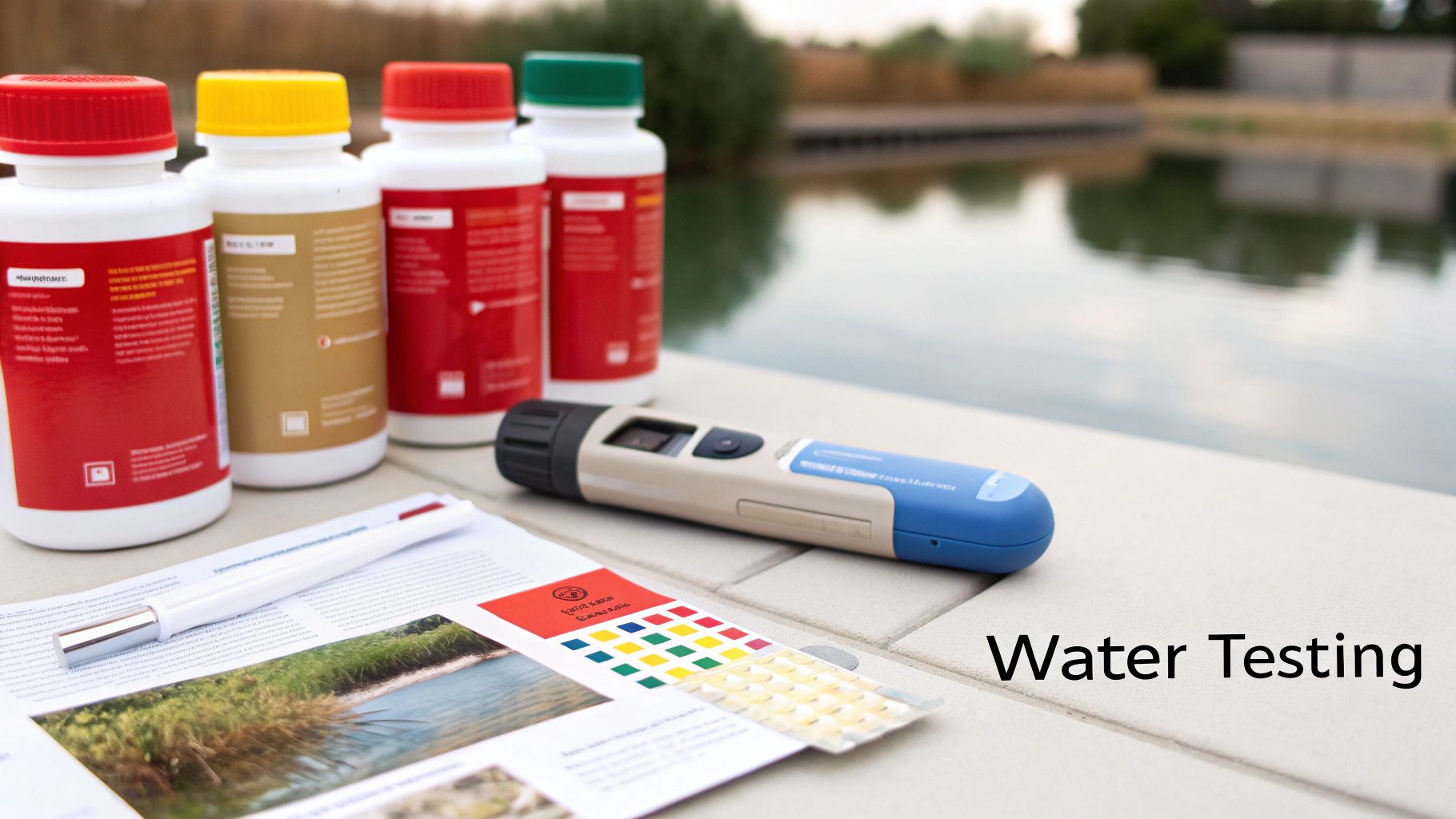
The core of this project is to collect water samples from various locations and analyze them for parameters like pH, dissolved oxygen, nitrates, phosphates, and turbidity. Students can use standardized water testing kits to get quantitative data. The investigation can be expanded by including a biological assessment, such as identifying macroinvertebrates (like dragonfly nymphs and caddisflies), whose presence or absence can serve as a powerful indicator of water purity and long-term ecosystem health.
Why It's a Great Project
- Community Impact: The findings can highlight real-world pollution issues in the local community, making the project incredibly relevant and impactful.
- Interdisciplinary Science: It effectively blends biology, chemistry, and ecology, providing a comprehensive scientific experience.
- Clear, Data-Driven Results: The project generates quantitative data that can be graphed and analyzed, which is perfect for a science fair presentation. To explore principles of self-contained ecosystems, nutrient cycling, and environmental balance in a small-scale setting, you might consider learning how to create a terrarium.
To get started with hands-on environmental testing, exploring comprehensive science fair project kits can provide the necessary tools and guidance for accurate and safe experimentation.
Key Insight: This project demonstrates that an ecosystem's health is written in its water. High nitrate levels might point to agricultural runoff, while low dissolved oxygen can explain a lack of fish. Connecting chemical data to biological observations (like the types of insects found) tells a complete story about the environmental pressures on an aquatic habitat.
5. Enzyme Activity and Reaction Rates
This project dives into the invisible world of biochemistry, exploring the powerful catalysts that drive life itself: enzymes. It’s one of the most dynamic science fair biology projects because it allows students to quantify a biological process in real-time. By measuring how factors like temperature and pH affect enzyme efficiency, students can uncover the fundamental principles of biochemical kinetics and understand how living organisms maintain homeostasis. This is a fantastic project for high school students interested in medicine, biochemistry, or cellular biology.
Project Overview
The core of this experiment is to measure the rate of an enzyme-catalyzed reaction under various conditions. A classic setup involves using the enzyme catalase (easily sourced from potato or liver) to break down hydrogen peroxide into water and oxygen gas. By changing one variable at a time, such as temperature (using water baths) or pH (using buffer solutions), you can measure how quickly oxygen is produced. The rate of this gas production serves as a direct indicator of the enzyme's activity level.
Why It's a Great Project
- Quantitative and Data-Driven: Unlike purely observational projects, this experiment generates hard data (e.g., mL of gas per minute), which is perfect for creating graphs and performing statistical analysis.
- Connects to Human Health: The principles of enzyme kinetics are central to understanding digestion, metabolism, and how many medicines (like enzyme inhibitors) work.
- Teaches Precise Lab Skills: It requires careful control of variables, accurate measurements, and repeated trials, building excellent scientific methodology skills.
Exploring different science fair topics can help you see how foundational concepts like enzyme activity apply across various biological fields, from genetics to ecology.
Key Insight: The success of this project lies in isolating variables. An enzyme’s structure is its function; even a slight change in its environment can alter its shape and drastically reduce its efficiency. Your data will visually demonstrate this delicate balance, showing a clear optimal temperature or pH where the enzyme performs best, with sharp drop-offs on either side. This "peak performance" curve is the essence of your findings.
6. Genetics and Heredity using Model Organisms
This advanced project brings the foundational principles of genetics to life by recreating the classic experiments of Gregor Mendel and Thomas Hunt Morgan. By breeding model organisms like fruit flies (Drosophila melanogaster) or fast-growing plants, students can directly observe how physical traits are passed from one generation to the next. It’s a fantastic choice for high school students interested in genetics, inheritance, and the statistical nature of biology.
Project Overview
The core of this project is to select a model organism with easily identifiable, contrasting traits (e.g., red eyes vs. white eyes in fruit flies, or purple vs. white flowers in pea plants). Students will cross-breed a "pure" parental generation (P generation), then breed their offspring (the F1 generation) to produce a second generation (F2). By meticulously recording the traits of each individual in every generation, you can collect quantitative data to test Mendelian inheritance ratios.
Why It's a Great Project
- Hands-On Genetics: Instead of just learning about Punnett squares, you get to see them play out with living organisms, making abstract concepts tangible.
- Data-Driven Conclusions: This project requires careful data collection and statistical analysis, teaching valuable skills in scientific methodology.
- Demonstrates Key Concepts: It perfectly illustrates dominant and recessive alleles, genotypes, phenotypes, and the laws of segregation and independent assortment.
For students looking for more ways to explore biological principles, checking out various science fair topics can provide inspiration for unique and compelling investigations.
Key Insight: The power of this project lies in the numbers. Your goal isn't just to see traits get passed down; it's to see if they appear in the predicted Mendelian ratios (like 3:1 for a monohybrid cross). A successful project will compare observed results to expected results using statistical tools like the chi-squared test to validate the hypothesis. Starting early is critical, as you need time for at least two generations to mature.
7. Microorganism Identification and Microscopy
This fascinating project opens up the invisible world of microbes, turning everyday environments into a safari of single-celled life. It’s one of the more exploratory science fair biology projects, encouraging students to become microbial detectives. By collecting samples from diverse locations like pond water, soil, or even their own skin, students learn to use a microscope to identify the incredible biodiversity of bacteria, protists, and fungi that exist all around us.
Project Overview
The core of this project is sample collection and observation. Students will prepare slides, often using techniques like wet mounts for living organisms or Gram staining to differentiate bacteria types. Using a microscope, they will examine these samples, sketch or photograph what they see, and attempt to identify the organisms based on their shape, size, and movement. Comparing samples from a clean puddle versus stagnant pond water, for example, reveals powerful lessons about microbial ecology.
Why It's a Great Project
- Hands-On Exploration: It moves beyond a set procedure, encouraging genuine scientific curiosity and discovery.
- Develops Core Lab Skills: Students gain invaluable experience with microscopy, slide preparation, and staining techniques.
- Highlights Biodiversity: It powerfully demonstrates that complex ecosystems exist at a microscopic level, reinforcing concepts of ecology and cell biology.
For those wanting to explore the unseen world further, there are many exciting biology science projects that can take this initial investigation to the next level.
Key Insight: This project is less about proving a single hypothesis and more about systematic observation and classification. The real success lies in carefully documenting the diversity of microorganisms found in different environments and using field guides or online resources to identify them. Creating your own identification key based on morphology (shape) and motility (movement) is an excellent way to showcase advanced understanding.
8. Effects of pH and Osmosis on Cell Structure
This project provides a microscopic view into the fundamental processes that keep cells alive and functional. It’s one of the most foundational science fair biology projects, as it explores how environmental conditions like pH and solute concentration directly impact cell integrity. By observing cells swell, shrink, or even burst, students gain a tangible understanding of osmosis and the importance of maintaining cellular balance, or homeostasis. This experiment is perfect for students ready to connect chemistry concepts with biological structures.
Project Overview
The core of this investigation involves exposing plant cells (like onion skin or Elodea leaves) or animal cells (if accessible and handled safely) to solutions with varying pH levels and solute concentrations. You will prepare isotonic (balanced), hypotonic (low solute), and hypertonic (high solute) solutions, as well as acidic and basic solutions. Using a microscope, you will observe and document the physical changes in the cells, such as plasmolysis (cell membrane pulling away from the cell wall in plants) or hemolysis (bursting of red blood cells).
Why It's a Great Project
- Connects Chemistry and Biology: It elegantly demonstrates how chemical principles like pH and concentration gradients have profound biological consequences.
- Visually Dynamic: Witnessing a cell shrink or swell in real-time under a microscope is a powerful and memorable learning experience.
- Real-World Applications: The project relates to medical concepts like IV fluid design, food preservation techniques using salt and sugar, and the physiological effects of dehydration.
For more inspiration on how to bring cellular biology to life, exploring a variety of hands-on science activities can provide excellent ideas for extending this experiment or finding a new one.
Key Insight: This experiment reveals the critical role of the cell membrane as a selective barrier. The key to a winning project is not just observing the changes but quantifying them. By counting the percentage of cells that have undergone plasmolysis in different solutions or creating a time-lapse video, you can transform qualitative observations into compelling quantitative data that explains why cellular environments are so tightly regulated.
9. Bioremediation: Using Microorganisms to Clean Pollution
This forward-thinking project moves beyond simple observation to tackle a major environmental issue: pollution. Bioremediation is the process of using living organisms, primarily microbes, to clean up contaminated environments. This experiment allows students to demonstrate how nature’s smallest workers can be harnessed to break down harmful substances, making it one of the most impactful and innovative science fair biology projects for high schoolers interested in environmental science and biotechnology.
Project Overview
The project involves setting up a controlled experiment to observe microorganisms breaking down a pollutant. A common approach is to culture specific bacteria known for consuming contaminants, such as oil or industrial dyes. Students create a simulated polluted environment (e.g., water with a small amount of motor oil or a safe dye) and introduce the microorganisms. By measuring the reduction of the pollutant over time and comparing it to a control group without microbes, you can demonstrate the power of bioremediation.
Why It's a Great Project
- Environmental Impact: It directly addresses real-world problems like oil spills and industrial waste, showing how biology offers practical solutions.
- Cutting-Edge Science: The project introduces students to biotechnology and environmental engineering, fields at the forefront of scientific innovation.
- Scalable Complexity: It can be simplified by using safe, oil-based food coloring as a pollutant or made more advanced by using a spectrophotometer to precisely measure pollutant concentration.
Key Insight: The success of this project lies in proving that the pollutant's disappearance is due to microbial action, not just evaporation or settling. A sterile control group (polluted water with no bacteria) is essential to show that without the microorganisms, the pollutant remains. This comparison provides the critical evidence that bioremediation is actively occurring.
10. Biodiversity Survey and Species Identification
This project transforms students into field ecologists, taking them out of the lab and into the natural world to measure an ecosystem's health. It involves systematically surveying a local habitat, like a park, pond, or forest, to identify the different species present and quantify their abundance. This type of hands-on ecological investigation is one of the most rewarding science fair biology projects, as it directly connects students to their local environment and the principles of conservation.
Project Overview
The core of this project is to choose a specific study area and conduct a thorough inventory of its living organisms, from plants and insects to birds and mammals. Students will use field guides, apps like iNaturalist, and observation techniques to identify as many species as possible. By recording the number of individuals for each species, they can calculate biodiversity metrics like the Shannon or Simpson index. The project can be expanded by comparing the biodiversity of two different habitats or the same habitat across different seasons.
Why It's a Great Project
- Real-World Relevance: It directly addresses crucial environmental topics like habitat loss, conservation, and the importance of biodiversity for ecosystem stability.
- Active and Engaging: This project gets students outdoors, encouraging observation skills, patience, and a deeper appreciation for nature.
- Demonstrates Key Concepts: It’s a perfect illustration of ecological principles, including species richness, evenness, food webs, and human impact on the environment.
Key Insight: This project is about more than just making a list of animals and plants. The goal is to interpret the data to tell a story about the health of the ecosystem. A high biodiversity index often indicates a healthy, resilient environment, while a low index might suggest pollution, habitat disturbance, or other environmental stressors. Your conclusion should focus on what your biodiversity findings reveal about the quality of the habitat you studied.
Science Fair: 10 Biology Project Comparison
| Project | 🔄 Implementation complexity | ⚡ Resource requirements | 📊 Expected outcomes | ⭐ Effectiveness / quality | 💡 Ideal use cases |
|---|---|---|---|---|---|
| Bacterial Growth and Antibiotic Resistance | 🔄 Moderate — requires sterile technique and incubation | ⚡ Moderate — petri dishes, agar, antibiotics, incubator | 📊 Visual colony survival; selectable resistance patterns in 24–48 h | ⭐⭐⭐⭐ — high relevance to public health and evolution | 💡 Microbiology lessons, science fairs; use non‑pathogenic strains and controls |
| Plant Growth under Different Light Conditions | 🔄 Low–Moderate — simple setup but requires consistent care over weeks | ⚡ Low — pots, soil, LED lights, ruler, scale | 📊 Quantitative growth metrics (height, biomass, chlorophyll) over 3–4 weeks | ⭐⭐⭐ — strong for applied plant science and agriculture | 💡 Horticulture optimization, classroom experiments, LED effects studies |
| DNA Extraction from Living Organisms | 🔄 Low — straightforward protocol with basic steps | ⚡ Very low — household reagents (soap, salt, alcohol), simple tools | 📊 Rapid, qualitative visible DNA precipitate within minutes | ⭐⭐⭐ — highly engaging visual demo of molecular biology | 💡 Introductory genetics demos, museum outreach, quick classroom labs |
| Water Quality Testing and Aquatic Ecosystem Health | 🔄 Moderate — field sampling plus lab measurements | ⚡ Moderate — field kit, probes, test reagents, microscope for biology | 📊 Quantitative parameters (pH, DO, turbidity, nutrients) and biological indicators | ⭐⭐⭐⭐ — strong environmental and community relevance | 💡 Local monitoring, watershed studies, policy‑relevant projects |
| Enzyme Activity and Reaction Rates | 🔄 Moderate — requires precise timing and controls | ⚡ Low–Moderate — substrates, enzyme source, timers, water baths | 📊 Quantitative reaction rates; graph‑friendly kinetic data | ⭐⭐⭐⭐ — excellent for demonstrating biochemical kinetics | 💡 Biochemistry labs, kinetics experiments, advanced fair projects |
| Genetics and Heredity using Model Organisms | 🔄 High — multi‑generation breeding and careful record‑keeping | ⚡ Moderate — organisms, containment, space, feeding materials | 📊 Clear Mendelian ratios across generations (weeks–months) | ⭐⭐⭐⭐ — comprehensive demonstration of heredity | 💡 Long‑term classroom projects, genetics demonstrations, statistical analysis |
| Microorganism Identification and Microscopy | 🔄 Moderate — requires staining practice and microscopy skills | ⚡ Moderate — microscope, stains, slides, sample collection tools | 📊 Direct observations of microbial diversity; identifications via morphology | ⭐⭐⭐ — strong for showcasing microbial ecology and techniques | 💡 Lab skills training, environmental surveys, microscopy demonstrations |
| Effects of pH and Osmosis on Cell Structure | 🔄 Low — quick experiments with microscopic observation | ⚡ Low — slides, microscope, buffer/salt solutions, onion or RBC samples | 📊 Visual plasmolysis/hemolysis and measurable cell changes in minutes–hours | ⭐⭐⭐ — clear demonstration of membrane function | 💡 Cell biology lessons, quick classroom demos, microscopy practice |
| Bioremediation: Using Microorganisms to Clean Pollution | 🔄 High — longer timelines and careful experimental controls | ⚡ Moderate–High — cultures, pollutant surrogates, monitoring equipment | 📊 Measurable pollutant reduction trends; growth vs. degradation data (weeks) | ⭐⭐⭐ — strong applied environmental and biotechnology relevance | 💡 Environmental engineering projects, sustainability case studies |
| Biodiversity Survey and Species Identification | 🔄 Moderate — fieldwork logistics and identification challenges | ⚡ Low–Moderate — field guides, GPS, cameras, sampling gear | 📊 Diversity indices and habitat comparisons; seasonal/ spatial patterns | ⭐⭐⭐⭐ — excellent for ecology and conservation education | 💡 Community science, habitat assessments, conservation recommendations |
Launch Your Experiment and Spark a Love for Science
You have now explored a comprehensive roundup of ten fascinating science fair biology projects, each offering a unique window into the living world. From the microscopic battlegrounds of bacteria and antibiotics to the sprawling ecosystems in your own backyard, the potential for discovery is immense. We have journeyed through genetics, plant science, and environmental biology, providing a launchpad for students of all ages to engage with science in a tangible, hands-on way.
The common thread weaving through every successful project, whether it's extracting DNA from a strawberry or testing local water quality, is the scientific method. It is your roadmap from a simple question to a confident conclusion. By following this structured process of observation, hypothesis, experimentation, and analysis, you transform curiosity into knowledge. This methodical approach is the single most valuable skill a young scientist can develop, far outweighing the project's final outcome. A "failed" experiment that is well-documented and thoughtfully analyzed is often more impressive than a successful one with poor data.
From Idea to Award-Winning Exhibit
The key to a truly memorable science fair biology project lies not just in choosing a compelling topic but in executing it with precision and presenting it with passion. Here are the crucial takeaways to guide you:
- Documentation is Paramount: Your lab notebook is your project's official story. Record every observation, measurement, and even your mistakes. This detailed log is the backbone of your research and will be invaluable when you create your display board.
- Safety First, Always: Many of these experiments, especially those in microbiology and chemistry, require strict adherence to safety protocols. Always wear appropriate personal protective equipment (PPE), work in a well-ventilated area, and ensure adult supervision is available.
- Tell a Compelling Story: Your presentation board should be more than just a collection of facts. It should guide the judges and audience through your scientific journey. Use clear headings, high-quality images, and easy-to-read graphs to narrate your process, from the initial question to your final discovery. Explain why your project matters.
Think beyond simply listing results. How do your findings connect to the real world? An experiment on plant growth under different light sources could inform indoor gardening, while a bioremediation project offers a potential solution to local pollution. Making these connections demonstrates a deeper level of understanding and critical thinking that judges love to see.
Igniting a Lifelong Passion
Ultimately, the goal of a science fair is not just to win a ribbon; it's to spark a genuine, lifelong interest in the world around us. Each of these science fair biology projects is a self-contained adventure, a chance to become an expert on a small piece of the universe. By taking ownership of your research, you are developing critical skills like problem-solving, analytical thinking, and effective communication.
These are not just "school project" skills; they are life skills that will serve you well in any future career. The confidence gained from designing an experiment, collecting data, and defending your conclusions in front of judges is immeasurable. You are stepping into the shoes of a real scientist, and that experience is transformative. So, choose the project that excites you the most, gather your materials, and prepare to be amazed by what you can discover. Your scientific journey is just beginning.
Ready to turn these ideas into reality with everything you need in one box? Explore the exciting world of Playz science kits, which provide the tools and easy-to-follow instructions perfect for many foundational science fair biology projects. Get started on your path to discovery and #KidsLearnBestThruPlayz by visiting Playz today