

A child stares at a worksheet about fractions, forgets the explanation, and starts fidgeting. Then you hand over measuring cups, let the child build equivalent portions, or ask them to stand on a floor number line. Suddenly, the abstract idea has something to hold, move, compare, and explain.
Kinesthetic learning activities use physical movement, hands-on materials, or bodily action to help children explore an idea. They don't replace reading, listening, drawing, or writing. Instead, they give children another route into a concept, especially when a lesson feels too abstract or when attention drops during extended sitting.
The best activity depends on the child's developmental readiness, the learning goal, available space, and sensory needs. A preschooler may benefit from scooping and sorting, while an older child may learn more from constructing a model, testing a hypothesis, or performing a historical scene. Safety, supervision, and a clear objective matter just as much as the activity itself.
The ten ideas below are organized by developmental fit and learning purpose. Each includes a practical setup, directions, differentiation options, assessment ideas, safety guidance, low-cost adaptations, and room-layout suggestions. For more ideas when choosing an age-appropriate present, see these practical birthday shopping tips.
1. Hands-On Science Experiments and Discovery Kits
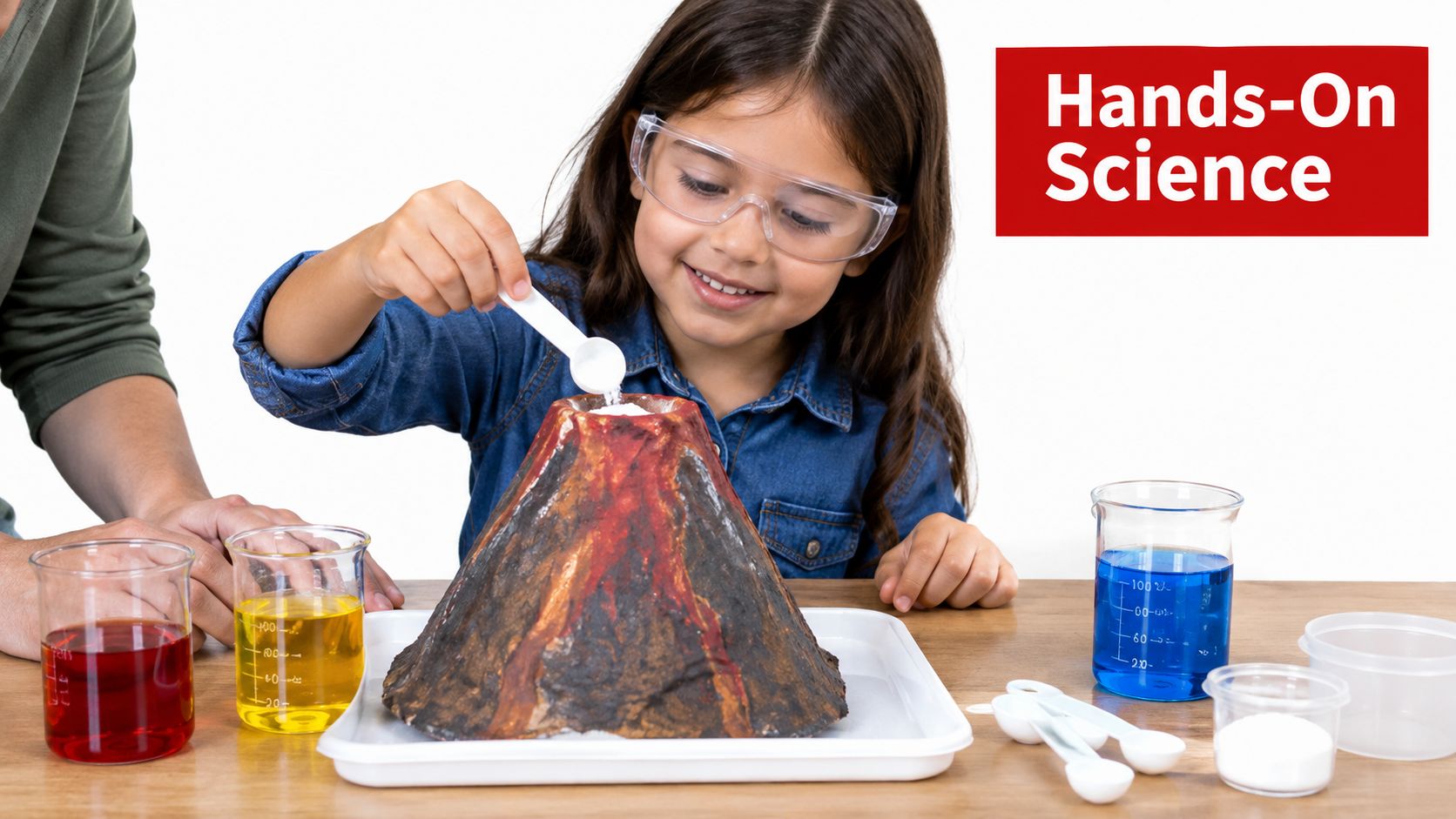
Science becomes easier to discuss when children can mix, measure, observe, and test instead of only reading about a result. A crystal-growing activity, a baking soda and vinegar volcano, or a slime investigation turns vocabulary such as reaction, prediction, texture, and change into something children can experience directly.
Use a safe, age-appropriate kit or assemble a simple investigation with household materials. Playz science kits can support crystal growing, slime making, and chemistry exploration, while National Geographic Kids activity boxes and KiwiCo-style subscription kits offer structured project ideas. A classic volcano made with baking soda and vinegar works well when the focus stays on prediction and observation rather than spectacle.
Classroom-ready implementation card
- Materials: Choose a kit or household materials, measuring tools, containers, paper towels, protective covering, safety glasses, and a science journal.
- Steps: Read the instructions first. Ask children what they think will happen, conduct the experiment, and record changes through drawings, words, or photographs.
- Objective: Connect cause and effect with observation, measurement, and evidence-based explanation.
- Differentiation: Let younger children sort materials and describe what they see. Older learners can change one variable and compare results.
- Assessment: Look for a prediction, an observation, and an explanation using relevant science vocabulary.
- Safety: Supervise closely, protect the work surface, keep materials away from eyes and mouths, and follow every product instruction.
- Low-cost adaptation: Use cups, water, ice, food coloring, and household ingredients for simple tests.
- Room layout: Place materials at one central demonstration table, with journals and cleanup supplies at nearby stations.
The science kit activity ideas from Playz can provide a starting point, but children don't need specialized equipment to investigate. Afterward, ask a follow-up question such as, “What could we change next time?” That question turns a one-time activity into inquiry.
A short video demonstration can help adults prepare the setup before inviting children to participate.
2. Building and Construction Projects with Blocks and Models
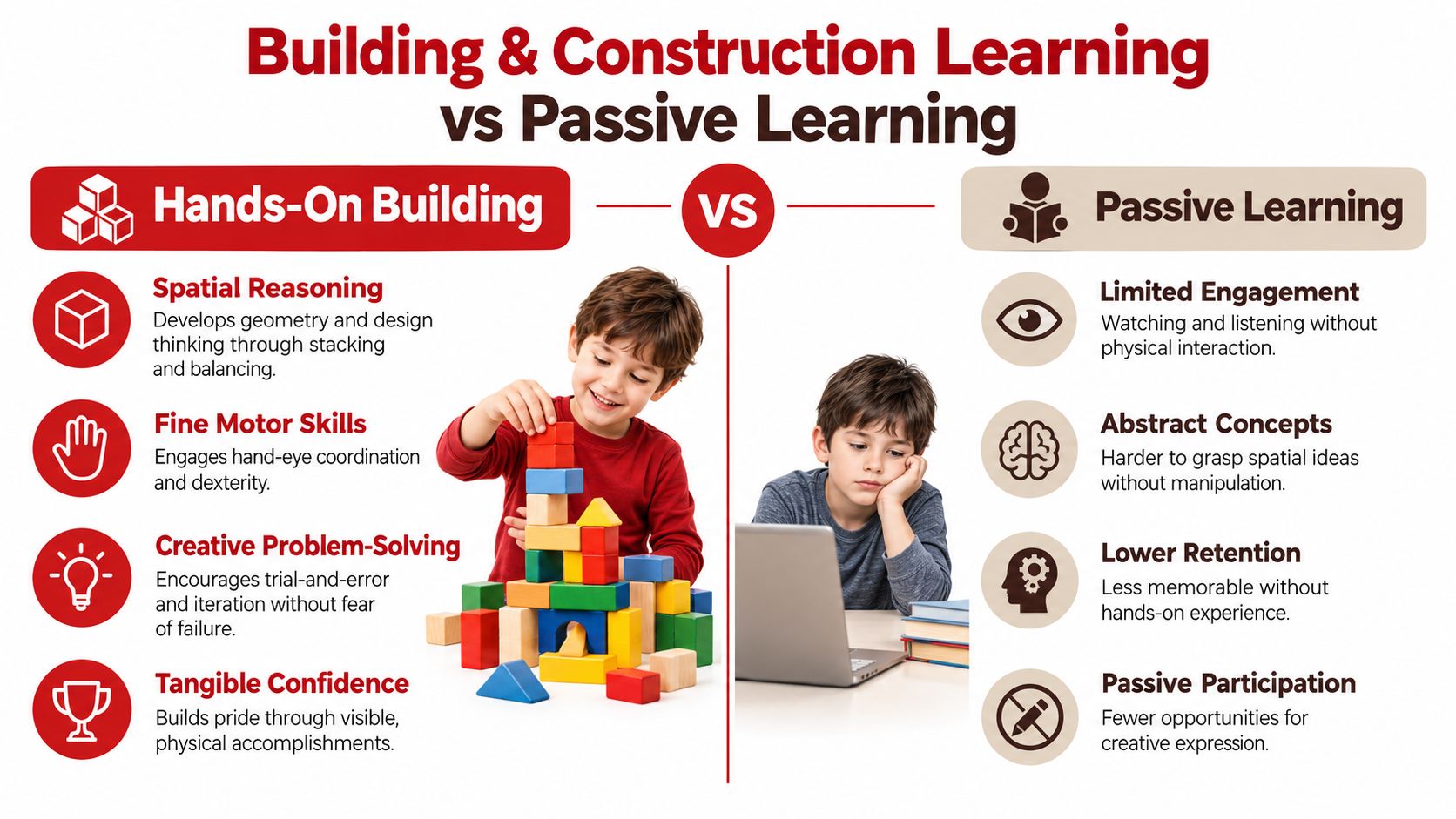
A bridge sags under a toy figure, or a tower falls when one block shifts. These moments give children a physical way to explore balance, stability, symmetry, shape, and design. They can test a structure, identify the weak point, and rebuild it with a clear reason for changing the plan.
Start with free construction so children learn how materials connect. Then offer a focused challenge, such as building a shelter, bridge, or tower that supports a chosen object. LEGO, LEGO Education systems, Magna-Tiles, Magna-Blocks, wooden blocks, cardboard, paper towel tubes, and masking tape support different levels of control. A Playz play tent or fort-building kit can extend the task into shared imaginative play. The building kit guide from Playz offers examples of linking construction with role-play.
Build-and-test classroom plan
Materials: Set out blocks, magnetic tiles, cardboard, tape, rulers, toy figures, and paper for sketches.
Steps: Let children explore first. Present one design brief, model how to test it, and give teams time to revise. Ask each group to name the change it made and what that change was meant to improve.
Learning purpose: The activity develops spatial reasoning, planning, fine motor control, collaboration, and problem-solving.
Adjustments: Picture plans can support children who need a clear starting point. Larger pieces make handling easier, while older learners can add limits such as height, span, or available materials.
Assessment: Listen for explanations of design choices. Ask children to point out a failed feature, describe the revision, and explain whether the structure performed better.
Safety and setup: Check pieces for damage, supervise magnetic materials, and keep large structures away from walkways. Use a quiet sketching table, a shared construction floor, and a display area.
For a low-cost version, use boxes, recyclable containers, paper tubes, and painter's tape. Photograph models before dismantling them, then invite children to dictate a caption about the building process.
Practical rule: Let children explain why a structure works before suggesting an improvement.
3. Movement-Based Learning Games and Physical Activity Stations
A child steps onto a number card, then chooses the next card to solve a counting problem. In movement-based learning, the body acts like a second pencil. Each action should represent lesson content, so children are building understanding rather than burning off energy.
Choose activities by developmental fit and purpose. Younger children can follow an alphabet path or move to pictures that begin with a target sound. Older learners might arrange vocabulary cards into a sentence, classify objects by observable properties, or walk a number line to model addition and skip patterns. Short jumping or dancing breaks can refresh attention between tasks, while the learning goal stays visible.
Classroom implementation
- Materials: Prepare floor markers, flashcards, cones, hoops, music, and response cards.
- Steps: Mark clear boundaries, demonstrate one round, and use a signal for rotation. Give each station one task and ask learners to explain a response afterward.
- Objectives: Practise recall, sequencing, classification, spelling, computation, coordination, and turn-taking through purposeful movement.
- Differentiation: Offer walking, pointing, reaching, or seated gestures instead of jumping. Pair learners for support, reduce the number of choices, or add multi-step challenges for children ready for more complexity.
- Assessment: Note responses at each station and ask, “What did your movement show?” Listen for accurate vocabulary and reasoning, not speed alone.
- Safety: Remove obstacles, define one-way travel paths, limit running, check floor surfaces, and provide a cool-down before quiet work.
- Low-cost adaptation: Make cards from paper, then use tape lines, cushions, or recycled containers as markers.
- Room layout: Push furniture to the edges, separate active stations, and reserve a calm reflection space where children can record or discuss their thinking.
For younger children, these gross motor activity ideas can connect physical development with suitable play. Keep groups small when space is limited, and let children watch a round before joining.
4. Role-Playing and Dramatic Play Scenarios
A pretend clinic opens with a child checking a patient's symptoms, writing a note, and explaining the next step. Role-play gives language a purpose while children practise perspective-taking. A shop supports counting and communication. Older students can stage a historical decision to examine motives, consequences, and competing viewpoints.
Choose a problem, then leave room for children to shape the scene. A play tent might become a clinic, shop, classroom, spacecraft, or community centre. Add dress-up clothing, notebooks, signs, toy tools, and simple props. Children can recreate a story, respond to a community problem, or perform a short scene from a social studies unit. The benefits of pretend play become easier to see when the activity connects movement with discussion and reflection.
A flexible classroom setup
Start by introducing the situation and its learning purpose. Invite or assign roles, allow brief rehearsal, and pause for a debrief. Ask, “What did your character need?” or “What changed during the scene?” These questions help children explain what their actions showed.
- Materials: Use props, costume pieces, signs, paper, pencils, and optional character cards.
- Learning goals: Build oral language, empathy, collaboration, perspective-taking, and understanding of academic concepts.
- Access: Provide non-speaking roles, visual prompts, paired roles, or an observation role before participation.
- Evidence of learning: Listen for accurate vocabulary, cooperative interaction, and a clear explanation of the character's viewpoint.
- Safety and space: Choose lightweight props, remove trip hazards, make participation voluntary, and separate a play zone from a planning area and audience space.
- Low-cost option: Household clothing, cardboard signs, empty food boxes, and paper badges can establish the setting.
Keep groups small enough for every child to contribute. A sign, a role, and a meaningful problem can be enough to begin.
5. Sensory Learning Stations and Tactile Exploration
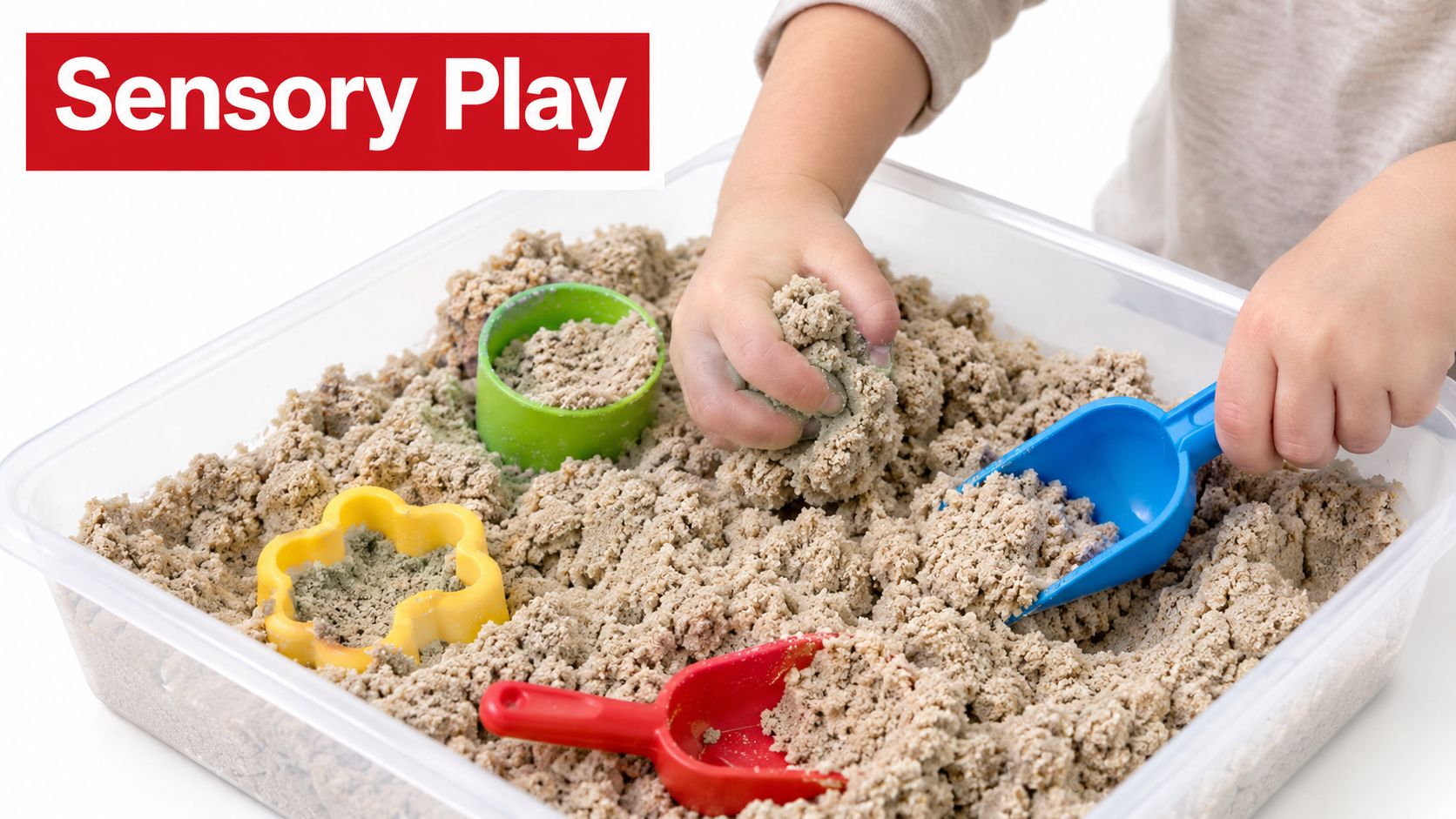
A child scoops rice, presses playdough, or pours water through a funnel. Each action provides information about texture, weight, temperature, resistance, and movement while strengthening fine motor control. Sensory stations work like small laboratories: children test materials, notice differences, and describe what their hands discover. What sensory play involves offers further guidance for choosing materials with purpose.
Begin with one contained station and a clear invitation, such as “Which objects feel smooth?” or “Can you fill this cup without spilling?” Use rice, beans, kinetic sand, foam, or water with funnels and droppers. A texture board made from fabric, cardboard, foil, and other safe surfaces offers a drier alternative. Watch each child's response. A texture that helps one child settle may overwhelm another.
Classroom-ready setup
- Materials: Bins, scoops, funnels, cups, playdough, textured objects, trays, and hand-cleaning supplies.
- Steps: Model safe handling, allow open exploration, then add sorting, describing, or counting prompts.
- Objective: Build tactile discrimination, fine motor control, descriptive language, and self-regulation.
- Differentiation: Offer tools instead of direct touch, suitable gloves, larger materials, or a quiet alternative.
- Assessment: Ask children to compare materials, follow a sequence, or show controlled tool use.
- Safety: Check allergies, remove choking hazards for young children, supervise continuously, and maintain hygiene.
- Low-cost adaptation: Use dry pasta, cardboard, fabric scraps, measuring cups, and clean containers.
- Room layout: Set bins on washable mats, mark clear boundaries, and place a calm seat nearby.
Introduce the station before a demanding cognitive task when tactile input helps a child engage. Keep participation flexible, since children do not need the same sensory experience.
6. Nature Exploration and Outdoor Learning Adventures
A child crouches beside a garden bed, compares soil in sunlight and shade, then sketches what changed. Outdoor learning turns movement and observation into evidence. Living things, weather, sounds, textures, and uneven ground give children concrete material for questions about plant needs, classification, measurement, and seasonal change.
Choose one question and mark the exploration area before children begin. They might sort fallen leaves by shape, search for contrasting textures, or watch insects without touching them. A nature journal supports different ways to communicate: sketches, labels, symbols, or dictated sentences. Keep the route short enough for the group's stamina, and pause at a shared meeting point to connect discoveries with the classroom topic.
Explore, record, and explain
- Materials: Prepare journals, pencils, magnifying glasses, collection trays, plant guides, water, and weather-appropriate clothing.
- Steps: Check the site, set boundaries, model respectful observation, investigate one question, then gather for reflection.
- Objective: Build environmental awareness, gross motor skills, vocabulary, curiosity, and evidence-based observation.
- Differentiation: Provide seated observation, shorter routes, picture cards, a partner role, or an indoor observation option.
- Assessment: Review a sketch, classification, spoken observation, or explanation that connects evidence with an idea.
- Safety: Inspect the area, teach children to avoid unknown plants, supervise near water, and prepare for changing weather.
- Low-cost adaptation: Make journals from folded paper, use recycled containers, and create simple magnifiers with household materials.
- Room layout: Outdoors, mark exploration zones and a gathering point. Indoors, set up a specimen table and journal station.
The same investigation can happen in a community garden, forest classroom, stream area, or classroom weather station. Families planning an outdoor break can find a summer camp that includes exploration in active play. End by asking children to show what they noticed and explain how it answers the original question.
7. Music, Dance, and Rhythm-Based Learning Activities
A child who claps vol-ca-no feels each of the word's three syllables as separate beats. Rhythm gives language, numbers, and sequences a structure children can hear and physically repeat. For example, students can drum a four-beat pattern while solving 4 × 3, then explain how the repeated groups represent multiplication. For science, use the tune of “Twinkle Twinkle” to sing the steps of the water cycle, while gestures show evaporation, condensation, precipitation, and collection.
Choose the movement for its learning purpose. A steady beat supports counting and syllables; changing levels or directions can show stages in a process. Children may sing, tap, gesture, dance, or keep time with a partner, so participation does not require identical performance.
A rhythm lesson in practice
- Materials: Prepare a familiar melody, hand drums or shakers, word cards, picture cards, scarves, and a clear area.
- Steps: Model the target pattern, connect each beat or gesture to the concept, practise together, then invite pairs to create a variation and explain it.
- Objective: Practise phonemic awareness, multiplication, sequencing, memory, coordination, or subject vocabulary.
- Differentiation: Offer seated tapping, visual beat marks, slower repetition, partner support, or a listener and timekeeper role.
- Assessment: Ask students to perform or arrange a sequence, identify its pattern, and state what each movement represents.
- Safety: Keep volume comfortable, space children apart, secure scarves, and remove floor obstacles. Stop if movement becomes unsafe or overstimulating.
- Low-cost adaptation: Use clapping, desk tapping, body percussion, recycled containers, and familiar melodies.
- Room layout: Form a circle for shared rhythm, leave a marked movement area, and provide a quiet edge for observation or breaks.
Record a performance only with appropriate permission. Reviewing it lets children name one successful connection and one change, turning repetition into reflection.
8. Cooking and Food Preparation Learning Projects
A bowl, measuring cup, and recipe turn abstract ideas into actions children can see and feel. Measuring ingredients develops number sense, fractions, and comparison. Reading picture recipes supports vocabulary and sequencing, while kneading, mixing, and observing heat connect movement with scientific change. The finished food provides a visible result, though tasting should not determine whether learning was successful.
Start with the learners' abilities and the lesson's purpose. Younger children might decorate cookies, assemble sandwiches, or combine smoothie ingredients. Older learners can compare ratios, write recipe cards, investigate yeast, or examine a cultural dish through its ingredients and traditions. Choose no-cook tasks when time, equipment, or supervision is limited.
A practical setup might look like this:
- Materials: Gather ingredients, measuring tools, bowls, utensils, picture recipes, aprons, wipes, and allergy information.
- Steps: Read the recipe together, assign roles, predict changes, measure and prepare ingredients, then describe the result.
- Objective: Apply mathematics, reading, sequencing, science vocabulary, and cultural knowledge.
- Differentiation: Provide pre-measured ingredients, picture instructions, adapted utensils, or partner roles. Children who cannot write independently can dictate steps or arrange picture cards.
- Assessment: Ask learners to sequence the recipe, use measurement language, and explain how an ingredient changed.
- Safety: Adults manage heat and sharp tools. Check allergies, wash hands, clean surfaces, and follow food hygiene practices.
- Low-cost adaptation: Use sandwiches, fruit kebabs, no-cook snacks, or dough made with basic ingredients.
- Room layout: Separate reading, preparation, washing, and serving areas to reduce crowding.
Invite children to draw and label their own recipe cards. The physical order of each task makes procedural language concrete.
9. Puzzle Solving and Manipulative Challenges
A child rotates a tangram piece, tests a new position, and notices the shape finally fits. That physical feedback makes spatial reasoning visible. Jigsaws, interlocking blocks, Rubik's cubes, and mechanical puzzles also give learners repeated practice with planning, revision, and persistence.
Match the task to the learner's developmental fit and purpose. Younger children may sort large pieces or complete simple picture puzzles. Older learners can examine patterns, explain several solution paths, or design a puzzle for a partner. Choose a challenge that requires effort without making every attempt discouraging. Offer a hint card, model one strategy, then let learners decide what to try next.
A classroom setup can follow this sequence:
- Materials: Use jigsaws, tangrams, pattern blocks, logic puzzles, mechanical puzzles, trays, and optional timers.
- Steps: Introduce the goal, demonstrate one move, let learners test ideas individually or collaboratively, and pause for strategy sharing.
- Objective: Build spatial reasoning, fine motor control, planning, flexible thinking, and persistence.
- Differentiation: Change piece size or complexity, add a reference image, mark tactile features, provide partner support, or allow oral explanations.
- Assessment: Ask learners to describe a strategy, show a revision, identify a pattern, or solve a related challenge.
- Safety: Check small pieces for age suitability, keep walkways clear, and store materials securely.
- Low-cost adaptation: Cut recycled packaging into picture pieces or create shape puzzles from cardboard.
- Room layout: Set up separate tables for independent work, collaboration, and completed or unfinished puzzles.
Leave unfinished work on trays so learners can return to it without starting over. A photograph, sketch, or brief explanation records the reasoning process, not just the final speed.
10. Art and Craft Creation with Three-Dimensional Materials
A cardboard box can become a shelter, a mask, or a small animal. As children press clay, roll playdough, cut cardboard, attach fabric, balance pieces, and revise unstable parts, they turn an abstract idea into something they can inspect. These actions strengthen fine motor control, visual-spatial reasoning, and creative problem-solving while allowing several successful outcomes.
Choose materials and expectations that match the learners' development. Younger children can squeeze, stack, and join large pieces. Older learners can plan a model, test how it stands, and explain why a material supports the design. Demonstrate one technique, then let children choose the object, texture, or story they want to create. A clay animal, textured scene, or cardboard-and-paper mask gives each learner a concrete reason to make decisions.
Use this quick planning guide before the activity:
- Materials: Clay or playdough, cardboard, paper, fabric, glue, child-safe scissors, paint, natural materials, and washable mats.
- Learning purpose: Develop fine motor skills, spatial thinking, creative expression, planning, and communication.
- Teacher moves: Show one technique, invite a simple plan, allow making and revision, then ask learners to present their objects.
- Access and assessment: Offer adaptive tools, larger pieces, pre-cut shapes, visual examples, or oral presentation. Ask what the learner planned, changed, and discovered.
- Safety and setup: Supervise tools, choose non-toxic supplies, control glue and small parts, and ventilate areas when needed. Separate design tables, wet work, drying racks, and displays.
- Low-cost option: Reuse boxes, tubes, leaves, sticks, packaging, and fabric scraps.
Place finished work at children's eye level when possible. The gallery values purposeful choices and visible progress, even when creations differ from the demonstration.
10-Item Comparison of Kinesthetic Learning Activities
| Activity | Implementation 🔄 | Resources & Setup ⚡ | Expected Outcomes 📊⭐ | Ideal Use Cases 💡 | Key Advantages ⭐ |
|---|---|---|---|---|---|
| Hands‑On Science Experiments and Discovery Kits | 🔄 Moderate, structured protocols, adult supervision needed | ⚡ Low–Medium, common consumables, basic labware, occasional replacements | 📊 Strong concept retention and inquiry skills; ⭐ High scientific thinking | 💡 STEM lessons, weekend kits, small-group inquiry | ⭐ Tangible results, curiosity-driven learning |
| Building and Construction Projects with Blocks and Models | 🔄 Low–Moderate, open‑ended with optional scaffolding | ⚡ Medium, quality sets, clear floor/table space, storage | 📊 Improved spatial reasoning and engineering thinking; ⭐ High creativity | 💡 STEAM, collaborative builds, design challenges | ⭐ Scalable complexity, iterative problem solving |
| Movement‑Based Learning Games and Physical Stations | 🔄 Moderate, needs rules, rotation management, safety oversight | ⚡ Low, open space, minimal props, music | 📊 Better focus, behavior, and embodied memory; ⭐ Moderate academic gains | 💡 PE, classroom brain breaks, kinesthetic lessons | ⭐ Boosts engagement and physical fitness |
| Role‑Playing and Dramatic Play Scenarios | 🔄 Low, flexible, child‑directed with facilitator prompts | ⚡ Low, costumes/props, open play area | 📊 Enhanced language, social‑emotional skills, empathy; ⭐ High interpersonal learning | 💡 Early childhood, social skills, storytelling units | ⭐ Promotes empathy and collaborative communication |
| Sensory Learning Stations and Tactile Exploration | 🔄 Low–Moderate, setup, containment, and rotation required | ⚡ Low, bins, varied materials; periodic replenishment | 📊 Better fine motor control and sensory regulation; ⭐ Strong sensory discrimination | 💡 Preschool, special needs, calming transitions | ⭐ Inclusive, calming, highly engaging for tactile learners |
| Nature Exploration and Outdoor Learning Adventures | 🔄 Moderate, planning, safety checks, weather contingency | ⚡ Low, natural materials; may need transport/gear | 📊 Improved attention, resilience, environmental literacy; ⭐ High affective impact | 💡 Field trips, outdoor science, garden programs | ⭐ Authentic, low‑cost experiences with lasting memories |
| Music, Dance, and Rhythm‑Based Learning Activities | 🔄 Low, repeatable sequences; simple choreography | ⚡ Low, music source, space, optional instruments | 📊 Strong memory encoding and coordination; ⭐ High retention of content | 💡 Language/music integration, memorization tasks | ⭐ Enhances memory, timing, and group cohesion |
| Cooking and Food Preparation Learning Projects | 🔄 Moderate, safety, hygiene, and supervision required | ⚡ Medium, kitchen access, utensils, ingredients | 📊 Multidisciplinary learning (math, science, literacy); ⭐ Practical life skills | 💡 Math/science lessons, cultural studies, home learning | ⭐ Multisensory, immediate consumable outcomes |
| Puzzle Solving and Manipulative Challenges | 🔄 Low, self‑directed; difficulty scalable | ⚡ Low, reusable puzzles, dedicated workspace | 📊 Improved spatial reasoning, persistence, metacognition; ⭐ Durable learning gains | 💡 Quiet time, enrichment, logic practice | ⭐ Reusable, fosters strategic thinking and resilience |
| Art and Craft Creation with 3D Materials | 🔄 Low, open‑ended with materials management | ⚡ Low, craft supplies, cleanup area, storage | 📊 Enhanced fine motor skills, creativity, emotional expression; ⭐ High creative output | 💡 Art classes, therapeutic activities, free exploration | ⭐ Supports creative risk‑taking and tactile experimentation |
Choose the Right Activity and Start Small
The strongest activity isn't always the most elaborate one. Choose a project that matches the child's developmental readiness and the skill you want to practise. A preschool child working on descriptive language may benefit from a sensory bin with scoops and texture cards. A primary learner studying ecosystems may gain more from a nature journal and outdoor observation. An older student exploring engineering may need a construction challenge with a defined design problem.
Movement-based learning should be structured rather than treated as “more movement” in general. A 2025 review of school-based movement pedagogy found the most consistent gains in fundamental movement skills when activities were developmentally appropriate, repeated, explicit, and engaging, rather than merely active according to the review. That principle applies across the list. Children need to know what they're exploring, what action matters, and how they'll show understanding.
Use this planning rhythm for nearly any activity:
- Define one objective: Decide whether children are practising measurement, vocabulary, collaboration, motor control, or explanation.
- Prepare a safe setup: Check materials, boundaries, allergies, noise, access needs, and movement routes before children begin.
- Invite prediction or explanation: Ask what children expect, what they notice, or why they chose a particular action.
- Observe the process: Watch how they handle materials, communicate, persist, and revise.
- Assess visibly: Use a product, performance, conversation, drawing, journal entry, demonstration, or reflection.
Kinesthetic activities also work best as part of a multimodal approach. A systematic review of 15 empirical studies published from 2016 to 2024 found that vocabulary strategies included Total Physical Response, gesture-based learning, movement games, drama, and technology-assisted approaches, supporting a combination of movement, language, visuals, and repetition in this systematic review. Don't label a child permanently as a “kinesthetic learner.” Use hands-on strategies because they serve the lesson and give children more than one way to participate.
Start small: One clear objective, a safe material, and a short reflection can produce better learning than an overfilled activity with no time to think.
Families and educators can adapt household materials before buying supplies. Cardboard can become a fort or model. Measuring cups can support mathematics. Fabric scraps can create a texture station. Water, containers, and funnels can become a controlled exploration. For younger children, early childhood guidance recommends at least 60 minutes of active play outside every day, while another review recommends several hours of unstructured active play per day for preschool children, including at least one hour of moderate-to-vigorous physical activity in this early childhood play review. Learning activities can contribute to an active routine, but they shouldn't replace free play, rest, or a child's need to stop.
Playz is one optional source for science kits, play tents, and creative toys that support hands-on exploration. You can also use this children's martial arts guide by Locals Jiu when considering structured physical activities beyond classroom projects. The right choice is the one that fits the child, the space, the goal, and the adults available to supervise.
Choose one screen-free activity this week. Prepare the materials, state one learning objective, let the child predict or explain, and document what happened with a photo, drawing, or short note. Then repeat the activity or adapt it for a new subject, building a practical routine around purposeful play rather than waiting for the perfect lesson.
Playz offers play tents, science kits, and creative toys that connect active play with exploration, building, and discovery. Visit Playz to find a hands-on starting point for your next kinesthetic learning activity.